A concrete tile roof repair paid through insurance should price what it takes to reach the break and close it, and that is usually more than a new tile. Under each tile sit fasteners, underlayment and a batten or the deck. If your estimate lists only a count of tiles, read it against those layers before you accept it. The one thing a storm claim will not normally pay for is underlayment that has simply worn out.
I'm a licensed public adjuster for homeowners in Illinois (#19461872) and Indiana (#3556317), with an Illinois roofing contractor licence (#105.009193) and a HAAG inspector certification (#992104047). The repair details below come from the TRI Alliance installation manual, published by the tile industry's trade body. It is good evidence of how the work is done, but it isn't a term of your policy, and I'm not a lawyer.
What sits under one broken concrete tile?
Five layers, and a repair can touch all of them. Start at the top of this stack and tick each layer off against your estimate. One cracked tile on a sound roof may only need the first three, so a missing line isn't always a mistake, but you should be able to say why it's missing.
- The tiles around itWhat the work needsNeighbouring tiles are wedged up or the nose of the course above is lifted so the new tile can slide in. Afterwards the shims come out and those tiles have to sit properly again.On the estimateLabor for the repair, or a detach and reset line where tiles have to come off.
- The broken tileWhat the work needsA tile of the same profile that interlocks with the ones on each side. The manual's method breaks the old one into smaller pieces to disturb its neighbours less.On the estimateA count and unit price, with the profile named.
- The fasteningWhat the work needsOld fasteners are cut or pulled. The new tile hangs on a batten by its lug, or is held by a hook, a wire, mastic or approved adhesive placed clear of the water channel.On the estimateHooks, wire or adhesive, per tile.
- The underlaymentWhat the work needsHoles left by the old fasteners are cleaned and patched. The underlayment is the second barrier, so it gets looked at before any new tile goes over it.On the estimateA patch by the square foot or square, sized from what was found.
- The batten or deckWhat the work needsIf the roof has no battens, the manual has a small plywood piece nailed to the deck to act as one. Wet or rotted deck is repaired before the tile goes back.On the estimatePlywood piece or sheathing, only if the opened roof shows the need.
Summarised from the manual's sections on broken tile replacement and tile repair (pages 10, 67 and 68 of the March 2024 edition, revised May 2025).
For the way those lines are laid out on a printed estimate, I went through the columns in reading an Xactimate estimate line by line.
Why can a missing line decide whether anything is paid?
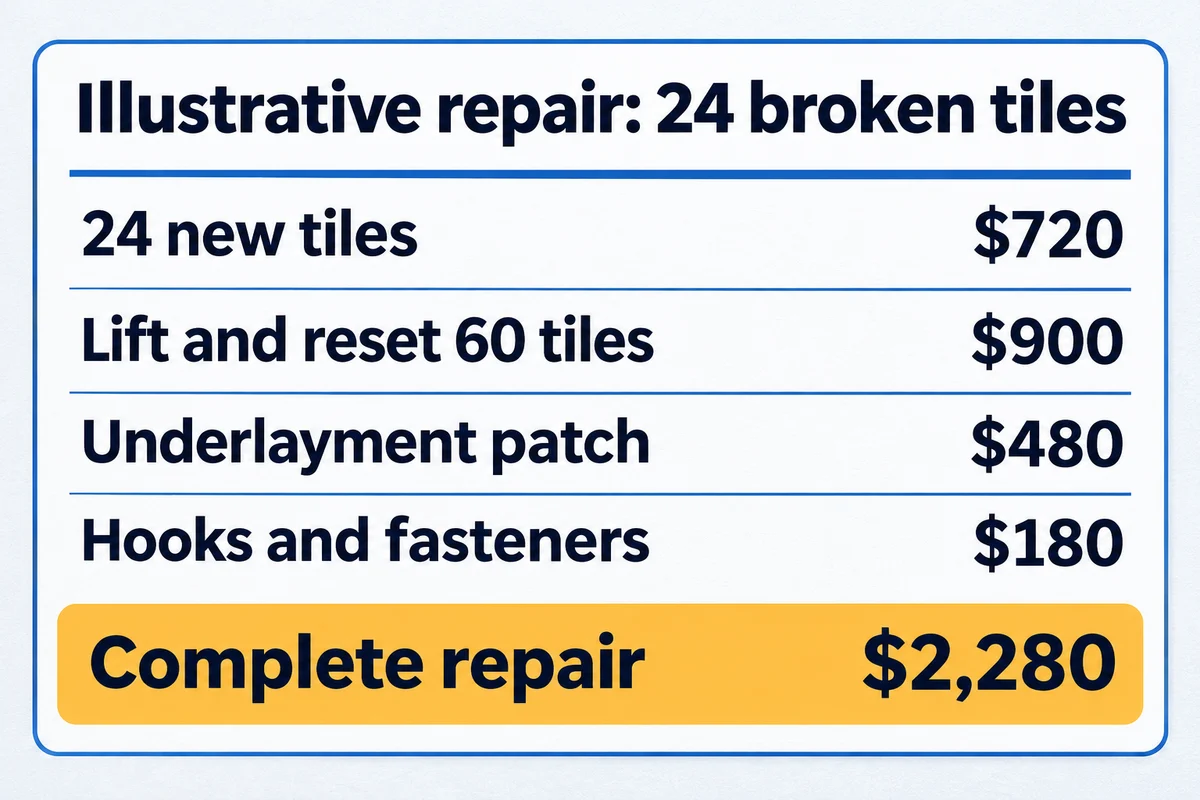
Because small tile repairs often sit near the deductible, a short scope can fall under it and leave you with no payment at all. This is an illustrative worked example, with invented figures, of the same 24 broken tiles priced two ways on a policy with a $1,000 deductible.
| Line | Tiles only | Whole repair |
|---|---|---|
| 24 new tiles at $30 | $720 | $720 |
| Lift and reset 60 tiles at $15 | $0 | $900 |
| Underlayment patch | $0 | $480 |
| Hooks and fasteners | $0 | $180 |
| Repair total | $720 | $2,280 |
| After the $1,000 deductible | $0 | $1,280 |
Illustrative worked example only. A real payment also depends on your wording, and on any depreciation held back, which I explain in why the first check is smaller than the repair.
Those extra lines have to be earned on the roof. A roofer's written note on how many tiles must come off, with photographs of the opened area, is what gets a line added. Saying the scope feels low doesn't.
Does insurance pay to replace the underlayment under tile?
It depends on what damaged it. A storm that breaks a tile and opens the felt below is a different loss from felt that has aged out across a whole slope. The standard ISO homeowners form, in the copy Maine's insurance bureau publishes, excludes wear and tear and deterioration, so these four situations play out differently. Your own form may be worded differently.
The tile broke and the felt below is sound
The usual outcome. The tile and the fastener holes get repaired, and nobody needs to argue about underlayment.
The break tore or exposed the felt
I'd expect that area to be part of the repair. The TRI Alliance walkability brief warns that sun and water can damage underlayment once a tile is broken, so cover the opening quickly, keep the receipt and photograph it first.
The felt is worn all over and the tiles are intact
That's age, and the insurer is entitled to say so. Lifting the tile and laying new underlayment is the owner's maintenance cost. A wet ceiling under that roof raises a separate question, because the form treats some ensuing loss differently, so ask about it in writing.
The storm broke tiles and the felt is too brittle to patch
This is where most of the argument happens. The trade's position is plain:
"New or harvested roof tiles should not be installed over compromised underlayment"TRI Alliance Technical Brief 2022-001
That tells you what a sound repair needs. It doesn't say the insurer pays for it, and an insurer may pay for the break and leave the rest with you. What I document is how far the patch has to run before it reaches felt that holds, with photographs at each edge. If the two sides then disagree about what the policy wording means, that part goes to a lawyer.
The same brief also says that underlayment kept out of the weather will likely go on shedding water whatever its age. So ask what was found when a tile was lifted. A note giving only the age of the roof suggests nobody looked.
Is a chipped concrete tile damage or only a mark?
It depends on where the break is and how long it is. The tile industry published its own test in Technical Brief 99-002, built around the usual 3 inch overlap between courses. It's a trade guideline from 1999, and the adjuster may weigh it differently, but it gives both sides something better than opinion.
| What the tile shows | What the brief says |
|---|---|
| A crack or break across the face, in either direction | Replace the tile. |
| A broken corner longer than 3 inches, on either lock | That length qualifies it for replacement. |
| A broken under lock | Generally better replaced, since that lock carries water. |
| A cover lock corner under 3 inches, with the piece saved | It may be glued back with an adhesive made for roof tile. |
| A cover lock corner under 3 inches, with the piece gone | A judgment call on water shedding. Looks count for more on a steep, visible slope. |
Keep every piece you find in the yard or the gutters, because a saved corner changes the answer in that fourth row. Two things are often mistaken for damage: shake profile tiles can have rough lower edges from the factory, and white chalky bloom on the surface is efflorescence, which the manual describes as temporary. If your policy carries a cosmetic damage endorsement, the sorting gets stricter, as I showed with one filed wording in the siding damage assessment guide.
How big does hail have to be to break concrete tile?
Bigger than it takes to damage most shingles, though flat tile and S-shaped tile behave very differently. Engineers at Haag tested new tiles with launched ice balls in their paper on hail damage threshold sizes. They also report field surveys, where concrete tile of all ages began to show damage at about 1.75 inch hail.
| Ice ball size | 1 in | 1.25 | 1.5 | 1.75 | 2 in |
|---|---|---|---|---|---|
| Flat tile | 0% | 20% | 50% | 50% | 100% |
| S-shaped tile | 0% | 0% | 0% | 0% | 80% |
Share of tests that damaged the tile, by ice ball size in inches. From Table 2 of the paper by Marshall, Herzog, Morrison and Smith.
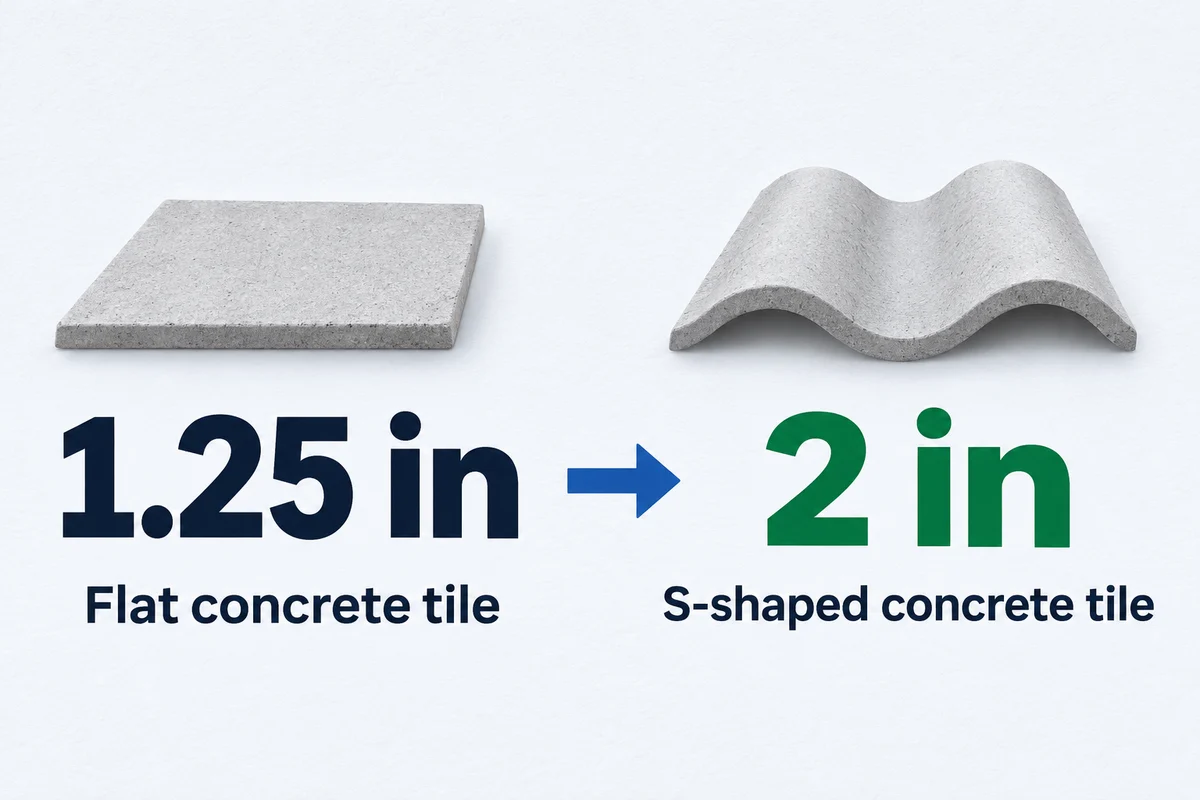
Use these numbers carefully, in both directions. The lab tiles were new and the ice was harder than natural hail, and the same paper says older products were generally more easily damaged. So a report of 1.5 inch hail doesn't rule out a fracture on a 30 year old roof, and it doesn't prove one either. The break itself has to be shown: the paper describes several irregular fractures running out from the point of impact. My hail damage claims page covers the rest of the roof and the house.
Who broke it: the storm or the inspection?
Sometimes that can't be settled afterwards, which is why the photographs have to come first. Concrete tile can crack under a boot. The TRI Alliance walkability brief says most manufacturers don't warrant breakage from foot traffic, and it tells anyone who must walk the roof to step on the bottom 3 inches of each tile, with feet parallel to the ridge, and to stay off cut tiles at hips and valleys. On S tiles the heel and toe go on the high points of neighbouring tiles. Stay off the roof yourself and work through this order:
- Photograph every slope from the ground or a ladder, from fixed points, before anyone goes up.
- Ask the adjuster and the roofer, in writing, how they plan to get across the tile.
- Be there for the inspection if you can, and note who walked which slope.
- Take the same photographs from the same points once they've gone.
- Report any new breaks to the insurer the same day, with both sets of pictures.
What if my concrete tile is no longer made?
Then the repair runs on salvage, or on tile taken from elsewhere on your own roof. Start with the broken piece and look on its back for a stamp, because TRI Alliance Bulletin 2026-04 identifies some discontinued lines that way. The bulletin lists discontinued profiles and manufacturers that have stopped production, Monier among them, and it says current profiles generally won't interlock with those old tiles.
Reclaimed tile from a salvage yard is one route. It comes with no manufacturer's warranty, according to Technical Brief 2021-02. Brief 2022-001 describes another, called harvest and repair: sound tiles come off a slope the street can't see and fill the visible repair, and the hidden slope is re-covered with new tile of a similar shape. That second route costs far more than a tile count, so the written replies from the manufacturer and the yard belong in the claim file. I worked through the wider choice of repair, one slope or a new roof in the slate and tile guide, and the argument over slopes that weren't hit is in matching in Illinois.
Does a Chicago winter change the tile repair?
It can change the details, so ask before the repair is priced. The main TRI manual says it is meant for areas without regular freeze and thaw, and it points roofers to a separate cold and snow regions manual where the January mean is 25 degrees Fahrenheit or lower, or where ice damming often occurs. The National Weather Service normal for O'Hare is 25.2 degrees, right on that line, and ice dams are a familiar Chicago problem. Put three questions to your roofer:
- Which installation guidance are you following?
- The answer tells you whether the repair was thought through for a cold climate, and it gives the adjuster a document to read.
- Does the building department require ice protection at the eaves for this work?
- Requirements vary by municipality. A cost that exists only because of a code requirement may fall under Ordinance or Law, which I explained in code upgrade coverage.
- Is the replacement tile rated for freeze and thaw?
- The manual expects concrete tile in these conditions to meet the freeze and thaw requirements of ASTM C1492. This matters most with salvage or custom tile, where you may have no paperwork.
When do you need a public adjuster for a tile roof?
Call when the estimate prices tiles and nothing under them, when a storm break has been written off as age with no tile lifted, or when the profile can't be found and the scope hasn't moved. You don't need me if the whole repair is close to your deductible, or if the insurer's scope matches a licensed roofer's written price. Worn felt with no storm damage is a maintenance job, and I'll tell you so.
Questions about what a clause legally means, or about a deadline to file suit, belong with a lawyer. For the facts on the roof, see how I handle tile and slate roof claims, then send your estimate and photographs through the contact page. Nobody honest can promise in advance what an insurer will pay.