An ice dam is a ridge of ice at the cold edge of a warm roof, and the water it holds back gets under the shingles and into the house. Most Illinois homeowner policies pay for the sudden water damage that follows — ceilings, drywall, insulation, contents — because that part is accidental. What they usually will not pay for is the reason it happened: attic insulation, ventilation, heat cable, or a roof that had already reached the end of its life. Damage that has been leaking quietly for weeks is often excluded as well. Photograph the ice before it melts, stop the water without climbing onto the roof, and read the exclusions before you agree to a number.
Ice dam damage is the one Chicago loss where the evidence melts while the claim is still open. By the time anyone is looking at the brown ring on your ceiling, the ice that put it there is gone. These claims turn on documentation more than almost any other kind, and most of it has to be collected by the homeowner, in the first two days, in bad weather.
I am a licensed public adjuster in Illinois (#19461872) and Indiana (#3556317), a HAAG certified inspector (#992104047) and a licensed Illinois roofing contractor (#105.009193). I have been in the attics where these leaks start and I have read the reports written about them afterwards. What follows is general information about Illinois and Indiana, and it is not legal advice.
What is an ice dam, and why do Chicago roofs get them?
An ice dam is a ridge of ice at the eave. Heat escaping from the house melts snow on the upper roof, the meltwater runs down to the overhang that hangs past the heated wall and stays at outdoor temperature, and it refreezes there. Water then pools behind the ice and works back under the shingles.
The important part of that is heat escaping from the house. An ice dam is a building event that needs weather to show up, not a weather event. A deck sitting over a warm, badly ventilated attic runs above freezing while the overhang beyond the wall line does not, and that split is the whole mechanism — which is why two roofs on the same street in the same storm behave completely differently. The warm air normally has an obvious source: an attic hatch with no weatherstripping, recessed light cans open to the joist bays, a bathroom fan discharging into the attic, unsealed ductwork, or insulation pushed flat against the eave where it blocks the soffit vents it was meant to sit behind. The University of Minnesota Extension publishes the clearest non-commercial explanation of the building science in its guide to dealing with and preventing ice dams.
The roof itself can only do so much. Asphalt shingles are lapped, not sealed: they shed water running downhill and are not built to hold standing water above them, so trapped meltwater finds the laps and the nail penetrations. Cold-climate practice now puts a self-adhering ice barrier membrane along the eaves for exactly this reason, and a great many older Chicago houses have ordinary felt there and nothing else.
Does homeowners insurance cover ice dam damage?
Usually yes for the damage inside, on most Illinois homeowner policies. The dwelling is typically written on an open-perils basis, so water that suddenly backs up under the shingles and ruins a ceiling is covered unless a specific exclusion applies. The dispute is rarely about whether water damage is covered. It is about cause and duration.
Those two questions decide most ice dam files. Was it sudden? A single thaw that pushed water through a ceiling in January reads as an accident. A stain that has been growing since last winter reads as seepage, and most forms exclude continuous or repeated seepage over a period of weeks, months or years. Was it the damage or the cause? The wet plaster is damage. The insulation and ventilation that let the roof run warm is the cause, and the cause is maintenance.
Read the dwelling section and the contents section separately; they are often written on different bases. Dwelling coverage on a common form is open perils. Personal property is frequently named perils, and the names that matter here are the weight of ice, snow or sleet, and accidental discharge or overflow of water.
What will my policy usually not pay for?
The cause, rather than the damage. Adding insulation, correcting the ventilation, installing heat cable or replacing a roof so it does not happen again is ordinarily maintenance and falls outside the claim. Damage from slow, repeated leakage over weeks is commonly excluded, and so is wear and tear on a roof that was already finished.
| What happened | How it is usually treated | Where to check |
|---|---|---|
| Stained and saturated ceilings, drywall, trim, floors | Usually covered as sudden accidental water damage | The water damage exclusion and the seepage wording |
| Soaked attic insulation and damaged contents below | Usually covered; contents are often settled at actual cash value first | The contents settlement basis on the declarations page |
| Shingles, flashing or gutters pulled apart by the ice | Argued case by case — covered where the ice did it, denied where the roof was already worn out | The cause of loss stated in the field report |
| Insulation, ventilation, heat cable, a new roof to prevent a repeat | Usually not covered — that is the cause, not the damage | The faulty maintenance and wear and tear exclusions |
| Removing the ice itself | Handled inconsistently; some carriers pay it as reasonable emergency mitigation, some decline it as maintenance | The duty to protect the property condition |
| Mould that follows a wet ceiling | Often capped well below the rest of the claim | The fungi or mould sublimit, usually an endorsement |
The ice removal line surprises homeowners most. Whether steaming a dam is reimbursed usually comes down to how it is characterised: preventing further damage to a house that is actively leaking is a different thing from clearing ice off a roof that is dry inside. Photograph the water coming in before the crew arrives, keep the invoice, and have the work described in writing as mitigation. That guarantees nothing, but an undocumented invoice has no chance at all.
What should I do in the first 48 hours?
Protect the house, document it, then report it. Most policies impose a duty to protect the property from further damage, and reasonable costs of doing so are usually reimbursable. The documentation matters just as much: the ice will be gone within days, and it is the only thing that explains the ceiling.
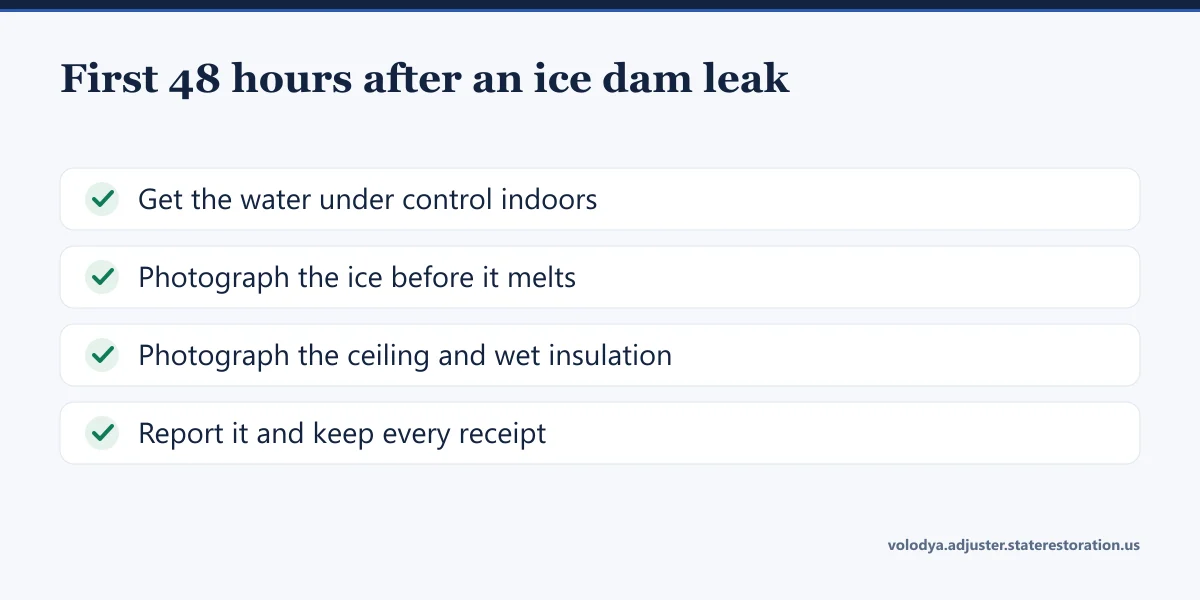
- Get the water under control. Move what is underneath, put down containers, and if a ceiling is sagging with trapped water above it, draining it deliberately into a bucket does less damage than letting the whole section come down at once.
- Photograph the ice before it melts. From the ground: wide shots of every elevation, close ones of the dam and the icicles, a tape measure in the frame if snow depth is part of the story. Keep the originals with their timestamps and do not edit them.
- Photograph inside on the same day. Ceiling stains with something for scale, wet insulation in the attic, damaged contents individually, and the water actually running if it still is.
- Report the loss and write down the claim number, the date, the time and the name of the person you spoke to. That log is worth more later than anyone expects.
- Keep every receipt — drying, tarping, steaming, a hotel night if the house is not liveable. Additional living expenses are a separate coverage, and it pays only what you can evidence.
Two things not to do. Do not attack the dam with a hammer, an axe or a shovel: you will break shingles, and fresh mechanical damage makes the cause of loss far harder to argue. And do not climb onto a snow-covered roof at all. A roof rake used from the ground, or a company with a steamer, is the version that does not end in an ambulance.
How do I prove the claim once the ice has melted?
With three independent records that agree: your dated photographs of the ice and the interior, moisture readings taken by a mitigation company in writing, and the public weather record for the date of loss. Any one of them alone is arguable. Together they describe a specific event on a specific day.
Moisture readings are the piece most homeowners skip. A mitigation contractor documents readings and drying logs as routine, and those numbers establish that the assembly was genuinely wet rather than stained, and roughly how far the water travelled. Ask for the report in writing even if the drying is quick. Worth having alongside it: a written statement of cause from a roofer or inspector who actually went up and looked. It binds nobody, but it means the file holds a technical opinion other than the carrier’s.
For the weather, the National Weather Service Chicago office publishes local observations and climate records, and the freeze-thaw sequence in the days before the leak is often the clearest support for a sudden event. Pin down the date of loss while you are there: it is the day the water first appeared, not the day you noticed the ceiling, and it sets the policy period, the deductible in force and the notice clock. I have set out the clocks that run on an Illinois claim in how long you really have to file and to sue.
How much of an ice dam repair actually reaches me?
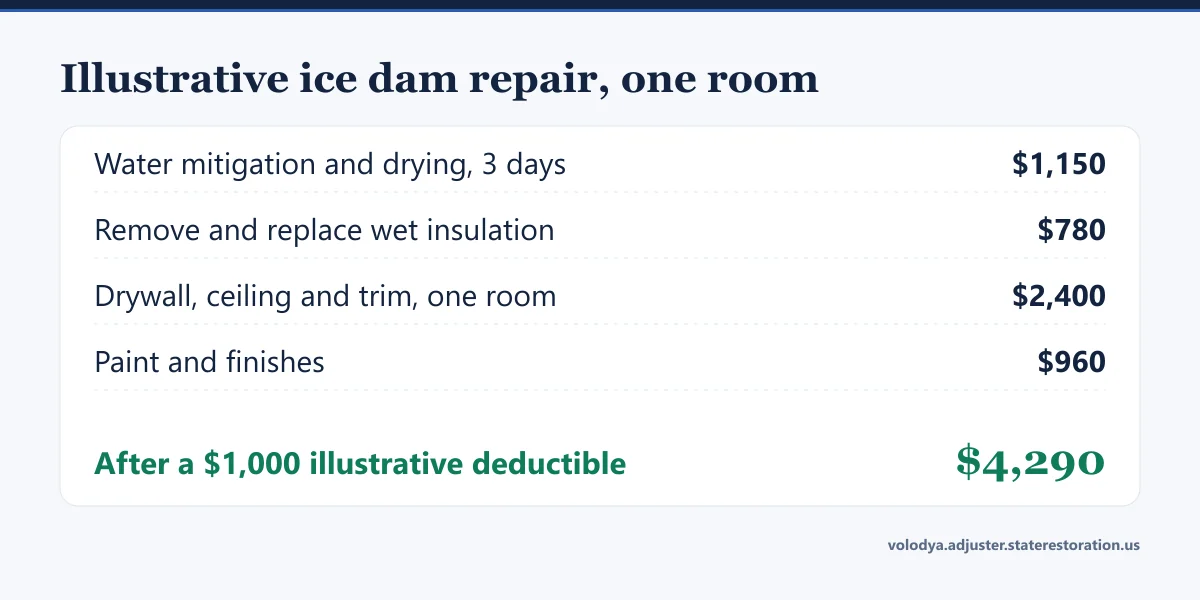
Less than the estimate total, in two steps: the deductible comes off, and the depreciation is usually held back until the work is done. The example below is illustrative arithmetic to show the shape of it — not a typical figure, not a promise, and not taken from any real file.
| Line | Illustrative amount |
|---|---|
| Water mitigation and drying, three days | $1,150 |
| Remove and replace wet insulation | $780 |
| Drywall, ceiling and trim, one room | $2,400 |
| Paint and finishes | $960 |
| Subtotal before the deductible | $5,290 |
| Less an illustrative $1,000 all-other-perils deductible | −$1,000 |
| Illustrative claim payment | $4,290 |
Check the declarations page rather than assuming which deductible applies. Windstorm-or-hail deductibles are often a percentage of the dwelling limit and can be several times the flat amount, but an ice dam is usually handled under the all-other-perils deductible instead. The second reduction is depreciation: on a replacement cost policy the first payment is normally actual cash value, with the recoverable depreciation released once the repair is finished and documented. It looks underpaid at that point, and often it is not. I have written out how that second payment is collected in why your first insurance check is smaller than the repair.
When is an ice dam a maintenance problem rather than a claim?
When nothing sudden happened. If the same corner of the same ceiling has stained every February for four winters, that is a building defect running its course, and most forms exclude it as gradual damage. If the visible damage is one small stain and the repair sits close to the deductible, there may be nothing worth filing either.
I would rather say that plainly than take on a file that should not exist. If the roof is at the end of its service life, the honest fix is a re-roof with a proper ice barrier at the eaves, and no claim will fund that. Where a public adjuster does earn the fee is the opposite case: real, sudden, widespread interior damage, a scope covering one room when the water reached three, contents ignored, mitigation invoices unpaid, or a denial describing your house as though it had been leaking for a year when it had not.
What if the claim is denied or paid short?
Ask in writing for the field report and the specific basis for the decision, then answer it with evidence rather than argument: the dated photographs, the moisture readings, the weather record, and a request for re-inspection with your own representative present. Give a date by which you expect a reply.
What comes next depends on what is actually in dispute, and the distinction matters. If everyone agrees the ice dam damaged the house and the disagreement is about what the repair costs, that is a dispute about the amount of loss, and most policies contain an appraisal clause built for exactly that. If the disagreement is whether the loss is covered at all — sudden versus gradual, damage versus cause — that is a coverage question. I am a public adjuster, not a lawyer, and when a claim turns on what your policy obliges anyone to do, an attorney is the right person to ask. Both the Illinois Department of Insurance and the Indiana Department of Insurance take consumer complaints about claim handling; a complaint does not move the claim by itself, but it creates a record.
What to do next
If your ceiling is wet right now, the order is simple: contain the water, photograph the ice today, report the loss, keep the receipts. None of that requires a decision about who represents you, and all of it gets harder a week from now.
If you would rather have someone read the roof, the attic and the estimate together, the free inspection and policy review is exactly that: I look at what caused it, tell you what the evidence supports, and say so plainly when the answer is that you do not need a public adjuster. The offerings page sets out the work I take on, and my licences and certifications are published in full. My hours are Monday to Friday 9–6, Saturday 9–5 and Sunday 10–5, and I speak English, Ukrainian and Russian.
Nothing above is legal advice. Inspecting a roof, documenting a cause of loss and negotiating a scope is claim handling, and that is my job; what your policy obliges your carrier to pay is a legal question for an attorney.