Matching is the question of whether your insurer pays for undamaged siding, shingles or flooring next to the damaged part, because repairing with today's material would leave the wall or the roof visibly mismatched. No standard Illinois homeowners policy uses the word matching. What it promises is repair or replacement with material of like kind and quality, and the whole argument lives inside that phrase. Three things decide it in practice: whether the original material is genuinely unavailable, whether the mismatch shows across one continuous surface, and whether you can prove both on paper rather than in conversation.
Matching is the argument that costs homeowners the most money and gets raised the least. A hailstorm dents the north wall of a house. The carrier scopes that wall honestly, prices it fairly, and pays it. Then the siding supplier says the colour was discontinued eleven years ago, the closest current product is half a shade off, and the house ends up with one wall that does not belong to it. Nobody disputed the damage. The disagreement is entirely about the three walls nobody touched.
I am a licensed public adjuster in Illinois (#19461872) and Indiana (#3556317), a HAAG certified inspector (#992104047), a licensed Illinois roofing contractor (#105.009193) and a general contractor (#TGC115063). I have made this argument and I have also told homeowners it was not worth making. What follows is general information for Illinois and Indiana, not legal advice.
What does matching mean on a property claim?
It means replacing undamaged material so the finished repair looks like one surface instead of a patch. The damage itself is not in dispute. What is in dispute is the material either side of it, which the storm never touched, and which only needs replacing because the replacement for the damaged part will not match it.
The phrase your policy almost certainly uses instead is like kind and quality. It appears in the loss settlement condition and it is doing more work than most people notice. It does not say identical. It does not say the same colour. Carriers read it as a standard about the material — same grade, same gauge, same profile, same performance — and homeowners read it as a standard about the result. Both readings are available in the words, which is exactly why this ends up argued instead of calculated.
Worth separating two things that get muddled constantly. Matching is about undamaged material replaced because of appearance. Code upgrade coverage is about undamaged work required by a building department. Both involve paying for something the storm did not damage, and they draw against different parts of the policy — how ordinance or law coverage works in Illinois covers the second one.
Does an Illinois policy have to match?
Sometimes, and it depends on the wording and the facts rather than on a rule. Illinois has no property regulation that says an insurer must match undamaged material. Some states have written one. Illinois has not, so the answer comes from the loss settlement language in your own policy and from how courts have read it.
This has been litigated here. In 2019 the federal appeals court covering Illinois considered hail damage to the aluminium siding on a group of Naperville condominium buildings, in a case brought by the Windridge of Naperville Condominium Association against Philadelphia Indemnity. Applying Illinois law, the court did not limit the insurer's obligation to the individual dented panels: the siding on each building functioned as one continuous surface, and replacing only the damaged panels would not have restored it. That is one court, one policy, one set of facts about condominium buildings, and it is not a general rule that every Illinois house gets a full re-side. How it bears on your policy is a question for an attorney.
What I can tell you is how the conversation actually goes with a field adjuster, because it is rarely about law. It is about whether the product is available and whether the mismatch is visible. Those two facts are mine to establish, and when they are established properly the file usually moves without anybody citing anything.
Why can't the contractor just buy more of the same siding?
Because exterior products have short commercial lives and long service lives. A vinyl siding colour sold for a decade sits on a house for forty years. Manufacturers retire colours, change blends, revise profiles and close plants, and none of that is announced to the homeowner. Five separate things can break a match, and they break it in different ways.
| What has changed | Why it breaks the repair | What proves it |
|---|---|---|
| The colour or line is discontinued | Nothing current is the same colour; the nearest option is a different product | A written statement from the manufacturer or a distributor, naming the product and the year it ended |
| The colour blend was reformulated | Same name on the label, different pigment; the two read as different colours side by side | A physical sample held against the existing wall, photographed in daylight |
| The existing material has weathered | Even genuinely identical stock looks new against fifteen years of sun; south and west elevations fade hardest | Photographs of new material against each elevation, taken the same hour |
| The profile or exposure changed | A different reveal or lap will not line up with the existing courses, so the seam shows in shadow, not just in colour | A tape measure on the existing exposure and on the proposed product |
| The batch or dye lot differs | Common in carpet and in some vinyl; visible where two runs meet in one room or one wall | Lot numbers from the supplier, and a seam photograph |
The fourth row is the one that changes the character of the argument. Colour is aesthetic, and an adjuster can reasonably tell you the policy does not insure aesthetics. Exposure is dimensional. If the replacement lays at a different reveal, the courses cannot be tied in, and what you have is not a cosmetic complaint but a repair that does not work. Measure it before you argue about colour.
How far does the replacement go: the panel, the wall or the house?
Most field adjusters work to a natural break. Siding is replaced to an inside or outside corner, to a trim line, or to a change of plane, because that is where a transition can be made without the eye catching it. The disagreement is usually about which break counts, not about whether breaks exist.
The competing standard is line of sight: replace whatever a person standing in one place sees as a single surface. On a house with strong corner boards, the two standards give the same answer. On a wraparound elevation with no vertical break, or on a house where the front and one side read as one plane from the street, they give very different answers, and that gap is where the money sits.
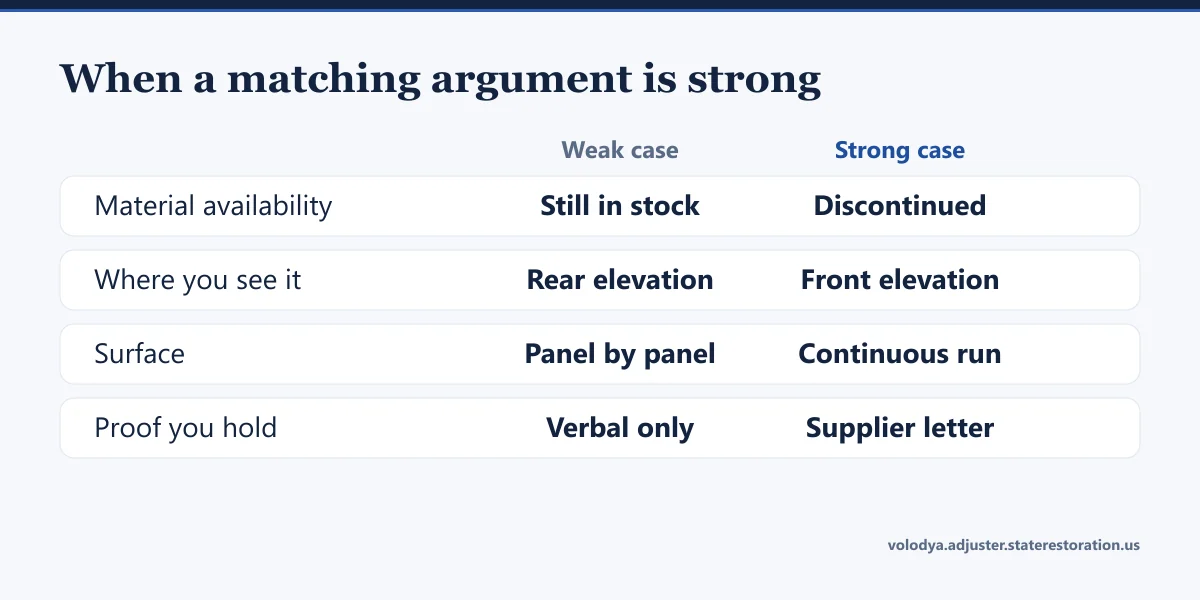
Be honest with yourself about which side of that table your house is on. Hail on a rear elevation, in a colour still in production, on a wall with corner boards at both ends, is a weak matching claim and I will tell you so. Hail on a front elevation in a discontinued colour, on a run that turns a corner without a break, is a strong one. Most houses are somewhere between, and the useful work is establishing which facts you actually have before anybody makes a demand.
What does the difference look like in money?
It scales with the size of the undamaged area, so it is usually the largest single number in a siding dispute. Here is the shape of it on a modest two-storey house where hail hit one elevation and the colour is out of production.
| Elevation | Illustrative amount |
|---|---|
| North wall, hail damaged, 12 squares | $3,720 |
| East wall, undamaged, 9 squares | $2,790 |
| South wall, undamaged, 11 squares | $3,410 |
| West wall, undamaged, 6 squares | $1,860 |
| Whole-house replacement | $11,780 |
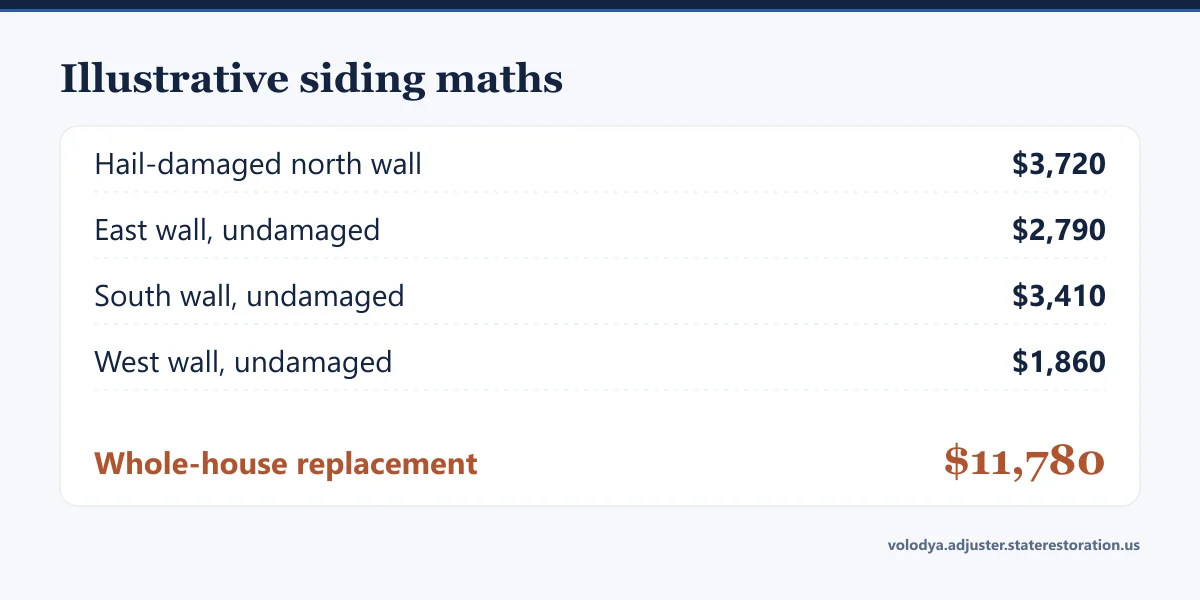
Three quarters of that total is material nothing happened to. That ratio is why carriers scrutinise matching and why homeowners should expect to document it rather than assert it. It is also why a partial answer is common and reasonable: a carrier may agree to the damaged elevation plus the one that shares a plane with it, and decline the two nobody can see at once. That is a negotiation about line of sight, not a denial, and it is worth recognising the difference before you escalate.
Is a roof the same argument as siding?
The principle is the same and the evidence is different. On a roof the natural breaks are ridges, valleys and changes of plane, so carriers commonly pay slope by slope. The stronger roof argument is usually functional rather than visual, which is not true on a wall.
Asphalt shingle lines turn over quickly. A discontinued shingle is often replaced by a product with a different exposure, a different thickness or a different tab pattern, and those cannot be woven into existing courses without a visible step at the tie-in. Older shingles also become brittle: lifting sealed tabs to slide new material under them breaks the ones you were trying to keep, which turns a small repair into a larger one on the same slope. Both of those are physical findings a roofer or an inspector can record, and both are stronger than saying the colour is off.
There is a limit to the argument I want to be straight about. A slope the storm did not hit, on the back of the house, facing away from every vantage point, is a hard sell and often a fair decline. If you want to know what genuinely counts as roof damage in the first place, what a HAAG inspector looks for on an asphalt roof covers the test squares and the mat fracture.
Interiors follow the same logic with different materials. Continuous hardwood running from a damaged kitchen through into a dining room with no threshold is the classic, because there is no break to stop at. Carpet in one dye lot, a run of cabinets, a countertop with a seam nobody would accept in the middle of it — each is the same question about where a surface honestly ends.
What do you actually have to prove?
Availability and visibility, in writing, before the repair starts. An adjuster cannot approve a matching allowance on the strength of a contractor's opinion, and asking them to is what stalls these files for months.
- Get unavailability from the supply chain, not the contractor. An email from a manufacturer or distributor naming the product and stating it is discontinued is the single most useful document in the file. A roofer saying they cannot get it is not the same thing.
- Hold a physical sample against the existing wall and photograph it. Same daylight, both surfaces in one frame, at the distance a person would actually stand. A close-up macro of two colours proves nothing about what the house looks like.
- Photograph each elevation as one surface. The point is to show where the run breaks and where it does not, so shoot the corners and the transitions, not just the damage.
- Measure the exposure on the existing material and on the proposed replacement. A dimensional difference moves the conversation off appearance entirely, which is where you want it.
- Ask for the matching allowance as its own line in the estimate. Buried inside a general siding line it is invisible to the desk reviewer and impossible to negotiate separately. If line items are unfamiliar territory, reading an estimate line by line is the place to start.
Sequence matters as much as content. Once the damaged elevation is re-sided, the mismatch you were trying to prove is installed on the house and the argument becomes about whether it is bad enough to redo. Get the documents before the first panel comes off.
Does anything in the policy shut the argument down?
Yes, and it is worth reading your endorsement list before you spend a month on this. Some carriers now attach an endorsement that limits or excludes payment for undamaged material replaced only to achieve a match, sometimes capping it at a percentage. If you have one, the coverage is whatever it leaves.
Two other practical limits. Matching money is part of the same claim, so it sits behind the same deductible — a strong argument on a small area can be worth less than the effort of making it. And on a replacement cost policy the amount is still split between the first cheque and the depreciation held back until the work is done, so agreeing a matching allowance is not the same as having it in the bank. That mechanism is the same one described in what actual cash value means on an Illinois claim.
When is this a lawyer question rather than mine?
When the dispute stops being about the material and starts being about the words. Establishing that a product is discontinued, measuring exposures, documenting a continuous run and pricing the replacement is claim handling, and that is my licence. Arguing what like kind and quality obliges an insurer to do is legal work.
The practical test I use: if the answer to the carrier is a photograph, a measurement, a supplier email or a line item, bring it to a public adjuster. If the answer is an interpretation of a clause, or a decision about whether a partial denial was proper, talk to an attorney — and do it without delay, because the suit-limitation period in your own policy runs from the date of loss and does not pause while letters go back and forth. The range of what I handle is set out on the representation page.
Getting help with a matching dispute in Chicago
If a carrier has agreed one elevation or one slope and you are looking at a house that will not match itself, send me the estimate, photographs of each elevation and whatever the supplier has told you about the product. I will tell you whether there is a matching argument worth making and roughly what it is worth. On some houses there is not, and saying so early is more useful than a long letter. There is more about how I work on the about page, or send the documents through the contact page.
Volodymyr Lukaniuk, licensed public adjuster. 3052 N Long Ave #2, Chicago, IL 60641. Telephone +1 224-481-2095, email volodymyr@staterestoration.us. Hours are Monday to Friday 9–6, Saturday 9–5 and Sunday 10–5, and I speak English, Ukrainian and Russian. I am licensed in Illinois and Indiana only.
Nothing above is legal advice. It is general information about how first-party property claims are handled, written by a public adjuster rather than a lawyer. Policy wordings differ from one form to the next, and your own declarations page and endorsement list are the authorities on your claim.