On a slate or tile roof insurance claim in Illinois, a handful of broken pieces is normally a repair. Slate, clay tile and concrete tile are laid as separate units, and one unit can be taken out and replaced without touching the rest. The claim grows from a repair to a slope, or to the whole roof, for one of three reasons: the count of broken pieces is high, a replacement piece that fits can no longer be bought, or the repair itself would break more of an old roof than it fixes.
I am a licensed public adjuster in Illinois (#19461872) and Indiana (#3556317), and I also hold an Illinois roofing contractor licence (#105.009193). This page explains how each of those three reasons is shown on a roof, using two published guides that neither side of a claim wrote. It is general information for Illinois and Indiana homes, not legal advice. Your policy decides what is paid.
How do slate, clay tile and concrete tile break, and how is each one repaired?
They fail differently, and the repair differs with them. Slate is nailed stone and cracks or loses a corner. Clay and concrete tiles are moulded pieces that lock into their neighbours, and they crack or snap at the lock. Find your roof in the table first, because the rest of the claim follows from it.
| Roof | What storm damage looks like | How one piece is replaced | What can stop a repair |
|---|---|---|---|
| Natural slate | A cracked or broken slate, a missing corner, a slate that has slid out of its course | The nails are cut with a slate ripper, a matching slate is slid in, nailed once and covered with a copper bib | Too many broken slates on one slope, slate at the end of its life, no slate of the same size and weathered colour |
| Clay tile | A cracked or snapped tile, often at a corner or along the lock | The broken tile is lifted out and a tile of the same profile is seated in its place | An imported or old profile that nobody can supply, so the new tile will not lock or sit flat |
| Concrete tile | A cracked tile or a broken corner | The same as clay: a tile that interlocks with the ones around it | A profile on the discontinued list, with no tile that seats properly |
What does a proper slate repair involve?
It is slow hand work, and an estimate should price it that way. The National Park Service describes the sequence in Preservation Brief 29, on the repair of slate roofs. Read a repair line in your estimate against it:
- The nails holding the broken slate are cut or pulled with a ripper slid under the slate above. If the roof was laid with steel nails, the neighbouring slates can be damaged in the process and have to be repaired too.
- A new or salvaged slate is slid into place. It should match the old one in size, shape, texture and weathered colour.
- It is held by one nail driven through the joint of the course above.
- A strip of copper about 3 inches wide and 8 inches long is pushed up over that nail to keep water out of the new hole.
Two details from the same brief matter in Chicago. A simpler method, a copper tab bent over the tail of the slate, is described there as not recommended for northern climates, because snow and ice can fold the tab and let the slate slide out. And roofing mastic or sealant on a broken slate is not treated as a repair at all: it hardens, cracks and lets water in again. An estimate that allows for sealing cracked slates has not priced a repair.
At what point is a slate roof replaced and not repaired?
No policy contains a percentage, so the number has to come from somewhere neutral. Contractor pages quote several different figures, usually with no source behind them. The one I can point to in writing is this:
If 20% or more of the slates on a roof or roof slope are broken, cracked, missing, or sliding out of position, it is usually less expensive to replace the roof than to execute individual repairs. This is especially true of older roofs nearing the end of their serviceable lives because even the most experienced slater will likely damage additional slates while attempting repairs.
National Park Service, Preservation Brief 29 (1993)
Be straight about what that sentence is. It was written in 1993 for owners of historic buildings, and it is a guideline about cost. It does not bind your insurer and it is not a term of your policy. What it gives you is a way to turn an opinion into a count: the number of damaged slates on each slope, divided by the number of slates on that slope.
Count by slope, because the brief does, and because storms rarely hit every side of a house equally. The same brief says that often only one slope needs replacement while the others can be repaired.
Here is an illustrative worked example. The counts are invented to show the arithmetic and are not from a real file.
West slope, facing the storm
23%265 of 1,150 slates cracked, broken or slid. Over the 20% guideline, so this slope is evaluated for replacement.
East slope
4%46 of 1,150 slates damaged. Well under the guideline, so this slope is evaluated for repair, slate by slate.
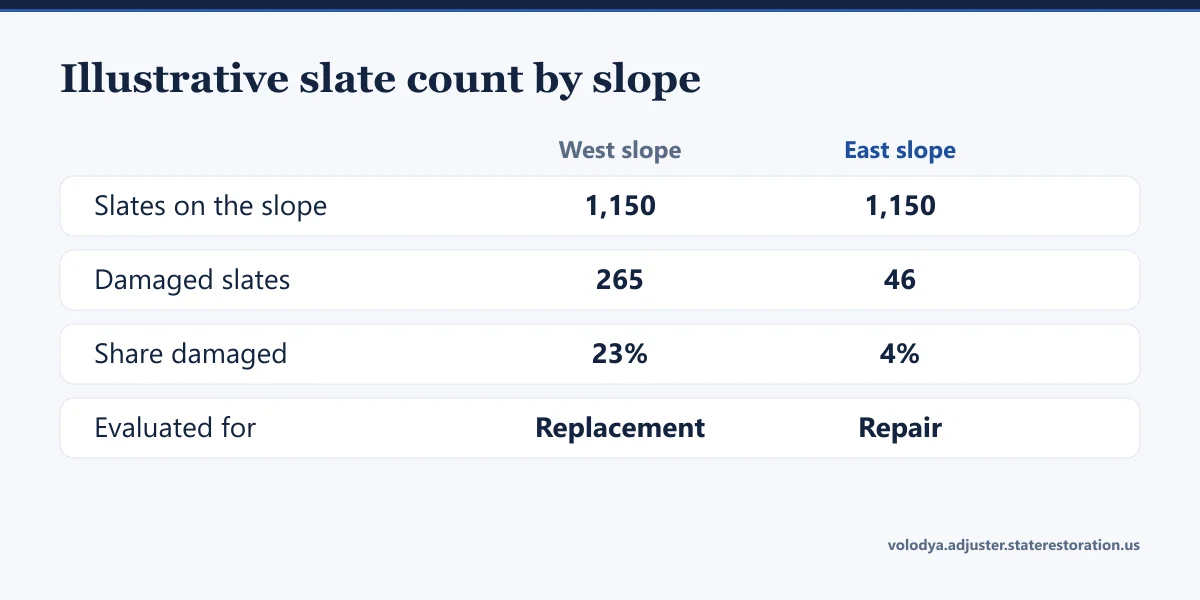
Both sides can check a count. That is its value: a marked-up roof plan with a number on each slope is harder to wave away than the word extensive, and it also tells you early when the honest answer is a repair.
What if my roof tile is not made any more?
Then the question is whether a tile exists that locks and sits flat with yours, and the order of options is set out by the trade body for the tile industry. The TRI Alliance covers it in Technical Brief 2021-02, on tile replacement. It says most concrete and clay tiles on the market are still in production, that it keeps a list of discontinued products, and that a tile which does not seat properly can lead to leaks, breakage and courses that no longer line up. The routes, in the order I would work through them:
- Ask the manufacturer of the existing tile whether it, or a tile that interlocks with it, is still made. If yes, this is an ordinary repair.
- Look for the discontinued tile in a salvage yard, or have replacements custom made. The brief notes that such tiles are not covered by a manufacturer's warranty, and custom tiles need checking for code acceptance and fit.
- Harvest sound tiles from another roof plane to repair the damaged one, and re-cover the plane they came from with new tile. The brief says this may or may not be viable, depending on planning, local code and the roof design.
- If no tile can be made to interlock and seat with the existing ones, harvesting or a complete roof replacement may be required.
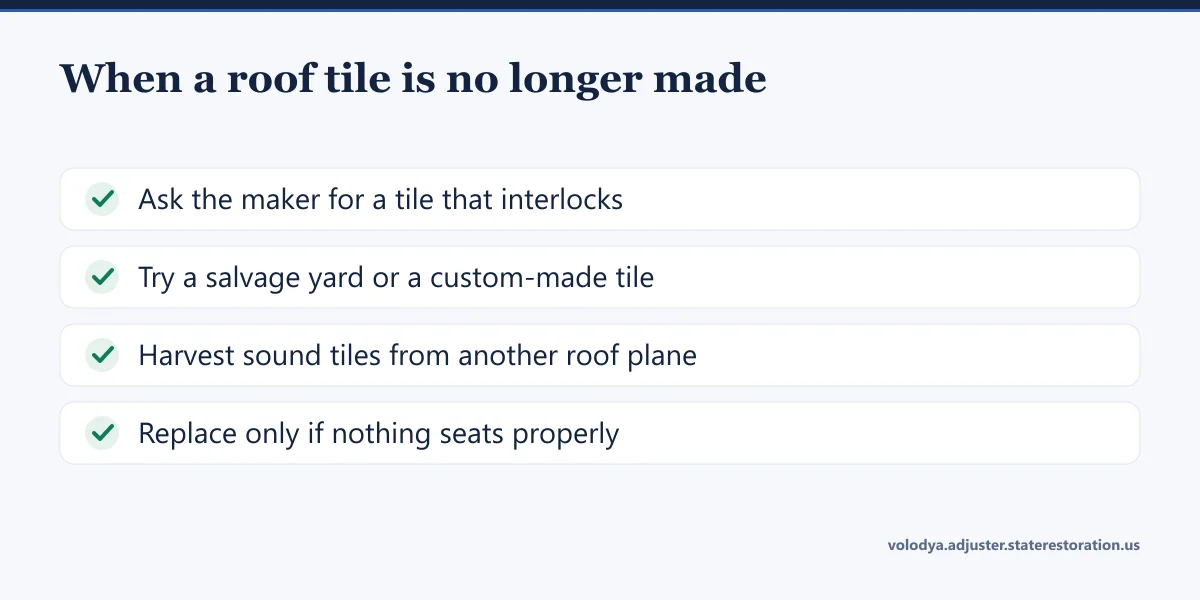
For a claim, each step you have tried is evidence. A written reply from the manufacturer, the name of the profile on the discontinued list and a note from a salvage yard that it has none do more for the file than a roofer's sentence that the tile is obsolete. The brief also sends you to the local building official, because in some places a partial replacement above a set share of the roof means bringing the whole roof up to current code. Ask your own building department what applies to your address. If it does apply, the code upgrade coverage in your policy is the part that responds, up to its limit.
How does anyone tell storm damage from an old roof?
By looking at the break and at the slate around it. Insurance pays for sudden damage and excludes wear, and slate does wear out. Brief 29 gives rough service lives by origin: about 125 years for Vermont and New York slate, 175 years or more for Buckingham Virginia slate, and in excess of 60 years for Pennsylvania soft-vein slate. It also describes what worn slate does: thin layers flake off the surface, the slate turns soft, and a slate tapped with a knuckle gives a dull thud where a sound one rings clear.
So a roof where the broken slates are also flaking and dull is an old roof, and the insurer is right to say so. A roof where sound, ringing slates have clean breaks after a dated storm is a different file. The brief lists what breaks individual slates outside a storm too: falling tree limbs, ice dams in gutters and valleys, and the weight of a person walking on the roof. That last one is why foot traffic matters so much. An inspection that walks a slate roof can add to the damage it came to count, and the brief recommends surveying from the ground with binoculars or from a lift. The same care applies to me, to a roofer and to the insurer's adjuster.
What does the policy add once the roof question is settled?
Four things change the money or the timetable, and the first two have their own pages here.
- Depreciation. If your policy pays the roof at actual cash value, or holds depreciation back until the work is done, age counts heavily on a roof that may be eighty years old. The guide to the first cheque shows the arithmetic.
- Matching. A repaired slope beside a weathered one will not look the same, and Brief 29 notes that imported slates often do not match the colour and texture of American slate. Illinois has no matching regulation, so the answer comes from your policy wording, as the matching guide explains.
- Time. Slate is not stocked like shingles. The brief gives delivery times of 4 to 12 weeks, and up to a year for special orders, and an average laying rate of about one roofing square a day. A claim with repair deadlines in the policy needs those dates asked for in writing early.
- Cosmetic damage wording. Some policies carry an endorsement that excludes marks which do not affect how the roof sheds water. Read your endorsements before the inspection, not after.
What should I do before the adjuster inspects?
- Stay off the roof, and ask everyone else how they plan to get up there.
- Photograph each slope from the ground, and any pieces lying in the yard or the gutters, before anything is cleaned up. Keep the fallen pieces: a fresh break shows on them.
- Write down the date and time of the storm.
- Find out what the roof is: the slate's origin if any paperwork says, or the tile maker and the name of the profile.
- Cover any opening against rain and keep the receipt. Your policy expects you to protect the house from further damage.
- Ask for the insurer's estimate in writing, with a count per slope, not a lump sum.
If the count is low, the pieces can be bought and the insurer's estimate prices the hand work properly, you do not need a public adjuster. A slater's invoice and the estimate will settle it. If the two sides disagree about the count, the cause, or whether a matching piece exists, send me the estimate and the photographs and I will tell you whether there is anything I can add. Questions about what your policy wording means, or about a deadline to file suit, belong with a lawyer. You can read about my licences and background or see how I handle roof damage claims in general.