Code upgrade coverage — printed on most policies as Ordinance or Law — pays the extra cost of putting the building back to the code enforced today rather than the code it was built under. A standard Illinois homeowners form excludes that cost in the exclusions and then hands a limited amount back, commonly 10 percent of your Coverage A dwelling limit. It is not automatic. The requirement has to come from a code actually being enforced on your repair, the increased cost has to appear as its own line in the estimate, and on most forms the work has to be done and invoiced before the money is released. On a roof it is usually tear-off of a second layer, new sheathing over plank decking, ice barrier at the eaves and drip edge.
Code upgrade coverage is the line that decides whether a repair you were told was fully covered still leaves you writing a cheque. The carrier scoped the damage honestly, the estimate looks complete, and then the roofer pulls the old shingles and the city inspector says the deck has to be sheathed before anything goes back on. That work is not damage. Nobody caused it. It is the difference between the code in force when the house was built and the code in force this morning, and there is a specific pot of money in your policy for it.
I am a licensed public adjuster in Illinois (#19461872) and Indiana (#3556317), a HAAG certified inspector (#992104047), a licensed Illinois roofing contractor (#105.009193) and a general contractor (#TGC115063). I have stood on the roof while the inspector made that call. What follows is general information for Illinois and Indiana, not legal advice.
What is code upgrade coverage, and where is it in my policy?
It is a capped additional coverage that pays the increased cost of complying with a building code when you repair damage from a covered loss. In the ISO homeowners form it is worded as a percentage of Coverage A, commonly 10 percent, and carriers offer endorsements that raise it. Look on your declarations page for the words Ordinance or Law.
The structure catches people out because the same policy says two opposite-sounding things in two different places. In the Section I exclusions there is an Ordinance or Law exclusion: the policy does not insure loss caused by the enforcement of any ordinance or law regulating construction, demolition, remodeling, renovation or repair, including removal of the resulting debris. Read alone, that says no. Then in the additional coverages the form gives a defined slice of it back.
So the real question is never whether your policy covers code upgrades. It is how large the give-back is and whether your claim was documented in a way that reaches it. The give-back is usually expressed as a percentage of the dwelling limit, so on an illustrative Coverage A of $320,000 a 10 percent provision is $32,000, a 25 percent endorsement is $80,000 and a 50 percent endorsement is $160,000. Those are illustrative figures on a round number, not a quote and not anyone's actual policy. Your own declarations page is the only place the real one exists.
Why is the extra cost excluded in the first place?
Because a property policy insures the building as it stood, not as a municipality would prefer it to be. The exclusion keeps the carrier from underwriting every code change enacted since the house was framed. The additional coverage then puts a bounded amount back, because everyone understands a real repair has to pass a real inspection.
That logic is worth holding on to, because it tells you how the argument gets won. You are not arguing that the code upgrade is damage. You are showing that it is a cost you incurred in repairing damage, that a code enforced in your municipality required it, and that the amount sits inside the limit you paid for. Three facts, each of them documentable.
Which code upgrades actually turn up on an Illinois roof?
Five of them cover most residential roof claims: removal of a second covering layer, solid sheathing over spaced plank decking, an ice barrier at the eaves, drip edge at eave and rake, and attic ventilation brought up to the required ratio. None of them is exotic. All five are invisible until the old roof is off.
| What the inspector finds | What the code generally requires | Where it lands in the estimate |
|---|---|---|
| Two or more layers of covering already on the deck | The existing coverings come off to the deck; a recover is not permitted over two applications | Additional layer of tear-off, per square |
| Spaced plank or board decking, or deck that is water soaked and deteriorated | A deck that will hold the specified fastener, which in practice means new solid sheathing | Sheathing, per square, plus additional dumpster |
| Eaves in an area with a history of ice backing up | An ice barrier running from the lowest roof edge to a point inside the exterior wall line | Ice and water barrier, per square |
| No drip edge at the eave or the rake | Drip edge at eaves and rake edges under asphalt shingles | Drip edge, per linear foot |
| Attic ventilation below the required net free area | Balanced intake and exhaust meeting the required ratio for the vented space | Ridge vent and soffit vent, per linear foot |
Which edition of which code applies to you depends on where you live, and Illinois is not uniform about this. Chicago runs its own building code and its own electrical code. Most suburbs adopt a version of the International Residential Code with local amendments. Municipalities that have adopted nothing of their own fall under the Illinois Residential Building Code. The practical consequence is that two identical bungalows four miles apart can get different answers, and neither adjuster nor contractor gets to decide it from memory. The building department does.
Interiors have their own list. Since 1 January 2023 Illinois has required smoke alarms in dwellings to be hardwired or to carry a sealed ten-year battery, so a fire or water claim that involves replacing ceilings often picks that up. Opening walls can bring circuits into the current electrical code. Rebuilding a finished basement bedroom raises the egress window question. Each of those is the same argument in a different trade.
What does the increased cost actually look like?
Smaller than people fear and larger than the estimate allowed for. On a full residential re-roof the code items are usually a four-figure number, driven mostly by sheathing, because sheathing is the one that scales with the size of the roof. Here is a worked example on a two-storey Chicago bungalow.
| Code-driven line | Illustrative amount |
|---|---|
| Second layer tear-off, deck-down | $1,480 |
| New sheathing over plank deck, 21 squares | $3,780 |
| Ice barrier at eaves and valleys | $1,240 |
| Drip edge, eave and rake, 215 linear feet | $560 |
| Increased cost of construction | $7,060 |
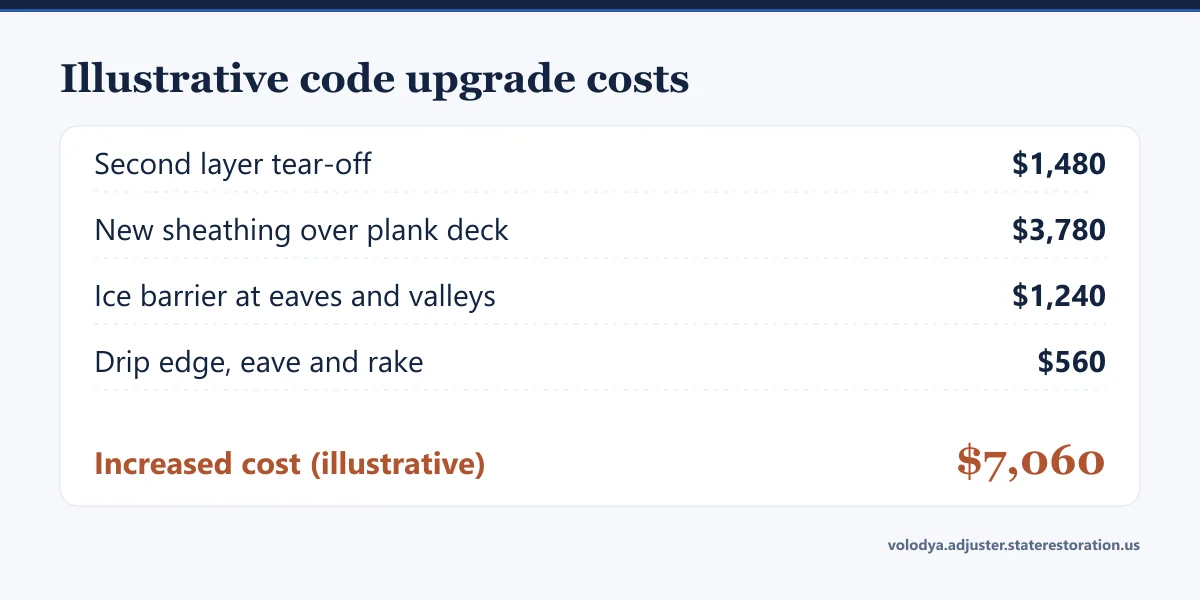
Against an illustrative 10 percent provision on $320,000 of Coverage A, that $7,060 sits comfortably inside a $32,000 limit. The number that matters is not whether the pot is big enough. It is whether those four lines were ever written down. An estimate that scopes a re-roof without them is not wrong about the damage; it is silent about the code, and silence is what you are correcting. If you have never read one of these documents closely, the eight columns and the summary stack is the place to start, because the code lines live in exactly the same place as the accessory lines that go missing.
What has to happen before the carrier pays it?
On most forms the increased cost has to be incurred, which means done and invoiced, not estimated. That puts code upgrade coverage in the same family as recoverable depreciation: it is real money, and it is released against proof of work rather than against a plan to do the work. Sequence matters more than argument here.
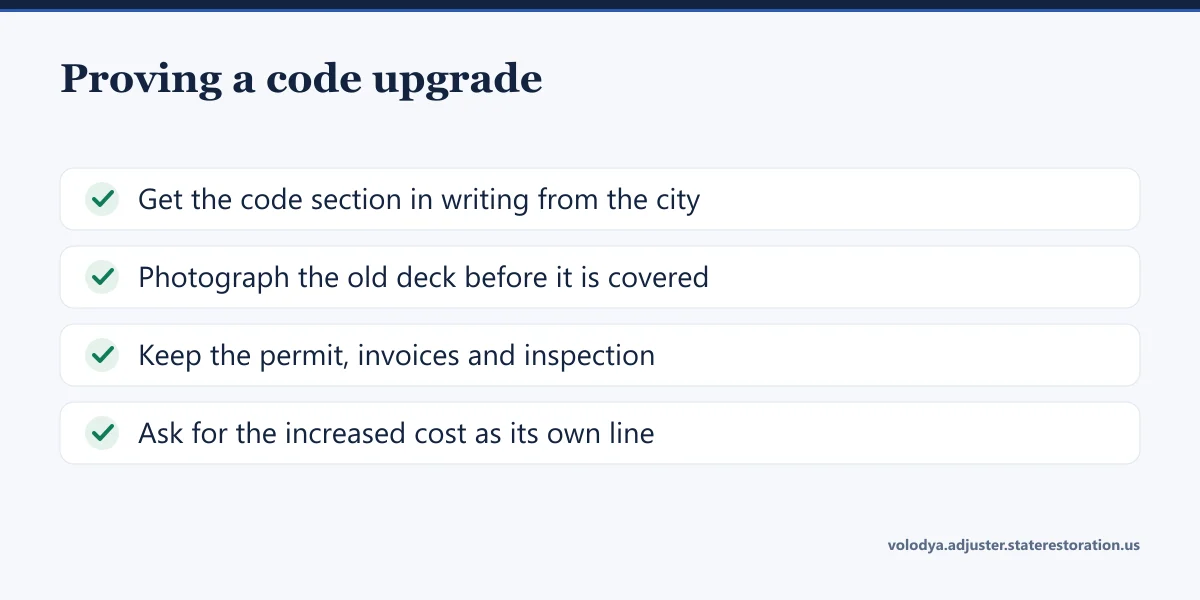
- Get the requirement in writing from the building department. A permit correction notice, an inspection card, a plan-review comment, or an email naming the section. The name of a code section beats anyone's professional opinion, including mine.
- Photograph the condition before it is covered. The two layers, the gaps between the planks, the missing drip edge. Once new sheathing is down, the reason for the sheathing is gone forever and you are asking an adjuster to take your word for it.
- Ask for the increased cost as its own line. Bundled into a general repair line it draws against the wrong limit and it becomes invisible to the desk adjuster reviewing the file.
- Keep the permit, the invoices and the signed-off inspection. These are what turn an estimate into an incurred cost, and they are what the carrier will ask for months later.
- Check that the ordinance is one being enforced on your job, not one that exists on paper. Enforcement is the trigger, and on most forms the code has to be in force when the loss happens.
- Confirm the limit on your declarations page before you commit to the work, because a 10 percent provision and a 50 percent endorsement lead to very different conversations with your contractor.
The one that gets skipped is the photograph, every time. A roofer working on a schedule tears off, sheathes and dries in the same day, and the evidence of why the sheathing was needed is under the new deck by lunchtime. Ten minutes with a phone is the cheapest insurance on the whole job.
What does code upgrade coverage not pay for?
Four things, reliably. It does not pay the loss in value the ordinance causes. It does not raise the amount payable for the physical damage itself. It generally does not pay for complying with a code you were already in violation of before the loss. And most forms exclude the cost of testing for or removing pollutants when an ordinance requires it.
That last one deserves a sentence of its own, because in older Chicago housing stock it is not theoretical. Where an ordinance requires testing for or the removal of a pollutant, many homeowners forms exclude that cost from the ordinance or law coverage, and asbestos in plaster, flooring or pipe insulation is commonly handled under that wording. Whether your particular form does that, and what your options are if it does, is a question for the wording in front of you rather than a general rule.
There is also a scope boundary worth knowing. The give-back typically applies to the damaged part of the building and to the undamaged part only where the repair genuinely cannot be completed without touching it. A code requirement affecting a wing of the house that was never damaged usually falls outside it. This is the same territory as a matching argument, and the two get confused constantly, because both of them are about work on undamaged material.
Is there a 50 percent rule in Illinois?
For buildings in a mapped floodplain, effectively yes. Under federal floodplain rules that local communities administer, if the cost of restoring a structure to its pre-damage condition reaches 50 percent of its market value before the damage, the repair counts as substantial and the building has to be brought into compliance with current floodplain requirements.
The part that surprises people is that the cause does not have to be flooding. A fire or a severe wind loss on a house inside a Special Flood Hazard Area can cross that threshold, and then elevation and floodproofing requirements attach to a claim that had nothing to do with water. The costs involved are an order of magnitude above a drip edge, and they are exactly what a higher ordinance or law limit exists for. If your property is in a mapped zone, this is the reason to look at the endorsement now rather than after a loss.
Whether your community applies the rule at 50 percent or lower is a local question, and the floodplain administrator at your municipality is the person who answers it. Ask before the repair is scoped, not after.
How do you get an adjuster to accept a code upgrade?
Give them a document, not a position. A named code section, a photograph of the condition it applies to, a permit or correction notice showing it is being enforced on your address, and a line-item price for the increased cost. That set is difficult to refuse, and it is difficult to assemble after the roof is closed up.
What usually goes wrong is tone rather than substance. A contractor tells the adjuster the city makes everybody sheathe, the adjuster has seen jobs in the same suburb that were not sheathed, and the conversation becomes two people's experience against each other. Nobody wins that. A correction notice with an address and a section number on it ends it in one email. When you price the work, price it the way the rest of the estimate is priced, with the general contractor's markup handled consistently — what O and P pays for and how it goes missing applies to code lines exactly as it does to everything else.
One more practical point on timing. Because most forms pay the increased cost as incurred, code upgrade money often arrives on the same schedule as the depreciation held back from your first cheque, which means a second submission rather than a second argument. If the difference between the two cheques is still unclear, what actual cash value means on an Illinois claim covers that ground.
When is this a lawyer question rather than mine?
When the dispute is about what the policy language means rather than what the building department requires. Reading a roof, documenting the deck, obtaining the code section and pricing the increased cost is claim handling, and that is my licence. Interpreting an exclusion, or deciding whether a denial of ordinance or law costs was proper, is legal work.
The dividing line is the same one I use on every file. If the answer to the carrier is a photograph, a measurement, a permit or a line item, it belongs with a public adjuster. If the answer is an argument about what a clause means, talk to an attorney, and do it without waiting, because the suit-limitation period in your own policy runs from the date of loss and does not pause while letters go back and forth. You can see the range of what I handle on the representation page.
Getting help with a code upgrade on a Chicago claim
If your roof has been opened up and the city is asking for work the estimate does not contain, that is worth a conversation before the deck is closed rather than after. Send me the estimate, the correction notice and a photograph of the deck, and I will tell you whether there is a code argument to make and whether it is large enough to be worth making. Sometimes it is not, and I would rather say so. There is more about how I work on the about page, or you can send the documents through the contact page.
Volodymyr Lukaniuk, licensed public adjuster. 3052 N Long Ave #2, Chicago, IL 60641. Telephone +1 224-481-2095, email volodymyr@staterestoration.us. Hours are Monday to Friday 9–6, Saturday 9–5 and Sunday 10–5, and I speak English, Ukrainian and Russian. I am licensed in Illinois and Indiana only.
Nothing above is legal advice. It is general information about how first-party property claims are handled, written by a public adjuster rather than a lawyer. Codes and their local amendments change; your building department and your own policy wording are the authorities on your claim.