When a car hits your house in Illinois, the driver's insurance company usually calls within days, makes an offer and sends a release to sign. Don't sign that release until a contractor has priced the whole repair and you know the driver's policy limit. A release closes your claim against the driver for good, and the first offer is often written before anyone has opened the wall. Your claim on your own homeowners policy can run at the same time, and it has tools the driver's company does not give you.
I'm a licensed public adjuster in Illinois and Indiana, and I also hold an Illinois roofing contractor licence and a general contractor licence. I see these files after the brick is on the lawn and the porch is on temporary posts. The order in which the two insurers pay, and what each one covers, is set out on my page about car into house damage claims. This article is about the one sheet of paper that can end your options early.
What is the driver's insurer asking you to sign?
It is asking you to sign a release for damages, and you get the check in exchange. The Illinois Department of Insurance says plainly that in most cases the company will not settle your claim until you sign a release for damages, and it tells you to be sure you are ready to accept a final amount before you cash the check or sign.
Every company words its release its own way. The card below shows the kind of phrases I see on property damage releases, with what each one means for your house in practice. Read your own form, and if you are not sure what it gives away, a lawyer is the right person to read it with you. I read the numbers; a lawyer reads the legal effect.
For the sum of $______, the undersigned accepts this payment in full and final settlement1 of any and all claims, known or unknown2, for damage to the property at ________ arising out of the accident of ________3, and releases the insured driver, the vehicle owner and all other persons4 from further liability for that damage.
- Full and final means there is no second payment from this company. If the price of the repair goes up later, the difference is not theirs to pay any more.
- Unknown claims are the cracked lintel behind the brick and the joist that was pushed off its bearing. On a car hit, those are found when the mason opens the wall, often weeks after the offer. I wrote about that moment in adding damage found during the repair to your claim.
- The date ties everything from that crash to this paper: the house, the garage, the fence and the landscaping, unless the release names only certain items.
- Wide wording like this may reach further than the driver. Ask the company in writing who exactly is released, and keep its answer.
Will the driver's offer pay for the whole repair?
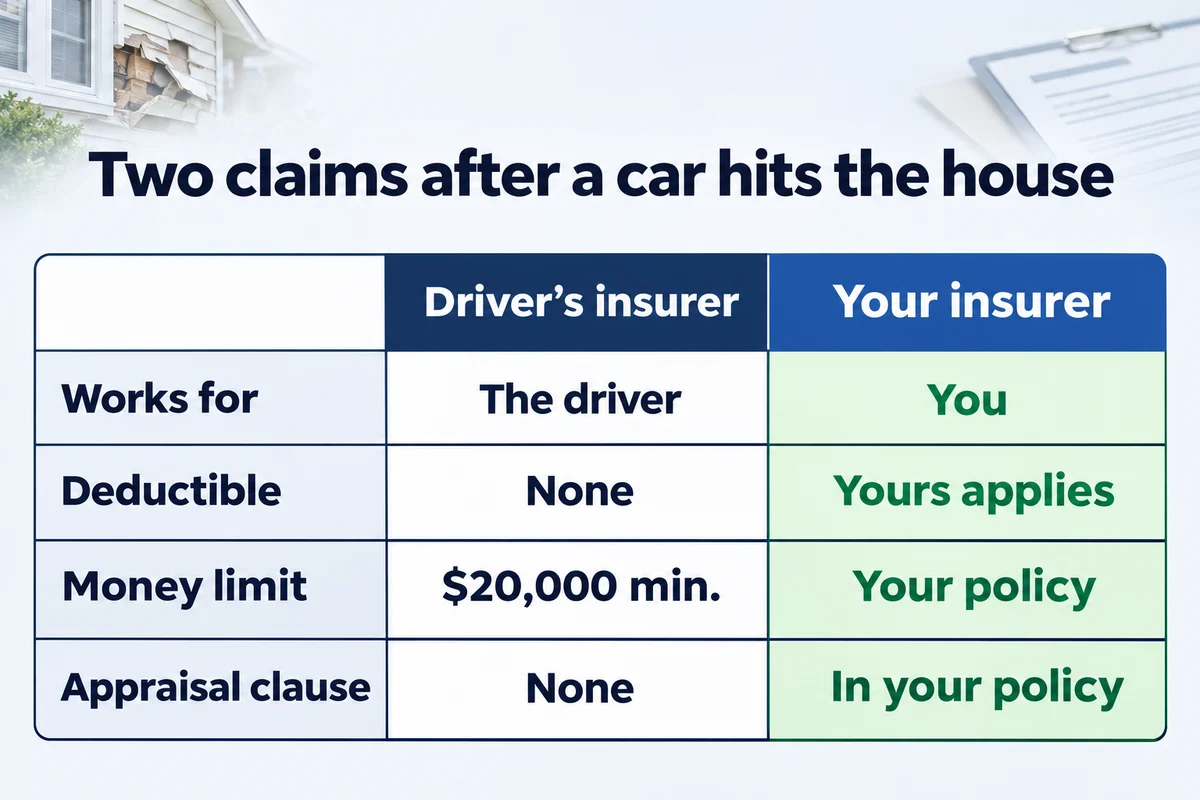
Often it can't, because the money comes from the driver's property damage liability limit, and in Illinois the minimum is $20,000 per accident. That one amount is shared by everything the car hit in the same crash. A driver who carries only the minimum may simply not have enough coverage for a brick front, a porch and a parked car together.
So before the offer is weighed, two numbers have to be on paper. The first is the full repair, priced by trade: shoring, masonry, the steel lintel, the window, framing, drywall, flooring, debris removal, and the gas meter or electric service if the car reached them. The second is the driver's limit, which you can ask the driver's company to state in writing. If the claims of everyone hit by the car add up to more than that limit, how it is divided is a legal question, and that is the point to talk to a lawyer.
Can you claim on your own policy before the driver's company pays?
Yes. A standard homeowners form does not ask you to collect from the driver first, so you can report the crash to your own insurer in writing right away. Your insurer can pay you and then recover from the driver's company. That right to recover is written into the policy as the subrogation condition:
"If not waived, we may require an assignment of rights of recovery for a loss to the extent that payment is made by us. If an assignment is sought, an insured must sign and deliver all related papers and cooperate with us."
Section I Conditions, Subrogation, ISO homeowners form HO 00 03 10 00. Your policy may use other forms or endorsements.The release touches your own claim too. Your insurer counts on recovering from the driver. If you have already signed a full release with the driver's company, some carriers treat that as a problem for the claim under your own policy. So tell your own insurer about the offer in writing before you sign anything, and ask it in writing whether the release affects your claim. If the answers are unclear, that is a question for a lawyer, not for me.
| Question | Claim against the driver's insurer | Claim on your own policy |
|---|---|---|
| Who the adjuster works for | The driver and the driver's company | Your insurer, under a contract you bought |
| Deductible | None, per the Illinois Department of Insurance | Your deductible applies; ask in writing whether the recovery from the driver will include it |
| How much is available | The driver's property damage limit, shared by everyone hit | Your dwelling, other structures, contents and loss of use limits |
| If you disagree on the amount | No appraisal requirement; your own policy or small claims court, the Department says | The appraisal clause in your policy |
| How it ends | A release and one check | Proof of loss and payments, often actual cash value first, the rest after the repair |
If your home has a mortgage, the check from your own insurer will usually name the lender as well. The steps to get that money released are in your insurance check names the mortgage company.
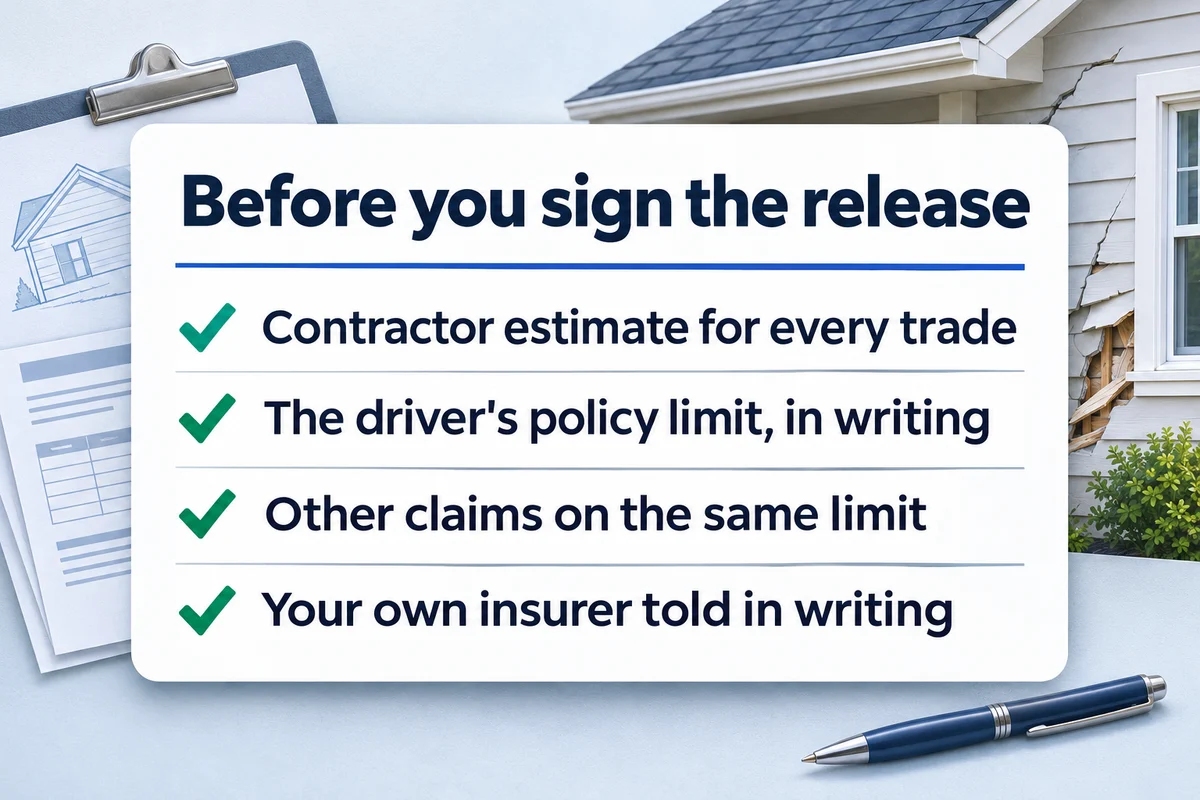
What to have in hand before you sign
- A written repair estimate from a contractor who has looked behind the damaged brick, not only at its face. If the wall still has to be opened, wait for that.
- The driver's property damage limit, stated by the driver's company in writing, and whether anyone else has a claim on the same crash.
- Photos of the house from the day of the crash and the police report number, so nobody later argues the crack was older.
- Your own insurer's written answer about the offer and the release.
- Receipts for the shoring, board-up and any hotel nights, so they are in the number and not forgotten.
The driver's insurer says no or goes quiet
Then your own policy is the main road. A denial from the driver's company usually comes down to fault, and that argument does not stop your claim under your own homeowners coverage.
Silence has a rule. Under the Illinois claims practice rules the Department quotes, when a property damage claim stays unresolved more than 60 days after you reported it, the company owes you a reasonable written explanation of the delay. Write down the day you reported, and ask for that letter when the 60 days pass. The same Department page lists the time it allows to sue over property damage from an accident; whether and when to sue is a decision to make with a lawyer.
When you can take the offer without me
Many car hits are small: a bent downspout, a cracked step, a section of fence. If a contractor's written price is in hand, the offer covers it, nothing behind the surface was touched, and the driver's limit is plainly enough, take the check. A public adjuster's fee makes no sense there. Where I help is the hit that reached the structure: the brick face, the porch beam, the window opening, the front room. That is where the first number is usually written before the wall is opened, and where your own policy and the driver's limit have to be lined up line by line. You can read about my work or send me photos of the wall and the offer letter, and I will tell you which of the two it is.