Almost every property estimate a carrier sends you in Illinois is an Xactimate report, and every one of them has the same three parts: a cover sheet, the priced line items grouped by area, and a summary that turns those lines into a cheque. Read it back to front. The summary tells you what was paid and why it was reduced; the lines above it tell you what was scoped, in what quantity, at which month’s prices. On most files I review, the problem is not a wrong price. It is a line that is not there at all.
An Xactimate estimate is the document most of my Chicago clients are handed along with a cheque and a sentence that says “this is our estimate of your damages”. Almost nobody reads past the last page. That is fair enough — it is eight to forty pages of abbreviations and columns — but the last page is a result, and every reason for that result sits in the lines above it.
I am a licensed public adjuster in Illinois (#19461872) and Indiana (#3556317), a HAAG certified inspector (#992104047) and a licensed Illinois roofing contractor (#105.009193). I write these estimates and I read the ones carriers write, several a week. What follows is how the document is built, so you can read your own. It is general information about Illinois and Indiana, the two states I am licensed in, and it is not legal advice.
What is an Xactimate estimate, and who writes it?
Xactimate is estimating software published by Verisk. Most US property carriers write their scopes in it, and so do most restoration contractors, so both sides of your claim are usually working in the same programme against the same regional price list. Your copy names, on the cover, the person who wrote it.
That shared toolset matters more than it sounds. When two Xactimate estimates of the same roof differ by thousands of dollars, it is rarely because one of them invented a price — the unit prices come from the same published list. It is because the two documents contain different lines, different quantities, or a different price list month. An argument that feels hopeless narrows down to three checkable things.
So start on the cover sheet. It carries your name and the property address, the claim number, the date of loss, the date of inspection, and the estimator with the company they work for. A staff adjuster employed by the carrier, an independent adjuster working the file on assignment, and your own contractor all produce documents that look identical. Verisk publishes the software; it does not decide what goes into your estimate. A person did that, and that person can be asked why.
How do I read a single line item?
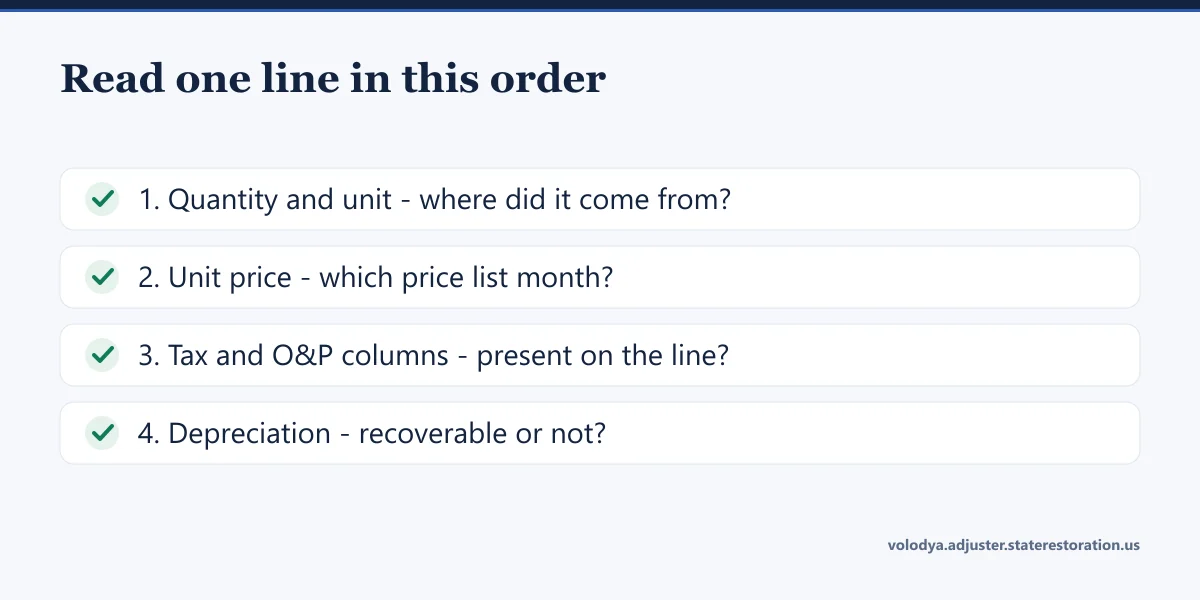
Every line has the same anatomy: a description, a quantity with a unit, a unit price, then columns for tax and for overhead and profit, and finally three money columns — replacement cost, depreciation, and actual cash value. Read them in that order and the line stops being a code. It becomes a decision somebody made.
| Column | What it holds | What to check |
|---|---|---|
| Description | The item, usually prefixed R&R (remove and replace) or D&R (detach and reset) | That the prefix matches the work. Detaching and resetting a gutter is not the same job as replacing it |
| Quantity | A number and a unit — SQ, SF, LF, EA, DA, HR | Where the number came from: the sketch, an aerial roof report, or a guess |
| Unit price | The published price for that item in that price list | Very little. This is the one number that is usually not in dispute |
| Tax | Material sales tax at the local rate | That it appears at all on material-heavy lines |
| O&P | Overhead and profit, where the estimate applies it | Whether it is on the line, only in the summary, or absent |
| RCV | Quantity multiplied by unit price, plus tax and O&P | The arithmetic, once, on two or three lines |
| Depreciation | What was held back for age and wear | Whether it is recoverable — the export normally flags the part that is not |
| ACV | Replacement cost minus depreciation | That those two columns agree with each other |
One habit is worth more than the rest: when a quantity looks wrong, do not argue about the price. Ask in writing where the quantity came from. On a roof it should trace back to the sketch or to an aerial measurement report, and that document can be produced. Depreciation is the other column people misread, because the figure alone does not tell you whether you can get it back later — how the holdback works, and what has to happen for the second cheque to be issued, is in the piece on why your first insurance check is smaller than the repair.
What do codes like RFG 240 and D&R mean?
Each line belongs to a trade category shown as three letters, followed by a selector that names the specific item. RFG is roofing, so an RFG 240 line is laminated composition shingles. The prefixes in front of the description tell you the action: R&R for remove and replace, D&R for detach and reset, a bare description for install only.
| Code | Trade | Usual units |
|---|---|---|
| RFG | Roofing | SQ (one square = 100 square feet of roof), LF, EA |
| SDG | Siding | SF, SQ |
| DRY | Drywall | SF, LF |
| PNT | Painting | SF, LF, EA |
| INS | Insulation | SF |
| FCC | Floor covering — carpet | SY, SF |
| DMO | Demolition and debris removal | EA, DA, HR |
| CLN | Cleaning | SF, HR |
The units are where quiet errors live. A roofing square is 100 square feet, so a 28 SQ roof is 2,800 square feet of roof surface — not the footprint of your house, which is smaller, and not the floor area on your tax bill. Carpet is priced by the square yard, which is nine square feet, so a room that reads 15 SY is 135 SF. If a quantity looks about a ninth or about a hundredth of what you expected, check the unit before you check anything else.
Why does the price list matter more than the price?
Xactimate prices come from a price list tied to a market area and a month, and the code for it is printed on your estimate — something naming the Chicago-area list and a month and year. Materials and labour move. An estimate written against a list from a year ago prices your repair at a year-ago cost.
This is the single most checkable thing in the document and the one homeowners never look at, because it sits in small type on the cover or in the footer rather than in a money column. It matters most on a claim that has dragged: the scope was written in March, the argument ran until October, the roof will be replaced in November, and the prices are still March’s. Asking for the estimate to be re-run on the current price list is an ordinary request, made in writing, and it costs nothing to make.
It also cuts the other way, and I would rather say so. If your loss happened in March and the work was done in April, a March list is the right list. The question is not “is this the newest list” but “does this list match when the work is actually being done”.
What does the summary page actually say?
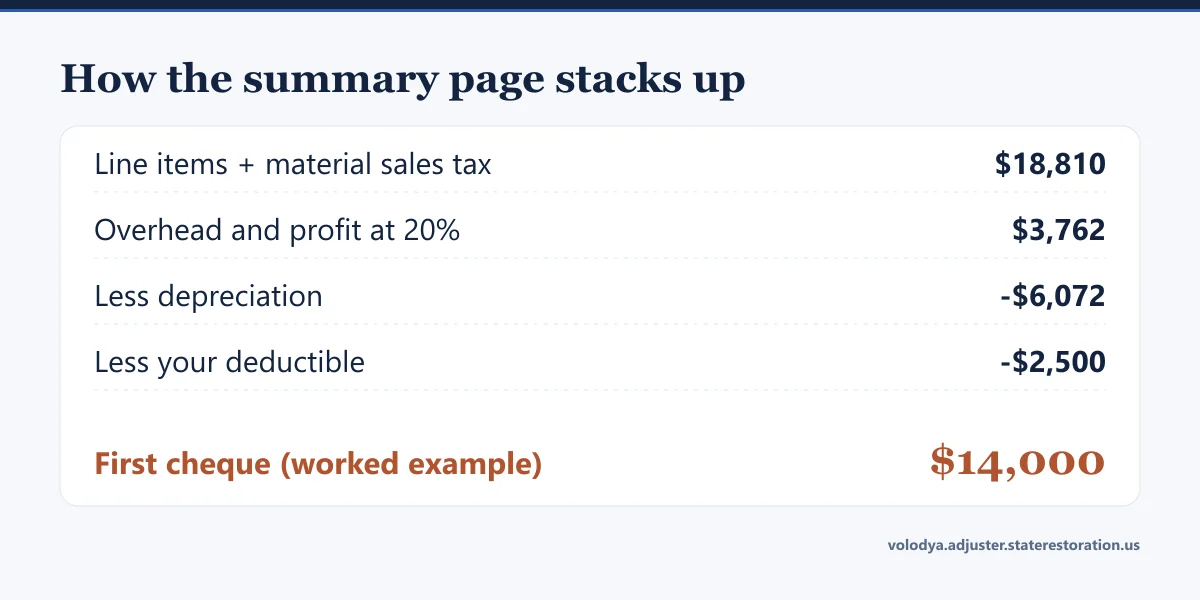
It stacks the whole estimate into one column of arithmetic: the total of all line items, material sales tax, overhead and profit, giving replacement cost value. Then it subtracts depreciation to reach actual cash value, subtracts your deductible, and prints the net claim — the figure on the cheque.
| Line on the summary | Worked example | What it is |
|---|---|---|
| Line item total | $18,400 | Everything that was scoped, before tax |
| Material sales tax | $410 | Local rate on the material portion |
| Subtotal | $18,810 | — |
| Overhead 10% and profit 10% | $3,762 | Applied here on this example, sometimes applied per line instead, sometimes not applied at all |
| Replacement cost value (RCV) | $22,572 | What the repair is estimated to cost to do |
| Less depreciation | -$6,072 | Held back for age and wear |
| Actual cash value (ACV) | $16,500 | The depreciated value |
| Less deductible | -$2,500 | Your share, taken once |
| Net claim | $14,000 | The first cheque |
| Total recoverable depreciation | $6,072 | Claimable later if the policy allows and the work is completed and documented |
| Net claim if depreciation is recovered | $20,072 | Replacement cost less the deductible |
Two things on that page are worth a second look. The first is whether an overhead and profit line exists at all — it is either applied per line, applied in the summary, or absent, and its absence changes the total by a fifth. When and whether it belongs on a given estimate is its own long argument, and it deserves its own article rather than a paragraph here. The second is the difference between the last two rows. The bottom line is not the cheque you received; it is what the file adds up to if the repair is completed and the depreciation is collected. People read the bottom number, believe they were paid it, and only find out in spring.
What is usually missing from a roof scope?
Accessories, almost always, because they are separate lines rather than part of the shingle price. Ridge cap, starter course, drip edge, ice and water barrier, valley metal, pipe flashings, and the charges for steep pitch and for working above one storey. None of them is exotic. Each is a line that either exists or does not.
A field shingle line does not include the ridge. It does not include the starter strip along the eaves and rakes. It does not include the metal at the edge, or the membrane in the valleys and at the eaves, or the boot around the plumbing vent, or the extra labour for a pitch a roofer cannot walk. Every one of those is its own item with its own quantity, and a scope written from a photograph rather than from the roof tends to be short of several. Detach-and-reset items go the same way: gutters, satellite dishes, solar attachments and any protrusion that has to come off and go back on.
The way to check is boring and effective. Take the estimate and the roof together, and for each item on the roof ask which line pays for it. Then look at the quantities: ridge cap in linear feet against the length of the ridges and hips, drip edge in linear feet against the eaves and rakes, ice and water barrier against the eave runs your building code calls for. What a proper inspection produces before any of this — the test squares, the marks, the slope-by-slope counts — is in the piece on inspecting hail damage on an asphalt roof.
How do I check the quantities are right?
Trace them to their source. Roof quantities come from the sketch or from an aerial measurement report, and both can be requested. Interior quantities come from room dimensions in the sketch, which you can check with a tape measure in ten minutes. A quantity nobody can source is a quantity nobody should be defending.
Three checks catch most of it. Compare the roof squares in the estimate against the total in the measurement report, remembering that waste is normally added on top as a percentage and should be visible as such. Measure two or three rooms yourself and compare the square footage. And read the room list against the house — a scope that never mentions the hallway ceiling the water ran along is not a pricing dispute, it is a missing room.
What if a line is wrong, or missing?
Put it in writing, item by item, with the reason and the evidence for each. Not “the estimate is too low” — that is unanswerable. Instead: this line has 18 SQ and the measurement report says 24.6 SQ; there is no ridge cap line and the ridge measures 62 LF; the price list is eight months old.
A written, itemised disagreement is how a supplement gets considered, and it is the format the estimator on the other end can actually act on, because they have to justify each change in their own file. Photographs, the measurement report, a contractor’s own Xactimate scope and any invoices all belong with it. Keep it to what you can show. One line you can prove moves further than ten you have asserted.
I cannot tell you what your claim is worth, and you should be careful with anyone who does before reading the policy and standing on the roof. What I can tell you is that the conversation is always about specific lines, and that a homeowner who has read their own estimate is in a completely different position from one who has read only the cheque.
What to do next
If you are holding an estimate and cannot tell whether the scope is complete, that is worth an hour. The free inspection and policy review is that hour: I read the estimate line by line with the property in front of me, tell you which lines are missing and which quantities do not trace back to anything — including when the answer is that the scope is fair and you do not need a public adjuster. The offerings page sets out the work I take on, and my licences and certifications are published in full so you can verify them before you call. My hours are Monday to Friday 9–6, Saturday 9–5 and Sunday 10–5, and I speak English, Ukrainian and Russian.
Nothing above is legal advice. Reading an estimate is claim handling and that is my job; what your policy obliges the carrier to do about a disputed line is a legal question, and if a claim reaches that point, an attorney is the right person to ask.