When a claim is paid on a house that still has a loan on it, the insurance check for the building usually carries two names: yours and your mortgage company's. You cannot deposit it on your own. You sign it, send it to the servicer's loss draft department, and the servicer pays the money back to you in parts while the repair goes on. How fast you see it depends on three things: which part of the claim the check pays for, whether your loan payments are current, and how quickly you give the servicer the papers it asks for. I'm a licensed public adjuster in Illinois and Indiana, and on most house claims I work, this is the last stretch before a contractor can start.
Why is the mortgage company on my insurance check?
Because your policy says so. The lender is named on the declarations page as the mortgagee, and the conditions section of a standard homeowners form tells the insurer to pay building losses to the lender and to you together. The house is the lender's security for the loan, so it gets a say in whether the money goes back into the house.
"If a mortgagee is named in this policy, any loss payable under Coverage A or B will be paid to the mortgagee and you, as interests appear."
Mortgage Clause, Section I Conditions, ISO homeowners form HO 00 03 05 11. Many carriers use their own form; look for the clause with the same name in yours.Read the sentence slowly. It names two coverages, not four. That one detail decides which checks should go through the bank and which should not.
Which parts of the payment should carry the bank's name
Only the money for the structures. The clause covers Coverage A (the house) and Coverage B (other structures). Your belongings and your extra living costs are left out of it, so ask the insurer to pay those parts to you alone.
Roof, walls, floors, wiring, plumbing, the attached garage.
Payee: you and the lender
Detached garage, fence, shed on the same lot.
Payee: you and the lender
Furniture, clothes, electronics, food in the freezer.
Ask for a check to you only
Hotel, rent, the extra cost of meals while you are out.
Ask for a check to you only
Some carriers still print one check for the whole payment. When that happens the contents money gets stuck at the bank with the rest, and a family living in a hotel waits for money that was meant for the hotel. Ask the desk adjuster for a payment letter that splits the amount by coverage before the check is cut. If the combined check has already gone out, the servicer can still separate it: the Fannie Mae servicing guide tells servicers to "immediately issue the borrower a check" for the part designated for contents or living expenses. What counts as a living expense is its own subject, and I wrote about it in what additional living expenses cover while the house is unlivable.
How much will the servicer release up front?
It depends on who owns your loan and whether you are behind on payments. Your servicer follows the rules of the investor that owns the loan. Fannie Mae publishes its rules, so they are the clearest example; Freddie Mac, FHA and VA loans have their own. Ask the loss draft department which set applies to you.
| Rule | Loan current or less than 31 days late | Loan 31 days or more late |
|---|---|---|
| First release | Up to the greater of $40,000, 33% of the insurance money, or the amount above what you still owe on the loan | $5,000 or less: paid in one payment. Above that: 25%, but no more than the greater of $10,000 or the amount above what you owe |
| The rest | Paid as periodic inspections show the repair moving | Steps of no more than 25% of the insurance money, each after an inspection |
| Receipts | Not needed when the insurance money is $40,000 or less | The servicer reviews and approves the repair plan and bids |
| Final inspection | Not required by the guide | Required |
| Money waiting | Kept in an interest-bearing account for your benefit; the interest is paid to you when the repairs are done | |
The full text is on the Fannie Mae servicing guide page for insured loss events. For a late loan the guide also tells the servicer to look at you for a workout option before it releases money, so a late payment can slow the claim down even when the claim itself is settled.
A worked example: one fire claim through the draw sheet
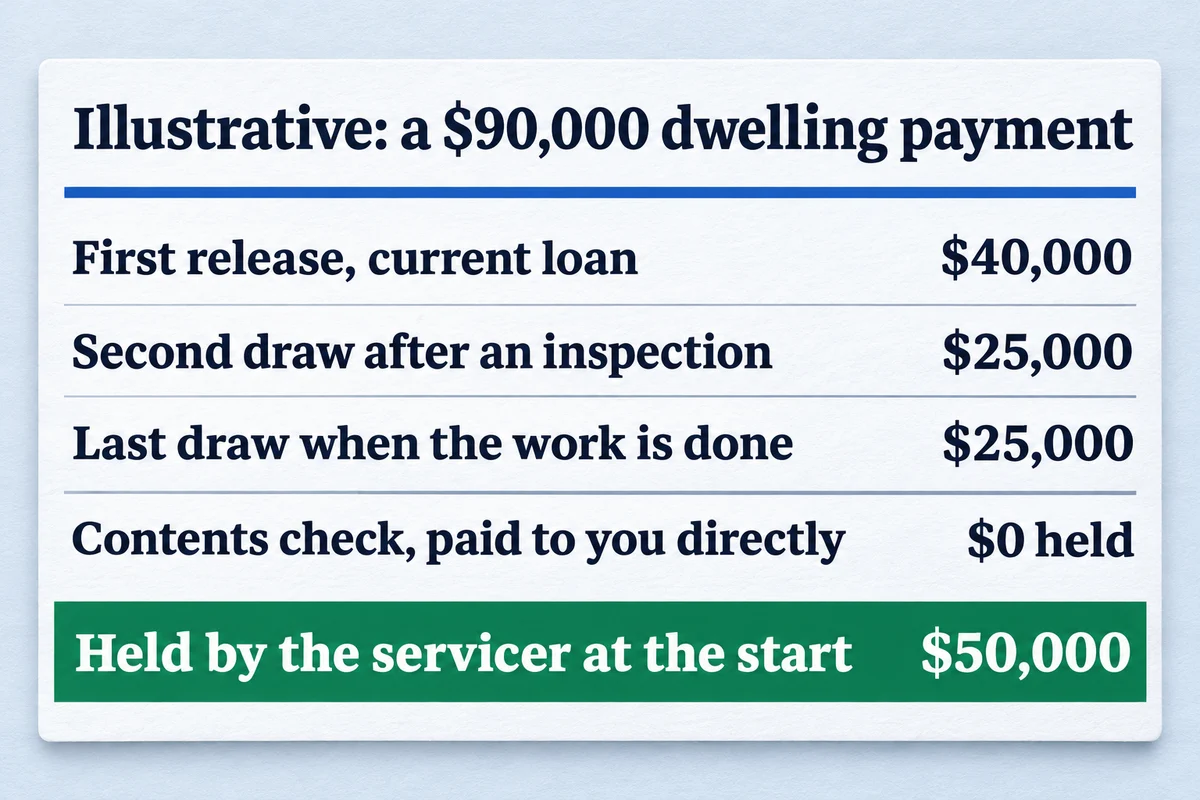
Here is an illustrative fire claim, not a real client. The dwelling payment is $90,000 on a loan that is current and owned by Fannie Mae. The contents payment of $18,000 and the hotel bills were issued to the owner alone, so they never touch the bank.
The check carries both names. The owner calls the loss draft line before signing, signs it the way the servicer says, and mails it with the insurer's estimate and payment letter.
A third of $90,000 is $29,700, so the $40,000 figure is the larger one and sets the first release. That pays the contractor's deposit and the demolition.
Once framing and the roof are done, the servicer's inspector visits. The size of this draw is illustrative: the guide does not fix it for a current loan.
With the work finished, the rest comes out with the interest it earned while it sat in the account.
Two more checks often follow on the same claim, and both usually carry the lender too. The first is the depreciation the insurer held back until the repair is done, which I explained in why the first check is smaller than the repair. The second is a supplement for damage found once walls are opened, covered in adding hidden damage to an open claim. Tell the servicer they are coming, so it keeps the file open.
What the loss draft department will ask you for
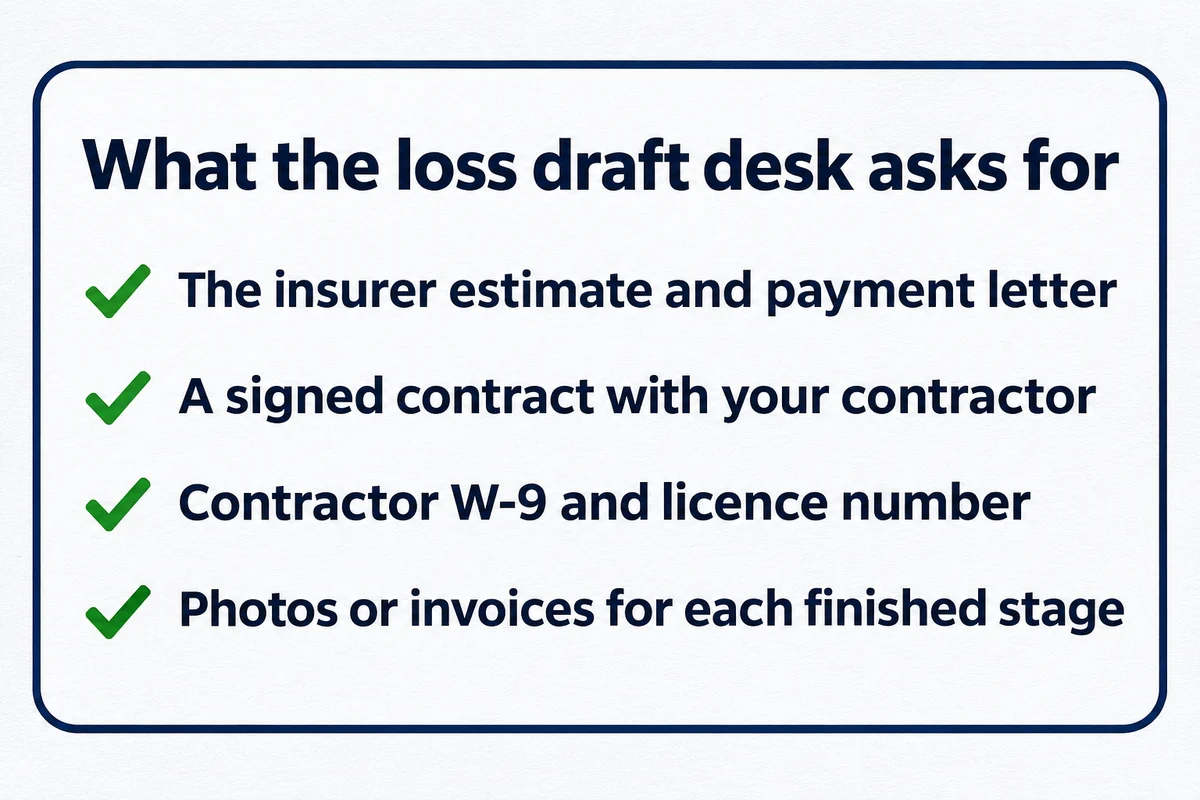
Paper that shows the money will go into the house. Each servicer has its own package, often a form called a loss draft or claim check packet, but the list is close to this:
- Your loan number and the claim number on every page you send.
- The insurer's estimate and the payment letter that matches the check.
- The check itself, signed only after the servicer tells you how and where to sign. Instructions differ between servicers, and a check signed the wrong way can come back.
- A signed contract with your contractor, with a price that lines up with the insurer's scope.
- The contractor's W-9 and licence number. Illinois licenses roofing contractors, and the City of Chicago licenses general contractors.
- For each draw, photos or invoices for the finished stage, and often a lien waiver from the contractor for the money already paid.
Send everything in one package and keep proof of delivery. Most delays I see are a missing page that nobody asked for until the second phone call.
What can I do when the servicer sits on the money?
Put the question in writing and make the servicer answer it in writing. I know of no Illinois statute that gives a servicer a fixed number of days the way Texas law does, so the rules you can point to are your mortgage, the investor's guide and the servicer's own letters.
- Send a short written request, like the one below, to the loss draft department and keep a copy.
- If an inspection is the hold-up, ask for the inspection date and for the result in writing.
- If weeks pass with no answer, file a complaint with the Consumer Financial Protection Bureau, which sends complaints about mortgage servicers to the company for a reply. The Illinois Department of Financial and Professional Regulation also takes complaints about the mortgage companies it licenses.
- If the dispute is about what your mortgage or the law requires, that is a question for a lawyer, not for an adjuster.
Loan number: ________ | Insurance claim number: ________ | Property: ________
I have received an insurance payment for damage to the property above. Please tell me in writing:
- every document you need to release the first payment;
- where and how to send them, and how I should sign the check;
- how the remaining money will be released, and what inspection you need before each payment;
- whether the account holding the money earns interest for me.
Please reply by email to ________. Thank you.
Keep paying the mortgage while all of this runs. The insurance money is for the repair, and the monthly payment is still due.
Where a public adjuster fits in this last stage
My part is the claim with the insurer: the scope, the estimate and the payment letter. Those are the papers the lender reads. On a fire claim or a large water loss I ask the carrier to issue the dwelling, contents and living expense payments separately, so only the building money goes through the bank, and I make sure the estimate the servicer sees is the one that was agreed. I'm also a licensed general contractor and roofing contractor in Illinois, so I know what a draw inspector looks at on a half-finished job. You can read more about my licences and background, or send me your claim and loan details so we can look at where the money is held up.