A siding damage assessment after a storm comes down to two decisions by the insurer's adjuster: whether this storm made the marks on this wall, and whether those marks count as damage under your policy. Only then does anyone price the wall. You can test the first decision yourself with a walk round the house, and the second is printed in the forms list of your policy.
I'm a licensed public adjuster for policyholders in Illinois (#19461872) and Indiana (#3556317) and a HAAG certified inspector (#992104047). Policies are worded differently, so hold yours next to this article. I am not a lawyer, and what a clause legally means is a question for an attorney.
Did this storm reach this wall? Start with a compass
Wind-driven hail hits the walls facing the storm hardest, so the pattern round the house tells you a lot before anyone climbs a ladder. Envista Forensics describes it this way: in a storm moving from west to east, the west-facing walls usually take the worst of it, and that direction helps separate this storm from an earlier one. Draw your own house the same way.
Your house, seen from above. Storm moving west to east.
West wall
It faced the storm, so expect the most marks here, on the panels and on the downspout beside them.
North wall
Side-on to the storm. Look for fewer marks, more of them towards the west corner.
East wall
Sheltered by the house. Marks here need another explanation, and the adjuster is likely to ask for one.
South wall
Also side-on. Compare it with the north wall, because a storm rarely comes from due west.
An illustrative house and storm. Put in the direction your own storm came from.
Metal beside each wall is your second witness. Hail leaves round dents in gutters, downspouts and window wraps, and dents on the same side as the siding marks support them. It can also knock the grime off a surface and leave a clean spot called spatter. Spatter is no damage in itself and it fades, but while it lasts it shows the direction and rough size of recent hail, so photograph it early.
Expect exceptions. Kenton Shepard and Nick Gromicko of InterNACHI, writing about roof slopes, point out that damage on opposite faces can mean two different storms, and that hail with little wind falls nearly straight down. Carry that over to a house and calm-air hail may damage the roof while leaving the walls almost clean, which is one reason a good roof claim does not always bring siding with it. If you want the wider picture, I separated the two perils in wind vs hail and the cause of loss.
Next, check the date against a record. NOAA's Storm Events Database lists reported events by county. A blank entry settles nothing: the National Weather Service office in Cheyenne notes that small hail is rarely recorded and that thin population and few roads leave some areas under-reported. Use the record alongside your walls, and don't treat it as the verdict.
Is the mark new, or was it already there?
Colour usually gives away the age. A fresh strike removes oxidation and dirt, and over time the spot weathers back towards the colour around it, at a rate that depends on the material. Old marks on the same wall don't cancel new ones, though they do need separating in your photographs. Before you count anything, rule out these look-alikes:
| What you see | What else makes it | What I check |
|---|---|---|
| Nicks in a band along the bottom courses | A mower or trimmer throwing stones | Whether the marks carry on up the wall, past where a thrown stone would reach |
| Dents in one patch at hand height | A ball, a ladder, a bike handlebar | The spread. Hail scatters across a whole face and marks the metal beside it |
| Vinyl rippled or sagging, nothing broken | Sunlight focused by a neighbour's window | Which windows face that spot, and whether the ripple sits apart from any impact |
| A grey crack along a nail line | Age and movement of the board | The colour inside the break, and the same crack on walls the storm never faced |
| Paint coming away in sheets | A finish that has already failed | Whether bare spots are round and sit on a dent |
The rippled vinyl is worth a closer word. A paper by David Crump of the National Association of Home Builders explains that double-paned low-e glass can flex slightly and focus reflected sun like a magnifying glass, and it cites the Vinyl Siding Institute's figure of 160-165 degrees Fahrenheit as the point where normal vinyl starts to soften. A claim built on that wall would be arguing about the wrong event.
What does a cosmetic damage exclusion do to a siding claim?
It removes payment for marks that change how the siding looks without stopping it from keeping weather out. Not every policy carries one, so look through the forms list on your declarations for an endorsement with "cosmetic" in its title. If it is there, the assessment becomes a sorting exercise, mark by mark.
For a real example, read the exclusion endorsements filed with Wisconsin's insurance regulator in November 2023, part of a merger between two mutual carriers. It's one company's Wisconsin wording, and your Illinois or Indiana form may read differently. Its list of covered surfaces names siding along with soffits, fascia, gutters and downspouts. Its list of cosmetic damage names marring, pitting, chipping and denting. The test comes at the end: the mark is cosmetic if it does not cause a "failure to perform its intended function of keeping out the elements", judged over an extended period.
How I would expect an insurer to read dents
- Round dents in aluminum panels with the coating intact
- Dents in a gutter or downspout that still carries water
- Shallow chips on a fiber cement face
What I would argue stays in the claim
- A hole or crack through a vinyl panel
- A board fractured through, or broken at a nail
- A panel torn from its lock, with wrap exposed behind it
- Chipped coating on metal, where the exposed spot can be shown to let the weather at the panel
That sorting is my reading of the words, not a ruling. Where the two sides read a clause differently, the meaning of the sentence belongs with an attorney, and the facts on the wall are what I can document.
What one wall pays on three different declarations pages
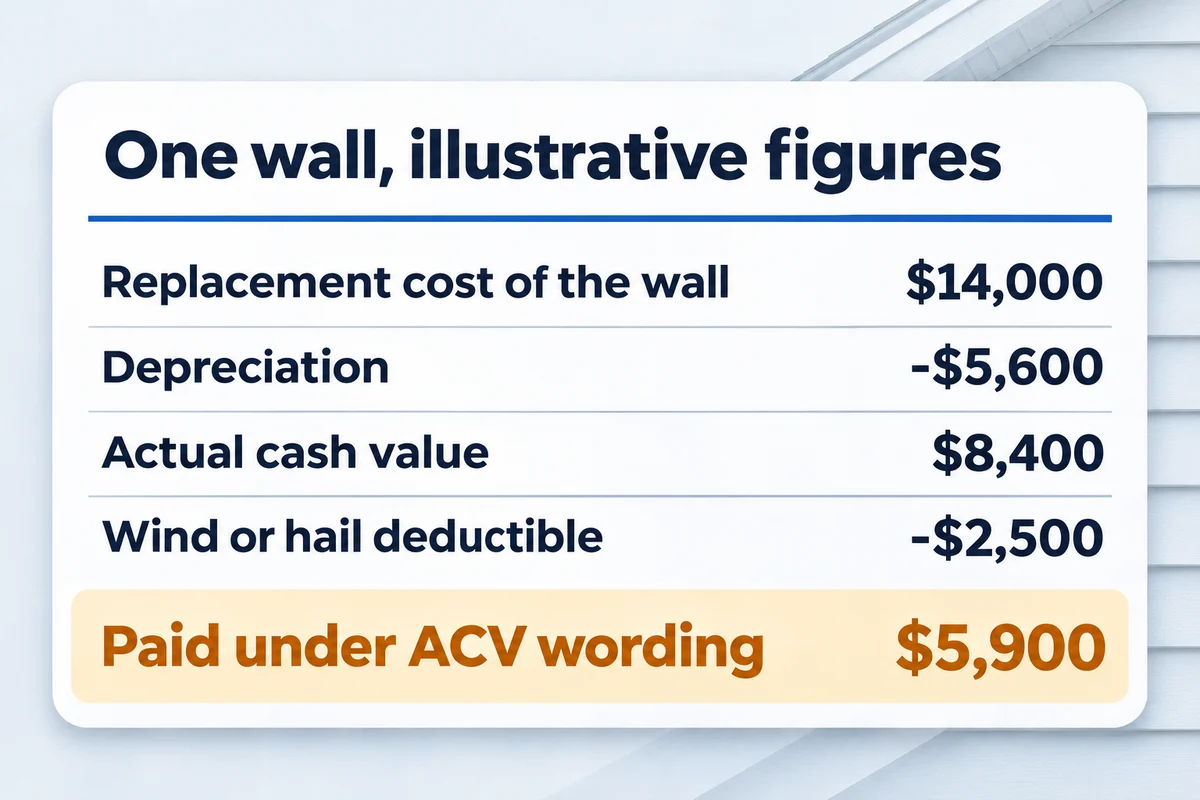
The same Wisconsin filing also carries a $2,500 wind and hail deductible and an endorsement moving exterior surfacing, siding included, to actual cash value. So the money can change a lot before anyone argues about a mark. All figures below are an illustrative worked example: a wall costing $14,000 to replace, depreciated by $5,600.
Replacement cost, $1,000 deductible
$7,400That's the first check. Another $5,600 is held back until the repair is done, so $13,000 in all.
Actual cash value on siding, $2,500 wind or hail deductible
$5,900That's the whole payment, with nothing held back to collect later.
Cosmetic exclusion, and the wall has dents only
$0Nothing for the dents on that reading. Add a few cracked panels and those go back in the claim, under whichever terms above apply.
Illustrative figures only, and they are invented. The first check on a replacement cost policy is explained in why your first check is smaller than the repair.
Why wind damage is harder to see from the ground
Hail marks the face of a panel, while wind usually works at the fastening. Pro Remodeler, citing FEMA, reports that vinyl which has come unlatched has often failed at the nailing hem, and that this leaves it easier to tear off in the next blow. That hem sits under the course above, so a photograph from the lawn can show a straight wall while the panel behind it has lost its grip. The same article describes fascia torn off first, with the wind then prying the soffit loose. When a note says "reattach", ask whether anybody lifted the panels and looked at the hems.
What should I do before the adjuster comes?
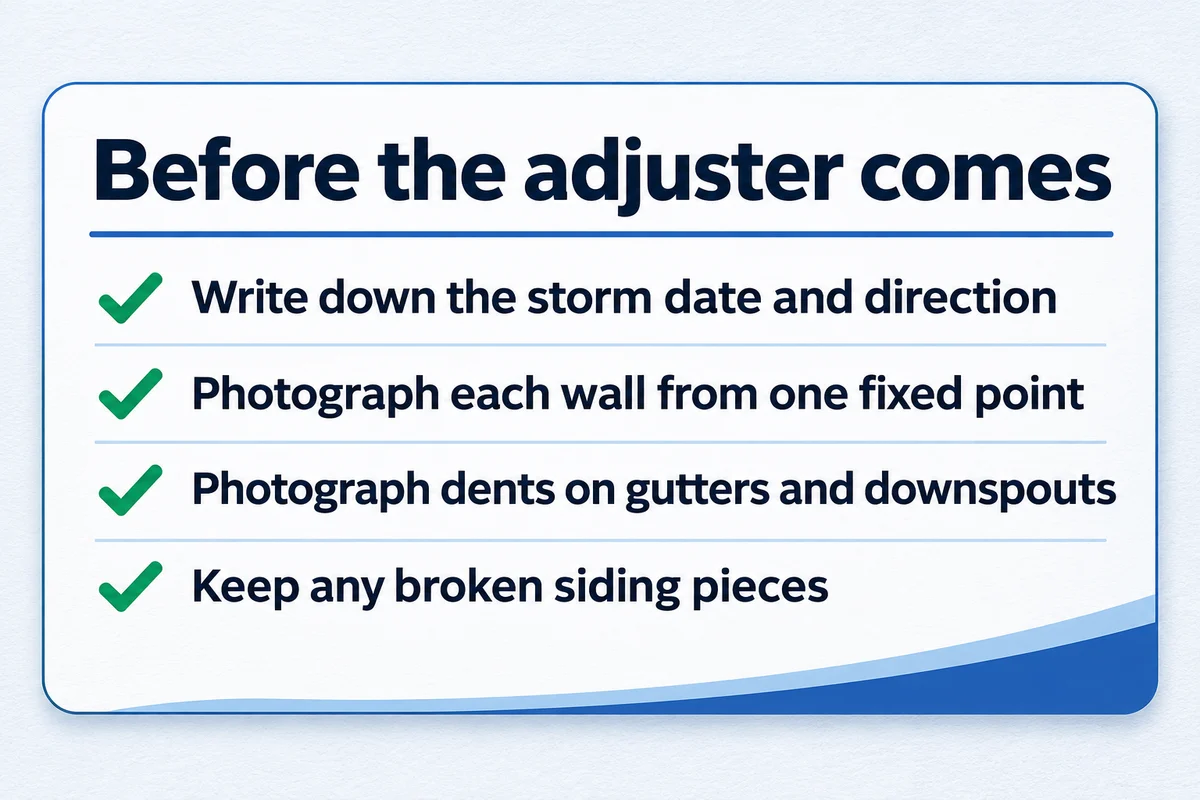
Make a record of all four walls while the marks are fresh, and tell the insurer about everything the storm touched. In this order:
- Write down the date, the time and where the storm came from. Name the siding, gutters and windows in your notice of loss, along with the roof.
- Stand at one fixed point for each wall and photograph the whole face, including walls with no marks. A clean east wall is evidence of direction.
- Take close-ups in low side light, with a ruler or coin in the frame, and note which wall each one belongs to.
- Photograph the gutters, downspouts and window wraps on the same side.
- Bag any broken pieces and label them by wall.
- Cover an open hole with something temporary and keep the receipt. Leave permanent repairs until the adjuster has seen the wall.
- Check your policy's time limits, which I set out in the Illinois deadline clocks.
Which questions should I put to the adjuster's note?
Ask them in writing, once you have the report and photographs. These five usually show how the assessment was reached:
- Which walls were inspected, and how?
- From the ground, from a ladder, or from the roof edge. A wall left off the scope should have a reason beside it.
- How many marks were counted on each wall?
- Ask for the photographs by wall, and for what was noted on the metal alongside.
- What makes you say a mark is older than this storm?
- You are asking for the observation behind the opinion, such as weathering inside a break.
- Which sentence of the policy leaves this out?
- Illinois Part 919 expects a reasonable written explanation when a first-party claim is denied, and I covered the rest of that letter in what to do when a claim is denied early.
- What was priced besides the panels?
- Trim, wrap and any sheathing are listed on my siding damage claims page. Undamaged walls raise a separate question, covered in matching in Illinois.
When is it worth calling a public adjuster about siding?
Call when a marked wall has been left out of the scope, when a broken panel has been written off as cosmetic, or when the note says "reattach" and nobody checked the hems. You can leave me out if the scope covers the walls you found and the price is one a contractor will accept, or if the whole repair sits close to your deductible.
A dispute over what the exclusion legally means, or any suggestion that you misrepresented the damage, belongs with an attorney. For the facts on the wall, send your photographs, the note and your forms list through the contact page for a free first conversation. Nobody honest can tell you in advance what an insurer will pay.