Your first check is the actual cash value of the damage: what it costs to replace, minus depreciation for age and wear, minus your deductible. If you hold a replacement cost policy, that depreciation is usually recoverable — you collect it in a second check once the repairs are actually done and documented. If your policy settles at actual cash value only, there is no second check. Which of those you have is printed on your declarations page, and it decides the whole arithmetic.
The call I get most often in the week after a storm goes roughly like this: the roofer quoted eighteen thousand, the insurance company sent nine, and the homeowner assumes something has gone badly wrong. Usually nothing has. The first check on a replacement cost policy is not supposed to match the repair. It is supposed to be the actual cash value, and the rest of the money is meant to arrive later — if the claim is handled properly and the paperwork is done.
That does not mean the number you were sent is right. It means it is a different number, calculated a different way, and you cannot tell whether it is correct until you can separate the parts that are normal from the parts that are an argument. This page is about how to tell them apart.
I am a licensed public adjuster in Illinois (#19461872) and Indiana (#3556317), and everything below describes how these claims are handled in those two states. It is process, not legal advice, and no honest adjuster will promise you an outcome.
Why is my first insurance check so much smaller than the repair estimate?
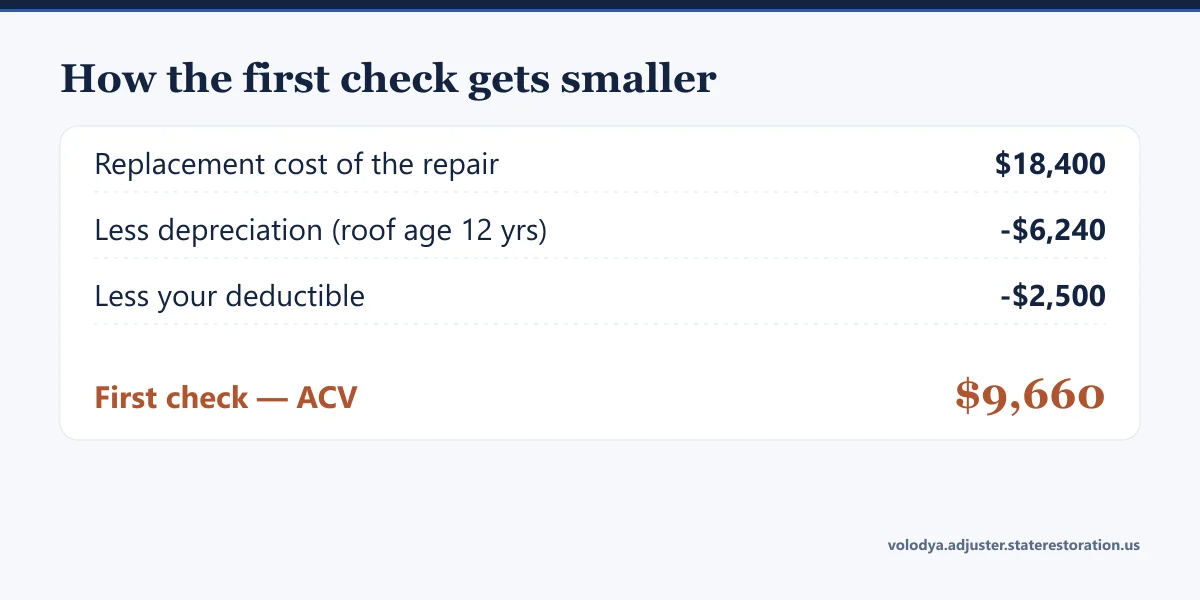
Because three subtractions happen before it is written. The carrier prices the repair at replacement cost, takes off depreciation for the age and wear of what was damaged, then takes off your deductible. What is left is the actual cash value. On an older roof, that can be a little over half of the estimate you were shown.
Here is the sequence with numbers attached. This is an illustrative worked example — the figures are made up to show the shape of the calculation. It is not a typical result, not a promise, and not your claim. Your policy, your damage and your carrier decide your numbers.
| Step | Illustrative amount |
|---|---|
| Replacement cost value (RCV) of the repair | $18,400 |
| Less depreciation on the depreciable items | -$6,240 |
| Actual cash value (ACV) | $12,160 |
| Less the wind and hail deductible | -$2,500 |
| First check | $9,660 |
| Recoverable depreciation, released after the work is done | $6,240 |
| Total paid if the repair is completed and documented | $15,900 |
Notice what the last two rows do. The homeowner who looks only at the first check believes the carrier valued an $18,400 repair at $9,660. The homeowner who finishes the work and files the paperwork ends up with $15,900 — the full replacement cost less the deductible they agreed to carry. Same policy, same damage, same carrier. The difference is entirely in what happened after the first check landed.
What does “actual cash value” actually mean?
In most Illinois homeowner policies, actual cash value means replacement cost minus depreciation — the value of what you had at the moment it was damaged, rather than the cost of a new one. But the definition that governs your claim is the one printed in your policy, and not every policy words it the same way.
Some policies define actual cash value explicitly. Some define it as fair market value, which is a different calculation with a different answer. Some do not define it at all. Where the wording is genuinely ambiguous, or where you and the carrier disagree about what the words mean rather than about the condition of your roof, you have crossed out of adjusting and into a legal question — and that is a conversation for a lawyer, not for me. I will tell you when I think you have reached that line.
The second thing worth understanding is that depreciation is an opinion, not a measurement. It is somebody's estimate of how much life a material had left, written as a percentage. A twelve-year-old roof that was maintained and a twelve-year-old roof that was already curling and losing granules are not in the same condition, but the software will happily assign both the same age-based figure unless someone documents the difference. That is why photographs taken at the inspection matter later, in a conversation that has nothing to do with photographs.
How is depreciation actually calculated?
Line by line, not as one percentage of the total. The estimator assigns each depreciable item an expected life, works out how much of that life has been used, and takes that share off. Labour, tear-off, disposal and permit fees are often left alone — though not always, and that exception matters more than it sounds.
Continuing the same illustrative example, this is where the $6,240 came from. It is not 48% of the whole estimate; it is 48% of the part of the estimate that was actually depreciated.
| Portion of the estimate | Illustrative amount | Treated how |
|---|---|---|
| Shingles, ridge caps, underlayment, flashing, accessories | $13,000 | Depreciated: 12 of a 25-year expected life, so 48% |
| Tear-off, disposal, permit | $5,400 | Not depreciated in this example |
| Depreciation applied | -$6,240 | 48% of $13,000 |
Three things in that table are worth checking on your own estimate. First, the expected life: a 25-year figure on a shingle that was sold with a longer service life is a number you can question with the product documentation. Second, what got depreciated: a permit fee has no useful life to consume, and neither does the dumpster. Third, and most contested, labour. Whether labour can be depreciated at all is decided by policy wording and by law rather than by an estimator's habit, and the answer has moved in different directions in different states. If your estimate depreciates labour and the amount is material, that is a question worth putting to a lawyer — I can show you where it appears in the estimate, and that is where my job stops.
What is recoverable depreciation, and how do I get the second check?
Recoverable depreciation is the amount held back from the first payment that a replacement cost policy pays out once the repairs are finished. You collect it by completing the work, sending proof of what was actually done and what it actually cost, and asking for the release in writing. It is not automatic and it is not usually offered.
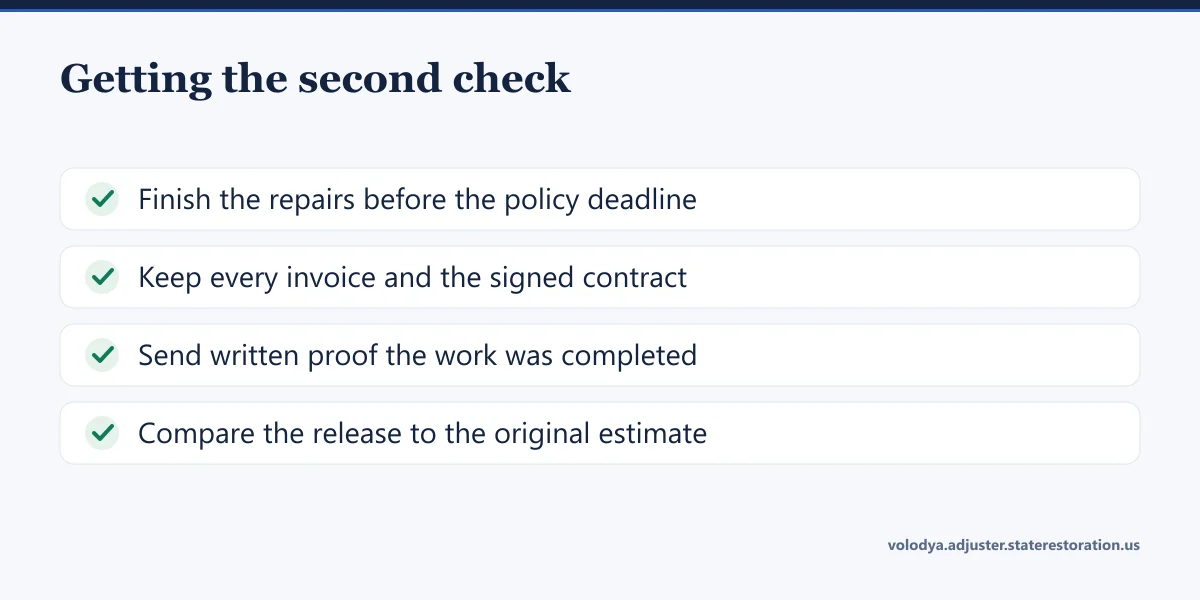
Four practical points decide whether that second check arrives.
- There is a deadline, and it is in your policy. Loss settlement conditions commonly give you a set period from the date of loss to complete repairs and claim the recoverable depreciation — often measured in months rather than years. Read yours and put the date somewhere you will see it. Where more time is genuinely needed, ask for an extension in writing before the date passes, not after.
- You are paid against paperwork, not against progress. The final invoice, the signed contract and photographs of the completed work are what release the money. A contractor who will not give you a detailed final invoice is a problem you want to discover in week one, not week twenty.
- If the repair cost more than the estimate, say so then. Hidden decking damage found once the roof is open, or a code requirement the inspector raises on site, is a supplement — a normal part of a claim rather than bad news. I wrote about where supplements come from in the step-by-step walk through a Chicago claim.
- Check the release against the original estimate. The depreciation that was withheld line by line should come back line by line. It is worth ten minutes with both documents side by side.
One more thing people are caught out by: if you have a mortgage, the check is frequently made payable to you and your lender together, and the lender may hold the funds and release them in stages as the work is inspected. That is a servicing process, not a claim problem, but it adds weeks. Call your lender's loss draft department the day the first check arrives rather than the day you need to pay a roofer.
Does my policy pay replacement cost or actual cash value?
Look at the declarations page, at the dwelling coverage, and then read the endorsements listed behind it. The words you are looking for are “replacement cost” or “actual cash value”. An endorsement can change the answer for one part of the building — most often the roof — without changing it for anything else.
This is the part of the policy that has quietly changed on a lot of Illinois homeowners at renewal, and almost nobody reads renewal paperwork. Five things are worth finding before you need them.
| What to look for | Where it usually sits | Why it changes your check |
|---|---|---|
| Dwelling loss settlement basis | Declarations page | Decides whether depreciation is recoverable at all |
| Roof surfacing endorsement | Endorsement list | Can put the roof alone on actual cash value, or on an age schedule that pays less as it ages |
| Wind and hail deductible | Declarations page | Often a percentage of the dwelling limit rather than a flat sum, which makes it far larger than the deductible people remember |
| Cosmetic damage exclusion | Endorsement list | Dents that do not affect function may not be payable |
| Time limit to complete repairs | Loss settlement conditions | Miss it and the recoverable depreciation can be lost |
If you want a straightforward exercise this week and there is no storm on the horizon: find those five lines in your own policy and write the answers on the front page. It takes about twenty minutes and it is the single most useful thing a homeowner can do before a claim rather than during one.
When is the first check actually wrong?
When the disagreement is about scope rather than valuation. Depreciation being applied is normal. Depreciation applied to items that had no life to consume, an expected life set shorter than the product carried, or a scope that is simply missing whole lines of the repair are not normal — and those three are what I check first.
The distinction is worth holding on to, because it tells you what kind of conversation you are about to have:
- A scope disagreement — the estimate does not include something the repair genuinely requires. This is settled with measurements, photographs and code references, item by item, and it is the most common reason a first estimate is not the last one.
- A valuation disagreement — the scope is right but the depreciation or the unit pricing is not. This is argued with evidence of the actual condition and with current local repair costs, which is a different exercise from arguing about what is on the list.
- A coverage disagreement — the carrier says the policy does not cover this at all. That may still be a factual question about cause of loss, or it may be a question about what the policy words mean, in which case a lawyer is the right person to ask.
When is the first check simply right?
Often, and I would rather say so on the phone than after you have signed anything. If your roof is old, your policy places the roof surface on actual cash value, and the estimate covers the real scope of the work, then a payment well below the contractor's quote is not an error. It is exactly what that policy promised to do, and the gap is the part you agreed to carry when the premium was set.
The same goes for damage that sits close to your deductible. If the actual cash value of the repair is barely above the deductible, there may be very little claim to pursue and filing at all may be the wrong move. That is a real answer, it is free, and you should get it before anybody signs you up for anything.
What to do next
If a check has already arrived and it does not look like enough, do three things before you cash it or argue with anyone. Find out whether your policy settles at replacement cost or actual cash value. Ask the carrier for the full line-item estimate the payment was based on, in writing, rather than the summary letter. And find the deadline for completing repairs, because that clock is already running.
Then get a second read on it. That is what the free inspection and policy review is for — I read the estimate and the policy and tell you where you stand, including when the honest answer is that the payment is correct and you do not need me. The offerings page sets out the kinds of work I take on, including renegotiating a claim that has already been underpaid or denied, and my licences and certifications are published in full so you can check them before you call. My hours are Monday to Friday 9–6, Saturday 9–5 and Sunday 10–5, and I speak English, Ukrainian and Russian.
Nothing on this page is legal advice, and no adjuster can tell you what your claim is worth before reading the policy and seeing the damage. What representation changes is whether anyone is checking the arithmetic on your side of it.