A chimney fire is a fire, and a standard Illinois homeowners policy covers fire, so in most cases the damage to the chimney and to the house around it is part of a covered claim. Where these claims go wrong is the cause. The insurer looks at creosote and old mortar and calls the cracked flue wear and tear. What settles that argument is evidence collected before anyone sweeps the flue clean, so the order of the first few days matters more than people expect. I'm a licensed public adjuster in Illinois and Indiana, and I'm also an Illinois roofing contractor, so on these claims I read both the chimney and the roof around it.
Does homeowners insurance pay for a chimney fire?
Usually yes, because fire is not excluded on the house. The common ISO homeowners form insures the dwelling against direct physical loss unless the loss is excluded, and fire is not on the exclusion list. The Chimney Safety Institute of America says the same thing from the sweep's side: most chimney fire damage is a covered loss. The trouble sits in a different part of the same form.
What the form gives
"We insure against direct physical loss to property described in Coverages A and B" unless the loss is excluded.
Coverage A is the house, and the chimney is part of it. A flue liner cracked by a fire inside it is a direct physical loss.
What the form takes away
"Wear and tear, marring, deterioration" and "Mechanical breakdown, latent defect, inherent vice".
This is the list the insurer reaches for when it says the liner was already cracked or the mortar was already gone.
Both quotes are from ISO form HO 00 03 05 11, the one many carriers copy or adapt. Your carrier may use its own wording, so read the same two places in your policy: the coverage grant for the dwelling and the list of exclusions under it. The same form also has a sentence that helps you: after the wear and tear list it says "any ensuing loss to property described in Coverages A and B not precluded by any other provision in this policy is covered." In plain words, if an old crack let a fire reach the framing, the old crack is excluded but the fire damage it led to is not.
How do you prove the chimney had a fire?
With the marks a fire leaves inside and outside the chimney, photographed before cleaning. Many chimney fires are never seen. CSIA lists nine signs a sweep looks for, and each one is also a piece of claim evidence:
| Sign | Where it is seen | What it tells the adjuster |
|---|---|---|
| Puffy or honeycombed creosote | Inside the flue and smoke chamber | Creosote that has burned and swelled. It is the clearest sign, and a sweep's brush removes it. |
| Warped damper, connector pipe or metal chimney | Firebox, stove pipe, factory-built flue | Metal bends from heat, not from age. Age shows as rust. |
| Cracked or collapsed flue tiles, or big pieces missing | Video of the flue | Fresh breaks have clean edges. Old cracks are dirty and often filled with soot. |
| Discolored or distorted rain cap | Top of the chimney | Heat came out of the top of the flue. |
| Heat-damaged TV antenna on the chimney | Roof | Same as the cap, and easy to photograph from the ground. |
| Creosote flakes on the roof or the ground | Roof, yard, firebox floor | Burned creosote was blown out of the flue. Rain and snow wash it away, so photograph it first. |
| Roofing damaged by hot creosote | Shingles and flashing near the chimney | Puts the roof around the chimney into the same claim. |
| Cracks in the outside masonry | Chimney walls above and below the roof | Can come from heat or from age, so it needs the other signs next to it. |
| Smoke escaping through mortar joints or liner joints | Attic, walls next to the chimney | The liner no longer holds smoke, and the rooms next to it may have smoke damage too. |
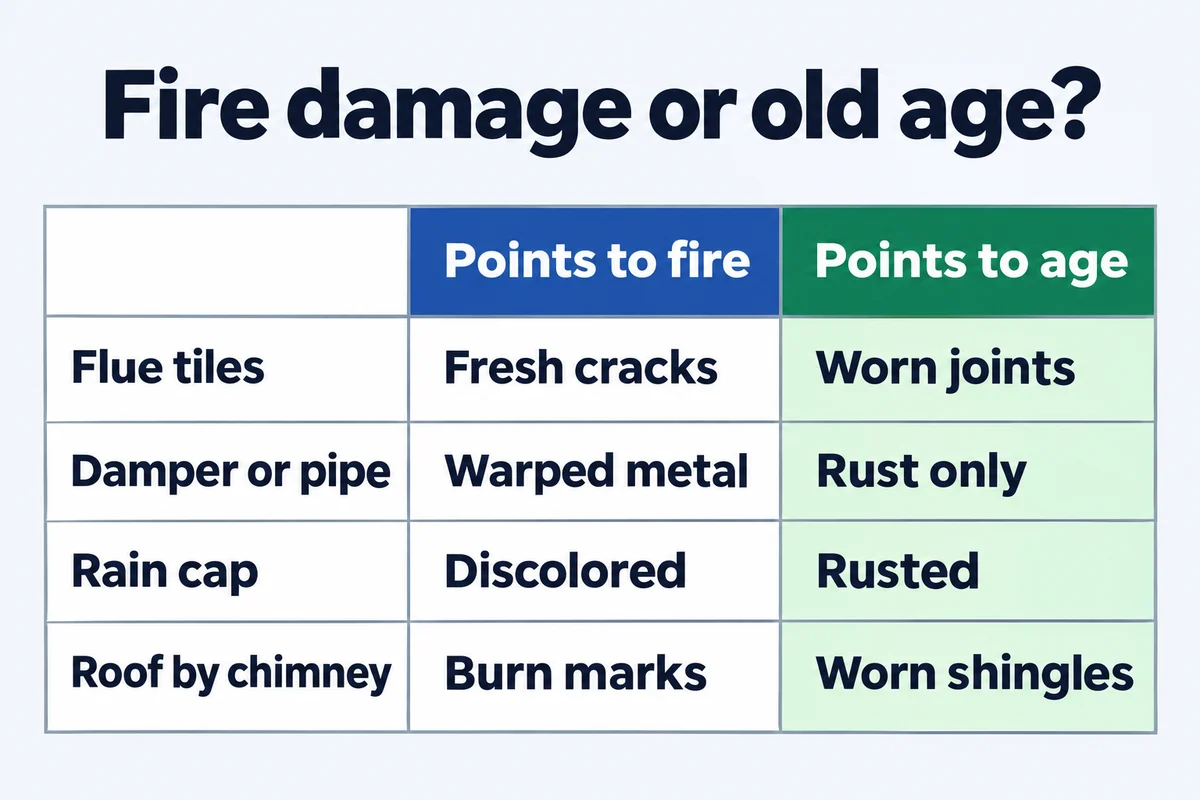
The list is from the CSIA page on preventing chimney fires. One sign alone is easy to argue with. Three or four together, with dates on the photos, are much harder to call old age.
Creosote is not an exclusion
The argument I hear most is that a chimney full of creosote was neglected, so the fire is the owner's fault. Read your exclusions and look for the word creosote. In the ISO form it is not there. Creosote is what wood smoke leaves on the inside of a flue every time a fire burns, and CSIA calls it highly combustible in any form. A fire in a chimney is that residue catching fire, which is the whole event the claim is about.
"Slow-burning chimney fires don't get enough air or have fuel to be dramatic or visible and they often go undetected until a later chimney inspection."
Chimney Safety Institute of America, Preventing Chimney Fires
That sentence cuts two ways. It explains why an owner can find the damage weeks after the fire, which helps. It also lets the insurer ask when the fire happened, because a fire found at a later inspection has no date. If your policy has a time limit for reporting, or a renewal date falls between the fire and the discovery, the date matters. I wrote about how the date of loss is set and why it matters. Give the insurer the night you heard the roar or saw sparks, if there was one, and the date the sweep found the damage. Whether a carrier may deny a claim for poor maintenance under your exact policy wording is a legal question, and on that point a lawyer is the right person to ask.
The first days, in the order that protects the claim
The fire department puts the fire out. It does not inspect the flue, and CSIA says so plainly. What happens next is on you, and the order is the point:
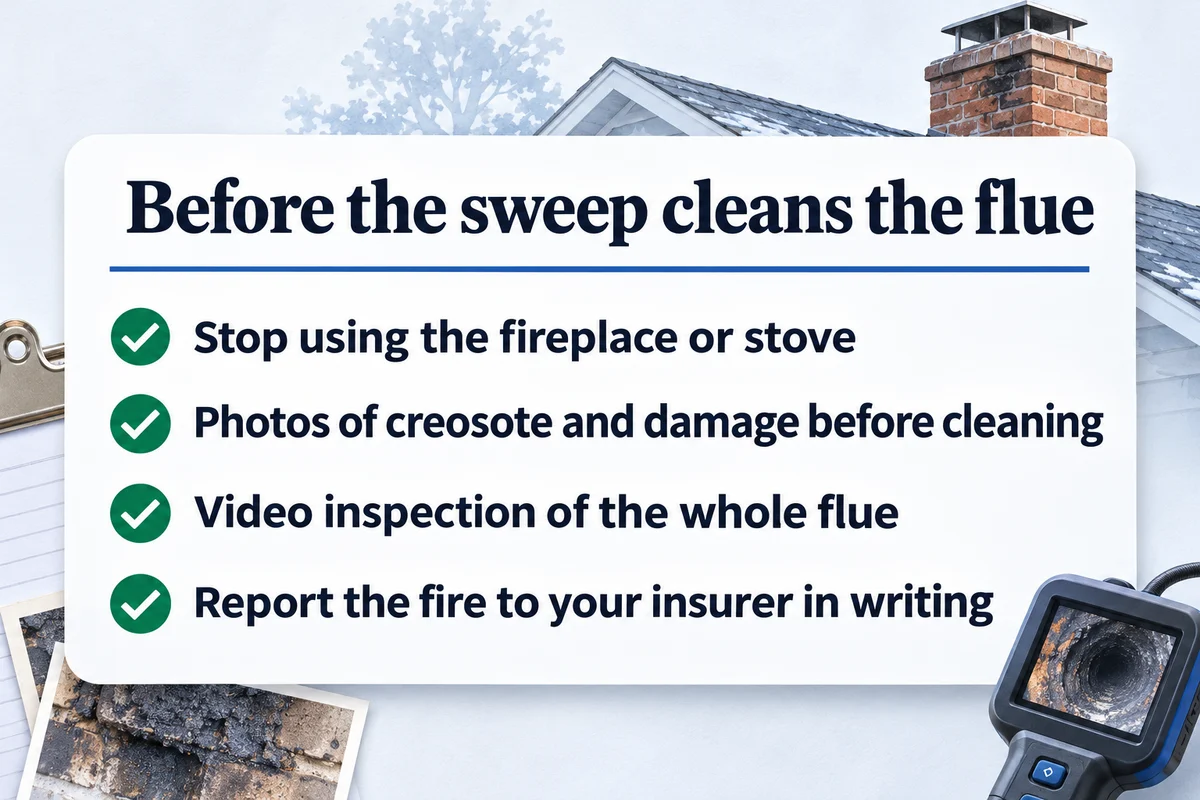
- Stop using the fireplace, the stove or any appliance on that flue. A cracked liner can let heat and gases into the walls around it.
- Photograph the outside the same day: the cap, the top of the chimney, the roof around it, and any flakes on the roof or in the yard. A phone from the ground is enough for most of it.
- Hire a chimney sweep to inspect, and ask for photos of the creosote and the damaged sections before the flue is swept. CSIA tells homeowners to ask for exactly this.
- After the sweep, ask for a video inspection of the whole flue and copies of the pictures. The camera finds cracked tiles and failed mortar joints that cannot be seen from the top or the bottom.
- Report the fire to your insurer in writing, with the date and a short description. Keep the claim number.
- If heat or a firefighter opened the roof around the chimney, cover it. The policy pays reasonable costs to protect damaged property from further damage, so keep the receipt.
If you live where the fire department sends a bill for the call, the ISO form has a small extra: up to $500 for fire department service charges, with no deductible. It does not apply inside the city or district that sent the trucks, so most Chicago homeowners will not need it.
Reline or rebuild: what the estimate should price
The biggest money question on a chimney claim is the repair method. A cracked clay flue can sometimes be relined with a new liner run down the old flue, and sometimes the chimney has to be taken down and rebuilt. The insurer's first estimate often prices the cheaper method without saying why. Ask for the reason in writing, and ask your sweep or mason to say which method the damage needs and why. Below is how I mark up the lines that belong on a chimney fire estimate:
The inspection that proves the damage is part of the loss, not routine upkeep.
Ask that it be paid as part of the claim, with the report attached.
New liner or rebuilt clay flue, sized for the appliance that uses it.
If the city now requires a different liner than the old one, the difference is a code item, not an upgrade you pay for.
Parts at the top and in the firebox that heat warped or cracked.
Match the photos to each line. A part with no photo is easy to strike.
Shingles and metal damaged by hot creosote or by the work of taking the chimney apart.
Removing and resetting flashing is part of the chimney job even where the roof itself is fine.
Rooms and the attic where smoke came through the joints.
Smoke in rooms the fire never touched is its own scope. See the article linked below.
The code point deserves its own sentence. In the ISO form the Ordinance or Law additional coverage lets you use up to 10% of your Coverage A limit for the extra cost of repairs that a building code requires. I explained how that coverage works in code upgrade coverage when the city makes the repair cost more. For the rooms next to the chimney, read smoke damage in rooms the fire never touched.
Is a chimney fire claim worth filing?
Compare the estimate with your deductible before you decide. Take an illustrative example: if a sweep finds a few cracked tiles and quotes a repair close to your deductible, the claim pays little and still goes on your record. If the liner has failed, the roof around the chimney is burned or smoke got into the walls, the job is usually much larger than a deductible. Do the inspection first, get the written repair price, then decide. Reporting the fire and filing for payment are related but not the same step, and your policy tells you how soon notice is due.
Where a public adjuster fits on a chimney fire
My work on these claims is the cause and the scope. I put the sweep's photos and video next to the policy wording, answer the wear and tear letter in writing, and check that the estimate prices the repair the chimney actually needs, together with the roof and the smoke in the house. I'm also a HAAG certified inspector and an Illinois roofing and general contractor, so I read the roof around the chimney myself. You can see the fire damage claims I handle, read about my licences, or send me the sweep's report and your insurer's letter and we can look at it together.