A roofing contract signed after an Illinois hailstorm has to carry the roofer's state licence number and name, a signed copy of the consumer rights brochure, and a clause in bold type that lets you cancel if your insurer turns the claim down. Illinois also gives you three business days to cancel any contract sold to you at your own door. The roofer may not promise to pay any part of your deductible, and may not file or argue your insurance claim for you. Those rules come from the state itself, in the Department of Financial and Professional Regulation's brochure for homeowners and the Attorney General's home repair fact sheet, and both are linked below so you can read them yourself.
I hold an Illinois roofing contractor licence (#105.009193) and an Illinois public adjuster licence (#19461872), so I see this from both sides: the roof, and the claim that pays for it. After a hail day in Chicago or the suburbs, the first person on your porch is usually a roofer with a clipboard. This post is about what that paper should say before you sign it. What a contract means in a dispute is a legal question, and a lawyer is the right person for that.
What you hear at the door, and what the state says about it
Most of what is said on a porch the day after hail is legal to say. A few lines are not, and a few more describe a right you have and the speaker does not mention. The left column below is what homeowners tell me they were told. The right column is what the state's own publications say.
The sources are the IDFPR brochure Find a Licensed Roofer, which describes the state law that took effect on January 1, 2012, and the Attorney General's Home Repair and Construction: Know Your Rights fact sheet. The brochure itself carries a note that it is for information and is not legal advice, and so does this post.
How long do I have to cancel a roofing contract in Illinois?
There are two separate clocks, and a storm contract can be under both. The first is three business days from signing, for any contract over $25 that was sold at your home. The second applies when you are counting on insurance to pay: you can cancel within five business days after your insurer tells you in writing that all or any part of the claim is not covered. The contractor cannot take the first right away by starting work or selling the contract to a lender.
Sold at your door
3 business days
Counted from the day you sign. Applies to a home sale over $25, storm or no storm. The contractor must disclose the right and hand you a form to use.
Insurance says no
5 business days
Counted from the insurer's written notice that all or part of the claim is not covered. The clause has to be in the contract in at least 10-point bold type, and money you paid comes back.
The second clock has an outer edge, and the two state publications describe it in different words. IDFPR puts it at the 30th business day after the insurer receives a properly executed proof of loss from you. The Attorney General's fact sheet says 30 days after you sent the claim to the insurer, whichever comes first. Read the bold clause in your own contract, because that is the text you will be held to, and ask a lawyer if the dates are close. I explain what a proof of loss is, and when one is asked for, in signing a sworn proof of loss in Illinois.
The brochure also says that when you cancel under the insurance clause, the contractor has to return any payments, partial payments or deposits, and any note or other evidence of a debt you signed. Cancel in writing, keep a copy, and send it in a way that leaves a date.
Can a roofer pay my deductible?
No. A contractor offering home repair in Illinois must not promise to pay or rebate any part of your deductible as a way to get the work. The deductible is your share of the loss under the policy, and the insurer's payment is calculated with it already taken off. The illustrative worked example below uses round numbers and leaves out any depreciation held back.
| Line | Illustrative amount | Who pays it |
|---|---|---|
| Agreed cost to replace the roof | $18,400 | The total the roofer is owed |
| Deductible on your declarations page | $2,000 | You |
| Insurer's payment for the roof | $16,400 | The insurer, on the loss less your deductible |
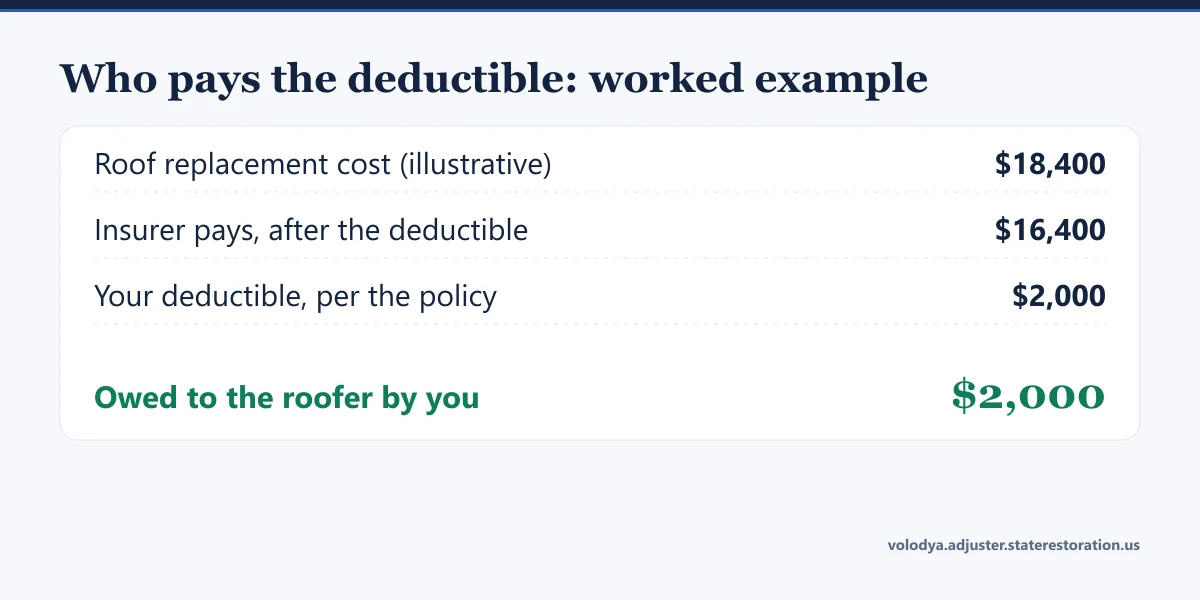
If a roofer says you will owe nothing, the $2,000 has to come from somewhere. Either part of the work the insurer paid for is left out, or the bill sent to the insurer is higher than the real price. The first leaves you without some of the roof you paid for. The second puts your own claim at risk, because the figures go to the insurer under your name. A payment plan for the deductible, written into the contract, is a different thing from a promise to waive it. If the deductible on your policy is a percentage of the dwelling limit, the amount can be far larger, and I show how that works in wind vs hail: why the cause of loss changes what you get paid.
Who is allowed to talk to my insurance company?
You are, always. After a storm that damages more than one home, a roofing contractor cannot represent you on the claim, offer to, or advertise that it will, and cannot call in or file the claim for you. A roofer can still measure the roof, photograph the damage, write an estimate, and meet the insurer's adjuster on the roof when you ask. Those are a contractor's jobs, and good roofers do them well.
Someone who negotiates the claim for you for a fee has to hold a public adjuster licence from the Illinois Department of Insurance. The Attorney General's 2021 storm warning gives the Department's number for checking one, (866) 445-5364, and says to look closely at the fee and at whether the adjuster requires you to use a particular contractor. In Illinois a public adjuster's fee on a residential claim is capped at 10 percent, and the contract has its own rules, which I set out in public, company and independent adjusters.
Report the claim yourself, in your own words, with the date of the storm. If the hail was real, the evidence on the roof does not depend on who made the call. What an adjuster looks for on a shingle is in my post on hail damage on an asphalt roof.
What has to be written into the contract
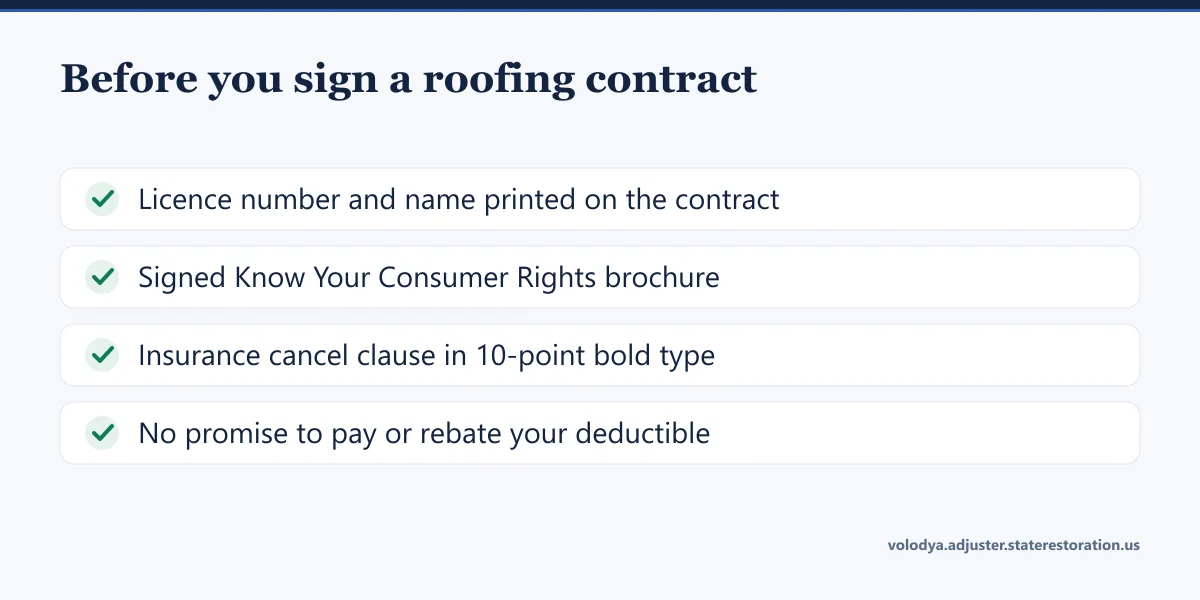
- The roofer's state licence number and the licensee's name. The brochure says these go on every contract, bid and permit application.
- For work over $1,000, a written contract that describes the work and states the total cost, with the materials named in some detail such as quality and grade.
- The timing of the work and the payment schedule: the down payment, the payments in between and the final payment.
- A date by which the work will be done, or the contract ends and the deposit is refunded. IDFPR accepts that weather moves crews around, but there should still be a date.
- The "Home Repair: Know Your Consumer Rights" brochure, with an acknowledgment form you sign and date, and a duplicate copy for you.
- A street address for the business. The brochure warns against a post office box, a mailbox service, a storage unit or a vacant lot.
- The cancellation clause for an insurance denial, in bold, if the work is after a storm and insurance is expected to pay.
- If there is an arbitration clause, a separate choice to accept or reject it and the jury trial waiver.
Never sign a contract with blank spaces, and keep a copy that carries both signatures. Read the warranty too: IDFPR suggests checking whether it covers the installation or only the shingles, and avoiding one that is cancelled by ordinary events such as wind over 45 mph.
How should I pay a roofer?
By personal check, money order or certified check, made out to the company and not to a person. Never in cash, and never the full amount before the work is finished. Before the last payment, ask for lien waivers from the shingle supplier and from any subcontractor. IDFPR makes a point that is easy to miss: a lien waiver signed by the roofing contractor is not a waiver from the supplier. If the supplier is not paid, it can file a mechanic's lien against your house even though you paid the roofer in full.
Insurance cheques after a roof claim often carry your name and your mortgage lender's. Endorse them when the work they pay for is done, not before. Depreciation held back on the first cheque is usually released once the roof is finished and the final invoice is sent, and I walk through that second cheque in what ACV means in Illinois.
A ten-minute check before you sign
- Write down the licence number and look it up on the IDFPR website. Do not judge it by the first digits; the lookup is what counts.
- Check that the name on the licence matches the name on the truck, the business card and the contract. The Attorney General's office calls a mismatch a red flag.
- Ask whether the licence is limited or unlimited. A limited roofing contractor may work only on homes and on condominium buildings of up to eight units.
- Ask for a certificate of insurance and proof of workers' compensation cover, and ask for photo identification of the person you are talking to.
- Ask whether a subcontractor will do the work. If so, the subcontractor must also hold a roofing licence.
- Call a neighbour the company worked for last year, or ask the company for references from the last twelve months.
IDFPR's licensing line is 1-800-560-6420. The Attorney General's Consumer Fraud Hotline in Chicago is 1-800-386-5438, and the office says you can call it to check out a contractor before you hire one.
When a knock on the door is fine
Plenty of good local roofers walk a neighbourhood after hail, because hail damage is often invisible from the ground and homeowners do not know to call. A knock is not the problem. The problem is a contract that is missing what the state requires, a promise about your deductible or your claim, or pressure to sign before you have checked anything. A roofer who welcomes the six checks above has nothing to hide.
If your roof is not leaking, it can usually wait the few days it takes to get a second estimate and hear from your insurer. If it is leaking, a temporary tarp is a repair you can pay for and claim, and it does not need a full replacement contract. My roof damage claims page explains how I handle the claim side when the insurer's estimate and the roof do not agree, and the services page lists what else I take on. If a contract is already signed and you are not sure what it binds you to, show it to a lawyer before the cancellation window closes. If your question is about the claim itself, send me the estimate and the contract and I will tell you whether you need help at all.