Hail damage on an asphalt roof is a fracture, not a stain. What decides the claim is whether the impact broke the mat — the reinforcing layer under the granules — because a broken mat is what shortens the life of the shingle. So the inspection looks for roughly round bruises that give under a thumb, granule loss with fresh dark asphalt underneath, a hit pattern concentrated on the slopes that faced the storm, and matching dents in the soft metal around the house. Blisters, foot traffic and ordinary weathering leave marks that look similar from a ladder and are not the same thing.
I hold a HAAG certified inspector number (#992104047) alongside public adjuster licences in Illinois (#19461872) and Indiana (#3556317), and an Illinois roofing contractor licence (#105.009193). That combination matters for one narrow reason: the argument is almost never about whether it hailed, since the weather is a matter of record. It is about whether the marks on your shingles were caused by that hail — and you answer that with a chalk square and a camera, not with an opinion. What follows is process rather than legal advice, and it describes how these claims run in Illinois and Indiana, the two states I am licensed in.
What does hail damage on an asphalt roof actually look like?
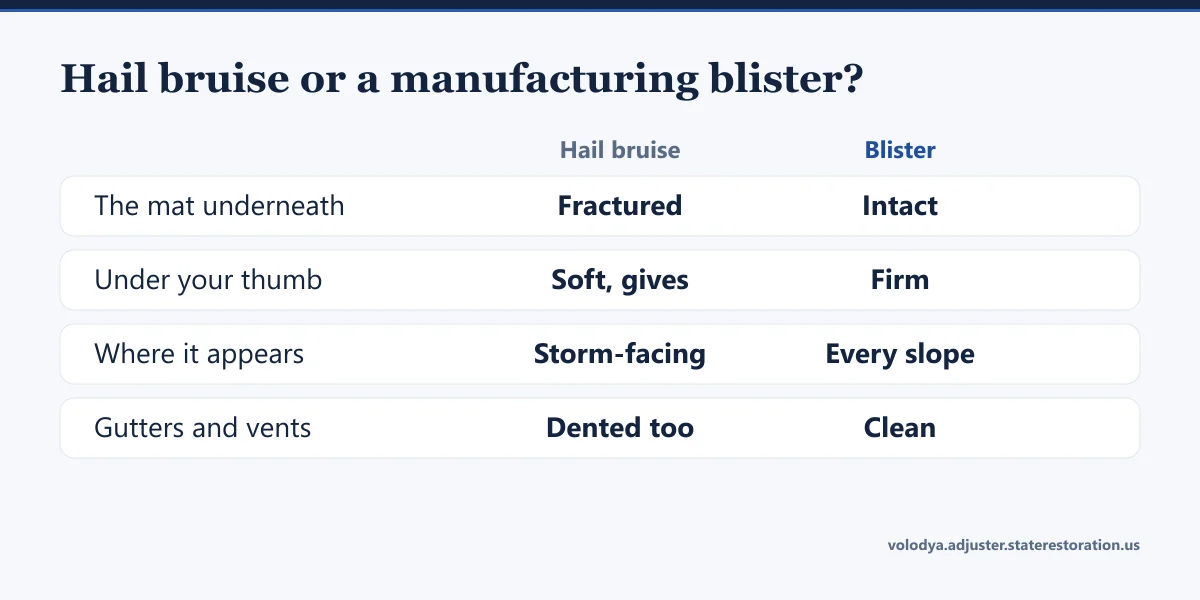
A roughly circular spot where granules have been knocked clear, with the exposed asphalt darker and fresher than the surface around it, and a fractured mat underneath. Pressed with a thumb, a real hit gives slightly — like a bruise on an apple. That give is the fracture, and it is the half of the test a photograph cannot show you.
Granule loss on its own is not damage; an asphalt roof sheds granules for its whole service life, fastest where water runs. What counts is whether the impact carried through into the fibreglass mat, because a fractured mat lets water reach the reinforcement and lets the shingle flex where it should be stiff. That is why the standard objection — “the roof is not leaking” — misses the point. Hail damage on a shingle roof is rarely a leak on the day of the storm. It is a shortened remaining life, and the loss is real whether or not there is a stain on a ceiling.
Two other things separate a hail hit from everything else. Hail lands at random, so real hits are scattered with no pattern; anything running in a line, or tracing a path from the ladder to the chimney, is somebody's boots. And the mark sits on the face of the shingle, not at its edge — torn tabs and creases are wind, a different cause of loss with a different scope.
How big does the hail have to be to damage a roof?
There is no single number, but stones around an inch across are the general point at which typical asphalt shingles begin to fracture. Older, sun-baked shingles fail at smaller sizes because the asphalt has hardened. Thick laminated and impact-rated shingles resist larger ones. Wind speed and the angle of the slope move the answer again.
So a hail report pulled for your address is a starting point, not a verdict. Three-quarter-inch stones do not close the file if your roof is twenty years old and brittle; two-inch stones do not open it if the storm tracked two streets over. Three variables do most of the work:
- Age. Asphalt loses flexibility as it oxidises, so a stone that dents a five-year-old shingle can shatter the mat of a twenty-year-old one. That cuts both ways in a negotiation, and it is worth knowing which side you are on before anyone else raises it.
- Construction. Impact-rated shingles are graded Class 1 to Class 4 under UL 2218, and many carriers discount the premium for a Class 4 roof. If yours earned that discount, the discount is evidence about what it takes to damage it.
- Angle. Wind-driven hail arrives on a slant, so a stone striking one slope square-on hits the opposite slope at a glance and may leave nothing. That is why the count is done per slope, not per roof.
What is a test square, and why does the number of hits matter?
A test square is a ten-foot by ten-foot area — 100 square feet — chalked out on each slope. Every impact inside it is circled and counted, then photographed. Fixing the area is what turns “there is damage up there” into a number someone else can check, compare across slopes and disagree with specifically.
The photographs are the deliverable: the whole square with its slope direction recorded, then individual hits close up with something in frame for scale. An inspection that produces a conclusion and no marked squares is an opinion you cannot audit.
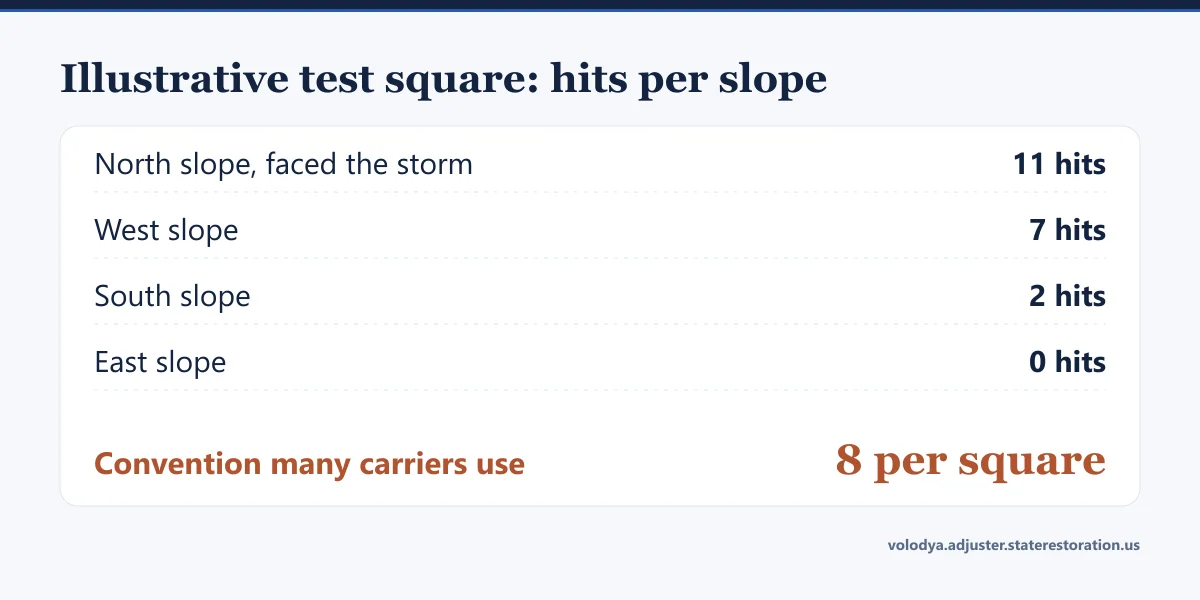
Many carriers work to a convention of roughly eight hits in a 100 square foot square before treating a slope as needing replacement rather than spot repair. That figure is an industry convention — it is not written in your policy and it is not a rule of Illinois or Indiana law — but it explains why an inspection finding seven hits and one finding nine can end in very different places.
| Slope | Hits in the 100 sq ft square | What that suggests |
|---|---|---|
| North — faced the storm | 11 | Above the convention many carriers use |
| West | 7 | Below it, and the slope most likely to be argued about |
| South | 2 | Glancing strikes, unlikely to be treated as damaged |
| East — sheltered | 0 | Consistent with the storm direction |
Read the spread, not any single number. A gradient from eleven down to zero running with the storm direction is itself evidence that hail caused this; the same modest count on all four slopes, including the sheltered one, should make you sceptical. Whoever inspects your roof, ask for the count per slope in writing and ask where the squares were placed.
What gets mistaken for hail damage?
Four things, mostly: manufacturing blisters, foot traffic, ordinary granule loss from age, and mechanical damage left by a previous repair. Blisters cost homeowners the most claims, because a blistered roof genuinely looks hailed from six feet away and behaves completely differently the moment you put a thumb on it.
| What it is | How it looks | How you tell it apart |
|---|---|---|
| Hail bruise | Round, granules knocked clear, dark fresh asphalt showing | Gives under a thumb, scattered at random, concentrated on storm-facing slopes, soft metals dented too |
| Blister | Small circular pockmarks, sharp-edged, often dense | Firm underneath, no fracture, on every slope including sheltered strips under overhangs |
| Foot traffic | Scuffed granules, smeared rather than removed | Follows a path — ladder to chimney, around a dish, along a valley |
| Weathering | Thin, diffuse granule loss | Heaviest where water runs and on the sunniest slope, with no bruise |
| Mechanical or tree contact | Gouges, straight scrapes, torn tabs | Tool marks have edges; limbs leave long scratches, not circles |
Blisters form when moisture or gas trapped in the asphalt expands, sometimes from manufacture and sometimes later from heat in a poorly ventilated attic. When one opens, the granules over it go too, leaving a bare circle that photographs exactly like hail. Telling a homeowner their roof is blistered rather than hailed is one of the more common conversations I have, and it is a free one.
Why do the gutters and the air conditioner matter more than the shingles?
Because soft metal keeps the record. Aluminium gutters, downspouts, drip edge, roof vents, flashing, window screens and condenser fins dent at hail sizes that shingles absorb. If none of that is marked, hail large enough to fracture a mat almost certainly did not fall at that address — which is why I would rather learn it from the gutters in ten minutes than from a denial letter in six weeks.
| Where to look | What hail leaves | What it tells you |
|---|---|---|
| Gutter tops, downspout backs, drip edge | Round dents, light spatter where oxidation was knocked off | Stone size and storm direction |
| Roof vents, turbine caps, pipe flashing | Dents on exposed faces, spatter on the caps | Angle of impact and which slopes were exposed |
| Outdoor AC condenser fins | Fins flattened consistently in one direction | Direction — and damage in its own right, since flat fins cost efficiency |
| Window screens, fascia wrap, siding | Punctures, dents, vinyl cracked in cold weather | Additional damaged items belonging in the same claim |
| Deck rails, fence caps, mailbox | Dark round bruises in wood, dents in thin metal | A hail-size record you can photograph from the ground |
Photograph all of it before anybody tidies up: a contractor who replaces a bent gutter as a courtesy has removed your evidence. And do not let the claim narrow to the roof by default — screens, condenser fins and wrapped fascia are separate line items, and the ones most often missing from a first estimate. Where an estimate is short, the route back is a supplement, which I walked through in the step-by-step account of how a Chicago claim runs.
How do you tell which storm caused it?
By the age of the marks and the storm record together. Freshly exposed asphalt is dark; over months it oxidises and lightens toward the colour of the shingle around it. Set that against published storm data for the address and you can usually narrow which date of loss to file — and the date is a field your policy cares about.
Do not guess it, and do not adopt a date handed to you by someone knocking on doors: carriers check it against their own weather data. It is also common to find two generations of damage on one slope, older oxidised hits alongside fresh dark ones, and both should be documented. Whether an older, unclaimed loss can still be pursued turns on notice provisions and time limits in your policy — a legal question rather than an adjusting one, and a lawyer is the right person past that line.
What does a cosmetic damage endorsement change?
It can remove payment for damage that does not affect how something performs. On a hail claim that bites hardest on metal — dented gutters, vents and fascia wrap that still work perfectly — but the wording varies, and some endorsements are written specifically around the roof surface.
It sits on the endorsement list behind your declarations page, next to the roof surfacing endorsement and the wind and hail deductible; I set out the five lines worth finding in your own policy in the piece on why your first check is smaller than the repair. This is also why the inspection is organised around fracture rather than appearance: a broken mat is a measurable loss whatever the roof looks like from the street. Where you and the carrier disagree about what the endorsement's words mean, rather than about the condition of the roof, you have moved from adjusting into a legal question. I am a licensed public adjuster, not an attorney, and I will say so rather than guess.
What should you do before anyone climbs on the roof?
Stay on the ground and document from there. Photograph every elevation, then the gutters, vents, screens and condenser fins close up. Write down the storm date you believe is right, and find your wind and hail deductible. All of it is easier before a contractor starts work than after.
- Photograph with scale. Put a ruler or a coin beside one dent so the size is on the record rather than in somebody's memory.
- Do not get on the roof yourself. Walking a hail-struck asphalt roof damages it, especially an older roof in cold weather, and foot-traffic scuffing is easy to identify later. It is also a genuine fall risk.
- Find the deductible on the declarations page. A percentage wind and hail deductible is far larger than the flat figure most people remember, and it changes whether filing makes sense at all.
- Get the inspection in writing — per-slope counts, photographs and the date. Whoever produces it, ask for the file.
- Read anything you are asked to sign, first. A contract signed on the doorstep the day after a storm can commit you to a roofer before anyone knows the scope. If you cannot tell what it commits you to, that is a question for a lawyer.
When is there no hail claim worth making?
When the marks are blisters or wear rather than fractures. When the count is well below what a carrier will act on. When the damage is genuinely cosmetic and your policy excludes it. Or when the repair lands close to your deductible — in which case filing costs you a claim on your record and returns nothing.
That last one is arithmetic anyone can do at the kitchen table. As an illustrative example: a two percent wind and hail deductible on a $400,000 dwelling limit is $8,000, more than plenty of hail repairs cost. Those figures are made up to show the shape of it; yours are on your own declarations page. A roof at the end of its service life with no fractures is not a hail claim either — it is a replacement you were already going to pay for.
What to do next
Have it looked at by someone you are paying. That is what the free inspection and policy review is for — I climb it, chalk the squares, count per slope and tell you where you stand, including when the honest answer is that those are blisters and there is nothing to claim. The offerings page covers the work I take on, including claims already underpaid or denied, and my licences and certifications, the HAAG number included, are published in full so you can check them before calling. My hours are Monday to Friday 9–6, Saturday 9–5 and Sunday 10–5, and I speak English, Ukrainian and Russian.
Nothing here is legal advice, and no honest adjuster will tell you what a hail claim is worth before seeing the roof and reading the policy. What representation changes is that the counting, the photographs and the arithmetic are done by someone on your side of it.