A sworn proof of loss is the one page of an Illinois property claim you sign under oath: the date and cause of the loss, who has an interest in the property, any other insurance, and the amount you are claiming. Most homeowner policies make it due 60 days after the carrier asks for it in writing, though some policies count from the loss itself. In Illinois, sworn means signed in front of a notary, and the notary has to witness the version you actually send. If the amount changes, the form is signed and notarized again. Reusing an old signature page has already cost one Illinois owner the right to sue.
I am a licensed public adjuster in Illinois (#19461872) and Indiana (#3556317). I prepare these forms with owners and go to the notary with them, so this is written from the kitchen table, not from a courtroom. Two things I quote below are law: a statute and a federal court opinion. I quote them so you can read them yourself. What they mean for your policy is a question for an attorney, and nothing here is legal advice.
What does the form actually ask you to state?
Five things, in roughly the order your policy lists them under Duties After Loss: when and how the loss happened, whose interest is in the property, other insurance, the value of what was damaged, and the amount you claim. Carriers print their own versions, and Illinois has no single state form. The layout below follows a sample the Texas Department of Insurance published as endorsement HO-190, used here only because it is a typical public example of the layout. Next to each line is what I tell an owner before the pen comes out.
SWORN STATEMENT IN PROOF OF LOSSTypical layout, with my notes beside each line
Copy them from the declarations page, spelled the way the policy spells them. If the house is in a trust or two names are on the deed, every named insured signs.
The date of the event, not the day you found the stain. For hail or wind, it should match the storm date in the weather record. Describe the cause in plain words ("hail and wind, roof and north elevation") and leave theories about coverage out of it.
Your interest is usually owner. Others are your mortgage lender and any loss payee, by name, with the loan number if the form asks. A lender left off this line can hold up the cheque later, because carriers often print the lender's name on it.
Any other policy that might answer the same loss: a condo association policy, a landlord's policy, a separate policy on a detached garage. "None" is an answer; a blank is not.
Split by dwelling, other structures, personal property and other. These numbers come from an estimate you can hand over, line by line. If the scope is not finished, the form is marked partial and the amount covers only what is documented today.
Signed on the day, in front of the notary, with the notary's seal, date and commission on the same document. Nothing is signed in advance and nothing is signed blank.
The form is not a release. The sample says so in its heading, and many carrier forms carry the same line. Signing a proof of loss for an amount does not settle the claim at that amount, which is why a partial proof is a normal thing to file. What it does do is put a number under oath, so every figure on it should match a document you are attaching: an estimate, an inventory, receipts for living expenses. If you are building a contents list for that page, the method in documenting contents after a fire with no receipts applies line for line.
Is a signature enough, or does Illinois want a notary?
Illinois courts read "sworn" as notarized. If your policy asks for a signed and sworn proof of loss, a signed form without a notary does not meet that requirement, however accurate it is. That matters for more than housekeeping, because of one sentence in the Illinois Insurance Code, 215 ILCS 5/143.1:
"Whenever any policy or contract for insurance ... contains a provision limiting the period within which the insured may bring suit, the running of such period is tolled from the date proof of loss is filed, in whatever form is required by the policy, until the date the claim is denied in whole or in part."
The words to notice are "in whatever form is required by the policy". A pile of photos and estimates emailed to the adjuster tells the carrier about the loss, and it is useful, but where the policy asks for a sworn form it is not the filing that statute is talking about. In a 2013 decision quoted by the federal court below, an Illinois appeals court read the duties section of a property policy as requiring a proof of loss "to be 'signed' by the insured and 'sworn,' i.e., notarized". In that case the owners had sent an unsworn submission first and a sworn one later, and the clock was treated as paused only from the sworn one.
What went wrong when an old signature page was reused?
The clearest Illinois example is recent. On November 3, 2025, the federal court in Chicago decided case 21 C 6228, a dispute between a 27-building condominium association in Glenview and its property carrier over a July 2019 storm. You can read the full opinion; these are the dates it sets out.
- Storm in Glenview; the association later reports roof damage from wind and hail. The policy asks for a signed and sworn proof of loss within 90 days after the loss and allows suit within two years.
- A day before the two years run out, the carrier extends the deadline to sue to October 2, 2021.
- The association's president signs a partial sworn statement in proof of loss before a notary. It claims a replacement value of over $2.9 million. It is never sent.
- A second partial proof, about $1.4 million higher at over $4.3 million, is sent to the carrier with the notarized signature from the first one attached. Nobody swore to this version.
- The carrier rejects the proof and gives its own estimate of $203,982.19, without a final coverage decision.
- The association files suit.
- The court finds the filed proof was not sworn, so the suit period was never paused. The case ends on timing, and the court never decides whether the storm caused the damage.
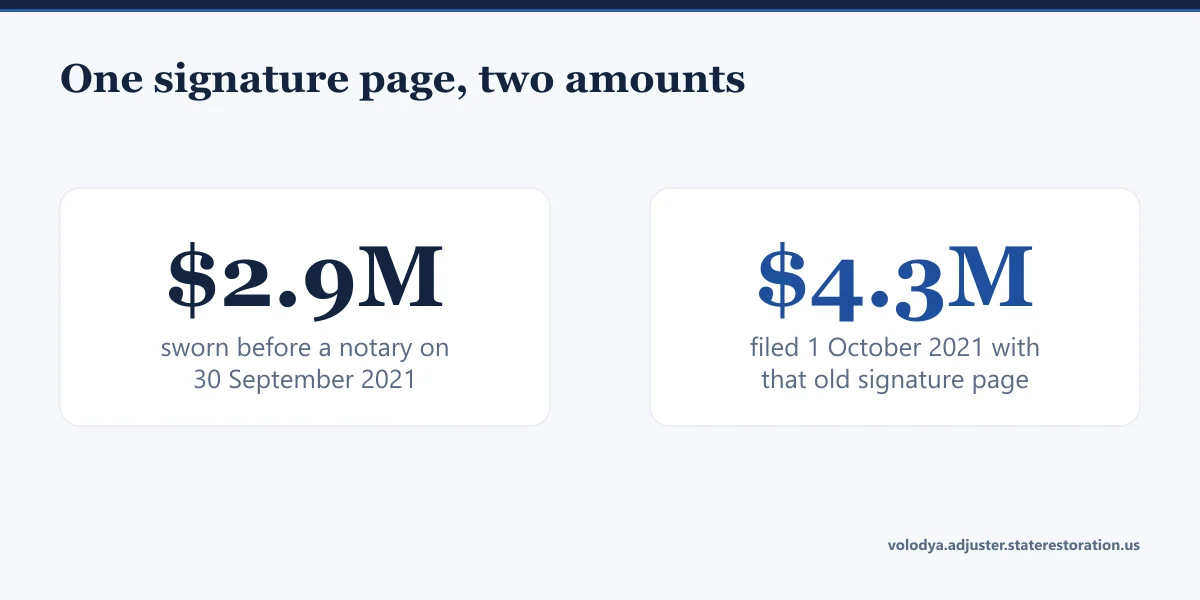
Read it for the mechanics, not the size. The same thing can happen on a $40,000 roof claim if a contractor's revised estimate goes in under a signature page from last month. Whether a court would treat your filing the same way depends on your policy wording and facts, and that is a lawyer's call. The habit that avoids the argument costs one more trip to a notary.
How do you file a revised proof of loss correctly?
Treat every new number as a new sworn statement. This is the sequence I follow with owners whenever a figure moves, even by a few hundred dollars:
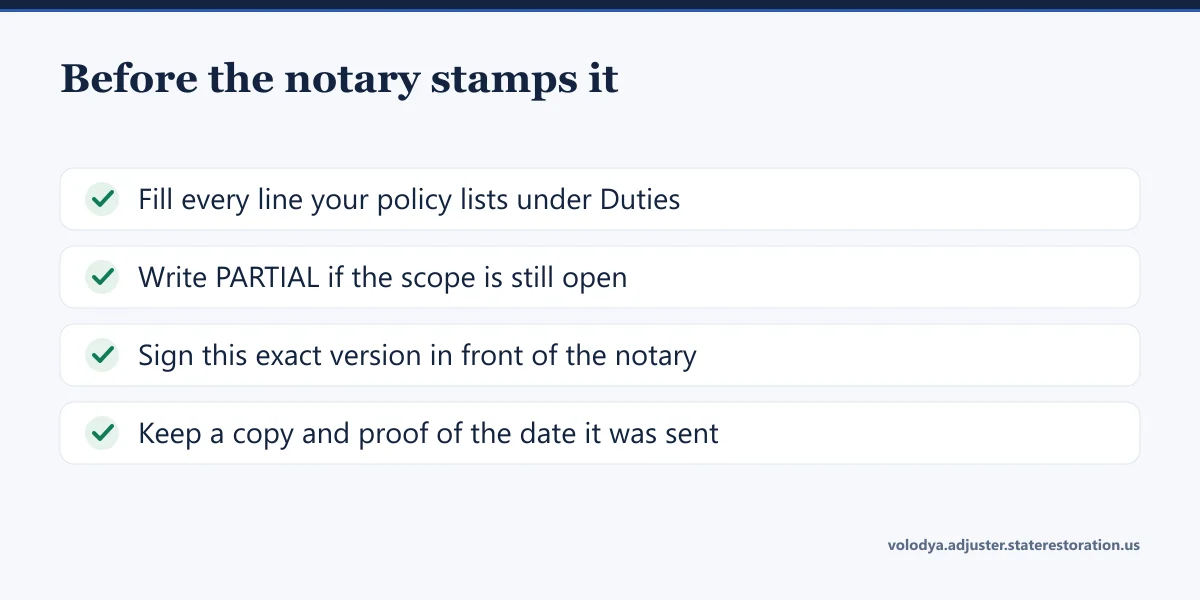
- Print a fresh form with the new figures and today's date. Do not edit the old one by hand.
- Label it so nobody can confuse it with the earlier one, for example "Partial proof of loss no. 2, replaces no. 1 dated ...", and attach the estimate the new figure comes from.
- Sign it in front of a notary who completes the notary block on that document. A scanned or copied signature page from another version is not an oath.
- Send it in a way that shows the date it arrived (certified mail, or email to the adjuster with the claim number in the subject line and a reply you keep), and write that date in your claim log.
- Keep the full signed copy, every page, as sent. If someone later asks what you swore to, you want the exact document, not a draft.
Many banks and shipping stores have a notary on site. Call first and bring photo ID; the notary will want to watch you sign, so do not sign at home.
Can you file before the repair scope is finished?
Yes, and on most real claims you should. The roof may be agreed while the drywall is still wet, or a supplement may be waiting on the carrier. Marking the form partial lets you put the documented part under oath now and add the rest when it exists, instead of guessing high to cover what you have not seen. A guess sworn to as fact is a problem you would be creating for yourself. The worked example below is illustrative only: invented numbers, showing how two partial proofs fit together on one hail claim.
| Document | What it covers | Replacement cost claimed | Attached |
|---|---|---|---|
| Partial proof no. 1 | Roof replacement and gutters, scope agreed with the field adjuster | $24,600 | Roofing estimate, test-square photos, storm date record |
| Partial proof no. 2 | Ceiling and wall repairs in two bedrooms, found once the drywall was opened | $6,850 | Interior estimate, moisture readings, photos of the opened ceiling |
| Running total under oath | Both, each sworn on its own date | $31,450 | Claim log with both filing dates |
Two separate sworn documents, each matching its own estimate, are easy to defend line by line. If the carrier's estimate and yours differ on a line, that is a pricing argument to have over the estimate itself, and reading an Xactimate estimate line by line shows where those differences usually hide.
What if the carrier never asked for one?
Then read the clause, because the answer depends on its wording. The common homeowner form runs the 60 days from the carrier's written request; on that wording the clock may never start if no request arrives. The opinion above mentions an earlier Illinois appeals decision on exactly that kind of policy, where the carrier never asked and a good-faith submission was treated as able to pause the suit period. The Glenview policy was written differently: it gave the insured 90 days after the loss, with no request needed. So two Illinois owners with two policies can face opposite clocks. Find the paragraph called Duties After Loss or Requirements in Case of Loss, note whether it says "after our request" or "after the loss", and write the date down with the others from the four clocks on an Illinois claim.
What does the carrier have to do once it receives the proof?
The Department of Insurance claim rule, 50 Ill. Adm. Code 919.80, sets two duties tied to the proof on fire and extended coverage policies, as the Insurance Code defines them. Under 919.80(d)(7)(B), a claim still unresolved 25 calendar days after the carrier receives the proof of loss, or 75 days after it was reported if that comes first, must get a reasonable written explanation for the delay, sent with the Department's notice of availability. Under 919.80(d)(8)(C), on a residential policy where the suit period was tolled, the carrier must tell you in writing at the time of a denial, in whole or in part, how many days were tolled and how many days are left to bring suit.
That second letter is the one to keep with the proof. In the Glenview case the carrier's response used the word "reject" and gave its own figure while leaving coverage undecided. Whether a letter like that counts as a denial in part, and what it does to the clock, is a legal question. If you receive one with a suit date anywhere near, call a lawyer that week.
Where does a public adjuster's part end?
My part is the document and everything under it: the scope, the estimate the numbers come from, the inventory, matching each line of the form to a page you can hand over, and getting it signed and sworn properly on the right day. I also keep the dates. When a carrier pays less than that documented scope, the underpaid claim work starts from the sworn figures. What I do not do is tell you whether your suit period was tolled, how long you have left, or what a rejection letter means in law. That is an attorney's work, and anyone in my licence who answers it for you is outside theirs.
Plenty of owners do not need me for this. If the carrier has agreed the scope, the estimate matches what your contractor will charge, and the adjuster asks you for a proof of loss for that agreed amount, you can fill it in yourself with the notes above and a trip to the notary. If the scope is still in dispute, the amount is large, or a revised figure is on the way, the free inspection and policy review on the offerings page is the place to start, and my licences are published in full so you can check them first. I work Monday to Friday 7 to 7, Saturday and Sunday 9 to 5, in English, Ukrainian and Russian, and you can reach me through the contact page.