A homeowner policy usually pays the water mitigation bill after a covered leak: the extraction, the drying equipment, the wet drywall cut out and the visits to check the readings. It pays what was reasonable and necessary to stop the damage from spreading, and it pays it as part of the same claim, after one deductible. The part of a drying bill that gets cut is the part nobody can show was needed. More fans than the wet area called for, days of equipment after the walls read dry, a charge for moving furniture out of a room that was already empty. What protects you is paper you can collect in the first week: the category of water written down, photos before anything is torn out, and the daily drying log.
I am a licensed public adjuster in Illinois (#19461872) and Indiana (#3556317) and a licensed general contractor, so I read these invoices both as the person who prices the rebuild and as the person who argues the claim. This post is about the first bill that lands after a burst pipe, a failed water heater or a leaking dishwasher line. What a contract clause means in court is a legal question, and a lawyer answers those.
Does homeowners insurance pay the water mitigation company?
Yes, when the water itself is a covered loss. Most homeowner policies make you protect the property from further damage once something has happened, and then pay the reasonable cost of what you did to protect it. Calling a drying company the same day is exactly that. The cost sits inside the dwelling limit of your policy, the same pot of money that pays for the rebuild, so a padded drying bill leaves less for the kitchen.
The water has to be covered first. A supply line that bursts is a sudden discharge and is normally covered; groundwater through a foundation crack or surface water after a storm usually is not, and then neither is the drying. That split is in my post on water damage vs flood in Illinois. Speed is not optional either. The EPA's brief guide to mold, moisture and your home says to dry water-damaged areas and items within 24 to 48 hours to prevent mold growth, and a policy that pays for drying often caps what it pays for mold.
You choose who dries your house. An insurer may give you the name of a company it works with, and calling that company is your decision, not a condition of the claim.
What a drying log looks like when it backs up the bill
A drying log is the technician's daily record: moisture readings taken at the same marked spots, the temperature and humidity in the room, and the equipment left running. It is the only document that says why there were six fans on Tuesday and four on Wednesday. Below is an illustrative worked example for one kitchen in a Chicago bungalow after a supply line under the sink split overnight. The readings are on the meter's drywall scale, and the dry goal is the reading the same meter gives on an unaffected wall in the same house.
Day 1
38
average of 8 marked spots, dry goal 9
- 6 air movers
- 2 dehumidifiers
- Water extracted, 2 ft of drywall cut out on two walls
Day 2
24
same 8 spots
- 6 air movers
- 2 dehumidifiers
- Room humidity falling
Day 3
14
two spots still wet
- 4 air movers, moved to the wet wall
- 1 dehumidifier
Day 4
9
all 8 spots at the dry goal
- Equipment removed
- Final photos of the readings
Illustrative worked example. The numbers show how a log should read, not what any particular kitchen will measure.
Read it the way an adjuster does. The equipment count drops as the readings drop, the spots are the same every day, and the equipment leaves the day the walls reach the goal. A log like that turns every equipment line on the invoice into arithmetic: 6 plus 6 plus 4 is 16 air mover days, and 2 plus 2 plus 1 is 5 dehumidifier days. A log with no readings, or one with the same reading copied down four times, turns the same lines into an argument.
Which lines on a drying invoice does the adjuster question?
The lines that depend on a judgment made on site. Extraction by the square foot and a measured flood cut are easy to check against photos. The questions come on the lines that count days, units, hours and the kind of water, and each has a record that answers it.
Some insurers send drying invoices to a bill review service before they pay, and those services ask for the same three things: the log, the photos and an itemized invoice. If you have them first, the review is a check of arithmetic rather than a debate. How the insurer's own estimate is laid out, line codes and all, is in reading an Xactimate estimate line by line.
A federal appeal where the drying bill was cut
The clearest public example I know of comes from the National Flood Insurance Program, which publishes its appeal decisions. A flood policy is not a homeowner policy, and the rule FEMA applied is the flood policy's own. The reasoning about the log is the same one a homeowner's adjuster will use. In FEMA flood insurance appeal decision #C25, FEMA wrote:
"When drying services are done by a mitigation company, a properly completed drying log and an itemized invoice should be submitted to validate the number of drying equipment units used."
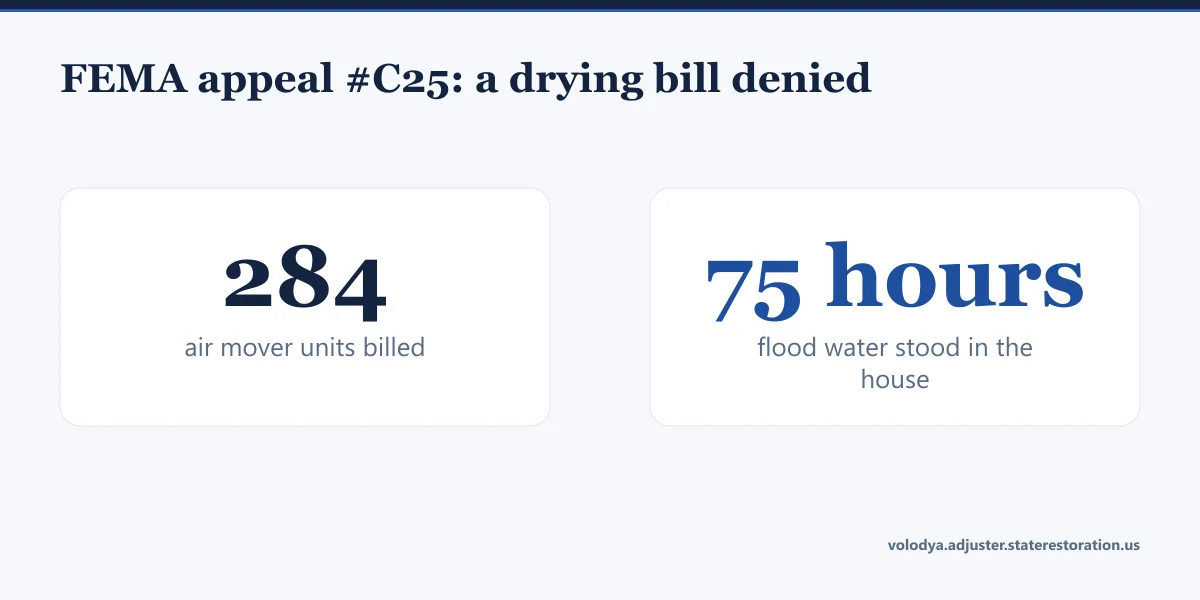
In that file, flood water stood in the house for 75 hours after a September 2018 flood. The mitigation company billed 284 units of air movers and 32 units of dehumidifiers. The insurer read the drying log, found the equipment and the demolition excessive for the damage it recorded, and refused the excess. FEMA agreed: nothing in the file showed the need for that many units. Two other charges went the same way. The company had billed for protecting contents that were already out of the house, and for sketching and writing its own demolition estimate. The policyholder told FEMA she had to use money meant for the repairs to pay the drying bill.
That last sentence is the real cost of a weak log. When the insurer pays less than the invoice, the drying company still sends its bill to you.
Is there a dollar limit on emergency measures in my policy?
Some policies have one, and you find it in the additional coverages section, not on the declarations page. A form may cap emergency measures at a flat amount or a percentage of the dwelling limit unless the insurer approves more. A 2021 Florida appeals decision, summarised on a policyholder law blog, shows how that plays out: the policy capped emergency measures at $3,000 unless the restorer asked for approval first, the restorer sent a $7,238.75 invoice after the work was finished, and the court held that an invoice for completed work is not a request to exceed the limit. Florida's form is not yours, and I mention the case only for its sequence. If your policy has a limit, the request to go past it goes to the insurer in writing while the equipment is still running.
What to sign, and what to keep, when the crew arrives
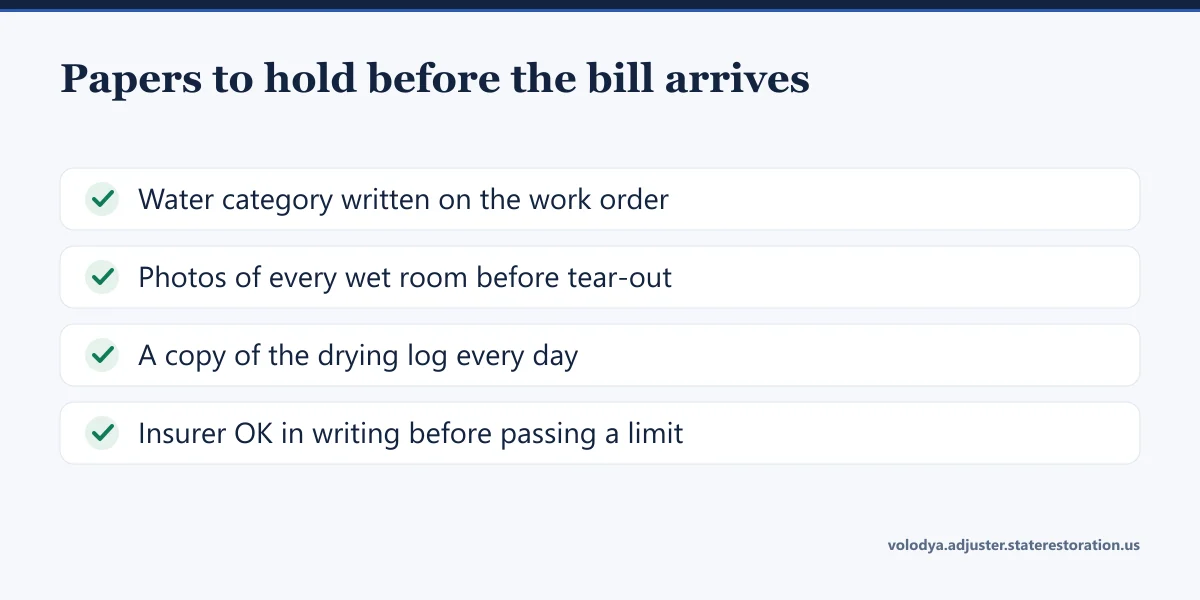
- Shut off the water and take photos and a short video of every wet room before the crew touches anything. Include the source: the split pipe, the failed fitting, the water heater.
- Report the claim yourself and write down the claim number, the time and who you spoke to.
- Read the work authorization before you sign it. Look for who the insurance payment is made out to and any clause that assigns your claim benefits to the company. What such a clause does under Illinois law is a question for a lawyer; if you are unsure, ask for a version without it.
- Ask the crew to write the water category and the reason for it on the work order.
- Ask for a copy of the drying log after every visit, not at the end. A photo of the technician's tablet screen is enough.
- Keep the failed part. A cut section of pipe or a cracked valve answers the cause question months later.
- Read your policy for an emergency measures limit, and if the job looks like it will pass it, ask the insurer in writing before it does.
Frozen pipes add one more question, whether the heat was on, and the records that answer it are on my frozen pipe claims page.
When the insurer pays less than the invoice
A partial payment on a drying bill usually arrives with a line-by-line explanation. Set it beside the invoice and the log. The table is an illustrative worked example built on the kitchen log above, with round illustrative prices.
| Line | Billed | Paid | Why the difference |
|---|---|---|---|
| Emergency service call | $350 | $350 | Arrival time on the work order |
| Extraction, 220 sq ft | $330 | $330 | Matches the photos |
| Flood cut, 48 linear ft | $480 | $480 | Readings show the drywall was wet |
| Air movers, 18 unit days | $630 | $560 | The log shows 16 unit days |
| Dehumidifiers, 6 unit days | $720 | $600 | The log shows 5 unit days |
| Contents moved and protected | $250 | $0 | Photos show an empty room |
| Monitoring visits, 4 | $380 | $380 | One visit a day on the log |
| Total | $3,140 | $2,700 | $440 not paid |
Here the cuts follow the log, and the $440 is a matter between you and the drying company: the extra units and the empty-room charge were never needed. Ask the company to correct its invoice to match its own log. When a cut does not follow the log, the answer goes back to the adjuster in writing, with the readings for the days in dispute. A cut with no reason given at all is worth asking about in writing too; Illinois expects an insurer to explain in writing why it pays less than a claim, and how to answer that letter is in what to do when a claim is denied in week one.
When a drying bill does not need a public adjuster
Most of the time it does not. A one-room leak, dried in three or four days, with an invoice the insurer paid in full or trimmed to match the log, is a small claim that you can close yourself. Where I come in is the larger loss: the drying was the first week of a claim that now includes cabinets, floors and walls across several rooms, the insurer is disputing the cause, or the drying bill was cut and the rebuild estimate is far below what contractors are quoting. My water damage claims page shows how I handle those, and the services page covers the rest. If you have a drying invoice and a partial payment in front of you, send me both and I will tell you whether the gap is worth arguing.