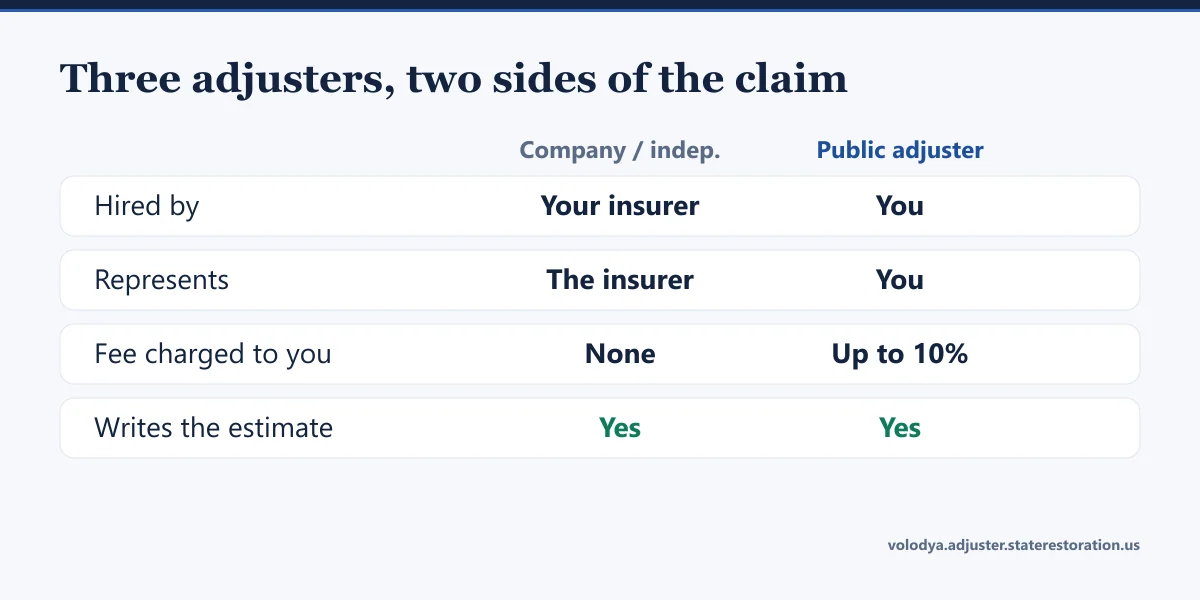
If you have a property claim open in Illinois, up to three kinds of adjuster can be involved in it, and the public adjuster vs company adjuster vs independent adjuster question comes down to two facts: who hired the person, and who pays them. Two of the three are hired and paid by your insurance company. The third is hired and paid by you. The rest of this page follows from that.
I am the third kind: a public adjuster licensed in Illinois (#19461872) and Indiana (#3556317). Below is how each type fits into a claim, what Illinois law makes a public adjuster tell you before you sign anything, and how the fee is limited. The statute references are to the Illinois Insurance Code; Indiana has its own rules, which differ in detail. This is general information, not legal advice, and your policy and your own contract govern your file.
How does Illinois law define the three types of adjuster?
The statute answers it in plain words. Before a public adjuster can sign you, 215 ILCS 5/1575(f) requires them to give you a separate, signed and dated disclosure that defines all three types. Every licensed public adjuster in the state hands over the same definitions, so they are the fairest summary there is:
"Company adjuster" means the insurance adjusters who are employees of an insurance company. They represent the interest of the insurance company and are paid by the insurance company. They will not charge you a fee.
"Independent adjuster" means the insurance adjusters who are hired on a contract basis by an insurance company to represent the insurance company's interest in the settlement of the claim. They are paid by your insurance company. They will not charge you a fee.
"Public adjuster" means the insurance adjusters who do not work for any insurance company. They represent the insured to assist in the preparation, presentation and settlement of the claim.
The same disclosure must also state three further points: you are not required to hire a public adjuster to meet your obligations under the policy, though you have the right to; the public adjuster is not a representative or employee of the insurer or of the Department of Insurance; and the fee is your obligation, not the insurer's.
Is an independent adjuster on my side?
No. "Independent" describes the employment arrangement, not the loyalty. An independent adjuster is a contractor your carrier assigns, often because its own staff cannot cover the volume after a large storm. They inspect for the carrier, write the carrier's estimate and report to the carrier, and they charge you nothing.
That is not a criticism of the people doing the job. Many independent adjusters are careful and fair, and their estimate is often the document I start from. But when you ask one whether something should be covered, you are asking the insurer's representative. Their report usually goes to a claims examiner at the insurance company who holds the authority to pay, so the person on your roof is frequently not the person who decides.
What does each adjuster actually do on my claim?
All three inspect, measure, photograph and price the damage, so the day-to-day work overlaps far more than the titles suggest. What differs is whose instructions they follow and whose interest decides a close call: whether a creased shingle is wind damage or age, whether a line item belongs in the estimate at all.
| Question | Company adjuster | Independent adjuster | Public adjuster |
|---|---|---|---|
| Who hires them | Your insurance company, as an employee | Your insurance company, on contract | You, by a signed written contract |
| Whose interest they represent | The insurer's | The insurer's | Yours, the policyholder's |
| What you pay them | Nothing | Nothing | The fee in the contract; on a home, at most 10% of what the insurer pays |
| Where you usually meet them | By phone or email; at the property on some claims | At the inspection, often after a storm | At the property, from the first inspection to the last cheque |
| Who decides the payment | The insurer, within the authority it gives them | Usually the insurer, on their report | The insurer; they negotiate, you approve |
How do I tell which adjuster I am talking to?
Ask, and write the answer in your claim notes. The roles get mixed up easily, because a carrier's adjuster and a contractor's "insurance specialist" both arrive with a ladder and a tablet. Four questions settle it in a minute:
- Who do you work for? A company adjuster names your insurer. An independent adjuster names their own firm and the carrier that assigned the file.
- Who pays you on this claim? If the answer is you, the person is acting as a public adjuster and must hold the licence.
- What is your licence number? For a public adjuster it must be printed on the contract under 215 ILCS 5/1575(a)(3).
- Can you approve this amount, or does someone else? The answer tells you where the decision is made and whom your written requests should go to.
One more case is worth naming. A roofer who offers to "handle the insurance" and negotiate your settlement is offering a public adjuster's job. In Illinois nobody may act as a public adjuster without the licence, and a contract made in breach of that rule is void (215 ILCS 5/1515). A contractor can document the damage and price the repair; negotiating your claim is a separate role with its own licence.
What must a public adjuster's contract contain in Illinois?
It must be written on a form filed with and approved by the Director of Insurance, and signed before any work starts other than emergency services. Section 1575 lists what goes in it. Read your copy against this list before you sign:
- The title "Public Adjuster Contract", and the adjuster's full name, business address, email, phone number and licence number.
- Your name, address, insurance company and policy number, plus a description of the loss and where it happened.
- A description of the services you are paying for.
- If the fee is a share of the settlement, the exact percentage; and any expenses to be repaid from the claim, listed by type with dollar estimates.
- A statement that the adjuster is bonded as State law requires.
- Both signatures, with the date and time each of you signed.
- Separately and in writing: any financial interest the adjuster has in a contractor, salvage firm, board-up company or anyone else working on the loss (5/1575(d)).
The same section lists terms a contract may not contain: a fee collected on money owed but not yet paid; the whole fee taken from the first cheque; a requirement that the insurer pay the adjuster alone; a bar on either of you pursuing civil remedies; a clause making you indemnify the adjuster for their own negligence; and a power of attorney letting the adjuster act in your place. A contract with any of these in it does not comply.
Five business days to change your mind
The adjuster must email an exact copy of the signed contract to your insurer within 5 business days. Once the insurer receives it, you have 5 business days to void the contract by written notice: registered or certified mail, delivery in person, or email to the address on the contract. Anything you paid under it must be returned within 15 business days.
How much can a public adjuster charge in Illinois?
On a personal residence, no more than 10% of what the insurer pays on the claim, on any claim (215 ILCS 5/1570(e)). On other property the 10% cap applies to claims from a catastrophic event declared by the Governor, unless the Director approves more in writing. Inside that ceiling, the percentage is whatever your contract says.
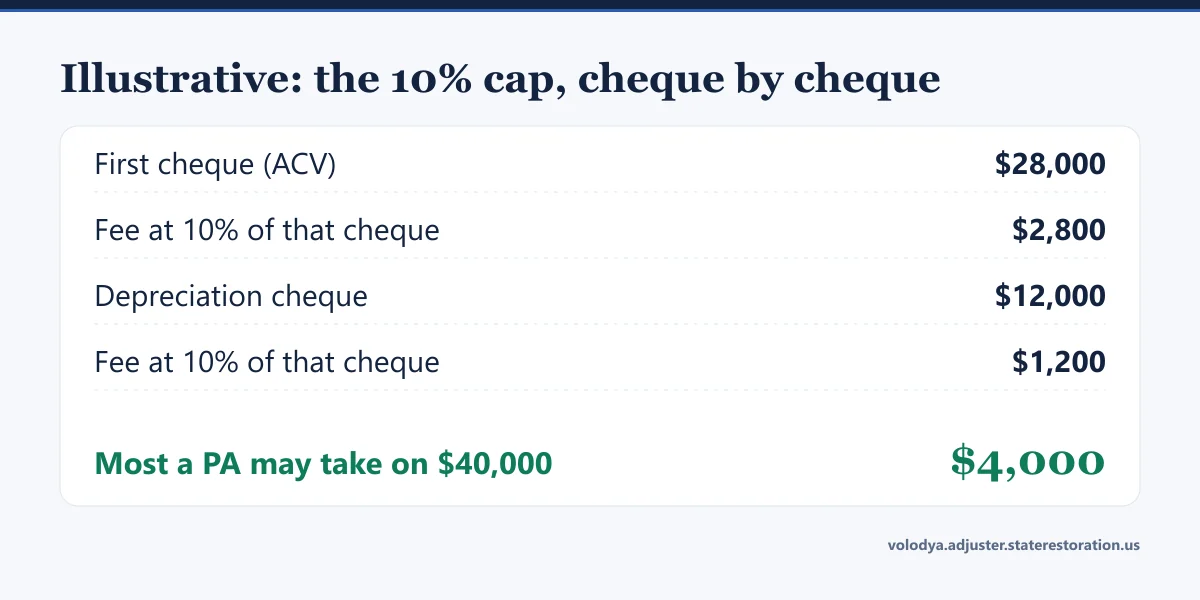
The fee follows the cheques. The contract may not let the adjuster take the whole fee out of the first payment, so it is a percentage of each cheque as it is issued. In this illustrative worked example, a home claim settles for $40,000, paid as a $28,000 actual cash value cheque and a $12,000 recoverable depreciation cheque once the repair is done. At the 10% maximum the fee is $2,800 from the first and $1,200 from the second: $4,000 in all, and never more than the cheques actually paid.
The cap leaves one question open that you should settle before signing: does the percentage apply to everything the insurer pays, or only to amounts above what it had already offered when the adjuster was hired? Practice varies, and the answer can change the fee more than the percentage does. Ask for it in writing, in the contract.
When the insurer pays the limit in the first week
If your insurer pays, or commits in writing to pay, the policy limit within 5 business days after you report the loss, a public adjuster may not take a percentage of it. They must tell you the amount might not be increased, and they are limited to reasonable pay for the time spent and expenses incurred (5/1575(c)). A percentage of a cheque that was coming anyway would buy you nothing, and the law treats it that way.
Do I still deal with the company adjuster if I hire a public adjuster?
Yes. Hiring a public adjuster does not take you out of your own claim. Your policy still requires you to cooperate: to show the damage, hand over records you have and, if asked, sit for an examination under oath. Because an Illinois contract may not give the adjuster a power of attorney, you sign your own proof of loss and you approve the settlement.
What changes is who carries the work. The inspections, the estimate dispute and the correspondence go through someone who works for you, and a public adjuster normally attends the carrier's inspection so that both sides measure the same roof on the same day.
Which one do I actually need?
Every claim gets a company or an independent adjuster; that is how your insurer evaluates it, and you do not choose them. A public adjuster is optional, and on many claims unnecessary. A small loss with a clear cause, where the carrier's estimate matches what your contractor will charge to do the work, leaves little room for a fee to pay for itself. The files where one makes sense look different:
- The carrier's estimate and your contractor's bid are far apart, and nobody can explain the gap line by line.
- The cause of loss is disputed, such as wind against wear or a sudden leak against slow seepage, or part of the claim has been denied.
- The loss is large or tangled: a fire, a house you cannot live in, a contents list running to hundreds of items.
- You cannot give months of your time to inspections, estimates and letters.
If the real question is what your policy means, or you have been accused of misrepresentation, or a suit-limitation date is close, you need a lawyer, not an adjuster of any kind. A public adjuster is not an attorney and cannot give legal advice. The guide to a denial in the first week shows where that line falls in practice.
If you are unsure which group your claim is in, send me the estimate and the offer or denial letter. I will tell you whether I can add anything, and if I cannot, I will say so. You can read about my background, see the claims I handle, or follow a Chicago claim day by day from a public adjuster's side.