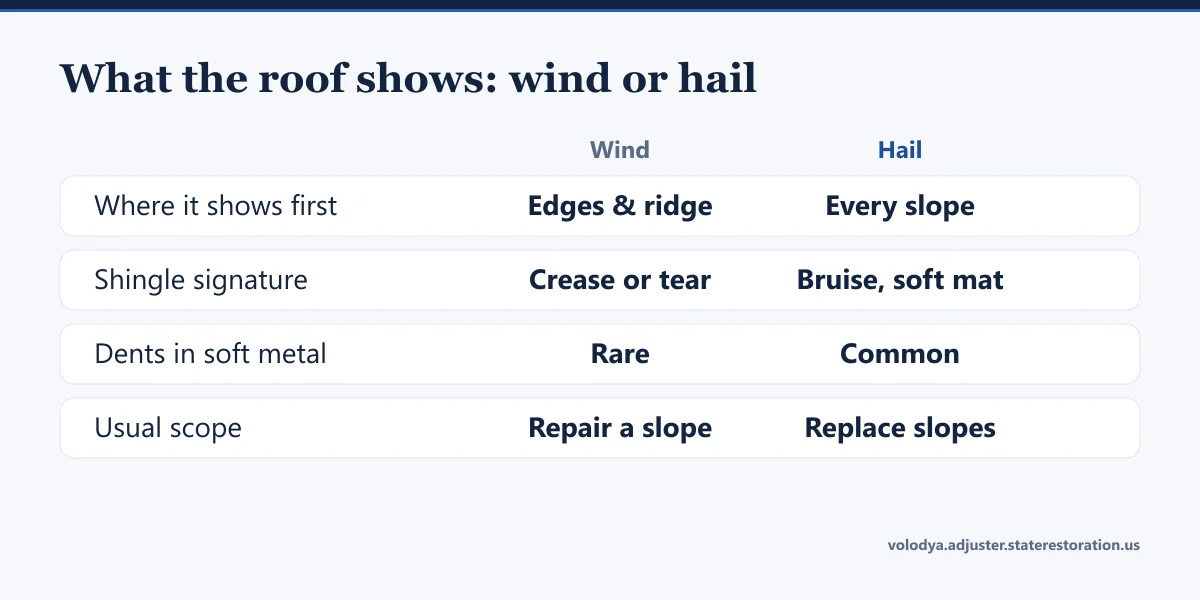
Wind and hail break a roof in different ways, and your carrier’s file records only one of them as the cause of loss. That word decides four things: how much of the roof is in scope, which deductible comes off the cheque, which exclusions the policy can raise, and what date the claim sits under. Wind works at the edges — creased tabs, broken seal strips, shingles gone from rakes and ridges. Hail lands on every slope the storm crossed and leaves round bruises with a fractured mat, plus dents in gutters and vents. If the label on your report does not match what is on the roof, raise it in writing before you agree to a number.
Wind damage and hail damage get discussed as though they were one claim with two names. They are not. On a Chicago roof the cause of loss is the first thing written into the file and the last thing anyone argues about, because everything downstream is decided by it.
I am a licensed public adjuster in Illinois (#19461872) and Indiana (#3556317), a HAAG certified inspector (#992104047) and a licensed Illinois roofing contractor (#105.009193). I climb roofs and I read the reports written about them, and the two do not always describe the same building. What follows is general information about Illinois and Indiana, the two states I am licensed in, and it is not legal advice.
What is the difference between wind damage and hail damage on a roof?
Hail is impact. It falls on whichever slopes faced the storm and bruises the shingle where a stone lands, fracturing the mat under the granules. Wind is leverage. It gets under the free edge of a shingle, breaks the seal strip and creases the tab, hardest at corners, rakes and ridges.
The pattern is what an inspector reads. A shingle is held down twice: by nails, and by a strip of factory adhesive bonding it to the tab below. Wind rarely tears one off in a single motion — it breaks the seal first, then works the tab until the mat creases across its width. A creased shingle can look perfect from the ground and still be finished: the crease is a hinge, and it will leak or let go in the next storm. Uplift is not even across a roof either. Pressure is highest at the corners, rakes and ridge, which is why a wind loss is often one or two slopes rather than the whole roof.
Hail leaves a different signature. A stone displaces granules in a rough circle and fractures the asphalt mat underneath, and the bruise feels soft under a thumb — that softness is the mat, not the surface. Granule loss on its own is not damage; shingles shed granules for twenty years without a storm. What separates hail is the fracture beneath the loss, and the randomness: hail does not respect the layout of the roof. I have set out what a HAAG inspector measures, including test squares and the marks routinely mistaken for hail, in hail damage on an asphalt roof.
| Evidence | Wind | Hail |
|---|---|---|
| Where it appears first | Corners, rakes, eaves, ridge and hip caps | Every slope the storm faced, at random |
| The shingle | Creased across the tab, seal broken, or missing | Round bruise, granules gone, mat fractured and soft |
| Soft metal | Ridge cap displaced, drip edge lifted, flashing peeled | Dents in gutters, downspouts, vents and valley metal |
Why does it matter whether my claim is called wind or hail?
Because four things follow from the label and none is easy to reopen afterwards: the scope of repair, which deductible comes off the cheque, which exclusions your policy can raise, and the date of loss the claim sits under. All four are settled before anyone discusses a price per square.
Homeowners tend to join the argument in the wrong place: they want to talk about the total, and the total is downstream of everything below.
| What it decides | Why it changes | Where to look |
|---|---|---|
| Scope | Wind is written slope by slope; hail takes every slope that fails the test | The scope pages — which slopes appear at all |
| Deductible | Often a percentage of the dwelling limit, with a smaller flat deductible for everything else | The declarations page, deductible section |
| Exclusions | Cosmetic damage endorsements usually attach to hail; wear and tear excludes both | The endorsement form numbers |
| Date of loss | It fixes the policy period, the deductible in force and the notice clock | The acknowledgement letter and the field report |
Does the cause of loss change my deductible?
It can, and by more than most homeowners expect. Many Illinois and Indiana policies carry a separate windstorm-or-hail deductible written as a percentage of the dwelling limit, alongside a smaller flat dollar deductible for everything else. Which one applies is decided by your declarations page, not by an adjuster.
A percentage deductible is calculated on Coverage A — the dwelling limit — not on the size of the loss, so it does not shrink when the damage is modest. Take an illustrative house insured for $300,000 with a $1,000 flat deductible, a 2 per cent windstorm-or-hail deductible and an agreed repair of $18,000. Under the flat deductible the payment is calculated after $1,000 comes out; under the percentage deductible, after $6,000. The repair has not changed. Only the label has. Those figures are a worked example to make the arithmetic visible, and nothing more.
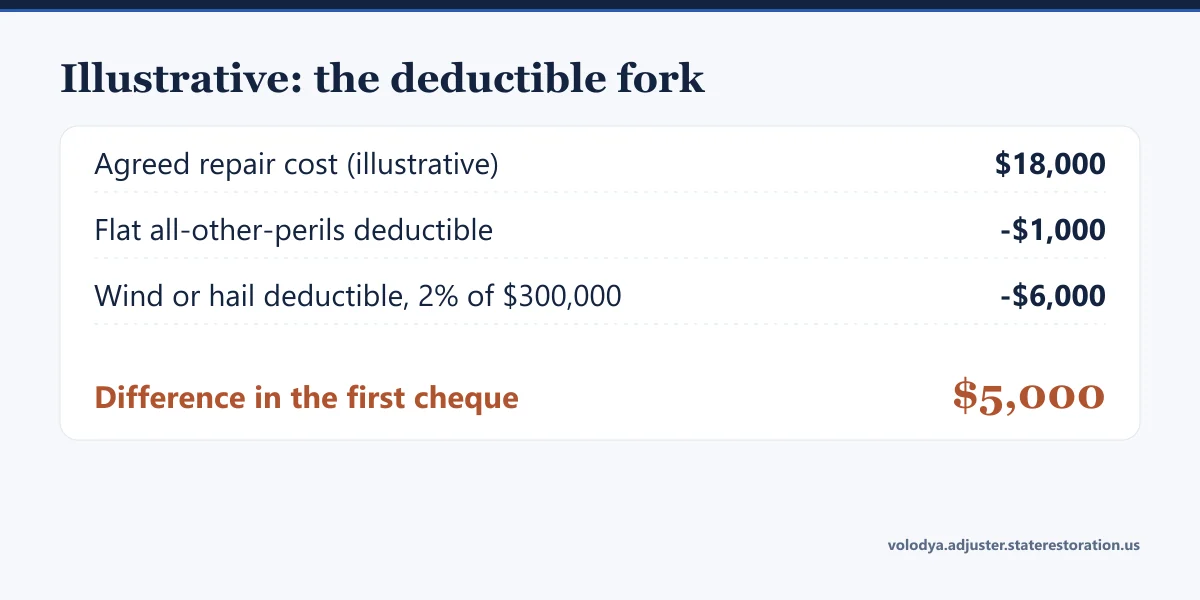
Wind and hail are often bundled into one deductible, and where they are, this question does not move that number at all. Two things still can. Some declarations pages split them, or apply the percentage to hail only. And a cosmetic damage endorsement — which limits payment for dents that do not affect how the roof performs — typically attaches to hail rather than wind. Read your own declarations page for the phrase “windstorm or hail”, the deductible beside it, and the endorsement form numbers underneath.
How do I tell which one hit my roof?
Start on the ground, not on the roof. Both leave evidence at eye level, and it is safer, faster and more persuasive than anything most homeowners can photograph from a ladder. Then match what you found against the weather record for that date, because two independent sources agreeing beats either one alone.
- Walk the perimeter first. Photograph the gutters and downspouts from the side and from above, the vents, the valley metal and the air-conditioner fins. Soft metal records hail honestly; asphalt hides it.
- Look for debris and displaced caps. Shingle tabs in the yard, ridge caps out of line, drip edge lifted at a corner, a fence section down — that is a wind story, visible from the driveway.
- Shoot each elevation whole. Four wide photographs of the four sides, not only the damage. Direction is evidence.
- Pull the weather record for the date. NOAA’s Storm Events Database and the Storm Prediction Center’s daily storm reports both publish reported hail sizes and measured wind gusts by county and date, free.
Date the photographs, keep them in one folder and do not edit them; if you later disagree with the cause of loss, that folder is most of your argument. What I would not do is climb up to prove a point — a wet or steep roof is dangerous, and foot traffic leaves scuffs the next inspector reads as damage.
What if the same storm brought both wind and hail?
That is common in Illinois — the cell that drops hail carries the gust front with it. One storm is normally one occurrence with one deductible, but the scope has to cover both mechanisms, and a report naming only one usually under-scopes the other. Check which slopes the report says were inspected.
The failure looks like this. An inspector finds obvious wind damage on the windward slope, writes it up properly, and never test-squares the other three slopes for hail. Nothing is denied — the claim is simply smaller than the loss, and the paperwork is internally consistent, which is why nobody catches it.
Two storms on different dates are a different matter. Each is its own claim with its own date of loss, its own deductible and its own notice clock, and the older one may already be short of time. I have set out the four clocks that run on an Illinois claim in how long you really have to file.
Why did my carrier call it wear and tear instead of a storm?
Because age, deterioration, manufacturing defect and installation error are excluded under most homeowner policies, so a non-storm cause of loss ends the claim without any argument about price. Sometimes that call is correct. What makes it checkable is that weathering and storm damage leave physically different marks.
Weathering is uniform: shingles across a slope lose granules together, curl at a similar rate and crack in patterns that follow the sun. Storm damage is not — hail is random across the field, wind is concentrated at the perimeter. A fracture made by a hailstone has a sharp edge with clean asphalt inside it; a crack made by twenty winters is weathered through and grey. Fastening is a related test: shingles nailed above the nail line let go in a gust that leaves a properly fastened roof untouched — an installation question, not a storm one.
The honest version is that a roof can be old and also be hit; those are not alternatives, and age by itself is not a finding.
What do I do if I disagree with the cause of loss?
Ask in writing for the field report and the basis for the determination. Then answer it with evidence rather than opinion: your dated photographs, the weather record for the date, and a request for a re-inspection with your own representative on the roof. Give a date by which you expect a reply.
A re-inspection is the ordinary route and it resolves more of these than homeowners expect, because a second estimator arrives with one specific question rather than a whole roof. What comes next, if it does not settle, depends on what is actually in dispute. If both sides agree the storm damaged the roof and disagree about the cost, that is a dispute about the amount of loss, and most policies contain an appraisal clause built for it. If the disagreement is whether the storm caused the damage at all, that is a coverage question, and whether an appraisal panel may decide it is a legal question. I am a public adjuster, not a lawyer, and when a claim turns on what your policy obliges anyone to do, an attorney is the right person to ask.
Both the Illinois Department of Insurance and the Indiana Department of Insurance accept consumer complaints about claim handling. A complaint does not replace the claim, but it creates a record.
What to do next
If you are holding a report whose words do not match what you saw in your own yard, put the photographs and the weather record for that date side by side before you agree to anything.
If you would rather someone read the roof and the report together, the free inspection and policy review is exactly that: I test what needs testing and tell you what the evidence supports — including the times it supports the carrier and you do not need a public adjuster. The offerings page sets out the work I take on, and my licences and certifications are published in full. My hours are Monday to Friday 9–6, Saturday 9–5 and Sunday 10–5, and I speak English, Ukrainian and Russian.
Nothing above is legal advice. Inspecting a roof, documenting a cause of loss and negotiating a scope is claim handling, and that is my job; what your policy obliges your carrier to pay is a legal question for an attorney.