Hail can break a TPO, PVC or EPDM roof without leaving anything you can see from the top. On a single-ply membrane the fracture usually starts on the underside of the sheet, at the point where the stone pushes the membrane into the board below it, and it may take weeks of sun and cold before it opens far enough to leak. That is why two honest people can walk the same flat roof after a storm and disagree. The disagreement is settled by a test cut, a moisture survey and photos of the underside of the sheet, and the building owner has every reason to be on the roof when those are done.
I am a licensed public adjuster in Illinois (#19461872) and Indiana (#3556317), a licensed Illinois roofing contractor (#105.009193) and a HAAG certified inspector (#992104047). This post is for owners and managers of buildings with a membrane roof: a strip mall, a warehouse, a church, a mixed-use building on a Chicago commercial street. It covers how hail damage on a single-ply roof is found and proved. What your policy wording means in a lawsuit is a question for a lawyer.
How does hail break a single-ply roof membrane?
A hailstone bends the sheet down into whatever sits under it, and the bottom face of the sheet stretches more than the top. So the crack begins underneath and works its way up. The stiffer the support under the impact, the harder the membrane is hit, which is why the worst spots on a mechanically fastened roof are the metal plates that hold the sheet and the boards down. Scott Morrison, a principal engineer at Haag Engineering, lays this out in his NRCA article "Holy hail!" in Professional Roofing, which is still the plain-language reference I hand to owners.
A fastened single-ply roof, top to bottom. Thickness varies by building; read yours off the original roofing invoice or a core.
Morrison's article also gives the test that matters for a claim. A roof is functionally damaged when hail has reduced its ability to keep water out or has shortened its expected life. A dent you can see but which did neither of those things is, in an engineer's report, cosmetic. Every argument about a flat roof hail claim comes back to that definition.
Is hail damage different on TPO, PVC and EPDM?
Yes. The two thermoplastic sheets, TPO and PVC, get stiffer and more brittle as they age and as the air gets colder, so the same storm does more harm to a fifteen-year-old sheet in a cold spring than to a new one in July. EPDM is rubber. It stretches under the stone and comes back, and Morrison notes that it does not build up fatigue from repeated hits, so on EPDM I spend more time on what is under the sheet than on the sheet itself.
| Membrane | What hail tends to leave | Where to look first | What makes it visible |
|---|---|---|---|
| TPO | Circular or star-shaped cracks, crescent cuts at plates | Seam laps and plate rows on fastened roofs | Bending the sheet by hand, a bright light from behind a cut sample |
| PVC | Star-shaped cracks in older, stiff sheets | South and west slopes, which get the most sun | Time: some cracks show on top only after the sheet relaxes, so a second look weeks later helps |
| EPDM | Dented or cracked insulation under an intact or slightly torn sheet | Soft spots underfoot, flashing at curbs and walls | Pressing on the sheet, then a core through the insulation |
Two conditions hide all of this. Water, snow or ice on the roof covers small cracks completely, and a low winter sun makes them hard to see even on a dry day. If the inspection is booked for a wet morning, ask for another date. Hail often travels with wind, and a lifted edge or a torn seam can be either peril; the way the two are told apart is in my post on wind vs hail as the cause of loss.
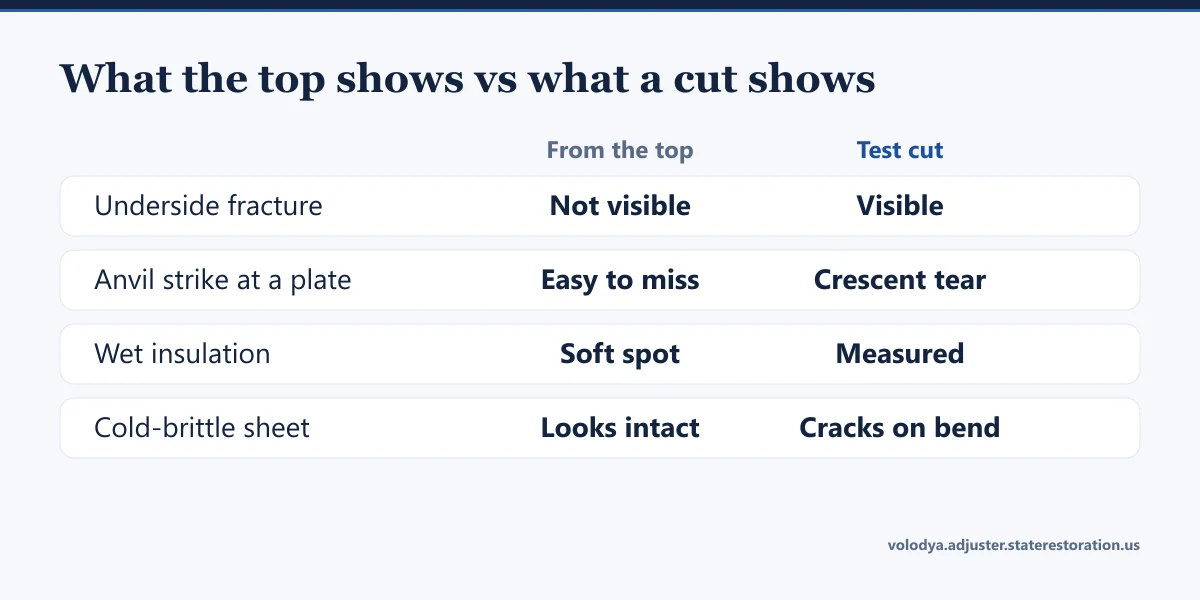
What happens at a test cut, and why should I be there?
A test cut is a small piece of membrane, sometimes with the insulation under it, taken out of the roof so the underside can be examined. It is the one piece of evidence on a flat roof that nobody can argue with later, as long as everyone knows where it came from. So the owner's job is less about the cutting than about the paper trail around it.
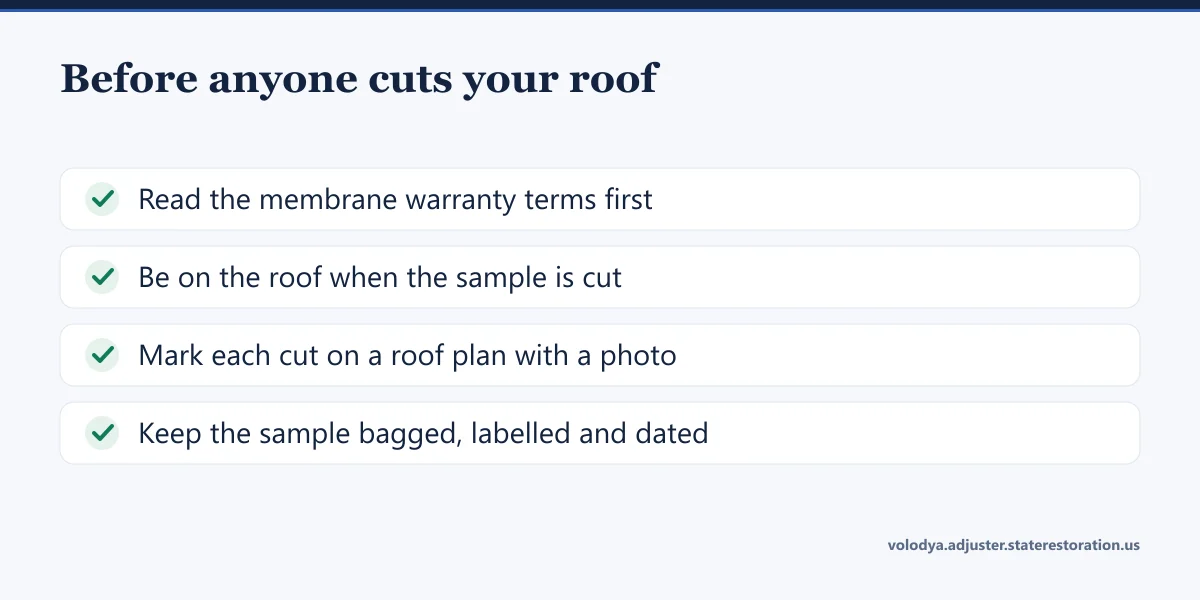
- Before anyone cuts, read the membrane manufacturer's warranty, or ask your roofer to. Some warranties expect repairs to be made by a contractor the manufacturer has approved, and you want the patch done by someone who keeps that warranty alive.
- Agree on where the cuts go. The insurer's inspector will often pick one spot; I ask for one at a plate row, one over open field and one in an area that looks clean, so the result is not decided by the choice of spot.
- Be on the roof, or send someone, when the sample comes out. Photograph the spot before the cut, the underside of the sample next to a tape measure, and the hole before it is patched.
- Mark every cut on a roof plan with its number. A sample nobody can place on the roof is worth very little six weeks later.
- Have the roofer patch each cut the same day and keep the patch invoice. It is part of the claim.
- Ask for the sample, or half of it. If the inspector keeps it for a laboratory, ask in writing for the lab's photos and findings when they exist.
How is wet insulation found under a flat roof?
Usually in two steps: a survey that shows where the roof is probably wet, and cores that prove it. An infrared camera, used in the evening after a sunny day, picks up the areas that hold heat longer because wet board cools more slowly. An impedance meter, rolled or pressed across the membrane, reads moisture in the layer under it. Neither is proof on its own. A core in the middle of a suspect area, and another just outside it, turns a picture into a measured wet area in square feet.
The size of that area decides a lot. Wet board under a patched membrane keeps the moisture against the deck, and a repair estimate that patches the sheet but leaves the insulation wet has priced the problem away rather than fixed it. If the inspector did not survey the roof for moisture, that is the first thing I ask about.
The one question to ask the inspector on the roof: "Which areas did you check for wet insulation, with what, and can I have the readings?"
Here is an illustrative test-cut log from a made-up 300-square roof divided into four sections. The numbers are a worked example, not a real building, and they show why one roof can need a patch in one corner and new insulation and membrane in another.
| Section | Cut and location | Underside of the sheet | Insulation | What the result supports |
|---|---|---|---|---|
| A, north | #1, open field | No fracture | Dry | No repair from this storm |
| B, east | #2, plate row | Crescent cut at plate edge | Dry around the cut | Repair of the plate row, after counting how many plates are cut |
| C, south | #3 and #4, field and plate | Star-shaped crack in both | Wet across about 1,800 square feet by core | Replacement of membrane and insulation in this section |
| D, west | #5, near a curb | Crack at the curb flashing | Wet within a few feet of the curb | Flashing and insulation repair at the curb |
Whether section C alone or the whole roof is replaced then depends on the policy wording, on whether the new sheet can be welded to the old one in sections A, B and D, and on what the code requires once a section is torn off. That last part is covered in my post on code upgrade coverage in Illinois. If the building cannot be used while the roof is open, the owner's lost income is a separate part of the claim, explained in the post on business income after a fire or leak.
The engineer's report says "no functional damage". What now?
Read it against the definition it uses, not against its conclusion. A report that finds cosmetic marks and no functional damage is a statement about specific cuts, specific areas and specific conditions on one day. These five things tell you whether those conditions were enough to support it.
- Were the undersides examined?
- Count the cuts and the photos of the underside of each sample. A report with no cuts has judged the top of the sheet only.
- Where were the cuts taken?
- Check them against the roof plan. Cuts only in open field on a fastened roof skip the plate rows, where damage usually starts.
- What was the weather that day?
- Look for the temperature, and whether the roof was wet or snow-covered. Standing water hides small cracks.
- Was moisture surveyed?
- Look for an infrared survey, impedance readings or cores. A report silent on the insulation has not answered the question of water under the sheet.
- Which hail date was checked?
- The report should name the storm and the hail reports for your address. A date that does not match your claim is worth pointing out in writing.
If the report missed something on that list, the next step is a written request for a reinspection with your own roofer or adjuster present, sent with your own photos and readings. If the insurer accepts that the hail damaged the roof but you disagree on how much it costs to fix, the policy usually offers appraisal, which settles the amount and not whether the damage is covered. A dispute over coverage itself, or over what a clause means, belongs with a lawyer.
When is a flat roof hail claim not worth filing?
When the cuts are clean, the insulation is dry and the only marks are on rooftop units that still run, the honest answer is often to fix the fins on the condenser and keep the roof under watch. The same goes for a roof whose leaks began years before the storm, or one where the wind and hail deductible, sometimes written as a percentage of the building's insured value, is larger than the damage the cuts showed. I would rather tell an owner that after the inspection than file a claim that adds a denial to the building's record. If you are unsure, my commercial roof damage claims page lists what I need to look at a roof and its estimate. For pitched roofs on the same property, the shingle side is in my post on hail damage on an asphalt roof.