Yes. When a covered fire sends smoke and soot through the house, the smoke damage is part of the same claim in every room it reached, including bedrooms and a basement the flames never came near. A smoke damage insurance claim is rarely refused outright. The argument is about how far the smoke went and whether each surface and each object can be cleaned or has to be replaced, and that argument is won with a room-by-room record made before anyone starts wiping.
I am a licensed public adjuster in Illinois (#19461872) and Indiana (#3556317), and a licensed Illinois general contractor (#TGC115063). I represent the homeowner, never the insurance company. This post walks a house after a kitchen fire and shows where the second half of the claim usually sits. What a court would make of a particular policy is a question for a lawyer, and I say where that line falls.
Which part of the policy pays for smoke on the walls, and which part for smoke on the sofa?
Two different parts, and they are written differently. On the common HO-3 form the house itself is covered for any direct physical loss that is not excluded, while your belongings are covered only for the perils the policy lists, and smoke is one of those listed perils. The Illinois Department of Insurance describes the same split in its Property Insurance Consumer Guide: on the special form, personal property is covered "for perils listed in your policy."
The house (dwelling coverage)
Walls, ceilings, trim, cabinets, ductwork, insulation, built-in fixtures
Covered unless an exclusion applies. Soot on a bedroom ceiling after a kitchen fire is a direct loss caused by the fire, so the question is only the size of the repair.
Your belongings (personal property)
Furniture, clothing, bedding, electronics, books, curtains
Covered for the named perils, which include fire and smoke. The usual smoke wording, quoted in the FC&S analysis of the standard forms, also reaches puffback of soot from a furnace or boiler.
The same FC&S page explains what stays outside that wording: smoke from agricultural smudging and from industrial operations, because those are constant exposures rather than accidents. A house fire is the opposite case. Read your own declarations page and the "Perils Insured Against" section, because a carrier can write its own form, but on the policies I see in Chicago the sofa and the ceiling are both inside the claim.
How does smoke reach a bedroom on the far side of the house?
It rides the air. Hot smoke rises, spreads along ceilings, pushes into any room with an open door and gets pulled into the heating system through the cold-air returns. A 2019 training presentation published by the National Air Duct Cleaners Association, Cleaning Air Ducts After A Fire, names the return duct as the most common way soot gets into the system and notes that ducts can be contaminated even when the furnace was off, because of the way pressure moves through a burning building. The presenter adds that the views are his own, not the association's position. In a typical Chicago brick bungalow with a fire at the kitchen stove, the smoke spreads like this:
Layout of an illustrative bungalow. A two-flat or a raised ranch moves smoke along different paths, but stairs, returns and open doors carry it in every one.
Before anyone cleans, walk the house with a phone and photograph these places in every room, close up and with a white cloth wiped across the surface so the residue shows:
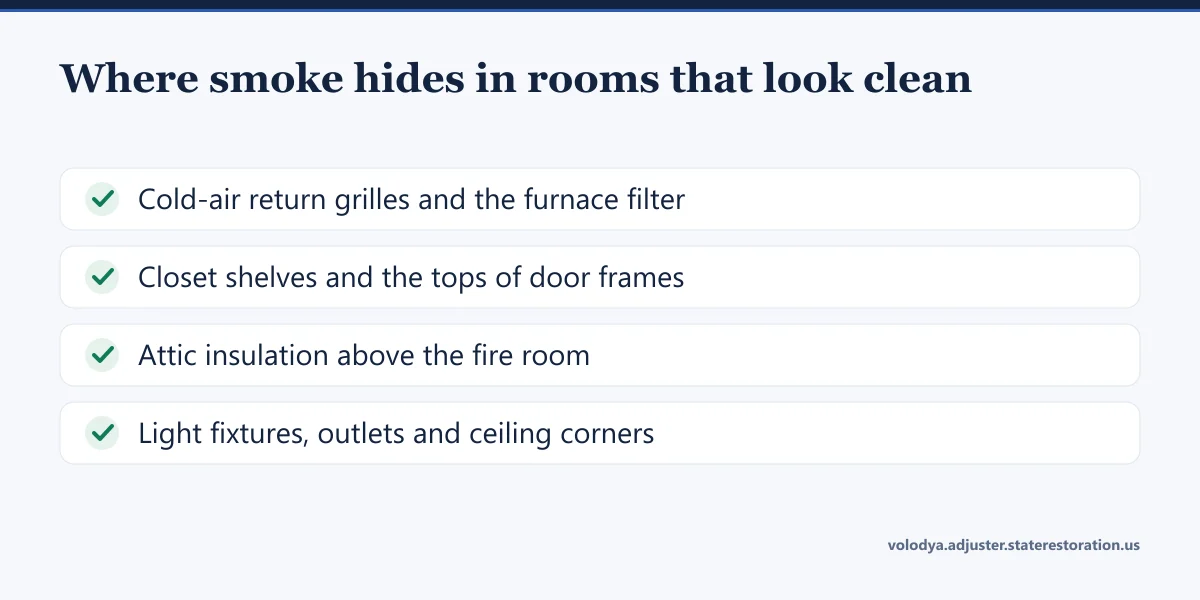
Clean or replace: where is the line drawn?
Cleaning comes first, and replacement is paid when cleaning has been tried or plainly will not work. That is fair, and it is also where a smoke claim gets underpaid, because an estimate often stops at the first step for every room. Think of it as a ladder. Each surface or object climbs only as far as the evidence pushes it:
Dry cleaning
HEPA vacuuming and dry chemical sponges on walls and ceilings with a light, dry film.Moves up when the sponge smears instead of lifting, which is common with greasy kitchen smoke and burnt plastic.Wet cleaning
Washing with a cleaner chosen for the residue. The NADCA presentation separates a protein fire, the burnt pot of food that leaves an almost invisible film with a strong smell, from a plastic fire, whose soot is sticky.Moves up when the stain or the smell comes back after the surface dries.Seal and paint
An odor-blocking primer and finish coats on cleaned walls and ceilings. This is a normal repair on rooms next to the fire, not an upgrade.Moves up when the material itself is changed: warped, cracked, melted or soaked through.Replace
Insulation, melted flex duct, ductwork that flame touched, porous items that kept the smell after cleaning. The same presentation notes that galvanized steel duct hit by direct flame fails over time and has to be replaced.Proof: the cleaning record from the rungs below, photos of the material, and the restorer's written reason.
The same logic applies to belongings. A leather chair may come clean; a mattress or a pillow that smells of smoke after professional cleaning is a replacement item. Keep the cleaner's tags and the list of what came back still smelling, because that list is the evidence for the next rung. How to build the inventory itself is in my post on listing contents after a fire when you have no receipts.
What should the heating and cooling lines on the estimate include?
More than "clean ducts". A furnace that ran while the house was smoky has soot in the return, the blower, the coil and the supply runs, and a filter swap does not reach any of it. Use this table to read that part of the estimate, or the part that should be there and is not. How the columns of an estimate work is in reading an Xactimate estimate line by line.
| Part | What contamination looks like | What to ask for on the estimate |
|---|---|---|
| Filter and return grilles | Gray or black filter, dark streaks on the grille slats | Photos kept as evidence before the new filter goes in |
| Return and supply ducts | Soot inside when a register is lifted, dark marks on the ceiling around supply diffusers | Source-removal cleaning of the whole system, priced per run or per opening |
| Blower and motor | Soot packed on the fan blades and the motor windings | Blower removed and cleaned; the NADCA presentation warns that soot left on hot windings keeps the smell alive |
| Coil | Residue pushed through the filter onto the cooling coil | Coil cleaning as its own line, separate from the ducts |
| Flex duct near the fire room | Sagging, melted or blistered jacket | Replacement, since melted plastic duct cannot be cleaned |
One more point from that presentation is worth repeating to any adjuster who proposes fogging the vents and calling it done: deodorizers and coatings are an addition to source removal, never a replacement for it. A spray that covers the smell for a month leaves the soot in place.
What does a fully mapped smoke scope add to a kitchen fire estimate?
It adds whatever the rooms beyond the fire actually need, and on a house that was closed up while the fire burned that is often a lot. The figures below are an illustrative worked example for the bungalow above, not a typical or promised amount. Your numbers come from your house, your contractor and your carrier's price list.
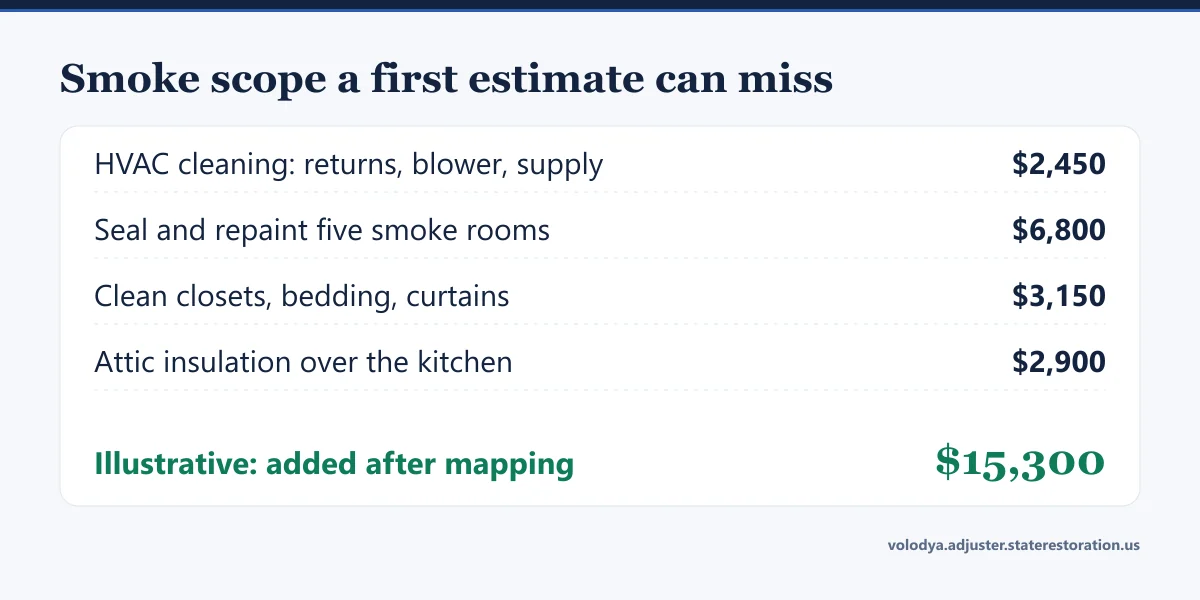
In that illustrative example the first estimate covered the kitchen and a wipe-down of the hall. Mapping the residue room by room, with the filter photos and the closet swabs, added four lines worth $15,300 in the worked example. None of those lines is exotic. They were simply outside the room everyone was looking at.
The house still smells, but the walls look clean. Does that count?
Smell is evidence that residue is still there, so it counts, but a smell alone is hard to price. Pair it with something an adjuster can see: wipe samples, the dirty filter, photos inside a register, the cleaner's report of what came back still smelling. That is the difference between "we think it smells" and a scope.
The reason to be careful is a 2025 California appeals decision, Gharibian v. Wawanesa, in which a homeowner's claim for soot and ash debris left around a house by a nearby wildfire was found not covered. United Policyholders and the Consumer Federation of America asked the California Supreme Court to depublish it, as described on the United Policyholders case page. It is a California case about wildfire debris, not Illinois law about a house fire, and I would not read more into it than this: a file built on what the residue did to surfaces is stronger than a file built on smell. If an insurer denies smoke damage on the ground that nothing was physically damaged, how that wording applies to your policy is a question for an Illinois attorney.
What should I do in the first two weeks?
- Keep the furnace off until the system has been looked at, unless the cold makes that unsafe; then ask the restorer to filter the returns first.
- Take the photos in the checklist above, in every room, before any cleaning crew arrives.
- Keep the old furnace filter in a sealed bag.
- Ask your insurer in writing which rooms its estimate includes, and list the rooms it left out.
- Throw nothing away until the adjuster has seen it or agreed in writing.
- Keep receipts for a hotel if the smell makes the house unlivable; that is the loss of use coverage covered in my post on additional living expenses.
If the fire department or an investigator is still involved, what that means for the timing is in the post on the insurer's fire investigation.
When do you not need a public adjuster for smoke damage?
When the smoke stayed in one room, the insurer's estimate already includes every room you can find residue in, and the cleaning company's work holds up after the first week. Then my fee would buy you very little. Bring someone in when the estimate stops at the fire room, when the heating system is missing from it, or when the clean-versus-replace answer is "clean" for everything. That is the work described on my fire damage claims page, and you can send me the estimate and the photos to look at first.