If your townhouse belongs to an association in Illinois, no statute says who insures the roof, the siding or the drywall under them. The recorded declaration of your community decides it. The Illinois Department of Financial and Professional Regulation puts it in one line: after listing what a condominium association must carry, its FAQ on association insurance tells a common interest community association to review its community instruments to determine what insurance the Association is responsible for maintaining
. So before anyone argues about a hail claim on a townhouse row, somebody has to read that document. On a townhouse file, that reading is the first hour of my work.
Why the condo statute does not decide a townhouse claim
Illinois has two separate laws for people who share a building with their neighbours, and only one of them talks about property insurance.
Condominium Property Act
765 ILCS 605, Section 12The association must insure the common elements and the units, including the bare walls, floors and ceilings unless the board decides otherwise, against special form causes of loss and for the full insurable replacement cost.
I read that section subsection by subsection in my guide to water coming from the condo above.
Common Interest Community Association Act
765 ILCS 160Covers real estate other than a condominium or cooperative
, and its definition in Section 1-5 names an attached or detached townhome, villa, or single-family home
.
Its one insurance section, 1-55, is fidelity insurance on the association's money, required once a community has 30 or more units. It says nothing about the roof over your bedroom.
A few townhouse developments were created as condominiums, and then Section 12 does apply. The declaration says at the start which act it was recorded under, so that is the first page to check.
Four ways a declaration can split the building
Because the statute leaves it open, declarations differ a lot. Read yours against these four patterns. Each strip runs from the roof down to the sofa, and tells you whose policy answers for that layer.
1. The association insures the whole shell
2. The association maintains the roof, the owner insures it
3. The association insures the roof only
4. Each owner insures the whole unit
Solid navy border: the association's master policy. Dashed border: the owner's own policy. These are patterns to read against, not a count of how often each one turns up.
The second pattern is the one that causes trouble, and it is real. In a 2011 reader question in CooperatorNews Chicagoland, an owner in a 40-unit townhome association in Des Plaines described a declaration under which the association owned and maintained the shingle roof while every owner had to cover roof losses on a personal homeowner policy. After a spring hailstorm, roughly 30 percent of the owners claimed on their own insurance and each hired a roofer separately. The Naperville attorney who answered called it an example of a poorly drafted declaration
and suggested an amendment. In the fourth pattern the association usually still insures what everyone shares, such as a clubhouse, a pool or private streets.
How do I find which pattern my association uses?
Ask the board in writing for the recorded declaration, the bylaws and the rules, then read the parts on maintenance, insurance and damage. The Act gives you the right to the papers, with a clock on the board's answer.
- Send the request by email or letter to the board or the managing agent.
Section 1-30(i) requires the board to keep the recorded declaration, the other community instruments, the bylaws and the rules available for examination and copying. It may charge a reasonable copying fee. A written request left without an answer for 30 days counts as a denial, and an owner who then wins in court can recover attorney's fees if the court puts the failure on the board.
- Check whether your association is small enough to be outside the Act.
Section 1-75 exempts an association with 10 units or less, or with annual budgeted assessments of $100,000 or less, unless it votes to be covered. The declaration is still a public record, because the Act defines recording as filing with the recorder of the county where the property sits. The county can give you a copy.
- Read the definition of your unit or lot before anything else.
If the lot line is drawn around the land under your part of the building, the roof and the walls sit on what you own; then check whether the insurance article follows the same line. If the unit stops at the inside face of the walls, the shell is common area.
- Search the text for insurance, casualty, damage or destruction, exterior, roof and maintenance.
Write down any clause where the maintenance duty and the insurance duty point at different people. That is the Des Plaines problem, and it is a question for the association's attorney before a claim is filed.
- Ask for the declarations page of the master policy and pull out your own.
On the master policy, look at which buildings are listed and the deductible for wind and hail. On yours, look at the dwelling limit and whether loss assessment coverage is listed and for how much.
- Ask for the board minutes of the last few years.
Minutes have to be kept for at least seven years. They show whether an earlier board already filed a roof claim on your row, which matters when an adjuster talks about the roof's age.
From January 1, 2028, a later amendment to the same section requires boards to keep a website with meeting information and approved minutes, so this step should get easier.
Which policy pays for each part of a hail claim?
Once you know the pattern, each piece of the damage goes to one policy. The table follows the first and the fourth patterns, because the other two are mixtures of them.
| Damage | Association insures the shell | Owner insures the whole unit |
|---|---|---|
| Shingles, underlayment and roof deck | Master policy, after its deductible | Your dwelling coverage |
| Siding, gutters and windows | Master policy, when the declaration counts them as exterior | Your dwelling coverage |
| Ceiling and drywall below the leak | Wherever the declaration ends the association's part; often your policy | Your dwelling coverage |
| Furniture, rugs and clothing | Your personal property coverage | Your personal property coverage |
| A hotel while the unit cannot be lived in | Your loss of use coverage | Your loss of use coverage |
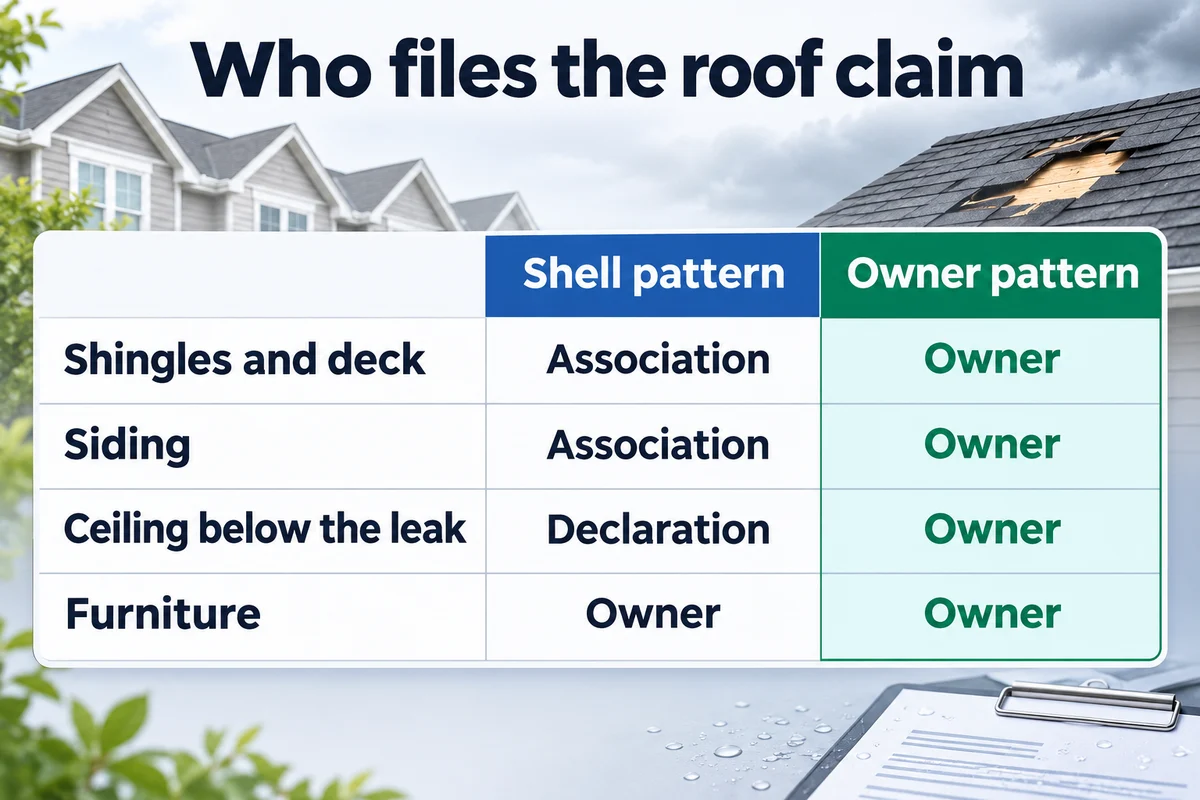
Sometimes both policies cover the same roof, for example when the declaration makes the association insure it and you also bought full dwelling coverage. Two policies do not pay twice. The standard homeowner form, ISO HO 00 03 05 11, says in its Other Insurance condition that it pays only the proportion of the loss that its limit bears to all the insurance covering that loss. The master policy has its own clause on the same point, and the two have to be read side by side before either carrier is told the number.
Who pays the association's deductible?
Your declaration and the board's rules decide whether a master policy deductible is passed on to owners. The townhouse statute does not set a rule, so the charge-back can be equal shares, shares by damage, or nothing at all.
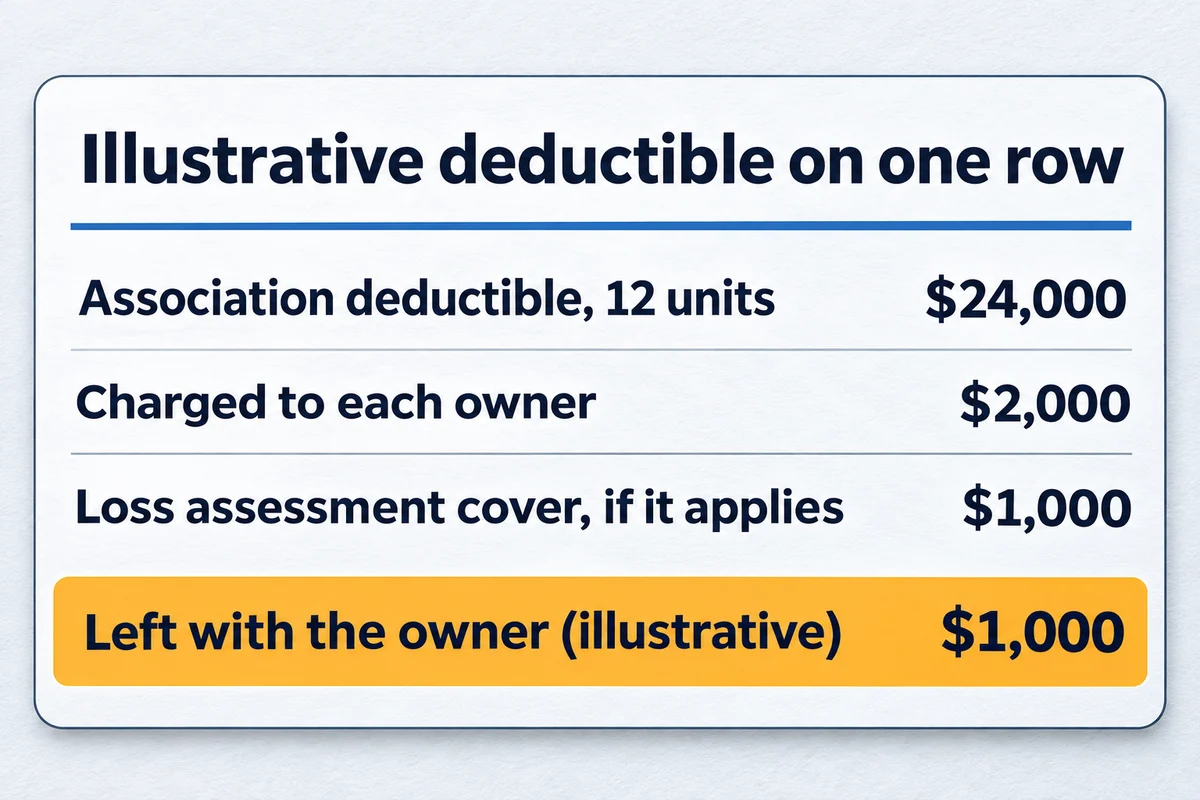
Take an illustrative 12-unit row with a $24,000 wind and hail deductible on the master policy, and a declaration that lets the board split it equally among the owners of the damaged units. All 12 roofs were hit, so each owner is billed $2,000. The owner then looks to the loss assessment part of a personal policy, which the standard form words like this:
We will pay up to $1,000 for your share of loss assessment charged during the policy period against you, as owner or tenant of the "residence premises", by a corporation or association of property owners. The assessment must be made as a result of direct loss to property, owned by all members collectively, of the type that would be covered by this policy if owned by you...
Two parts of that sentence decide the outcome. The limit is $1,000 unless you bought more. And the loss has to be to property owned by all members collectively
. Where the roof is common area, the assessment fits that phrase and, in this illustrative example, the owner pays $1,000 out of pocket. Where the roof sits on each owner's own lot, the carrier can say the charge is for property the members do not own together, and the owner may be left with the whole $2,000. That reading belongs to your insurer, and I ask for it in writing. Higher limits are sold by endorsement; my article on condo special assessments after a loss reads the endorsement wording line by line.
The first week after hail hits a townhouse row
- Photograph your roof from the ground, every stained ceiling, the siding and the gutters, with the date showing. If water is coming in, have it tarped and keep the receipt.
- Tell the board or the manager in writing what you see, and ask whether the association will file and under which claim number.
- If the declaration puts any part of the damage on you, or you cannot tell yet, report it to your own insurer as well. Your policy's notice clock runs separately from the association's, as my article on Illinois claim deadlines explains.
- Do not sign a contract with a door-to-door roofer for a roof the association repairs. What Illinois law puts into a roofing contract after a hailstorm still applies, but the person signing has to be the one who controls the roof.
- Keep a short log of who inspected what: the association's adjuster, your insurer's adjuster, roofers.
The roof is easiest to document in the days after the storm, before repairs and more weather change it, whatever the declaration says. My hail damage claim work starts there, and the question of whose policy pays runs alongside it.
When the board and an owner read the declaration differently
What a declaration means is a legal question, and I'm a licensed public adjuster, not a lawyer. If the board says the roof is yours to insure and you read it the other way, the association's attorney, or a lawyer you hire, gives that answer. Section 1-30(j) of the Act gives the board standing to act for owners in matters involving the common areas or more than one unit, so when the roof is common area the board can file one claim for the whole row.
My part is the claim itself: measuring the damage, pricing it, and negotiating it with the carrier for the party who holds the policy. For a board, that is the same work I do on association building claims.
When a townhouse owner does not need a public adjuster
If a few shingles blew off and the repair is below your deductible, there is nothing to claim. If the association has filed and its adjuster's estimate for your unit matches what an honest roofer found, let the association's claim run. A contents claim of a few hundred dollars does not need me either. When the numbers are large, the declaration is unclear or the two policies point at each other, send me the declaration and the photos. Looking at them costs you nothing.