When water comes through your ceiling from the condo above, two policies usually share the repair in Illinois. The association's master policy pays for the building and for the bare walls, floors and ceilings of your unit, and it pays first. Your own unit-owner policy, often called an HO-6, pays for the finishes and upgrades you own, your belongings and your costs of living elsewhere. The upstairs owner is not automatically the one who pays: the association's insurer has given up the right to pursue unit owners, and the board decides who carries the master policy deductible.
I am a licensed public adjuster in Illinois (#19461872) and Indiana (#3556317), and I work for the owner on water damage claims, including condominium units. Everything below comes from one statute, section 12 of the Illinois Condominium Property Act (765 ILCS 605/12), read against what an owner has to do with a wet ceiling. Your declaration, your bylaws and both policies decide the details. This is general information, not legal advice.
Which part of my unit does the association's policy cover?
The structure and the bare surfaces of your unit are on the association's policy, and what covers those surfaces is yours. Section 12(a)(1) requires the master policy to insure the common elements and the units, and it names each unit's bare walls, floors and ceilings, with one opening for the board: "except as otherwise determined by the board of managers". The cover has to be special form coverage for full replacement cost, less deductibles. Read from the building inward, a unit splits into four layers.
Structure, roof, outside walls, hallways, and pipes and risers that serve more than one unit. These are common elements, insured by the association.Section 12(a)(1)
The unfinished surfaces of your unit, plus fixtures the developer originally installed within them. Insured by the association unless the board has determined otherwise.Sections 12(a)(1) and 12(b)
Paint, flooring, wall and ceiling coverings, and what owners installed: cabinets, appliances, a water heater, light fixtures. The statute excludes coverings from the common elements and does not require the association to insure owner-installed items.Section 12(b)
Furniture, clothes, electronics, and a hotel or rental while the unit cannot be lived in. Only your own policy pays for these.Your HO-6
Whether the drywall counts as a bare wall, and whether the kitchen the developer put in counts as an original fixture, is written in your declaration or in a board decision. Ask for that page in writing before anyone starts tearing out. The statute's own definition of what is yours is short enough to read in full:
"Improvements and betterments" means all decorating, fixtures, and furnishings installed or added to and located within the boundaries of the unit, including electrical fixtures, appliances, air conditioning and heating equipment, water heaters, built-in cabinets installed by unit owners, or any other additions, alterations, or upgrades installed or purchased by any unit owner.
The association may choose to insure these as well. If it does, section 12(b) lets it charge the extra premium to the units affected.
Does it matter where the water came from?
Less for coverage than people expect, and more for the deductible. A sudden leak damages the same layers whichever pipe failed, and the master policy covers the bare surfaces either way. The source decides who repairs the pipe, whether the board can charge the deductible to the unit above, and whether an exclusion comes into play.
| Where it came from | What the source decides | What to keep |
|---|---|---|
| A riser or drain line that serves several units | Usually a common element. The association repairs the pipe, and the deductible is harder to put on any one owner. | The plumber's invoice naming the pipe and the units it serves. |
| A supply pipe that serves only the unit above | The declaration's maintenance section says who repairs that pipe. The damage to your bare ceiling still goes on the master policy. | The failed fitting or section of pipe, bagged and dated. |
| A washer hose, toilet or tub overflow upstairs | Coverage splits the same way. This is the case where the board is most likely to assess the deductible to the owner above. | The time it started, the plumber's note, and photos of the source if the neighbour allows. |
| The roof, a window or an outside wall | Common elements. The association's policy and its own deductible. | Photos of the ceiling and of the outside, and the date of the storm. |
| A backup through the building drain | Many policies exclude backup unless an endorsement was bought, on the master policy and on yours. | The endorsement pages of both policies. |
Water that seeped for weeks is a different claim from a pipe that let go on Tuesday. Most policies exclude long-term leakage, so the date the leak started is worth pinning down early. The line between water damage and flood is in my guide to water damage vs flood.
Who pays the master policy deductible?
The board does not have to send the deductible to the owner above. Section 12(c) gives it three choices for a claim for damage to a unit or the common elements:
- Pay the deductible amount as a common expense, shared by all owners.
- After notice and an opportunity for a hearing, assess it against the owners who caused the damage or from whose units the damage or cause of loss originated.
- Require the owners of the units affected to pay it.
The worked example below is illustrative, with invented figures, to show how the money moves. The association's policy carries a $10,000 deductible. A washer hose fails in the unit above and the unit below has $18,500 of damage.
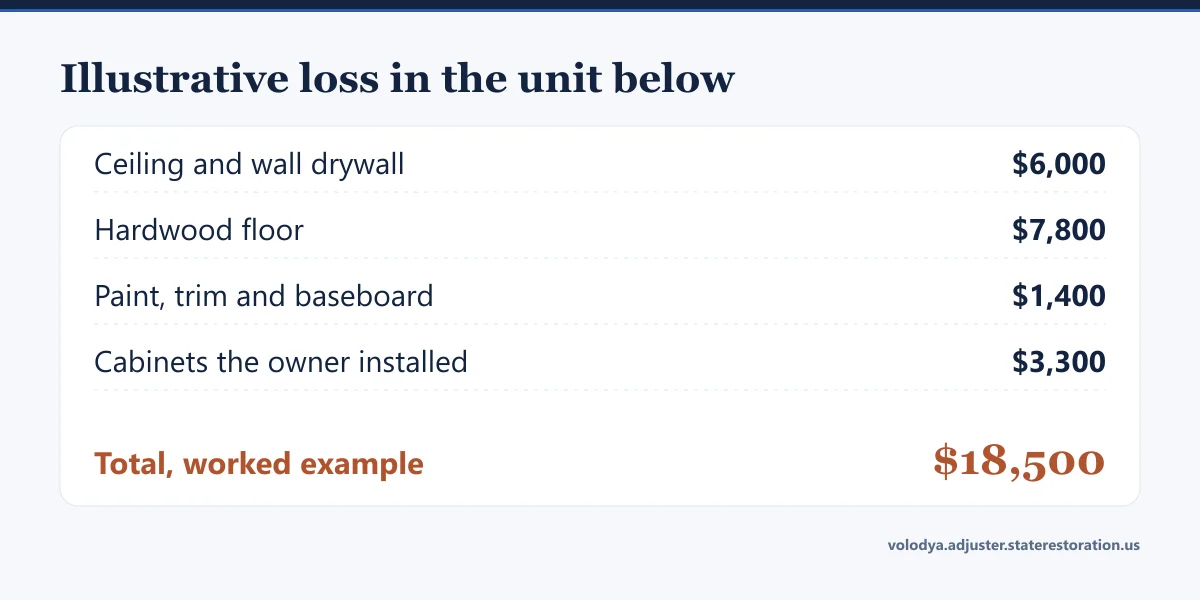
In this illustrative example the declaration treats drywall as bare wall, so $6,000 sits in the association's layer. All of it is inside the $10,000 deductible, and the master policy pays nothing toward it. That $6,000 is what the board now places with one of the three choices above. The other $12,500 is floor, finishes and cabinets the owner installed, which go to the owner's HO-6. With an illustrative $1,000 deductible on that policy, it would pay up to $11,500, less any depreciation it holds back until the work is done.
If the board picks the third choice and you are charged as the affected owner, ask your own insurer whether your loss assessment coverage applies. Many unit-owner forms carry a small amount of it, and the limit is on your declarations page. Section 12(h) adds one more piece: the board may require every owner to carry insurance for damage their unit causes to another unit, and that coverage "must include the deductible of the owner whose unit was damaged". If your building has such a rule, the upstairs owner's policy is where your deductible may be paid from.
Can anyone go after the owner upstairs?
Not the association's insurer. Section 12(e)(2) requires every master policy to say that "the insurer waives its right to subrogation under the policy against any unit owner of the condominium or members of the unit owner's household". Having paid for the bare ceiling, the master insurer cannot turn around and recover that payment from the neighbour whose hose failed. The board's route to the neighbour is the deductible assessment in 12(c), and it needs notice and a hearing first.
Your own insurer is a different question. Whether it can recover what it paid for your floor from the upstairs owner or that owner's insurer depends on your policy and on Illinois law, and that is a question for a lawyer, not for me. The same goes for suing a neighbour directly.
Who adjusts the claim, and who gets the cheque?
The association's insurer adjusts its part with the association, not with you. Section 12(g) says a loss under the master policy "must be adjusted by and with the association", and the money is paid to the association or its insurance trustee. It is spent first on the common elements and the bare walls, ceilings and floors, and an owner receives a share only if money is left over once everything is repaired. Section 12(f) makes the association's policy primary when your own policy covers the same property.
In practice that means two adjusters and two scopes for one room, and the claim goes wrong in the gap between them.
Usually in the association's scope
- Drying the structure and opening the ceiling
- Drywall and insulation, if the declaration treats them as bare surfaces
- The common pipe, riser or roof that failed
- Code items needed to close the ceiling again
Usually in your HO-6 scope
- Flooring, paint, trim and wall coverings
- Cabinets, appliances and fixtures you installed
- Belongings, cleaning and storage
- Living elsewhere while the unit is unusable
Ask for a copy of the association adjuster's scope for your unit and lay it next to your own. Every line of damage should appear on exactly one of the two. A line on neither, often the drywall or the painting of a ceiling that was opened by the association's contractor, is the one nobody pays unless you raise it. If you have to move out, the rules on additional living expenses apply to your own policy.
What should I ask for in the first week?
Stop the water, then put everything in writing. A phone call to the management company leaves no trace.
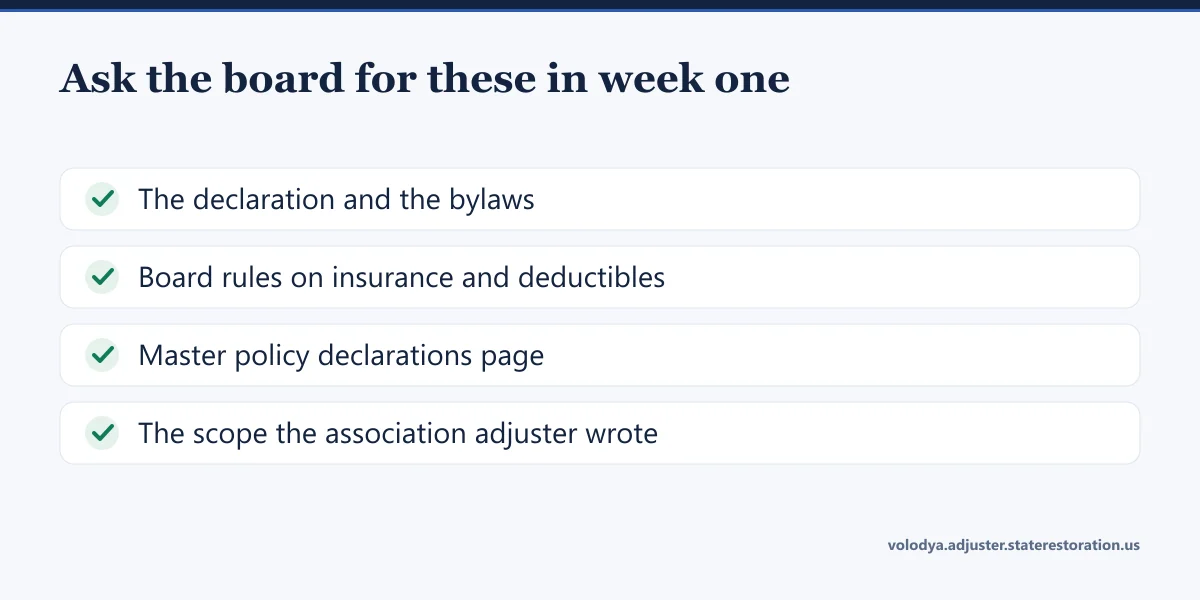
- Email the management company and the board the date, the time and the rooms affected, and ask them to report it to the association's insurer.
- Photograph every wet ceiling, wall and floor before the drying crew moves anything.
- Report the loss to your own insurer the same day, even if you expect the master policy to cover most of it.
- Ask the drying company for its daily moisture readings. They show how far the water went.
- Ask the board in writing which of the three deductible choices it intends to use, and when any hearing would be.
- Check the date on the master policy. The current section 12 applies to policies issued or renewed on or after June 1, 2015.
This guide reads the Condominium Property Act only. If your building is a townhouse association or another kind of community association, ask which documents and which law apply to it before relying on any of the above.
When do you need a public adjuster here, and when a lawyer?
Often you need neither. If the damage is one ceiling, the two scopes line up, and the board is paying the deductible as a common expense, you can finish this with the two adjusters and keep the fee. A public adjuster earns his fee when the two scopes leave a gap, when nobody agrees which layer the drywall or cabinets sit in, or when an HO-6 estimate does not cover the finishes you actually had. I measure, price and argue the scope. You can read about my licences and what I handle.
A lawyer is the right call when the board has assessed the deductible against you and you dispute where the water came from, when you are thinking of suing a neighbour, or when the meaning of your declaration is the real disagreement. If you are not sure which of the two you need, send me the letters and both scopes and I will tell you honestly. I am licensed in Illinois and Indiana only.