There is no single deadline, because four clocks run on the same claim. Your policy sets three: notice to the carrier “as soon as practicable”, a sworn proof of loss normally due 60 days after the carrier asks for one in writing, and a window to finish the repair if you want the withheld depreciation. The fourth is the deadline to sue, often one or two years, and commonly measured from the date of loss rather than the denial. The first three are handling questions. The fourth is a lawyer’s.
Illinois insurance claim deadlines are the thing homeowners ask me about last and worry about first. There is no clean answer because there is no single deadline: four clocks run at once, they start on different days, three of them are set by the contract you signed rather than by the state, and missing one does not cost you what missing another does.
I am a licensed public adjuster in Illinois (#19461872) and Indiana (#3556317), which means I represent the policyholder and never the carrier. It also means I am not an attorney. Most of what follows is claim handling, which I do every week; the deadline to file a lawsuit is law, and I will say so rather than guess. This is general information about how these deadlines work in Illinois and Indiana, the two states I am licensed in — not advice about your policy.
What deadlines actually apply to an Illinois property claim?
Four. Notice of the loss to your carrier, required as soon as practicable. A signed, sworn proof of loss, usually due 60 days after the carrier requests one in writing. A window to complete repairs if you want the depreciation that was held back. And the policy’s own deadline to file suit.
| Clock | Who sets it | When it usually starts | Where to read it |
|---|---|---|---|
| Notice of loss | Your policy | Date of loss, or when you should reasonably have known | “Duties After Loss” |
| Sworn proof of loss | Your policy | The day the carrier requests one in writing | “Duties After Loss” |
| Repair window for depreciation | Your policy | Date of loss, or the first payment | “Loss Settlement” |
| Deadline to file suit | Your policy, constrained by Illinois law | Commonly the date of loss, not the denial | “Suit Against Us” |
Look at the second column. Illinois law limits and pauses the suit clause, but the clause itself is in your contract, which is why I read the declarations page and the conditions before I look at the roof.
How long do I have to report damage to my insurance company?
No Illinois statute gives you a set number of days. Your policy controls, and nearly every homeowner form requires notice “as soon as practicable” or “promptly” — a standard of reasonableness rather than a date on a calendar. In practice that means days and weeks, not seasons.
That wording is not a loophole in either direction. What a carrier argues when notice comes late is that the delay cost it something it was entitled to: the chance to inspect before repairs, before another storm, before the debris went in a skip. Hidden damage complicates the start date — with a slow leak behind a wall, the honest date is when a reasonable homeowner would have known — and so does picking the right storm, because carriers check your stated date of loss against their own weather data. How the age of the marks narrows that down is in the piece on inspecting a hail-damaged asphalt roof.
Reporting fast is not always right, though: a loss that will land under your deductible still goes on your claim record once reported. When you do report, get the claim number and the date in writing, because every deadline the carrier owes you is counted from that day.
What is a sworn proof of loss, and when is it due?
It is a signed statement, usually notarised, setting out the date and cause of loss, the property damaged and the amount you are claiming. Most homeowner forms give you 60 days after the carrier requests one in writing. Until that written request arrives, the 60 days has not started — and on many claims it is never requested at all.
The word doing the work is “sworn”. You are signing a number under oath, so a proof of loss carrying a figure nobody can support is a problem you have made for yourself. If the scope is unfinished — a supplement pending, a contractor still opening walls — say so on the face of the document and reserve the right to amend, rather than guessing high or leaving the amount blank because somebody told you to. If you cannot meet the date, ask for an extension in writing before it passes, not after, and keep the reply.
Filing it also does something beyond satisfying a condition. Under Illinois Insurance Code section 215 ILCS 5/143.1, where a policy limits the period within which the insured may bring suit, that period is tolled from the date the proof of loss is filed until the date the claim is denied in whole or in part. It is worth knowing that statute exists. What it means for your clause and your claim is a question for a lawyer, not for me.
How long does the insurance company have to respond to me?
Here Illinois does set the deadlines, in the Department of Insurance’s claim-handling rule at 50 Ill. Adm. Code 919. In outline: acknowledge the claim within 15 working days, explain in writing any first-party claim still unresolved after 40 days, repeat that explanation every 45 days, and tender payment within 30 days of affirming liability on an amount that is agreed.
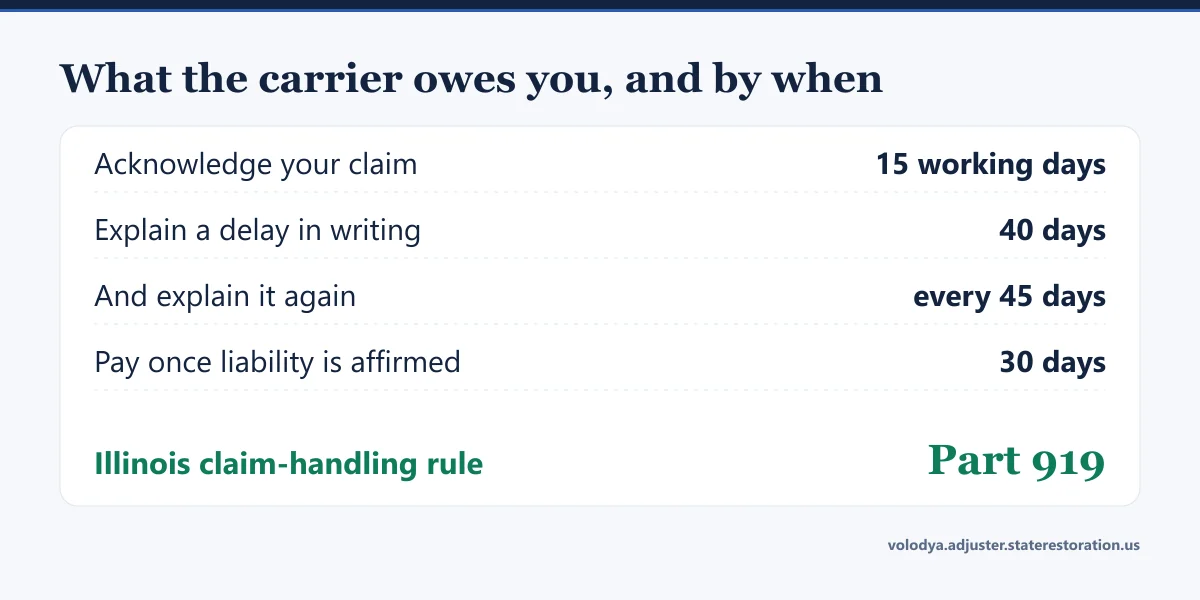
| The carrier must | By when | What that means for you |
|---|---|---|
| Acknowledge receipt of your claim | Within 15 working days of notice | Silence past three calendar weeks is not normal |
| Explain the delay in writing | Once a first-party claim is unresolved for 40 days | It must give a reason, not just say the file is under review |
| Send that explanation again | Every 45 days after the first | A file nobody writes about is a file nobody is working |
| Tender payment | Within 30 days of affirming liability where the amount is agreed and not in dispute | Liability affirmed and amount agreed is the trigger |
| Enclose the Department of Insurance notice | With a delay letter and with a denial | It tells you where to complain, and complaining is free |
Be precise about what this rule is. It is a regulation the Department enforces against carriers — a written standard to point at when a file goes quiet, not leverage I pretend to have, and what a breach is worth to you personally is another legal question. What it is genuinely good for is the free route it comes with: a complaint to the Illinois Department of Insurance goes on the carrier’s record. Note too that every deadline in it counts from a date, which is the whole argument for keeping a one-page log from day one — what that log holds is in the hour-by-hour account of how a Chicago claim runs.
How long do I have to sue my insurance company in Illinois?
Your policy sets that, and the number is far shorter than the general limitation period on a written contract in Illinois. Many property policies require suit within one or two years and — this is the part that catches people — the clause commonly runs from the date of loss, not from the date of the denial. This is the clock to hand to a lawyer.
Picture how it goes wrong. A storm in May. A claim that grinds through inspections, re-inspections and a disputed scope for fourteen months. A denial the following July. If the policy carries a one-year suit clause measured from the date of loss, the deadline may have passed while you were negotiating in good faith — and nobody writes to tell you, because it is your contract and you are assumed to have read it.
Section 143.1 addresses that gap by tolling the period between the filing of a proof of loss and a denial. But whether the clause applies to your claim, whether and when it was tolled, and whether anything the carrier did affected it are legal questions with case law behind them. I am a public adjuster; I do not answer those, and you should be wary of anyone in my line of work who does. What I can give you is the habit: in the week you open a claim, find the paragraph headed “Suit Against Us”, work out the date, and calendar it with a reminder ninety days ahead. If a claim is unresolved and that date is within a few months, a lawyer has stopped being optional.
How long do I have to collect the recoverable depreciation?
Your policy’s loss-settlement condition sets that window, and 180 days, one year and two years are all common. It usually runs from the date of loss or from the first payment. If the repair is not completed and documented inside it, depreciation the carrier already agreed was owed can be lost.
This is the clock people lose real money to, because nothing about it feels urgent: the first cheque arrives, the roof is not leaking today, the contractor is booked into spring, and the file goes quiet. How that holdback is calculated and collected is in the piece on why your first insurance check is smaller than the repair. The deadline half is simpler than the arithmetic — ask the adjuster in writing what the date is and what documents are needed, usually final invoices, proof of payment and photographs of the finished work. If permits, materials or weather are going to run you past it, ask for an extension while the window is still open rather than after it shuts.
What do the four clocks look like on one claim?
They overlap, and they start on different days. Below is one invented claim laid out day by day, so you can see which clock each date belongs to. The days are illustrative — a worked example to show the shape of it, not a schedule your carrier owes you.
| Day | What happens | Which clock it touches |
|---|---|---|
| Day 0 | Hail falls — the date of loss | Notice, and on most policies the suit-limitation clock |
| Day 3 | You report the claim and get a claim number | Notice satisfied; the Part 919 deadlines count from here |
| Day 24 | Written acknowledgement due — 15 working days from the report | Part 919 |
| Day 43 | Still unresolved at 40 days; written explanation of the delay due, and again every 45 days | Part 919 |
| Day 60 | The carrier asks in writing for a sworn proof of loss | Your 60-day clock starts today, not on day 0 |
| Day 105 | Proof of loss filed | Suit period tolled from here until denial (215 ILCS 5/143.1) |
| Day 120 | Liability affirmed, amount agreed | The 30-day payment clock starts |
| Day 365 | A one-year suit clause running from the date of loss falls about here | The date to have raised with a lawyer months earlier |
Are the deadlines the same in Indiana?
No, and an Illinois number should not be carried across the state line. The structure is the same — your policy sets notice, proof of loss and the deadline to sue — but Indiana’s claim-handling regulations and its treatment of suit-limitation clauses are its own. Read the Indiana policy on its own terms.
I hold an Indiana public adjuster licence (#3556317) alongside the Illinois one, so I work claims in both states; what I do not do is quote Illinois section numbers on an Indiana loss. The regulator’s own material is published by the Indiana Department of Insurance, and an Indiana attorney is the right person for anything touching the suit clause.
What should you write down this week?
Four dates, on one page, before anything else. Every argument about deadlines is really an argument about which day something happened, and the homeowner who wrote them down at the time wins it without raising their voice.
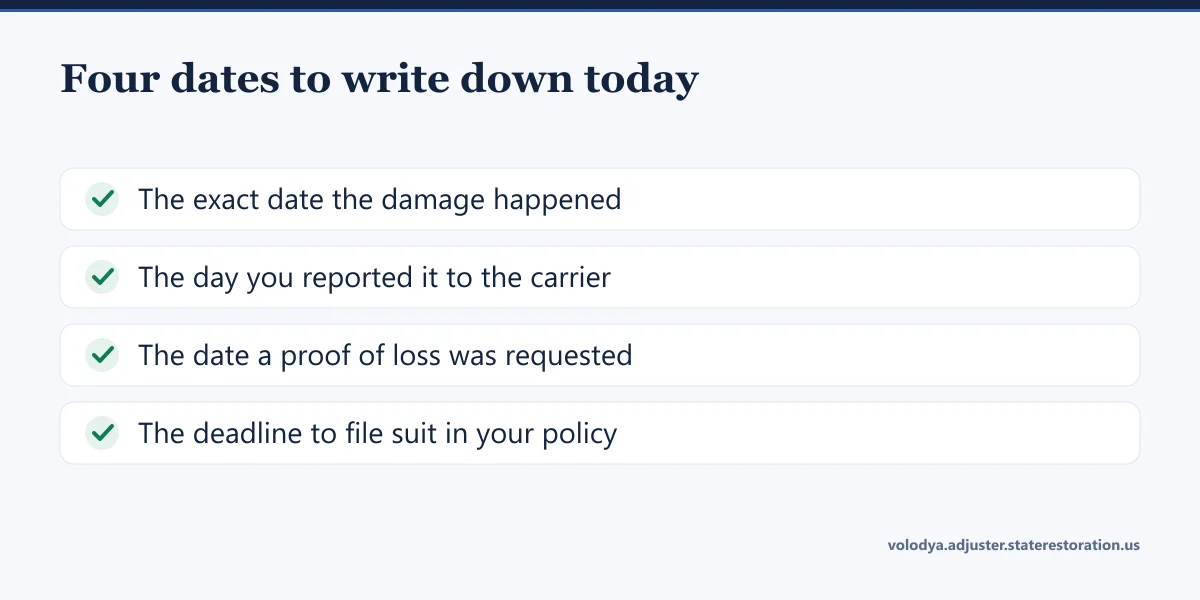
- The exact date the damage happened. Not the day you noticed the stain — the day of the event, as best it can be established from the marks and the weather record.
- The day you reported it, plus the claim number. Every deadline the carrier owes you is measured from this date, so an email confirming it beats the memory of a phone call.
- The date a sworn proof of loss was requested, if it was. Your 60 days starts there, and the request usually arrives inside a longer letter rather than announcing itself.
- Your policy’s deadline to file suit. Under “Suit Against Us”, with a reminder ninety days ahead of it.
What to do next
If a claim of yours is open and you cannot say which of the four clocks is closest, that is worth an hour of somebody’s time. The free inspection and policy review is that hour: I read the declarations page and the conditions with you, work out which dates apply, and tell you where you stand — including when the honest answer is that the claim is being handled properly and you do not need me. The offerings page sets out the work I take on, including claims already underpaid, delayed or denied, and my licences and certifications are published in full so you can verify them first. My hours are Monday to Friday 9–6, Saturday 9–5 and Sunday 10–5, and I speak English, Ukrainian and Russian.
One last time, because it is the most important sentence here: nothing above is legal advice, and the deadline to sue your insurer is a legal question. If that date is close, the person you need is an attorney — before the date, not after it.