After a hailstorm or a fire, an Illinois condo board can bill every owner for the part of the repair the master policy does not pay, most often the master policy deductible. That bill is a condo special assessment, and your own HO-6 policy may pay some of it through loss assessment coverage. Two things decide how much: what caused the loss, and the loss assessment limit printed on your declarations page, including a smaller cap many forms put on assessments that come from the association's deductible.
I am a licensed public adjuster in Illinois (#19461872) and Indiana (#3556317). I work the master policy claim for associations and the unit claim for owners. This post reads one assessment from both sides of the table. Whether a particular board acted within its declaration is a legal question, and I say where a lawyer comes in.
Can the board levy a special assessment without a vote of the owners?
Yes, the board adopts it, but owners get notice and, above a set size, a right to force a meeting. The rules sit in the Illinois Condominium Property Act, 765 ILCS 605/18(a)(8), which every declaration and set of bylaws must carry. Read in order, they work like this:
- Before the board meeting
Every owner gets notice of the board meeting where a separate (special) assessment will be adopted, in the same manner the Act requires for membership meetings.
- The board votes
If the new assessment pushes all regular and separate assessments for the year above 115% of last year's total, the owners' petition right below applies.
- Within 21 days of the board's action
Owners holding 20 percent of the votes can deliver a written petition to the board.
- Within 30 days of the petition
The board must call a meeting of the owners. The assessment stands unless a majority of the total votes, not only the votes of those who come, is cast to reject it.
A worked example with illustrative numbers: last year the owners of a 24-unit building paid $115,200 in assessments, so the 115% line is $132,480. This year's budget is $120,960, and after a hailstorm the board adds a $72,000 special assessment. The year's total, $192,960, is about 167% of last year, well past the line, so the petition right is live. Two exceptions change that picture.
Emergencies and work the law requires
The board may adopt these with no owner approval and no petition. The Act defines an emergency as "an immediate danger to the structural integrity of the common elements or to the life, health, safety or property of the unit owners." A roof that is letting water into units is the kind of repair boards put here.
Additions and alterations
New work on the common elements that was not in the budget needs two-thirds of the total votes. A storm repair that also upgrades the building can mix both kinds of cost, and the letter should say which is which.
The same section lets a board spread a separate assessment over more than one fiscal year, which matters for your own insurance claim later. Whether a given repair truly fits the emergency definition in your building is a question for the association's lawyer or yours, not for me.
What does a special assessment letter tell you, line by line?
It tells you the cause, the amount, your share and how the share was worked out, and each of those is something your insurer will ask about. Here is an illustrative letter of the kind owners bring me, with the five places I read first.
Board of Managers, a 24-unit condominium association, Chicago
1On June 18 a hailstorm damaged the roof, the skylights and the north elevation of the building. The association's carrier has accepted the claim.
2Our master policy carries a $50,000 deductible per occurrence. Under the declaration the board will pay it as a common expense.
3The carrier has not yet agreed to $22,000 of the skylight and flashing work. The board is advancing that amount so the roof can be closed before winter.
4A separate assessment of $72,000 was adopted at the board meeting of August 12 as an emergency expenditure.
5Your unit's share at its percentage of ownership (4.25%) is $3,060, due in two installments.
Illustrative letter. The building, dates and every dollar figure are a worked example, not a real association.
- The cause and the date of loss. Your HO-6 carrier pays a loss assessment only when the peril behind it is one your own policy covers, so hail, wind or fire written in the letter does work for you. "Roof replacement" with no cause reads like maintenance.
- The deductible line. Under 605/12(c) the board can pay the deductible as a common expense, charge it to the owners whose units were damaged, or charge it to the owner where the loss started. Which one it chose decides whether everyone shares it. My post on water from the condo above walks through those three choices.
- The disputed amount. This is the line I care most about. If the carrier simply has not agreed yet, owners may be paying for repair the master policy owes.
- The board date and the label. It starts the 21-day petition clock unless the board calls it an emergency, as this one does.
- Your percentage. 605/9(a) splits common expenses by each unit's percentage of ownership in the declaration, not per head. 605/9(e) lets the declaration charge work on limited common elements, such as one balcony, only to the units it belongs to.
Will my condo insurance pay my share?
Often part of it, sometimes none. Most HO-6 forms carry a small loss assessment amount as an additional coverage, commonly $1,000, and an endorsement raises it for a premium. The Washington insurance regulator's plain-language condo page states the test I use in Illinois too: if your own policy covers the cause of the damage, it covers the assessment for that cause.
| What the assessment pays for | Does loss assessment usually respond? | What to check first |
|---|---|---|
| Master policy deductible after hail, wind or fire | Usually yes, often up to a smaller cap | The special limit sentence in your endorsement |
| Storm or fire repair above the master policy limit | Usually yes, up to your limit | Whether the building was insured to full replacement cost |
| Repair the master carrier has not agreed to | Possibly, if the cause is covered | Whether the association's claim is still open |
| Water in the garage from surface flooding | Usually no on a standard HO-6 | Any flood policy and its own terms |
| Tuckpointing, an old roof, a new lobby | No, this is upkeep or an upgrade | Whether the letter mixes these with storm work |
Why does the deductible part of the bill pay out less?
Because many loss assessment endorsements cap the deductible-driven part on purpose. The Insurance Services Office sample of endorsement HO 04 35 (edition 04 91), published by the Independent Insurance Agents and Brokers of America, raises the loss assessment limit and then says:
SPECIAL LIMIT: We will not pay more than $1,000 of your assessment that results from a deductible in the policy of insurance purchased by a corporation or association of property owners.
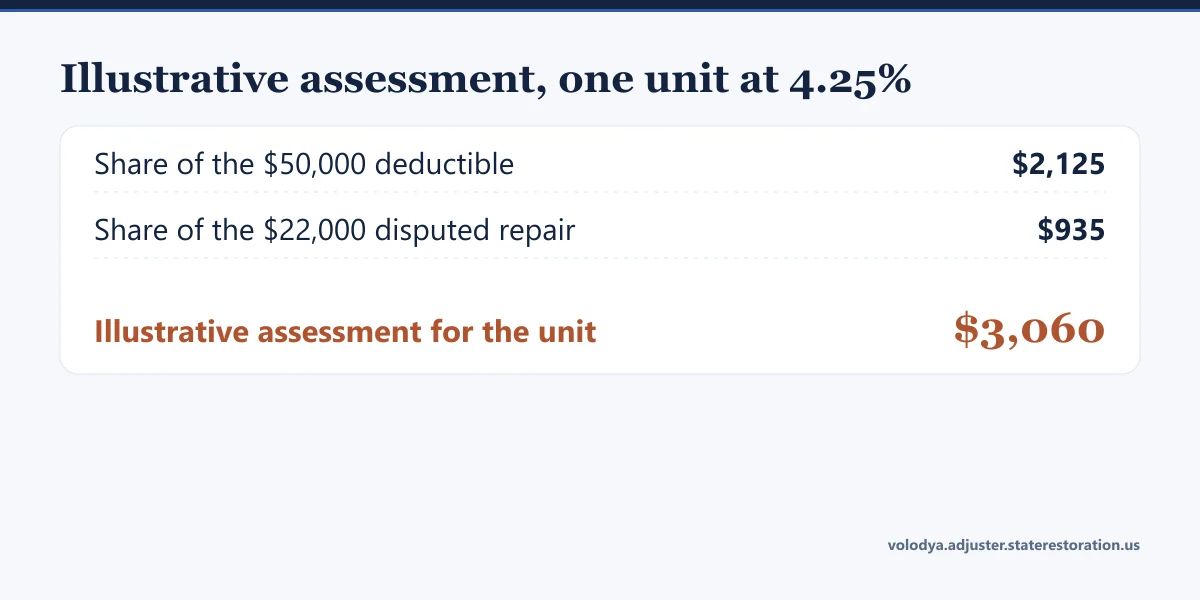
So an owner who bought a $10,000 limit can still find most of a deductible assessment uncovered. Carriers file their own editions and some changed this wording later, which is why I read the form number and edition date on the owner's declarations page before I say anything about a payment. Run through the illustrative letter above with that 1991 wording, the unit's $3,060 splits like this:
Worked example with illustrative figures. Whether your form applies a deductible to loss assessment, and how it stacks the base amount with the endorsement, is on your own policy.
Is a large assessment a sign the building's claim was underpaid?
Sometimes, and it is worth an hour before owners write checks. The deductible is a fixed number nobody can argue down. Everything else in an assessment after a covered loss is a gap between the repair and what the master carrier agreed to pay, and part of that gap can be scope that never made it onto the estimate. Under 605/12(g) the master claim is adjusted with the association, so owners cannot fix it themselves. The board can.
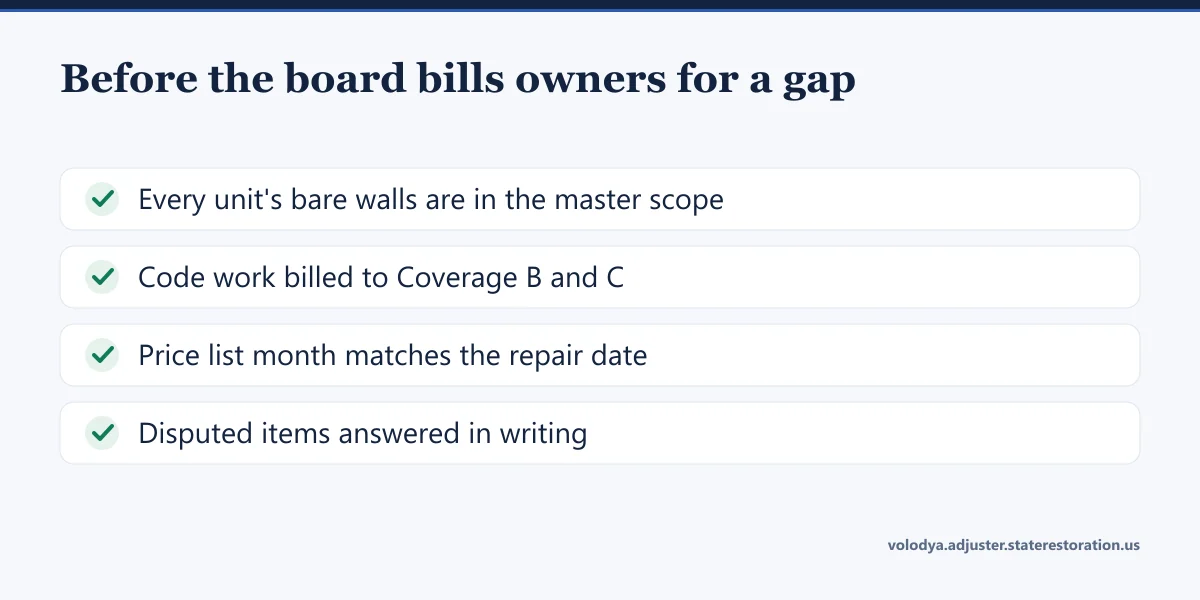
The Act requires the master policy to carry demolition and increased-cost-of-construction coverage of at least 10% of each building's value or $500,000, whichever is less, so code-driven work belongs there before it lands on owners. On an older Chicago building I also look at whether the estimate was priced for the month the work will be done and whether the bare walls, floors and ceilings of every damaged unit were counted. This is the work I do on master policy claims for condo associations, written up building by building and unit by unit for the board.
What do you send your own insurer?
Your carrier needs to see the assessment, the cause and the math. I put these in one email with a short cover note:
- The assessment letter and the minutes of the board meeting that adopted it.
- The master policy declarations page, or the certificate of insurance the association issues each year, showing the deductible.
- The master carrier's acceptance or estimate showing the date and cause of loss.
- The page of the declaration that sets your percentage of ownership.
- Proof of what you have paid so far, if the assessment is in installments.
Report it soon after the letter arrives, even before you pay. If the assessment runs over two fiscal years, ask the carrier in writing how it will handle the later installment. When your unit also has interior damage of its own, the loss assessment is one line inside a larger HO-6 claim, and the condo owner claims I handle usually carry both. If the carrier asks for a sworn statement, my notes on the Illinois proof of loss form apply to this claim too.
When you do not need a public adjuster, and when you need a lawyer
A deductible-only assessment of a few thousand dollars against a $1,000 special limit is a phone call to your agent, and I tell owners so. A public adjuster earns a fee when the building scope is short, when your own unit was damaged as well, or when the carrier refuses the assessment because of how the cause was described. If the question is whether the board followed the declaration, whether an "emergency" label was proper, or how to challenge the assessment itself, that is a lawyer's work. For anything else, the contact page reaches me directly.