After a total fire loss in Illinois you are not tied to the old lot. The standard homeowner form pays replacement cost for a house rebuilt on a different lot, but never more than it would have cost to rebuild on the original one. Buying a house that already stands is a different matter: the standard form does not mention it, so the amount is agreed with the carrier, in writing, before you sign a purchase contract. Until you replace the house in one of these ways, the carrier owes the actual cash value, and on most forms there is a 180-day window to tell it you intend to replace. I go through each choice below with the policy wording, one illustrative house and one Illinois order on the clock.
What does the standard policy pay if I rebuild on a different lot?
It pays the smallest of three numbers, and the second number is always priced as if you had rebuilt where the old house stood. The wording is in Section I, Condition D, Loss Settlement, of ISO HO 00 03 05 11, the homeowners form many carriers copy or adapt. When the house was insured for at least 80 percent of its replacement cost, the carrier pays the cost to repair or replace without depreciation, but not more than the least of
these amounts:
The Coverage A limit on the declarations page.
The house rebuilt with material of like kind and quality and for like use, priced at the original lot.
The necessary amount actually spent to repair or replace.
The box with the dark border is the one that usually decides a move: once you build somewhere else, what you spend is the number most often in play.
If the building is rebuilt at a new premises, the cost described in (2) above is limited to the cost which would have been incurred if the building had been built at the original premises.
So the form expects some owners to move and simply caps them. If the new lot has cheaper labour or a smaller house, you are paid what you spent. If it costs more, you are paid what the old lot would have cost, and the rest is yours. Your own policy may be worded differently, so I read its loss settlement condition before anything else; the declarations page tells you which form number you have.
If the house was insured for less than 80 percent, a lower formula applies. I worked through it on a landmark house in my article on insuring a historic slate roof in Chicago.
Three ways out of a total loss, side by side
Every path starts with the same first payment, the actual cash value. Item d of the same condition says the carrier pays no more than the actual cash value of the damage until actual repair or replacement is complete
. Why that first check is smaller, and how the held-back part is collected, is in my article on actual cash value in Illinois.
| Rebuild on the same lot | Build on another lot | Buy a house already built | |
|---|---|---|---|
| Where the form stands | The ordinary case | Named in D.2.a, with a cap | Not named; settled by agreement |
| First payment | Actual cash value | Actual cash value | Actual cash value |
| What releases the rest | Invoices as the work is done | Invoices for the new build | A closing statement, on terms agreed first |
| Ceiling | Replacement cost or the limit | Cost at the original lot | Whatever the written agreement says |
| What the adjuster asks for | Contract, permits, draws | Same, plus the new address | Purchase contract and price |
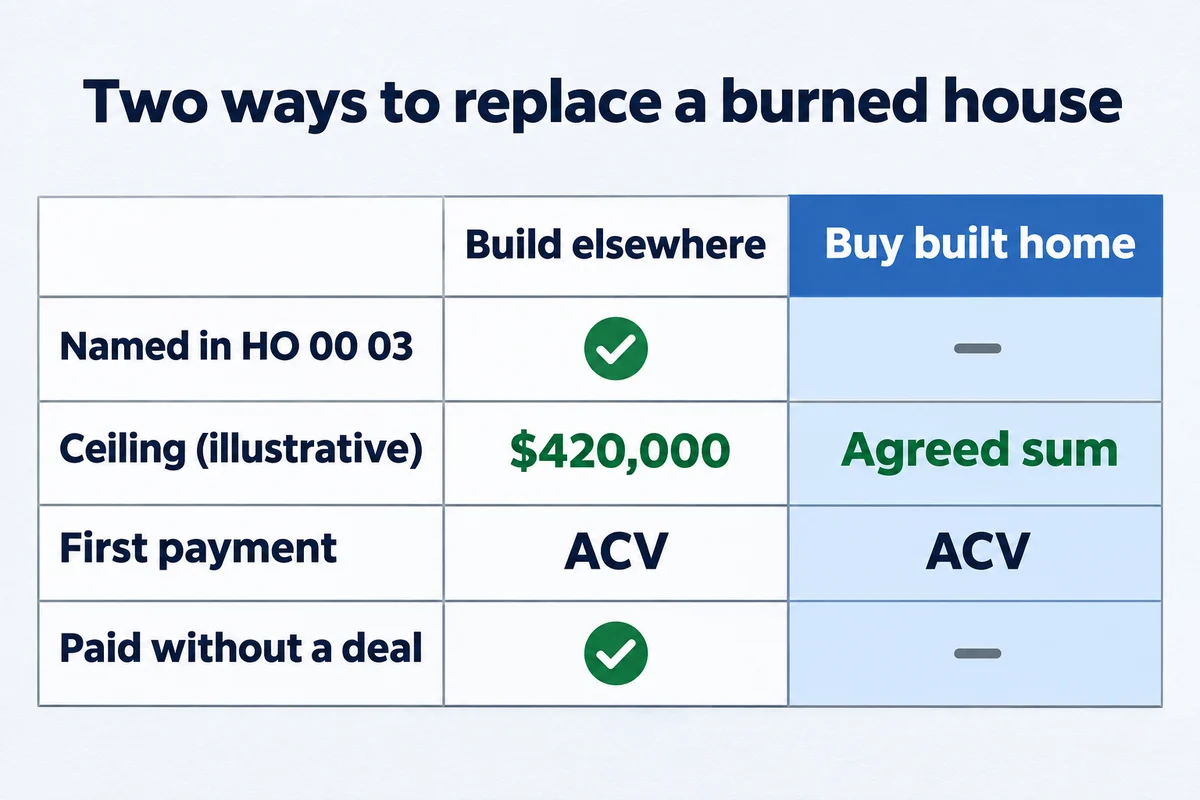
One house, four outcomes (worked example)
Take an illustrative Chicago bungalow destroyed by fire. The Coverage A limit is $450,000. The agreed cost to rebuild it on its own lot with like kind and quality is $420,000. After depreciation, the actual cash value is $290,000, so the first check is $290,000 and $130,000 waits on replacement. Every figure here is a worked example before the deductible, not a number any carrier has promised.
The third line is the one families get wrong. Buying for $360,000 does not leave a $60,000 bonus, because the form pays the amount actually spent. And if no agreement was reached before closing, the carrier can treat the purchase as no replacement at all and stop at $290,000. That gap is the reason for the next section.
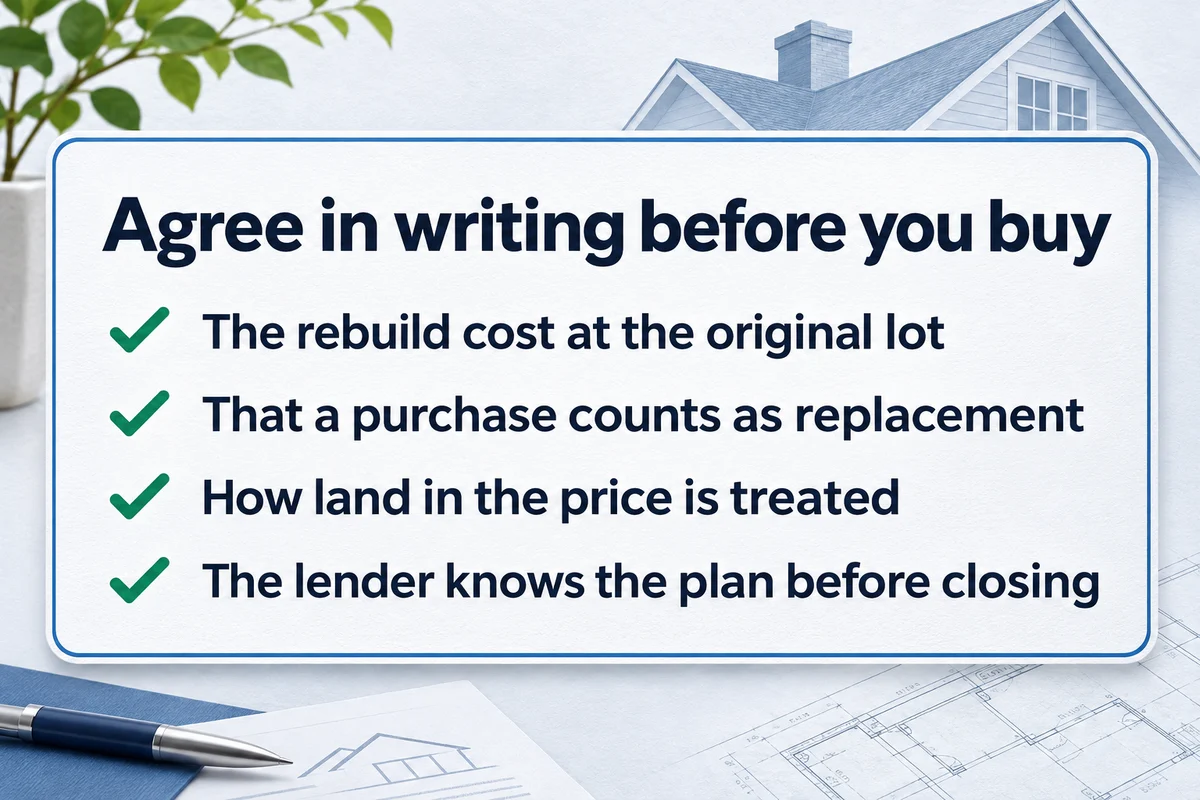
Before you sign a purchase contract on another house
Settle these points with the carrier by email or letter first. A phone call with the field adjuster does not bind anyone, and a contract signed before the answer arrives takes away your leverage.
- The rebuild cost at the original lot
This is the ceiling on every path. Agree it line by line, including debris removal and any code work your policy pays, before you look at houses. If the carrier's estimate is low, that argument comes first.
- That a purchase counts as replacement
Ask for a written statement that buying a built house will release the held-back replacement cost, up to the agreed figure.
- How the price of the new house is counted
A house price includes the land under it, and the old lot is still yours. Ask the carrier how it will treat the land in the price and get its method in writing.
- Which papers release the payment, and when
Usually the signed purchase contract and the closing statement. Ask whether the money can be paid at closing so you are not bridging it yourself.
- The lender's part
Under the mortgage clause your lender is named on the dwelling checks. Tell it the plan early; it decides how the old loan is paid off or moved.
I know of no Illinois statute that answers the purchase question for a homeowner, so the policy and this written agreement are all you have. If the carrier refuses outright and the wording of your policy is unclear, that is a coverage question for a lawyer.
How long do I have to decide in Illinois?
Two different clocks appear in Illinois policies, and they are easy to confuse. Read which one yours has, because missing it can cost you the held-back money.
A notice clock
Item e of the ISO form lets you take actual cash value first and claim the rest later, provided you notify us, within 180 days after the date of loss, of your intent to repair or replace
.
It asks for a notice of intent, not a finished house. Send it in writing early, even before you know which path you will take.
A repair clock
Some carriers write their own forms. One quoted in an Illinois case below paid the extra above actual cash value only if the owner would repair, rebuild or replace
within 180 days of the actual cash value payment.
That is a much shorter window for a total loss, where design and permits alone can take months.
A 2017 order of the Illinois Appellate Court, First District, looked at the second kind: 2017 IL App (1st) 161498-U, No. 1-16-1498, filed September 5, 2017. It was filed under Supreme Court Rule 23, so it is not precedent other parties can cite, but it shows how an Illinois court read the same words.
- The loss
- A fire on May 28, 2012 at a house on Chicago's South Side, with a $340,000 dwelling limit.
- The payments
- Actual cash value checks of $19,028.37 and $49,575.57 on November 5, 2013, while the owner's estimates were far higher and the carrier's own letter said unresolved issues would keep being reviewed.
- The defence
- No repairs within 180 days of that payment, so no replacement cost. The trial court agreed and barred the evidence.
- The endorsement
- The policy carried the Illinois Standard Fire Policy, which insures up to the cost to repair or replace
within a reasonable time after such loss
. - The result
- Reversed. The court read that endorsement as replacing the 180-day limit with a reasonable time from the loss, and found the carrier had also waived the limit by promising further review.
What counts as a reasonable time depends on the facts of each file, and the order left that for trial. Do not treat it as permission to wait: send the notice, keep every letter, and if a carrier says your time has run out, a lawyer is the person to answer that. I am a licensed public adjuster, not a lawyer.
What a total loss does not change
- Code upgrades are still a separate coverage. If Chicago or your suburb requires work the old house did not have, that money comes from Ordinance or Law, as in my article on code upgrade coverage, and the standard form pays it for increased costs you actually incur.
- Demolition and debris removal have their own rules and, on a fire in Illinois, can come with a payment hold for taxes and demolition, which I covered in the tax and demolition certificate.
- Living expenses keep running while you are out, but only for the shortest time needed to repair or replace or to settle elsewhere. A long search for the right house can shorten what additional living expenses will pay.
- Contents are a separate claim with their own inventory, whatever you decide about the house.
When you do not need a public adjuster for this
If the carrier's rebuild figure matches what two honest contractors priced, and you are rebuilding the same house on the same lot, the claim may need nothing from me. If you are moving and the carrier has already agreed in writing to count your purchase, the work is mostly paperwork. Where I help is the first item on the list above: the full cost to rebuild at the original lot, measured and priced room by room, because every path is capped by it. On a fire damage claim that is where most of my hours go. If you are deciding now, send me the declarations page and the carrier's estimate, seven days a week.