Additional living expenses pay the extra cost of living somewhere else while a covered loss leaves your home unfit to live in. The key word is extra: the carrier pays the difference between what you spend while displaced and what you would have spent at home, for as long as the repair reasonably takes, up to the loss-of-use limit on your declarations page. The mortgage and your normal groceries stay yours. Temporary housing, the added cost of food, extra mileage and laundry are the usual claim, and every line is paid against paperwork.
After a fire or a burst pipe, the first question a family asks me is rarely about the roof. It is where they are sleeping tonight, and who pays for it. The answer is additional living expenses, part of what the policy calls loss of use. It pays while the claim is still open, and it is one of the easiest places to lose money through thin paperwork rather than any real coverage dispute.
I am a licensed public adjuster in Illinois (#19461872) and Indiana (#3556317), a HAAG certified inspector (#992104047), a licensed Illinois roofing contractor (#105.009193) and a general contractor (#TGC115063). This is general information about standard homeowners forms in Illinois and Indiana, not legal advice; your own policy wording is the authority on your claim.
What are additional living expenses on a homeowners policy?
Additional living expenses, usually shortened to ALE, sit under Coverage D, loss of use. When a covered loss makes the part of the home where you live not fit to live in, the policy pays the necessary increase in your living costs so your household keeps its normal standard of living. It pays the increase, not the whole bill.
That is close to the wording on the standard form, and each phrase matters. Covered loss means the living expenses follow the property claim: if the damage is excluded, so is the hotel. Necessary increase means the carrier compares what you spend displaced with what you would have spent at home, and pays the gap. Normal standard of living means comparable: a family of four from a three-bedroom house is not expected to spend four months in one hotel room, and is not entitled to a penthouse either.
A second coverage under the same heading matters in Chicago, where many owners live in one unit of a two-flat and rent the other. If the rented unit is made unfit to live in by the same covered loss, fair rental value pays the rent you lose from it, less expenses that stop while it stands empty. It is a separate calculation, and it often goes unclaimed simply because nobody asked for it.
When does a house count as unlivable for an insurance claim?
The policy does not define it, so it is decided on the facts. The practical questions are whether the house has safe power, heat in season, running water, a working toilet and somewhere to prepare food, whether the air is safe after smoke or mould, and whether the city has barred occupancy. Losing one can be enough.
Season matters here. A house without heat in June is uncomfortable; in January it is not fit to live in. Smoke is the one people underestimate: a fire confined to a kitchen can leave soot and odour through the whole house, and a household member with asthma, a newborn or an elderly parent changes the answer. A short note from a doctor is evidence; a remark on the phone is not.
It is not all or nothing, either. If the kitchen is gone but the bedrooms are fine, the usual answer is that you stay home and claim the increased cost of eating while you cannot cook. If the only bathroom is out of use, that is often enough on its own to move out. Whatever the reason, photograph it the day it happens — the dead panel, the thermostat, the soot upstairs, any notice on the door. Once the house is cleaned and the power restored, the reason you left is much harder to show.
What does additional living expense coverage usually pay for?
Temporary housing, the extra cost of food, extra mileage, laundry, storage, pet boarding, furniture rental, utility connections at the temporary address, and moving out and back. Each item is paid as the difference against what you normally spend, and each has to be reasonable for your household and backed by a receipt.
| Expense | How it is usually paid | What to keep |
|---|---|---|
| Temporary housing | In full, when your normal housing cost continues, as a mortgage does | The lease or hotel folio, and the carrier's written approval |
| Food | Only the amount above your normal grocery spend | Receipts, plus three months of statements showing normal spend |
| Mileage | The extra distance to work or school over the normal trip | A mileage log with dates and both addresses |
| Utilities at the temporary address | Connection fees and bills, less the bills that fell at home | Both sets of bills for the same months |
| Storage and moving | Moving undamaged contents out and back, and a storage unit | Invoices and the storage agreement |
| Pet boarding | Where the temporary housing does not accept pets | Kennel invoices and the landlord's written pet rule |
Housing is usually paid in full because your normal housing cost does not stop: the mortgage on the damaged house continues, so the whole of the temporary rent is an increase. If you were renting and your rent stops, the rent you no longer pay is subtracted.
What does ALE not pay for?
Anything you would have paid anyway: the mortgage, property tax, the insurance premium, the car payment, your normal groceries. It also does not pay for a standard of living above the one you had, for time after the repair should reasonably have finished, or for displacement caused by a loss the policy excludes.
That last point catches people after basement water. If it was surface flooding, the homeowners policy is not paying for the house and so not for the hotel, and the federal flood policy has no living-expense coverage at all. I went through where that line falls in water damage vs flood on an Illinois policy.
The standard form also excludes loss or expense due to cancellation of a lease or agreement. So an early-termination fee on a temporary lease is a risk to settle with the carrier before you sign a twelve-month contract for a four-month repair. And if you use the rebuild to add a bathroom or finish the attic, the extra weeks that work adds are yours; keep it separate in the contractor's schedule.
How long will insurance pay additional living expenses?
For the shortest time reasonably required to repair or replace the damage or, if you move permanently, the shortest time needed to settle elsewhere. It is capped by the loss-of-use limit on your declarations page, and on the standard form it is not cut off merely because the policy itself expires in the middle of the repair.
The word that matters is shortest. The period is measured against how long the repair should reasonably take, so every delay needs an owner. A slow permit, a code item found once the walls are opened (the subject of how code upgrade coverage works in Illinois), a backordered material or a scope the carrier has not approved are not delays you chose. Changing contractors twice, or adding a remodel, are. Write down the cause of every delay as it happens and send it to the adjuster; dated reasons are the difference between an extension and a cut-off letter.
| Written as | What it looks like | What to watch |
|---|---|---|
| A percentage of the dwelling limit | Commonly 20 or 30 percent of Coverage A on standard forms | A large fire on a modest dwelling limit can use it up; 20 percent of an illustrative $250,000 limit is $50,000 |
| A number of months | Some carriers pay the actual loss sustained for a set period, such as 12 or 24 months | The clock runs whether or not the repair is on schedule |
| Both | A dollar cap and a time cap together | Whichever is reached first ends the payments |
Find that line on your declarations page now. It usually sits next to the dwelling and contents limits, and it is the number most people have never looked at.
What should I do before I move out?
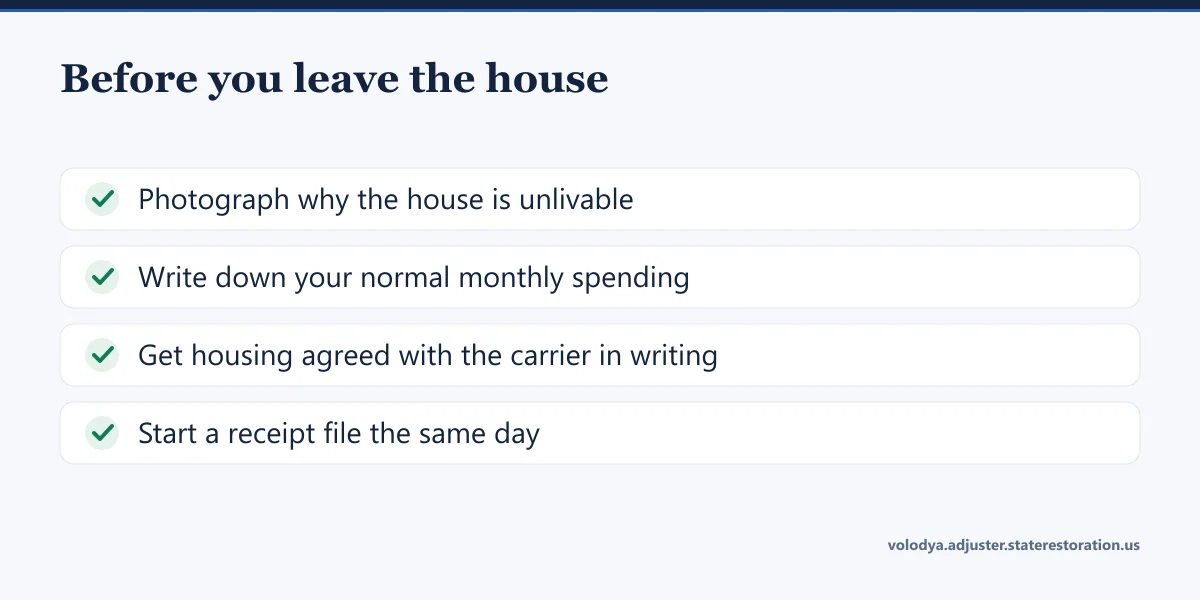
Photograph why the house is unlivable, write down what your household normally spends in a month, agree the housing arrangement with the carrier in writing before you sign anything, and start a receipt file the same day. Those four steps settle most living-expense disagreements before they begin.
On the first call, ask whether the carrier will advance a sum for immediate expenses; many will, and it beats carrying a hotel bill on a credit card for a month. Ask too whether they place people through a temporary housing company that bills the carrier directly, which takes you out of the payment chain entirely.
For the baseline, three months of bank or card statements is the simplest proof of normal spending, and producing it early ends the argument about whether a restaurant bill is an increase. Then submit monthly, with receipts grouped by category. A running monthly claim gets paid in pieces while you are still out; a shoebox handed over after six months is reviewed line by line, and the lines without paper are the ones that go.
How is additional living expense calculated?
Put a normal month and a displaced month side by side, category by category, and claim the difference. The figures below are an illustrative worked example, not a quotation and not a typical settlement: a family of four in a Chicago bungalow, out of the house for five months after a kitchen fire.
| Category | Normal month | Displaced month | Increase claimed |
|---|---|---|---|
| Housing | $2,150 mortgage | $2,150 mortgage + $3,200 furnished rental | $3,200 |
| Food | $1,100 | $1,450 | $350 |
| Utilities | $240 | $70 at the damaged house + $250 at the rental | $80 |
| Commute | $150 | $330 | $180 |
| Laundry | $0 | $90 | $90 |
| Total | $3,640 | $7,540 | $3,900 |
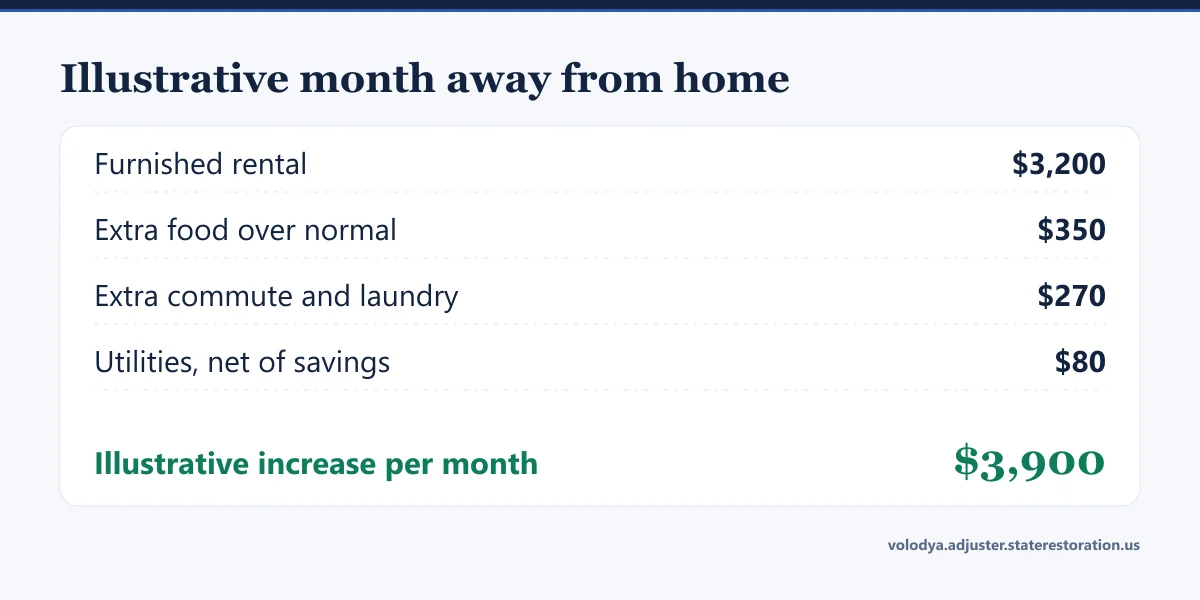
Over five months that illustrative family claims $19,500, well inside an illustrative limit of 20 percent on a $300,000 dwelling, which is $60,000. That is the usual shape on a kitchen fire: the dollar limit is not what runs out. The disagreement, when there is one, is about the number of months, which is why the delay record matters more than any single receipt. Note that utilities are netted, because the bills at the empty house fell, and food counts only above the normal grocery spend.
Is living-expense money taxable?
IRS Publication 547 says insurance payments for living expenses, after a casualty takes away the use of your main home, are not income up to the temporary increase in your living costs. Anything paid above that increase is reported as income. That is a question for your tax preparer, not for me.
Do I need a public adjuster for a living-expense claim?
Often not. If the carrier is paying the hotel or rental promptly and approving your monthly submissions, a living-expense claim on its own rarely needs representation. It becomes worth a call when payments stop before the repair is done, when the unlivability decision is disputed, or when the living expenses sit inside a larger claim that is going badly.
What I do on these files is claim handling: document why the house is not fit to live in, build the normal-versus-displaced ledger, submit it monthly, and keep the dated record of every repair delay. That work is set out on the representation page. Whether a cut-off letter breaches the contract is a legal question, and I will point you to an attorney rather than argue it myself.
Getting help with a living-expense claim in Chicago
If you are out of your house now, or about to be, send me the declarations page, the carrier's letters about housing, and a note of when you left and why. I will tell you what your loss-of-use limit is, whether what you are being paid looks like the increase the form describes, and what is missing from the file. Sometimes the answer is that the carrier is handling it properly and you need nothing from me. There is more about how I work on the about page, or send the documents through the contact page.
Volodymyr Lukaniuk, licensed public adjuster. 3052 N Long Ave #2, Chicago, IL 60641. Telephone +1 224-481-2095, email volodymyr@staterestoration.us. Hours are Monday to Friday 9–6, Saturday 9–5 and Sunday 10–5, and I speak English, Ukrainian and Russian. I am licensed in Illinois and Indiana only.
Nothing above is legal or tax advice. It is general information about first-party property claims, written by a public adjuster rather than a lawyer, and your own declarations page and policy are the authorities on your claim.