On a standard homeowners policy, a storm-damaged historic slate roof is normally repaired with slate, because the policy pays to replace damaged property with material of like kind and quality. Two things decide whether that payment covers the real bill on an old Chicago house. The first is your dwelling limit: if it is below 80 percent of what the whole house would cost to rebuild today, the insurer pays only a share of the repair. The second is the city: on a designated Chicago Landmark or a house in a landmark district, the permit is reviewed by the Historic Preservation Division, and work it requires beyond the broken slates is paid, if at all, from a separate and smaller pot.
I adjust roof claims for homeowners in Illinois (public adjuster licence #19461872) and Indiana (#3556317), and I hold an Illinois roofing contractor licence (#105.009193) and a HAAG inspector certification (#992104047). That combination matters on slate, where the estimate, the roof and the policy wording all have to agree. I am not a lawyer, and where a dispute is about what a policy word legally means, I say so below.
Who decides what on a landmark roof?
Two separate offices, and owners often expect one of them to answer for the other. The city decides what work is allowed on the house. The insurer decides how much of that work the policy pays for. Neither one is bound by the other's opinion, so you need an answer from each, in writing.
City of Chicago, Historic Preservation Division
- Reviews permit applications for work on designated and proposed Chicago Landmarks and on buildings in landmark districts.
- Checks that the work will not harm the building's significant historical or architectural features.
- Invites a pre-permit submission before you file, to clarify what the review will require.
- Says nothing about who pays.
Your insurance company
- Decides whether a covered peril, such as hail or wind, caused the damage.
- Prices the repair with material of like kind and quality.
- Applies the 80 percent condition, the deductible and any endorsements.
- Decides whether a permit requirement falls under the Ordinance or Law coverage.
The city's role is taken from its Landmark Permit Review page. A listing on the National Register of Historic Places is not among the cases that page names; city review attaches to Chicago Landmark designation.
Is my dwelling limit high enough for a slate roof?
Check it against today's rebuild cost with slate, not against what you paid for the house. The standard homeowners form (ISO HO 00 03 05 11, which I read from the copy the Maine Bureau of Insurance publishes) pays full replacement cost only if the limit on the house is 80 percent or more of the full replacement cost of the building immediately before the loss. Below that line, the policy pays the greater of the actual cash value of the damage or a proportion of the replacement cost. Your own policy may be a carrier form with different words, so look for this condition under Loss Settlement.
Slate houses fall below the line more often than most, because a limit set years ago on a square-foot figure rarely prices a slate roof, copper valleys and the carpentry of a 1910 house. Here is an illustrative worked example, not a real claim:
- Full cost to rebuild the house today, slate roof included$900,000
- 80 percent of that, the limit the policy expects$720,000
- The dwelling limit on the declarations page$630,000
- Share paid: $630,000 divided by $720,00087.5%
- Hail repair to the slate at replacement cost$64,000
- Proportion paid before the deductible, $8,000 less than the repair$56,000
Illustrative worked example; every figure is invented to show the arithmetic. If the actual cash value of the damage were higher than $56,000, the policy would pay that instead.
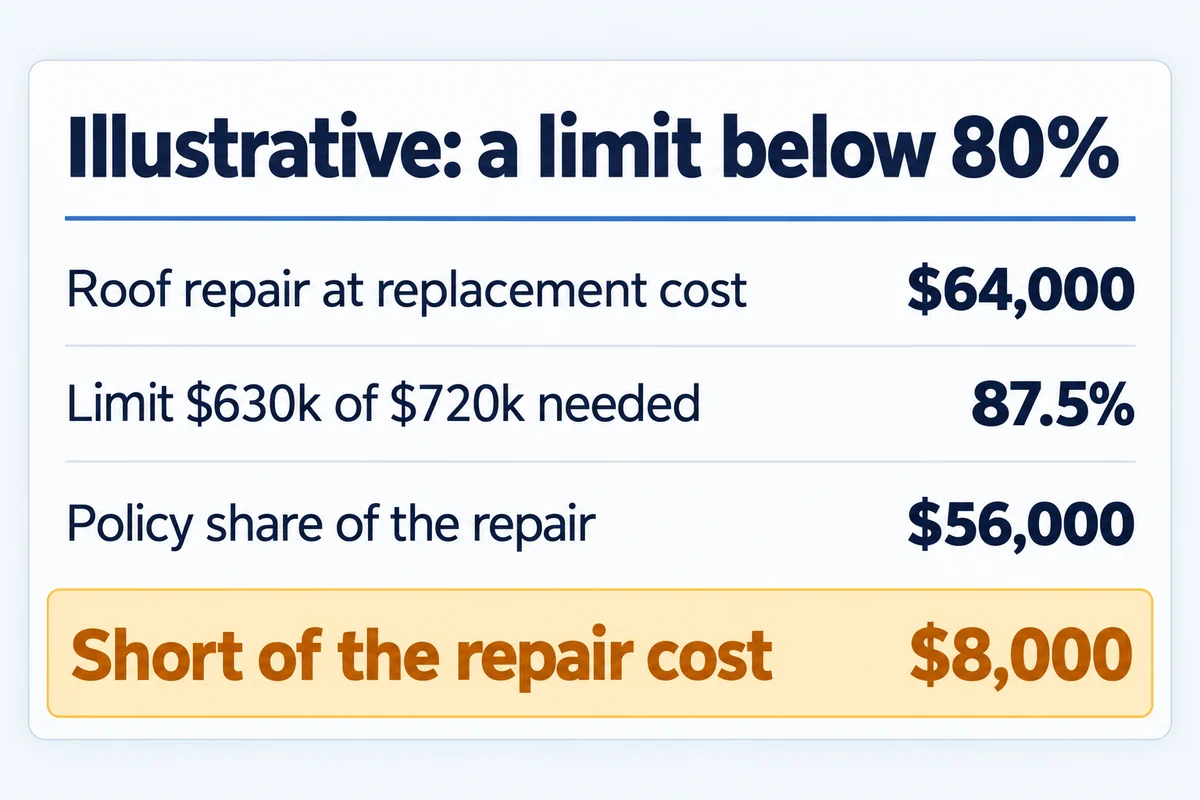
The same form caps replacement cost at the necessary amount actually spent, so a repair done cheaper than estimated is paid at what it cost. And the shortfall from a low limit grows with the size of the loss: on a fire that takes the whole roof and the attic, 12.5 percent of the bill is a large number.
How to test your own limit before the next storm
- Ask a slate roofer for a written price to replace the roof in kind: the same slate type and size, the same flashing metal, the same details at ridges, hips and dormers.
- Ask your agent which method produced your dwelling limit and whether the roof was entered as slate. If it went in as ordinary shingles, the whole figure is too low.
- Compare the limit with 80 percent of the full rebuild cost. If it is close or under, raise it in writing and keep the agent's confirmation.
- File the roofer's price, recent photos of every slope and any repair invoices in one folder. The same papers answer the adjuster's first questions after a storm.
Slate for slate: which part of the policy pays the permit work?
Most of what preservation staff ask for on a slate repair is already inside like kind and quality, so it is part of the ordinary claim. A requirement only moves to the Ordinance or Law coverage when the city makes you spend more than a like-for-like repair of the damaged part would cost. The sorting below is how I read a permit condition against the standard form:
| What the work requires | Why | Paid from |
|---|---|---|
| New slate of the same type, colour, size and thickness as the broken ones | That is the definition of like kind and quality for a slate roof. | The ordinary claim |
| Copper or lead flashing replaced in the same metal it was made of | The damaged part is rebuilt as it was. | The ordinary claim |
| Undamaged slate removed and relaid so the repair can be done the way the permit allows | Item (3) of the Ordinance or Law coverage reaches the undamaged part needed to complete the repair. | Ordinance or Law |
| A code item that the old roof never had, such as an ice barrier at the eaves | An increased cost caused by enforcing a building code. | Ordinance or Law |
| A drop in the house's market value because the rules limit what can be built | The form excludes loss in value due to any ordinance or law. | Not covered |
| A better slate, or a full new roof, that you choose and nobody requires | An upgrade by the owner, not a cost of the loss. | Your own money |
Whether a landmark permit condition is the enforcement of an ordinance or law for your policy is a question about the words of your policy and the city's written decision. Expect the adjuster to ask whether the requirement is mandatory or only a recommendation, so get the condition in writing from the city. If the insurer still refuses to treat it as an ordinance requirement, that is a coverage dispute, and an Illinois attorney is the right person to read it.
From the Ordinance Or Law additional coverage in the standard form: "You may use up to 10% of the limit of liability that applies to Coverage A for the increased costs you incur due to the enforcement of any ordinance or law".
On the illustrative $630,000 limit above, that is $63,000, available on top of the ordinary claim. The word "incur" means it is paid for costs you actually take on, so expect it to be paid after the work is done and invoiced.
Your agent can tell you whether a higher percentage is available on your policy. I go through how this coverage works on an ordinary Illinois roof, including the sheathing and ventilation items, in my post on code upgrade coverage.
What order do I do things in after the storm?
Protect the roof first, then get both offices on paper before the slate comes off. This is the sequence I follow on a landmark file:
- Stop the water with a tarp or temporary patch that does not damage the sound slate, and keep the invoice. Temporary protection is part of the claim.
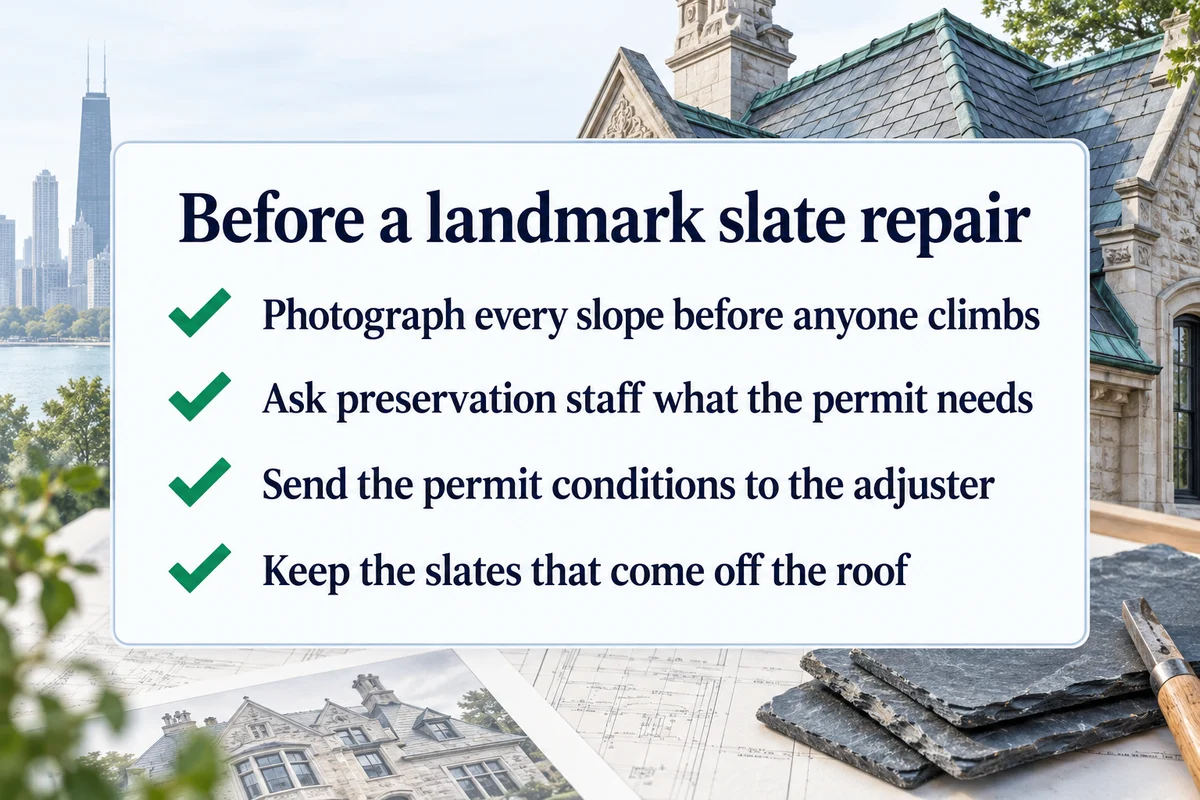
- Photograph every slope from the ground and from a ladder at the eaves, with the date visible, before anyone walks the roof. Slate breaks under the wrong footsteps, and you want a record of what the storm did.
- Report the claim, and tell the insurer in the first letter that the house is a designated landmark or sits in a landmark district.
- Contact the Historic Preservation Division (landmarks@cityofchicago.org, 312.744.3200) with the address and a description of the damage, and ask what a permit for the repair will require. The city's page also offers a Permit Fee Waiver Form; ask staff whether your work qualifies.
- Send the city's written answer to the adjuster and ask, also in writing, which items the insurer treats as like kind and quality and which as Ordinance or Law.
- Keep a few of the broken slates that come off. A slate supplier or roofer can identify the type from them, and the adjuster can see the fractures.
A roofer says the whole slate roof has to go: is that right?
Sometimes, but sound slate is repairable piece by piece, and a storm that broke a few dozen slates rarely ends an old roof's life. How a slate repair is done, and the point where one slope or the whole roof is replaced instead, is in my earlier post on a few broken slates or tiles after a storm. On a landmark house the question has a second edge: a replacement you did not need still goes through permit review, and the policy pays for the damage, not for the roof you would like to have. If the replacement slate is no longer quarried and new slate cannot blend with the old, that is a matching question, which I cover in when a carrier has to replace undamaged material.
Does this work the same way in Oak Park or Evanston?
The insurance side does, because the policy is the same. The permit side does not: suburbs such as Oak Park and Evanston have their own historic preservation commissions and their own review, so the written requirement comes from the village or city hall where the house stands. My page for Oak Park homeowners covers claims there, and the tile and slate roof claims page lists what I look at on these roofs.
When do you not need a public adjuster?
When the limit is comfortably above 80 percent, the damage is a handful of slates, the insurer has priced them in slate and the city has asked for nothing beyond a matching repair, a good slate roofer and you can finish it. I am worth calling when the payment came in as a proportion, when the estimate prices slate as asphalt, or when a permit condition sits unpaid between the city and the insurer. You can reach me seven days a week through the contact page. The first conversation costs nothing, and no one honest can promise you what an insurer will pay.