If your house in Illinois burned and the insurer has agreed the number but still will not release the money for the building, the reason is often a state law, not the adjuster. A fire claim payment for loss to the structure over $25,000 cannot be paid until the insurer has a tax and demolition certificate from your local officials, saying whether the lot owes delinquent property taxes or a demolition bill. The certificate costs at most $5, the city side has 30 days to sign it, and in Chicago an estimated demolition cost can be held back until the city says what was actually spent.
I am a licensed public adjuster in Illinois (#19461872) and Indiana (#3556317), and this request comes up on the larger fire damage claims I handle. The rule is section 397.1 of the Illinois Insurance Code, 215 ILCS 5/397.1, and I read it from the General Assembly's text for this article. I am not a lawyer, and where a city has already ordered the building down, the questions become legal ones.
Does the certificate rule apply to your fire claim?
It applies when four things are true at once. Section 397.1(a) makes it "unlawful" for an insurer to pay before the certificate arrives, so an insurer that skips it risks paying twice; subsection (g)(1) leaves it liable for the taxes and demolition money if it paid you without the certificate.
The cause was fire or explosion
Wind, hail, a burst pipe or a fallen tree are not in the section. A hail roof claim of $40,000 is paid without this step.
The building stands in Illinois
A house in Indiana is outside it, even with an Illinois agent and an Illinois owner.
More than $25,000 for the building
The "amount recoverable" is what all policies together pay for loss to the structure. Two policies of $15,000 each on one building count as $30,000.
Contents and living costs sit outside the count
The definitions speak only of loss to the structure. Furniture, clothing and the hotel bill do not push a claim over the line.
The Illinois Department of Insurance reminded every homeowners carrier of the rule in Company Bulletin 2021-04 of April 9, 2021, after its market conduct examinations found "a lack of compliance". The bulletin attached a sample certificate and lets each company use its own form if it asks for the same information. That is why the paper you get may look different from the one your neighbour got from another carrier.
Who signs the tax and demolition certificate?
Two different offices sign it, and the owner is the one who has to get it to the insurer (subsection (c) puts that duty on the "insured property owner", which also covers a mortgage holder, a land trust beneficiary and some lessees). Subsection (j) names the offices:
Property taxes
The county collector signs this half. In Cook County that is the County Treasurer.
It covers taxes delinquent on the date of the fire under the Property Tax Code. Taxes for which a certificate of error was issued do not count.
Demolition expense
Inside a city or village, the city clerk or village clerk signs this half. Outside any town, the head of the county building department signs it.
It covers what the local government spent or expects to spend to demolish or remove the building.
The certificate comes back in one of two forms. Under subsection (c)(1) it says there are no delinquent taxes and no unpaid demolition expense, and the insurer can pay you. Under (c)(2) it states the amounts owed and carries your direction to the insurer to pay them, which the insurer then does by cheque to the tax collector or the local government, with the rest coming to you. Subsection (k) caps the local fee for signing at $5.
The insurer also sends a notice of its intent to pay to the State's Attorney of the county, with your name, the address, the legal description, the property index number (the PIN on your tax bill) and the amount. Having the PIN ready saves a round of letters.
How long can the demolition side hold up the money?
The law gives the local government 30 days from the request to make its estimate and sign. If it does not, the insurer may pay as if the certificate showed no demolition cost. The days are counted from the day the request reaches the official:
- Day 0
The request is served. Subsection (b)(5) lets it be handed over in person against a signed, dated receipt, or sent by certified mail with a return receipt. Whoever sends it should keep that proof, because day 30 is counted from it.
- Day 28
The last day for a court to order an amount withheld for demolition, with the local government a party to the case. A court order replaces the city's estimate.
- Day 30
The local government has to estimate any demolition cost and sign. Silence lets the insurer pay without a demolition hold.
- After day 30, in Chicago only
Subsection (d)(2) covers cities of over 2,000,000 people, which in Illinois means Chicago. An estimated demolition cost is held by the insurer, not paid to the city, until an amended certificate says either that no demolition expense will be incurred or what the real cost was. You get interest on the held amount from the date the certificate was signed, under the Interest Act.
Outside Chicago, an estimate is paid to the local government, and subsection (f) returns any excess over the final demolition cost: first to unpaid taxes, then to you. The tax half has no 30-day clock in the section, so a slow tax office is a reason to ask the insurer early which office it is waiting on. If the whole claim has gone quiet for other reasons, the Illinois deadlines in my article on a delayed property insurance claim still run.
Where does the money go when taxes or a demolition bill are owed?
Taxes are paid first. Subsection (e) says that when the proceeds are smaller than the taxes plus the demolition expense, "unpaid property taxes shall be paid first". The worked example below is illustrative, not a real file: a Chicago frame house with an agreed structure loss of $148,000 after the deductible, $4,200 of delinquent taxes, and a demolition case the city opened after the fire and estimated at $36,000.
The mortgage holder's name on the cheque has nothing to do with section 397.1. It comes from the mortgage clause of the homeowners form, which pays loss under Coverage A or B "to the mortgagee and you, as interests appear". So a fire cheque in Chicago can be split three ways and still carry two names on the part that reaches you.
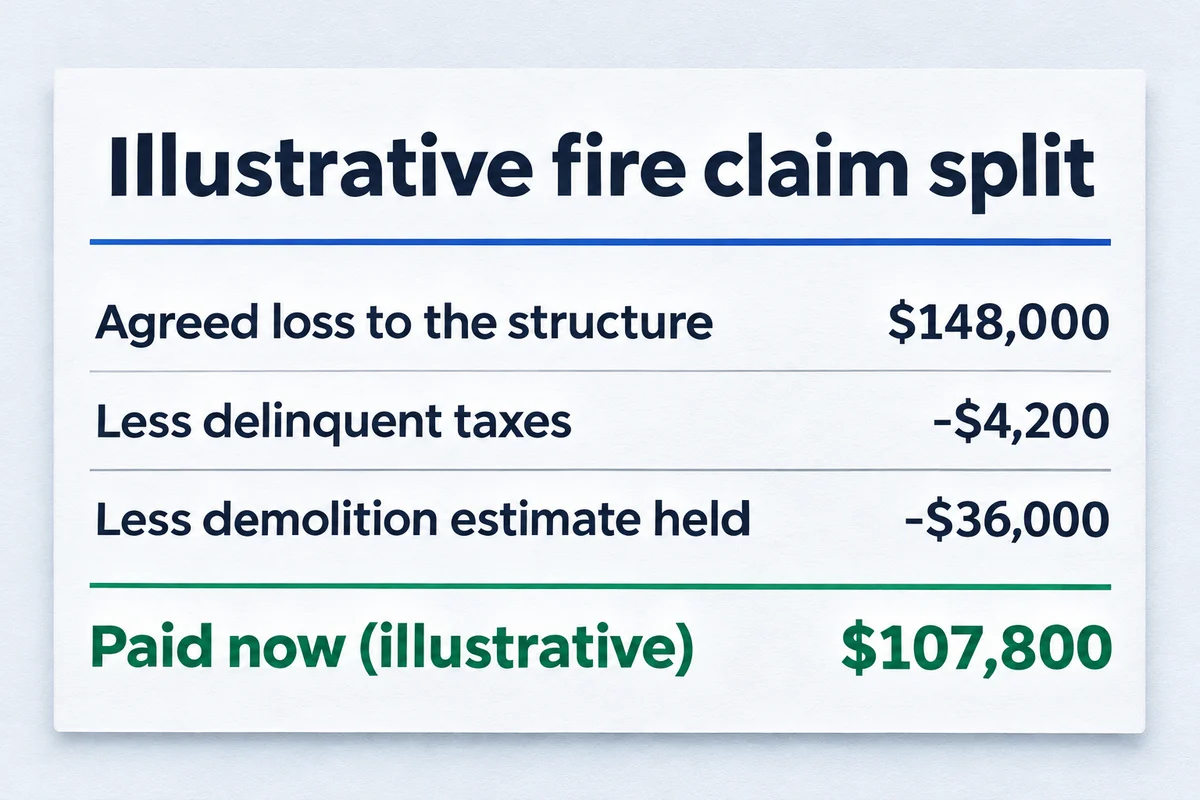
The section also protects the money from growing a second bill. Subsection (g) says it does not make the insurer liable for more than its policy pays (unless it skipped the certificate), and it does not make the city an insured on your policy.
Does the policy pay to knock the house down and haul it away?
Yes, within limits, and three parts of the standard form do the paying. I read them in ISO's HO 00 03 05 11 homeowners form, from the copy filed with the Maine Bureau of Insurance. Your carrier may have changed the wording, so read your own policy before relying on this table.
| Cost after the fire | Part of the form that pays it | The limit |
|---|---|---|
| Tearing out and carting away burned framing, roof and finishes | Debris Removal, an additional coverage | Inside the Coverage A limit, plus an extra 5% of that limit when damage and debris together go over it |
| Demolishing the part of the house that did not burn, because the building code requires the whole house to come down | Ordinance or Law, item (2) | Up to 10% of Coverage A, shared with every other code cost |
| Hauling away the debris from that code-required demolition | Ordinance or Law, paragraph b. | The same 10% |
| Testing for or removing pollutants because a law requires it | Excluded by Ordinance or Law paragraph c.(2) | Nothing under this part |
The 5% sentence is where most of the money hides on a total loss. Take an illustrative house insured for $250,000 under Coverage A, with $246,000 of fire damage and $16,000 to remove the debris. The total is $262,000, which is over the limit. The form makes "an additional 5% of that limit", $12,500, available for debris removal, so the $12,000 that did not fit inside the limit is paid from the extra amount and nothing is left unpaid in this worked example. With $20,000 of debris instead, $3,500 would fall outside both.
Code-driven demolition and the code upgrades that follow share one 10% pot, which is why I price them together. My article on code upgrade coverage in Illinois goes through that 10% line by line.
What should you gather before the insurer asks for the certificate?
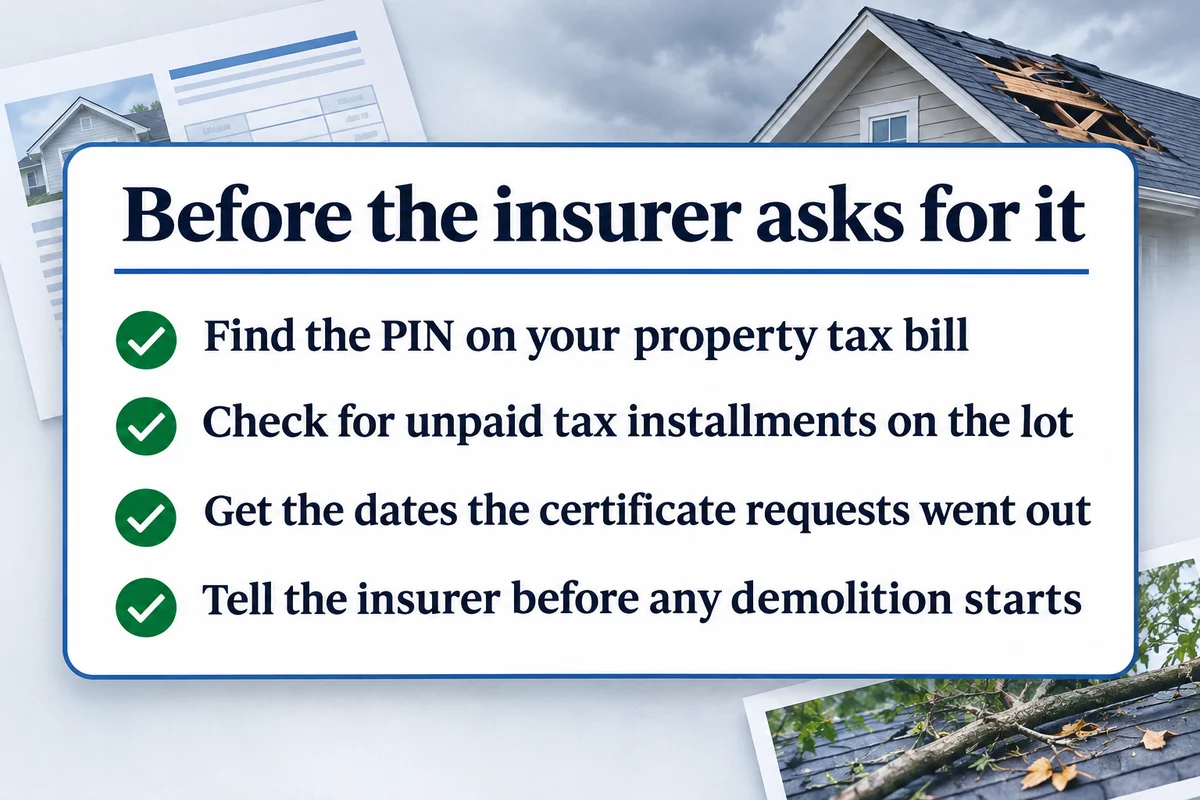
Most of the wait comes from a request that went to the wrong office, or from taxes nobody knew were behind. A few hours in the first week after the fire take that out:
- Find the PIN on your last property tax bill and check whether any installment on the lot is unpaid. Taxes that were already behind on the day of the fire are the ones the certificate lists.
- Ask the adjuster in writing whether the claim for the building is expected to go over $25,000, and which certificate form the company uses.
- Ask who sends the requests to the county collector and the clerk, you or the insurer, and get the dates they went out.
- Keep every letter, notice or placard from the city's building department about the burned house, with the date you received it.
- Do not sign a demolition contract or let a city contractor start until the insurer knows. Under subsection (b)(5)a., demolition by the local government before your proof of loss is accepted becomes a bill paid out of your claim.
- When a certificate shows an amount, ask for a copy of the city's estimate and the date the certificate was signed, because interest on a Chicago hold-back runs from that date.
The date your sworn proof of loss is accepted matters here too. It is one of the two dates the law compares when it decides whether a demolition the city already did counts as an incurred expense.
When the city has already ordered the building down
A city can treat a burned building as unsafe and move to have it demolished, and the cost of a demolition the city pays for can become a lien on the lot. Once a demolition case or a lien exists, the question of what you owe the city and whether the order was proper is legal. An Illinois real estate or insurance attorney should read the court papers, and I work alongside them on the insurance side: the scope, the price of rebuilding, and making sure the debris and code lines in the estimate match what the city requires.
Subsection (i) adds one narrow rule for a lot bought through a tax deed: taxes and demolition costs from before the deed are not taken out of a later fire claim on that building.
When you do not need a public adjuster for this
A kitchen fire with $18,000 of damage to the structure never meets the certificate rule, and on a large claim with paid-up taxes and no city case the clerk has 30 days to sign a clean certificate. In both, the certificate is paperwork you can handle with the adjuster. Where I earn my fee is the size of the structure number itself, the debris and demolition lines and the code costs. If you want me to look at a fire file, the services I offer and how I am paid are on one page, and you can reach me at +1 224-481-2093, Monday to Friday 7 AM to 7 PM and Saturday and Sunday 9 AM to 5 PM.