A standard Illinois homeowners policy pays for tornado damage to the house, the garage, your belongings and your extra living costs, because a tornado is a windstorm and windstorm is an insured peril. What it pays is decided by your estimate, your deductible and a few small clauses about rain, trees and debris. The National Weather Service rating of the tornado is good evidence of when and how hard the wind blew. It is not a scope of repairs, and it does not decide your claim either way.
I am a public adjuster and a HAAG certified roof inspector in Chicago, licensed in Illinois and Indiana. Below I read a tornado claim from three documents: the standard ISO homeowners form HO 00 03 05 11, which many Illinois carriers build on; the Enhanced Fujita scale report that the weather service uses to rate tornadoes; and the National Weather Service Chicago survey of the June 20, 2021 tornado. Your policy may be worded differently, so keep your own copy open next to this.
Does the policy have to say tornado?
No. The form never uses the word. It insures windstorm, and a tornado, a downburst and straight-line wind are all windstorms in that sense. So a carrier cannot fairly turn down roof damage because the weather service did not confirm a tornado over your street. The question the policy asks is whether wind did the damage, and the place to settle that is on your roof, not on a map.
This peril does not include loss to the property contained in a building caused by rain, snow, sleet, sand or dust unless the direct force of wind or hail damages the building causing an opening in a roof or wall and the rain, snow, sleet, sand or dust enters through this opening.
ISO HO 00 03 05 11, Coverage C peril 2, Windstorm Or Hail (copy published by the Maine Bureau of Insurance)
That sentence matters after almost every tornado. Rain that came in through a window the wind broke, or through a hole where the decking lifted, is part of the windstorm loss. Rain that seeped around an old window frame with no new opening is not. Photograph every opening the night it happens, before the tarp goes on, because the opening is what links the wet drywall to the wind.
The damage ladder: from the survey's words to your estimate
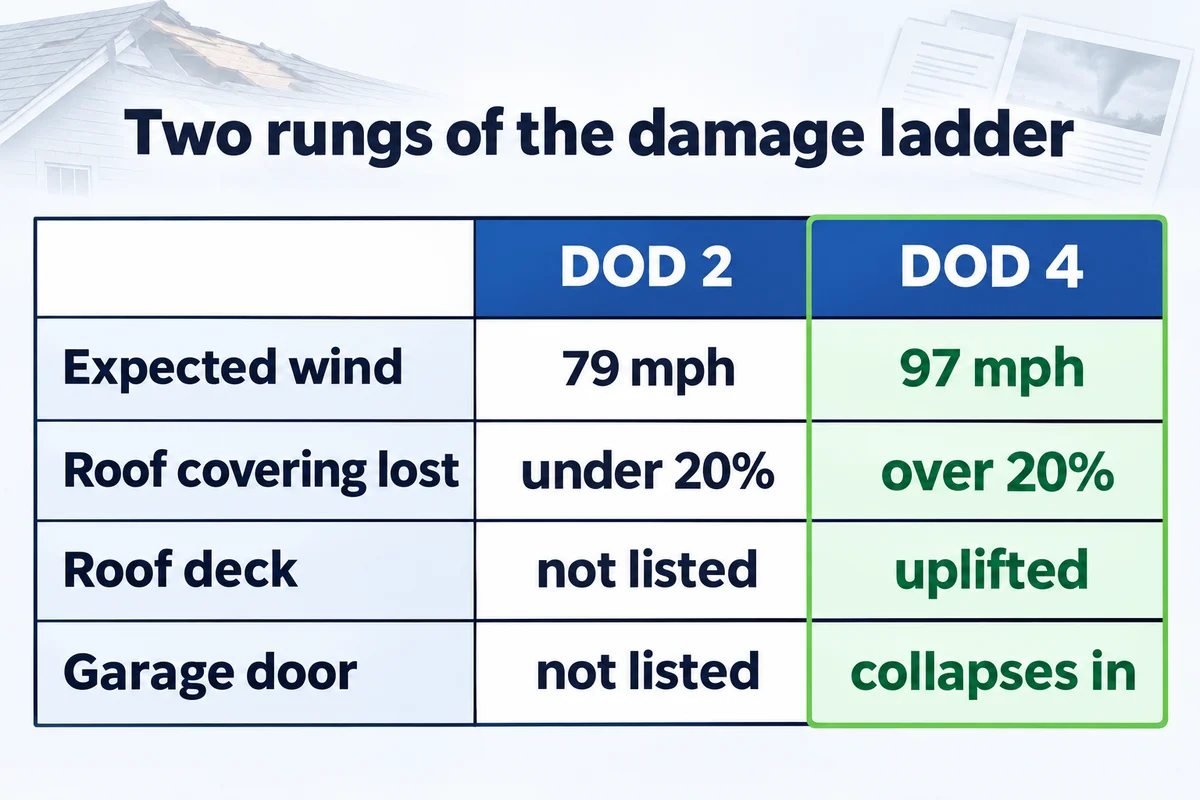
Weather service teams rate a tornado by matching what they see to a list of degrees of damage for each kind of building. For a one- or two-family house, the Texas Tech Enhanced Fujita scale report submitted to the National Weather Service in 2006 lists ten degrees, each with an expected wind speed. I use the same ladder in reverse. Once I know which rung a house is on, I know which estimate lines and which parts of the policy should be in the file.
- Degrees 1 and 265 to 79 mph expected
The survey's words
Threshold of visible damage; loss of roof covering material under 20%, gutters or awning; loss of vinyl or metal siding.What the claim should carry
Shingle repair or a slope replacement, gutters, siding on the wind side, and the matching question for siding that is no longer made. - Degrees 3 and 496 to 97 mph expected
The survey's words
Broken glass in doors and windows; uplift of the roof deck and loss of over 20% of the covering; chimney collapse; garage doors collapse inward; porch or carport failure.What the claim should carry
New deck sheets and a full roof, window units, the garage door, interior rain damage through each opening, and emergency tarping and boarding. - Degrees 5 to 7121 to 132 mph expected
The survey's words
The entire house shifts off its foundation; large sections of roof structure removed; exterior walls collapsed.What the claim should carry
An engineer's report, framing, possibly a rebuild, code upgrades under Ordinance or Law, contents, and months of additional living expense. - Degrees 8 to 10152 to 200 mph expected
The survey's words
Most walls collapsed except small interior rooms; all walls; a well built house destroyed and the slab swept clean.What the claim should carry
A total loss: the dwelling limit, debris removal with its extra 5%, the full contents inventory and the choice of where to rebuild.
The ladder is a checklist, not a valuation. The insurer is not bound by a weather service rating, and the rating of a tornado comes from its worst damage, so the house two blocks away may be on a much lower rung than the one that set the number. What helps is the vocabulary. When the estimate for a house with lifted decking and a garage door blown into the garage prices only shingles, the file is missing the rung the house is actually on.
The same rungs carry over to wind and storm damage claims that never get a tornado rating at all, and if hail fell in the same storm, wind versus hail changes the deductible and the scope in ways worth reading before the inspection.
What a weather service survey proves for your claim
It proves the date, the time and the strength of the wind along a mapped path. It does not prove what happened to your house, and a house outside the path can still have a covered windstorm loss. The NWS Chicago damage survey statement for the night of June 20, 2021 shows both sides. I read it the way I would read it for a client in that area.
- Rating EF-3, estimated peak wind 140 mph
- The peak is for the worst spot on the path. The same statement says damage to homes became common only east of Naper Boulevard, so most houses on that path saw far less than 140 mph.
- Path 17.6 miles long, at most 600 yards wide
- Six hundred yards is about a third of a mile at the widest point. Strong wind does not stop at the edge of a line on a map, which is why the survey looks at damage, not at a fixed radius.
- 11:02 PM to 11:25 PM CDT, about 230 homes damaged
- This fixes the date of loss. A storm close to midnight is exactly where a wrong date creeps into a claim, and the time on this page settles it.
- Straight-line wind damage surveyed in Downers Grove and Westmont
- The same night produced wind damage outside any tornado path. Under the policy wording that is still windstorm, and the claim is read the same way.
- Marked preliminary, subject to final review in NWS Storm Data
- Save the statement and the final Storm Data entry. If the numbers change, the later record is the one to cite.
The street by street path of that tornado is on my Naperville page. For any storm, how the date of loss is chosen and corrected explains why the time on a survey matters as much as the rating.
Who pays to haul the debris and the trees?
Your own policy, for most of it, under two different sentences with two different limits. After a tornado the yard holds your shingles, your trees, a neighbour's tree and pieces of houses you have never seen. The ISO form sorts them like this.
| What is in the yard | Paid under | How much |
|---|---|---|
| Your own shingles, siding, gutters and glass | Debris Removal a., debris of covered property | Inside the limit for the damaged property; if the limit runs out, another 5% of that limit is available for removal. |
| Your tree on the house or garage | Debris Removal b. | Up to $1,000 per loss, no more than $500 for any one tree. The house repair is a separate dwelling item. |
| Your tree across the driveway, car cannot get in or out | Debris Removal b. | Same $1,000 and $500 caps; a tree blocking a ramp for a disabled person counts too. |
| Your tree on the lawn, touching nothing | Nothing in the base form | Removal is not in b., and the tree itself is not insured against wind: the trees clause lists fire, lightning, theft and a few other perils, not windstorm. |
| A neighbour's tree that hit your house or blocks your driveway | Debris Removal b., on your policy | Same caps. Windstorm is a Coverage C peril, so a neighbour's tree felled by wind qualifies. |
| Parts of someone else's roof, fence or shed | Not reached by the wording as written | Sentence a. speaks of debris of covered property, and these pieces are not yours. Ask the adjuster in writing, and ask your village whether it runs a storm pickup. |
Tree crews bill after tornadoes in round numbers for the whole yard. Ask for one line per tree, with where each one fell, because the caps work per tree and the lawn tree is paid differently from the one on the roof. The fallen tree claims page walks through each landing spot in more detail.
Illustrative: one house on the fourth rung
A worked example, every figure illustrative. A suburban house insured for $350,000 has a windstorm or hail deductible of 2% of that limit, so $7,000. The tornado lifts part of the roof deck, strips siding on two sides, breaks four windows and pushes the garage door in. Rain enters through the roof opening. Two of the owner's trees come down: an oak across the driveway and a maple on the back lawn.
| Item | Cost | Where it sits in the policy | Paid |
|---|---|---|---|
| Roof deck sheets and a full re-roof | $21,800 | Dwelling, windstorm | see subtotal |
| Siding and gutters $6,900, windows $4,300, garage door $2,600 | $13,800 | Dwelling, windstorm | see subtotal |
| Ceilings, insulation and flooring wet through the roof opening | $8,200 | Dwelling, rain through a wind-made opening | see subtotal |
| Hauling the roof and siding debris | $1,450 | Debris Removal a., inside the dwelling limit | see subtotal |
| House subtotal, less the $7,000 deductible | $45,250 | One loss, one deductible | $38,250 |
| Oak across the driveway, removal | $1,400 | Debris Removal b., $500 for any one tree | $500 |
| Maple on the back lawn, removal | $900 | Not covered: hit nothing, blocks nothing | $0 |
| Whole file | $47,550 | Owner pays $8,800 in this example | $38,750 |
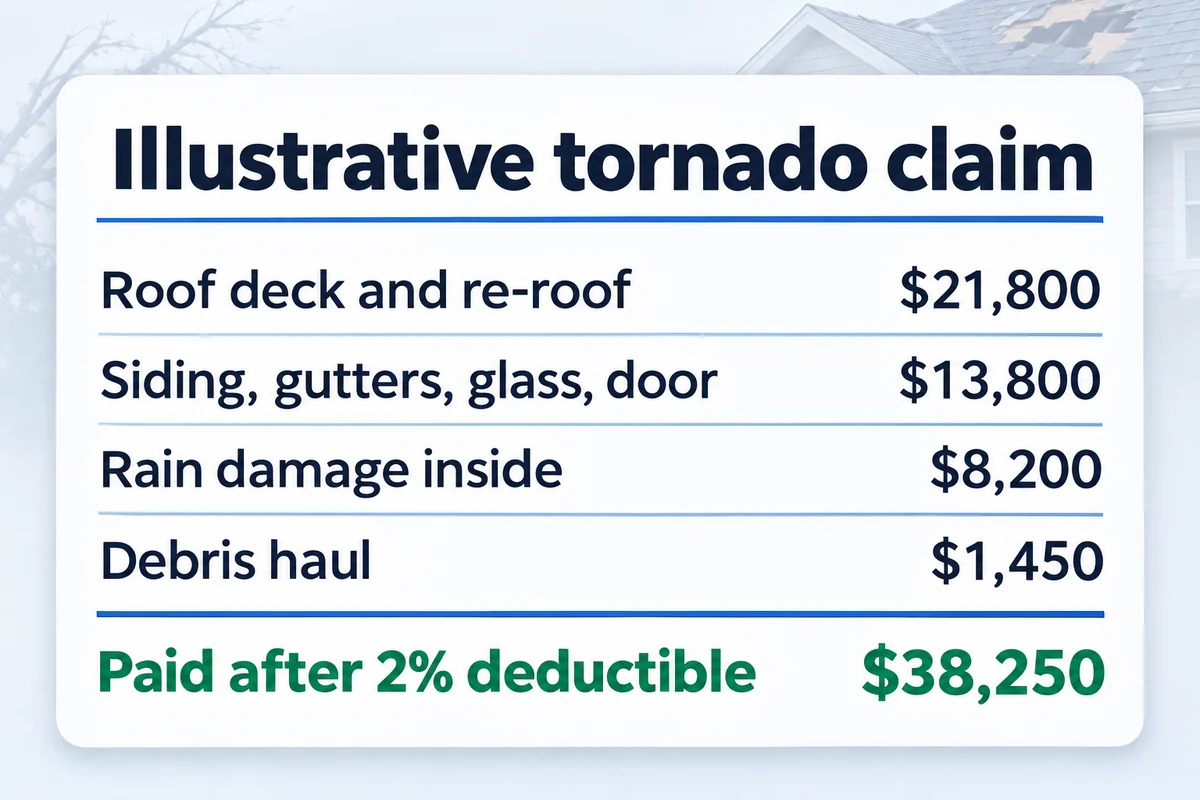
Two things change real outcomes in a file like this. The 2% is a choice made at purchase, and on a $350,000 house it is seven times a common flat $1,000 deductible; the declarations page shows which one you have. And a replacement cost policy often pays the first cheque at actual cash value, holding the depreciation back until the work is done, which the post on the first, smaller cheque explains step by step.
The first week after a tornado
- Stay off the roof and out of rooms with a sagging ceiling. Once it is safe, photograph every side of the house, every opening in the roof and walls, and the street, with the time on the photos. Those pictures of openings are the link the rain clause needs.
- Report the claim and write down the claim number and the adjuster's name. Then tarp and board. The form pays the reasonable cost of the necessary measures taken solely to protect covered property from further damage, and expects you to keep a record of what they cost.
- Keep every receipt, including your own materials.
- Photograph the roof before and after the tarp goes on.
- Before the tree crew cuts anything, photograph each tree where it lies and what it touched. Ask for a bill with one line per tree. Download the weather service survey statement for your date and save it with the claim papers.
- Start the contents list room by room, read the declarations page for the windstorm or hail deductible, and check any roofer before you sign. What Illinois law puts in a roofing contract after a storm applies after a tornado in the same way.
When a public adjuster helps, and when it is a lawyer
If the tornado took a few shingles and a gutter, and the carrier's estimate prices them fairly, you do not need me; the fee would cost more than any difference I could find. Where I earn the fee is a house on the third or fourth rung priced as if it were on the first: decking left out, siding replaced on one wall when the line is no longer made, rain damage written off as old leaks, or a percentage deductible taken twice. I inspect the roof myself, write the scope line by line, and deal with the carrier for you in Illinois and Indiana.
A dispute about what the policy means, a denial that says the loss is excluded, or a deadline in the suit clause is a legal question, and an attorney is the right call for it. If you want me to look first, send me the declarations page and your photos, and I will tell you which of the two you need.