The date of loss on an insurance claim is the day the damage happened: the day of the hail, the wind, the fire or the pipe that split. It is not the day you noticed it and not the day you called. That one date decides which policy answers, which deductible comes off, and when every deadline in the contract starts to run, so a wrong date can cost more than a low estimate. For a storm, the date is something you can prove from public weather records, and a wrong one on the carrier's paperwork can be corrected if you raise it in writing early.
I am a licensed public adjuster in Illinois (#19461872) and Indiana (#3556317) and a HAAG certified inspector (#992104047). I work for the property owner, never the insurer, and I am not a lawyer. What follows is how the date works on a homeowner claim in the two states I am licensed in, with the policy wording quoted so you can find it in your own contract.
What does date of loss mean on an insurance claim?
It means the calendar day the covered event happened, and the policy uses that day as an anchor in at least five places. The standard homeowners form, ISO HO 00 03 05 11, is the one most Illinois policies are built from (I read it from the copy the Maine Bureau of Insurance publishes). Your carrier's wording may differ, so treat the letters below as a map for finding the same clauses in yours.
This policy applies only to loss which occurs during the policy period.
The date picks the policy. One day before your renewal or a change of carrier, and the claim belongs to the old contract with its own limits and deductible.
With respect to any one loss
The deductible is charged per loss. Two dates mean two losses and, as a rule, two deductibles.
Give prompt notice to us or our agent
Prompt is measured from the loss. A carrier that says notice was late counts from your date, not from the day you found the damage.
within 180 days after the date of loss
The notice that you intend to repair or replace, which keeps the replacement cost part of the claim open.
within two years after the date of loss
The deadline to sue in this form. Illinois pauses it in some situations, which I cover in the four clocks on an Illinois claim.
The date also travels into documents you sign. The sworn proof of loss asks for it near the top of the form, and I explain that form in signing a sworn proof of loss in Illinois.
How is the date of loss chosen for a hail or wind storm?
For a fire or a burst pipe, the date is usually obvious. For hail and wind it is chosen by matching the marks on the roof to a storm that actually crossed your address. Carriers check the date you give against weather data, and so should you, before you give it.
Two free federal sources do most of the work. The Storm Prediction Center publishes daily storm reports of hail, wind and tornadoes, with hail size in hundredths of an inch (175 means 1.75 inches), back to June 1999. Those reports are preliminary. The finished record is the NOAA Storm Events Database, which you can search by county. It runs months behind: when I checked it today it held data through July 2026. It also offers a certified PDF of your search results through ncei.orders@noaa.gov, which is the version I would attach to a dispute.
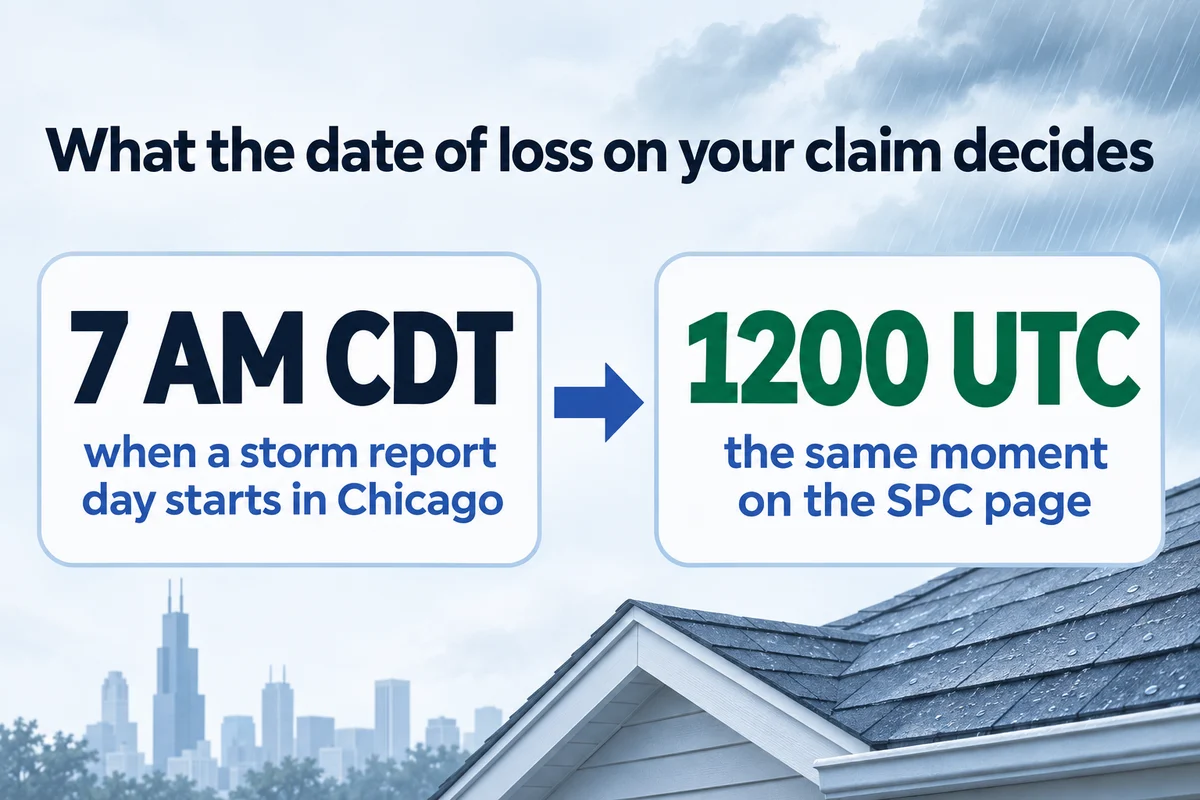
The trap is the clock. An SPC report day runs from 1200 UTC to 1159 UTC the next day, and every time on the page is in UTC. In Chicago in summer that day starts at 7 AM local time. A storm that hit your house before 7 AM is filed on the previous day's page, and an owner who looks only at today's page decides there was no storm.
| Hail at your house | Time on the SPC page | SPC page it is on |
|---|---|---|
| June 14, 4:10 PM | 2110 UTC, June 14 | June 14 |
| June 14, 9:45 PM | 0245 UTC, June 15 | June 14 |
| June 15, 6:20 AM | 1120 UTC, June 15 | June 14 |
| June 15, 7:30 AM | 1230 UTC, June 15 | June 15 |
Your date of loss is the local date. The 6:20 AM storm in the third row happened on June 15 at your house, even though the report sits on the June 14 page. Write June 15 and keep a printout of the June 14 page with the line marked, so nobody on the other side reads the page header as your date. In winter Chicago is six hours behind UTC, and the cut-off moves to 6 AM.
A report near you is a starting point, not proof that hail hit your roof. Reports come from spotters and the public, and a quiet street can sit between two dots on the map. On the roof, I compare the marks with the storm: fresh fractures with clean edges, dents in soft metal that match the reported size, and damage on the slopes that faced the storm's direction. How that inspection runs is in hail damage on an asphalt roof.
What if the insurer put the wrong date on my claim?
Ask for it to be corrected in writing as soon as you see it, with the weather record attached. A wrong date is common, because a claim cannot be opened without one and the person taking the first call sometimes types the day of the call. It matters when the wrong date falls outside your policy period, lands on a day with no storm, or makes your notice look late.
- Find the date on the acknowledgement letter, the claim portal and the field adjuster's report. They are not always the same.
- Pull the SPC page and, once it is published, the Storm Events entry for your county on the date you believe is right.
- Write to the adjuster, quote the claim number, give the date you believe is right and attach the record.
- Ask for a written reply confirming the change, and check that the next estimate and any proof of loss form carry the corrected date.
Claim number: [number]. The acknowledgement letter lists the date of loss as June 16. The hail that damaged the roof fell at about 6:20 AM on June 15. The attached Storm Prediction Center report lists 1.75 inch hail two miles from the house at 1120 UTC on its June 14 page, which is 6:20 AM on June 15 in Chicago.
Please correct the date of loss to June 15 and confirm the change in writing.
A sample of the wording I use. The dates and the report are illustrative.
If the carrier refuses because it believes a different storm did the damage, you are in a dispute about cause and timing, and the roof evidence decides it. If it refuses because the date it prefers falls outside the policy, and your evidence says otherwise, that is the point to talk to a lawyer about your rights.
Two storms on one roof: one date or two?
Two separate storms are two dates and, under the deductible clause quoted above, usually two deductibles. Owners sometimes want everything filed under one date to pay one deductible. That is not your call to make, and a date chosen to fit the money instead of the weather is the kind of statement the concealment clause below is written for.
On a Chicago roof the two storms are often hail one month and wind a few months later. The illustrative example below uses a house insured for $320,000 with a 1% wind and hail deductible, so $3,200 per loss.
Both storms in one policy year
May 18 hail: south and west slopes, $9,400. Less $3,200, $6,200 paid.
August 2 wind: north slope, $2,600. That is below the $3,200 deductible, so $0 paid.
Total on two dates: $6,200.
A new carrier from July 1
May 18 hail stays on the old policy: $6,200 paid by the old carrier.
August 2 wind goes to the new policy and its own deductible. If that deductible were a flat $2,000, the new carrier would pay $600.
Each policy answers only its own date.
Worked example. Every figure in this section is illustrative.
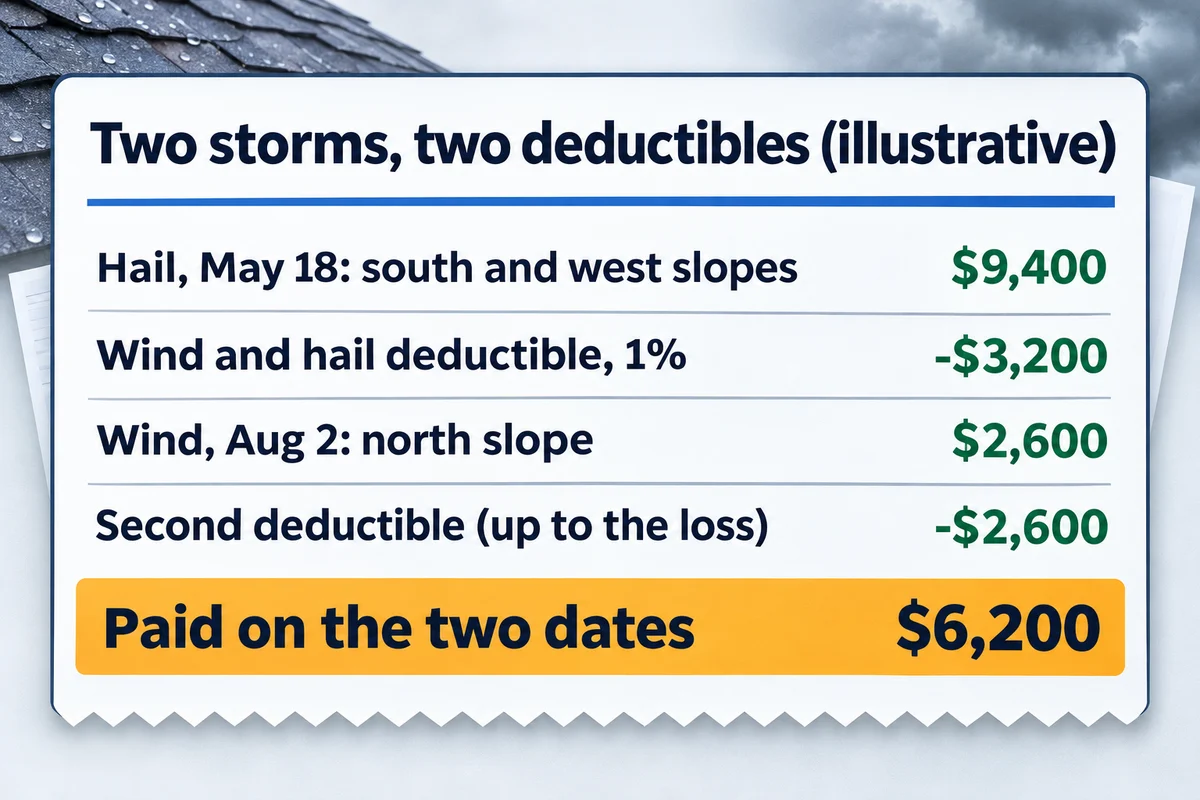
Two things follow. The damage from each storm has to be separated on the roof, slope by slope, and the photographs from the first inspection are what make that possible. And within one loss, if your policy carries both a flat deductible and a wind and hail deductible, the same clause says only the highest one applies. Which damage belongs to which peril is the subject of wind or hail: why the cause of loss changes what you get paid.
Damage you only found later
Plenty of losses are found weeks after they happen: a stain after the first heavy rain, hail damage spotted by a roofer doing something else. The honest answer is two dates. One is the day the event happened, which for a storm comes from the weather record. The other is the day you found the damage, and you should write that down too, with how you found it. Do not move the event to the discovery day, and do not guess an event date to make the notice look prompt.
We provide coverage to no "insureds" under this policy if, whether before or after a loss, an "insured" has: 1. Intentionally concealed or misrepresented any material fact or circumstance
That clause is about intent, and an honest "I am not sure of the exact day, here is what I know" is not a misrepresentation. A confident wrong date, repeated on a sworn form, can turn into one. When I am not sure of the date, I say so in writing and say what the evidence points to.
Before you give a date on the first call
- Look at your declarations page for the policy period, and note whether a renewal or a change of carrier falls near the storm.
- Check the SPC report page for the day of the storm and the day before, remembering the 7 AM cut-off in summer.
- Write down two dates: when it happened and when you found it, with a sentence on how you found it.
- Keep photos with their original files, since the time stamp is evidence of the day.
- If you are not sure, say so, and ask the carrier to note that the date is to be confirmed.
- Ask for the claim number and the date of loss the carrier recorded, and read them back.
When you do not need a public adjuster for this
If the storm is in the record, the date on the letter matches it, and the adjuster's scope looks like your roof, you do not need me to fix a date. A short email with the weather report attached is enough. Where I am useful is when the date is part of a larger fight: a carrier that says the damage is old, two storms that need separating on the roof, or a claim that crosses a change of carrier. That work is described on the roof damage claims page. If the dispute is about whether the policy applies at all, a lawyer is the right person to ask. If you want me to look at the paperwork first, send it to me; the office is open seven days a week.