If a winter storm blew powder snow into your attic through the vents and it melted through the ceiling, a standard Illinois homeowners policy built on the common HO-3 form will usually pay to repair the house: the wet insulation, the stained drywall, the paint. Your belongings in the room below are another matter. On that same form they are paid for snow damage only if the wind first broke an opening in the roof or a wall, and a vent that was built to be open does not count. So the ceiling and the bed under it can get two different answers on the same claim, and the evidence that decides both sits in the attic for only a few days before it melts.
I am a licensed public adjuster in Illinois and Indiana, an Illinois licensed roofing contractor and a HAAG certified inspector. After a blizzard, the call I get most is not about a broken roof. It is about a ceiling stain that showed up four days later, in a house where nothing outside looks damaged.
How snow gets into an attic when nothing on the roof is broken
An attic is meant to breathe. Cold air comes in low at the eaves and leaves high at the ridge, so the roof deck stays dry and cold. In a storm with fine, dry snow and gusts of 50 mph or more, that same airflow carries snow with it. It settles on the insulation in thin drifts, often right under the vent that let it in, and sits there frozen until the attic warms up.
- Ridge ventSnow in a long, narrow line on the insulation directly below the peak. The most common entry on a newer Chicago-area roof.
- Box vents near the ridgeA round or fan-shaped pile under each vent, larger on the side that faced the wind.
- Gable louversA drift that starts at the end wall and fades toward the middle of the attic. Older bungalows and two-flats often have them.
- Soffit vents at the eavesSnow packed along the eave, deep in the insulation where it is hardest to see from the hatch.
- Bath fan or dryer capMelt that runs back down the duct and shows up as a ring around the fan grille in the bathroom ceiling.
None of these vents is broken when it lets snow in. That fact is why the claim turns on which part of the policy you are reading, not on whether the storm was bad.
Does the homeowners policy pay for the ceiling?
On the ISO HO 00 03 05 11 form, which many carriers' homeowners policies follow, the house itself is covered on an open basis: the form says "We insure against direct physical loss to property described in Coverages A and B" and then lists what it does not cover. Snow blown in through a vent is not on that list. Your belongings are covered only for named perils, and the windstorm peril for them carries its own condition. The table sorts what got wet in a typical attic snow claim by the part of the policy that answers for it.
| What got wet | Part of the policy | Does it need an opening made by wind? |
|---|---|---|
| Attic insulation | Coverage A, the dwelling | No, on the ISO form |
| Drywall ceiling, paint, light fixture | Coverage A, the dwelling | No, on the ISO form |
| Wet roof sheathing or rafters | Coverage A, the dwelling | No, but expect the wear question |
| Carpet glued or tacked to the floor | Usually Coverage A | No, on the ISO form |
| Bed, rug, clothes, a laptop | Coverage C, personal property | Yes, for the windstorm peril |
| Boxes stored in the attic | Coverage C, personal property | Yes, for the windstorm peril |
The condition for belongings reads, in the windstorm peril of Coverage C, that it does not include loss to property inside a building caused by rain, snow, sleet, sand or dust "unless the direct force of wind or hail damages the building causing an opening in a roof or wall" and the snow comes in through that opening. An open ridge vent is not damage. The separate peril for weight of ice, snow or sleet does not help either: it is about the load of snow crushing something, which is the subject of my page on snow on the roof and collapse claims, not about melt dripping onto a mattress.
What the insurer may say instead, and how to answer it
Even where the ceiling is covered, an attic snow claim draws a few standard replies. These are the three I see, and what usually answers them.
- "The vent is worn out or was never baffled."
- The form excludes wear and tear, and it excludes faulty design, workmanship, materials or maintenance. A loose, rusted or missing baffle can bring those in.Read the whole exclusion. The faulty design clause in the ISO form ends by saying that ensuing loss not otherwise excluded is covered. A poor vent may not be paid for, while the wet ceiling it led to can still be. Ask the adjuster to name which damage each exclusion is applied to.
- "Your policy excludes rain and snow inside the house without an opening."
- Some carriers write the opening condition into the dwelling coverage as well, not only into the belongings peril. Where that sentence applies to the house, the vent argument changes completely.Ask for the exact policy form number and the page the sentence is on. Then read it against your own declarations page, not against a summary in the letter. If the wording is there, the question becomes whether the wind damaged a vent, a cap or the roof covering before the snow came in.
- "This has been leaking for a while."
- Old stains on the deck, dark rings around nail heads and rot along the eave can all point to years of condensation rather than one storm.Fresh snow on the insulation, a dated storm record and a stain that appeared within days of the storm are the answer. That is why the photos in the next sections matter more than anything you write later.
Why the leak shows up days after the storm
Snow that blows into a cold attic does not melt right away. It waits for the first sunny afternoon, a thaw, or warm air leaking up from the house. So the stain appears days after the storm, and the claim form asks for a date of loss. Use the storm date, not the day you noticed the stain, and keep the weather record that proves it. The National Weather Service office in Chicago keeps summaries of major storms. Its page on the January 31 to February 2, 2011 blizzard shows what such a record contains:
Source: NWS Chicago, January 31 to February 2, 2011 Historic Blizzard. The lakefront gust that night was 70 mph.
Wind in that range, with fine snow and drifting, is exactly the weather that pushes snow through vents. In a storm like that, with snow on the ground for more than two weeks after it, a homeowner could easily find the first stain a week or more after the date of loss. I explain how to pick and prove that date in what the date of loss on your claim decides. The storm record is also your answer to "this has been leaking for a while".
What to photograph in the attic before the snow melts
The evidence is frozen water, and it will not stay. Do this the day you find it, or have someone do it if you cannot get into the attic safely. Do not walk on the ceiling joists if you are not sure where they are; a foot through the drywall is a different claim.
- From the hatch, a wide photo of the whole attic with the drifts in it, before anyone touches them.
- Each vent from the inside, with the snow pile below it in the same frame, so the path is plain.
- A tape measure laid across the deepest drift and across the wet patch of insulation.
- Each vent from the outside, from the ground with a zoom lens is fine. A missing cap, a bent louver or a lifted ridge vent section is the photo that changes the belongings answer.
- The ceiling below, every stain, with the room in frame, and again two days later to show it spreading.
- Wet belongings where they stood, before they are moved or thrown out, and a list of each one.
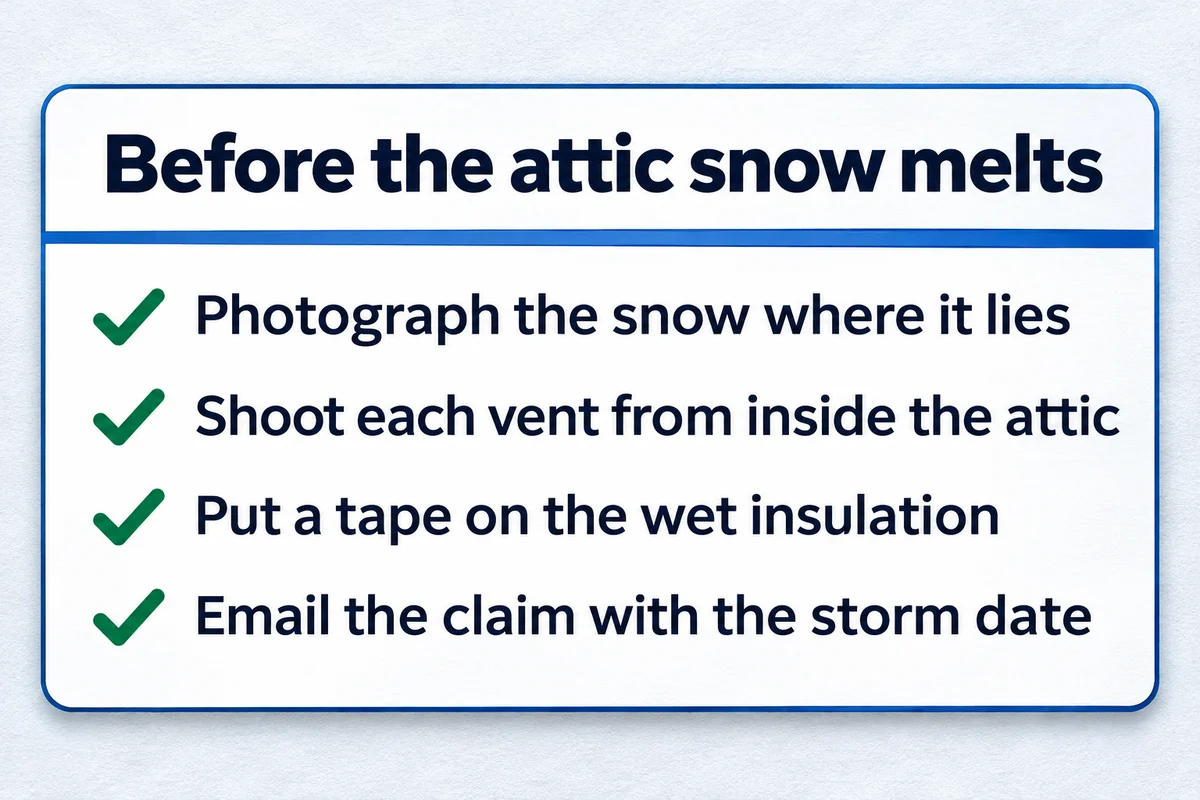
Then take the snow out. Scoop it into buckets and carry it down, or the melt will finish the job on the ceiling. The policy expects you to protect the house from further damage, and buckets, a fan and a few towels are reasonable steps. Keep any receipts. Report the claim in writing with the storm date, a few photos and a short description of what you found.
One illustrative claim, priced with and without a wind-made opening
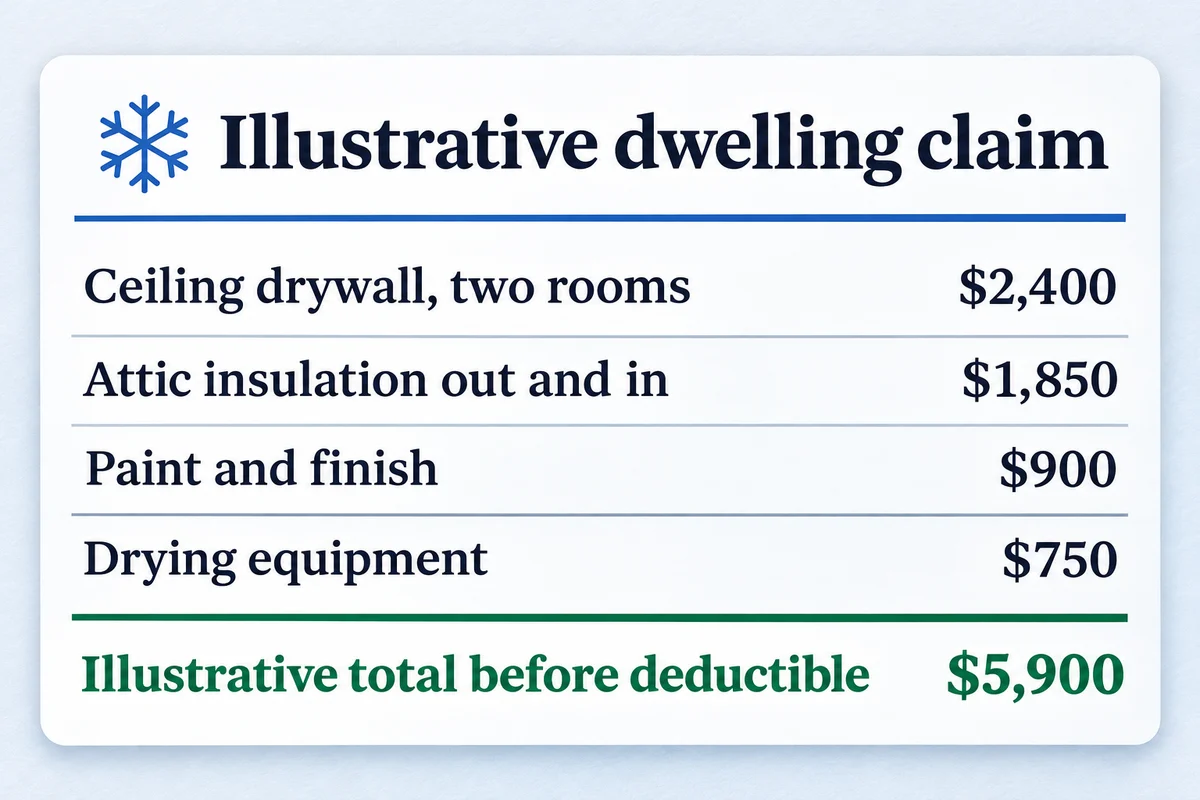
The figures below are an illustrative worked example for a Chicago bungalow with snow in through a ridge vent and melt into two bedrooms below. They are made up to show how the split works, not taken from any real file, and your deductible and depreciation will differ.
| Item | Amount |
|---|---|
| The house (Coverage A) | |
| Ceiling drywall, two rooms | $2,400 |
| Attic insulation, wet section out and new in | $1,850 |
| Paint and finish, two rooms | $900 |
| Fans and a dehumidifier for three days | $750 |
| House total, less a $1,000 deductible | $4,900 |
| Belongings (Coverage C) | |
| Mattress and bedding | $1,300 |
| Area rug | $700 |
| Boxes of clothes stored in the attic | $400 |
| If the vent was simply open: belongings paid | $0 |
| If wind tore off the ridge vent cap first: belongings added | $2,400 |
On one claim there is one deductible, so with a torn cap the illustrative total would be $8,300 of damage less the same $1,000. On a replacement cost policy, the first payment for each part is usually at actual cash value, with the depreciation released once the repair or replacement is done. How that second payment is collected is in why the first insurance check is smaller than the repair.
When the wind did break something
If a ridge vent section lifted, a box vent hood blew off, a gable louver bent in, or shingles tore away near a vent, the storm made an opening and the belongings rule is met for the snow that came through it. This is a roof inspection question first. Look for fresh bends, torn nail holes and missing pieces in the yard or the gutter, and get a written note from the roofer who finds them, with photos. Damage like that also belongs on the roof estimate itself, which my page on wind and storm damage claims covers. An ice dam is a different mechanism with different arguments, and I wrote about it separately in ice dams and Chicago winters.
When you do not need me
Many attic snow claims are small. A stain in one ceiling, a bag of wet insulation and a can of paint may come to less than your deductible, and then the claim is not worth filing at all. If the adjuster accepts the ceiling, pays a fair price and the belongings were not touched, you do not need a public adjuster. Where I help is the claim that was denied as wear and tear while the snow was still on the insulation, the one where the policy wording on the house is in dispute, or the one where a torn vent cap was missed and the belongings were set aside. If a letter quotes policy language you think is being misread, that part is a legal question and an Illinois attorney is the right person to read it. If you are not sure which case you have, send me the photos and the letter and I will tell you plainly whether my help is worth the fee.