An insurance claim denied four days into the file is a first position, not the end of the claim. It is what the carrier concluded from one short inspection and whatever the file held that morning. Before you appeal anything, get three documents: the denial letter with the policy language it relies on, the adjuster’s report with every photograph and the estimate behind it, and your complete policy including endorsements. Most week-one denials turn on scope or cause — something the inspection never looked at — and that is an argument about facts, not about wording. Sign no release, repair nothing you have not photographed, and answer in writing.
Having an insurance claim denied in the first week is the version that lands hardest, because the letter arrives before you have worked out what you are even claiming for. The roof is still tarped, the ceiling is still wet, and a page of policy citations tells you the answer is no. Homeowners read that as the end of the file. It usually is not.
I am a licensed public adjuster in Illinois (#19461872) and Indiana (#3556317), a HAAG certified inspector (#992104047) and a licensed Illinois roofing contractor (#105.009193). I have written the rebuttals and I have also told homeowners their denial was correct and there was nothing to fight. What follows is general information for Illinois and Indiana. It is not legal advice.
Is a denial in week one actually final?
Rarely. A first-week letter is a coverage position taken on thin information: usually one field inspection, no contractor estimate, and no interior moisture data. Carriers reopen files routinely when new documentation arrives. What decides your next move is whether the letter is wrong about a fact or wrong about the policy, because those need different responses.
Look at what the file actually contains on day four. A field or independent adjuster stood on the property for somewhere between twenty minutes and an hour. They may have viewed two slopes of a four-slope roof. They may not have gone into the attic, and on many claims nobody looks inside the house at all unless the homeowner insists. A desk adjuster in another state then read that report and wrote the letter. That is a first pass, and first passes get corrected when better information turns up.
Nothing in a standard homeowners policy says a denial closes the claim. The clock that genuinely matters is the suit-limitation period in your own policy, which runs from the date of loss and not from the date of the letter. That, plus the proof-of-loss and depreciation windows, is set out in the four clocks running on an Illinois claim. Knowing where you stand on those dates is what tells you whether you have room to reopen calmly or need help this week.
What does an Illinois denial letter have to contain?
Under the Department of Insurance claim-handling rule at 50 Ill. Adm. Code 919, a company denying a first-party claim is expected to give a reasonable written explanation of the basis of the denial, and to include the Notice of Availability of the Department of Insurance. A letter that says only that no coverage exists, with no provision named, is not doing that.
So read the letter for three things before you read it for tone. First, the exact policy provision relied on — an exclusion, a condition, or a definition — quoted or cited well enough that you can find it in your own copy. Second, the facts the carrier says bring you inside it: what was inspected, by whom, on what date, and what they concluded. Third, the Department notice telling you a free complaint route exists.
If any of the three is missing, your first letter back is not an appeal at all. It is a request: name the provision, send the report and the photographs, send the estimate even if it totals zero. That request costs you nothing, and it puts the letter beside the evidence it was written from, which every later step will need anyway. Part 919 is a regulatory standard for how a company behaves; whether a breach of it entitles anyone to money is a legal question, and an attorney answers that one, not me.
Why do most first-week denials happen?
Five reasons cover nearly all of them, and they split into two groups. Three are disputes about facts — what the damage is, what caused it, how big it is — and those are the ones that reopen on documentation. Two are about paperwork or policy status, and those are fixed with records rather than with argument.
| What the letter says | What actually decides it | What to gather |
|---|---|---|
| Damage is the result of age and normal wear | Whether there is a datable event signature on the roof or the wall, as distinct from uniform deterioration | Dated photographs, the National Weather Service record for the date of loss, roof age documentation |
| Our inspection identified no storm-related damage | What the inspection actually covered: which slopes, how long, whether the interior and attic were seen | The adjuster’s photographs and report, plus your own slope-by-slope documentation |
| The loss does not exceed your deductible | The scope, not the price. A short scope makes any loss look small | An independent line-item estimate of the full repair, and your declarations page |
| Notice of the loss was not prompt | When you first knew of the damage, and whether the delay changed what could be investigated | Dates: the storm, the discovery, the first call, and any log you kept |
| Damage occurred over weeks or months | Whether the event was sudden and accidental, and what the moisture evidence shows | Moisture readings, drying logs, dated interior photographs, mitigation invoices |
The wear-and-tear denial is the most common and the most reversible, because it is a conclusion rather than a measurement. Uniform granule loss across every slope really is age. Fresh mat fractures on two slopes, with matching soft-metal marks on the gutter apron and a weather record for the same day, are an event. Those two look nothing alike to anyone who has test-squared a roof, and a report written in twenty minutes often does not distinguish them.
What should you do in the first 72 hours after a denial?
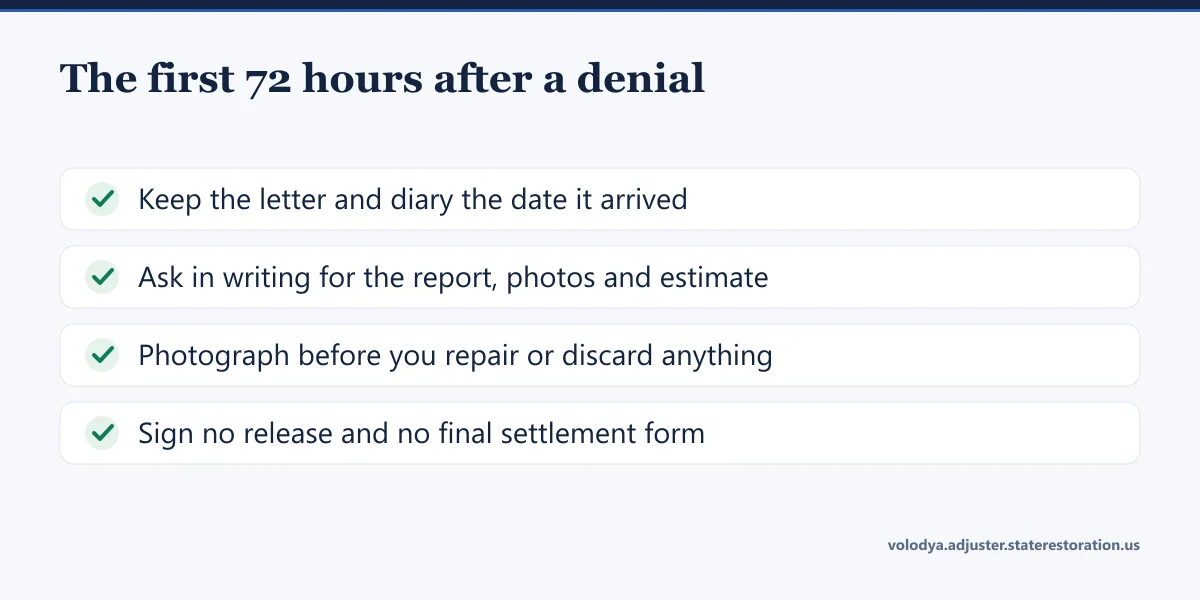
Preserve, request, and document, in that order. Keep the letter and the envelope, and write down the date it arrived. Ask in writing for the claim file. Ask for the complete policy. Photograph everything before any repair or clean-out. Sign nothing that closes the claim. Then, and only then, decide whether you are arguing at all.
- Keep the letter and diary the date. Every subsequent deadline is counted from a date, and the envelope postmark is worth keeping too.
- Ask in writing for the adjuster’s report, all photographs and the estimate. A zero-dollar estimate is still an estimate, and its line items tell you exactly what the carrier did and did not scope. Reading one is a skill worth having; the eight columns and the summary stack is where to start.
- Ask for the complete policy. Declarations page, the base form, and every endorsement. Endorsements are where deductibles change, where roof payment schedules appear, and where cosmetic damage exclusions live. A denial you cannot check against the wording is a denial you cannot answer.
- Photograph before you repair or discard anything. Emergency work to stop further damage is normally required of you and should go ahead; permanent repairs can wait until the evidence is captured. Keep removed materials where practical.
- Sign no release and no final settlement acknowledgement. Cashing a small payment is usually not a release on its own, but signing a document headed final settlement can be. Read anything you are asked to sign, and ask what it closes.
- Pull the weather record for your date of loss from the National Weather Service, and save the page. It is free, it is neutral, and it dates the event independently of anyone paid by either side.
- Get an independent line-item estimate from a contractor who will put the scope in writing, measured, not eyeballed from the driveway.
Every one of those is a document you will either have or not have in three months, and none of them gets easier to collect later. Two of them — the photographs and the weather record — expire in practice, because roofs get repaired and memories do not date-stamp themselves.
Appeal, reinspection or appraisal — which one applies?
They solve different problems and are not interchangeable. A reinspection revisits scope and cause on new evidence. A complaint to the Department addresses how the file was handled. Appraisal, where your policy contains the clause, resolves the amount of loss and not whether the loss is covered. An attorney addresses whether the denial is legally correct.
| Route | What it settles | Who decides | What it costs you |
|---|---|---|---|
| Reinspection with new documentation | Scope and cause of loss | The carrier, on the new facts | Nothing beyond producing the documentation |
| Complaint to the Illinois Department of Insurance | Whether the file was handled properly | The Department | Nothing |
| Appraisal, if the clause is in your policy | The amount of loss only | Your appraiser, the carrier’s appraiser, and an umpire | Your appraiser’s fee and a share of the umpire’s |
| Attorney | Whether the denial is legally correct | A court, or a negotiated resolution | Depends on the arrangement you agree |
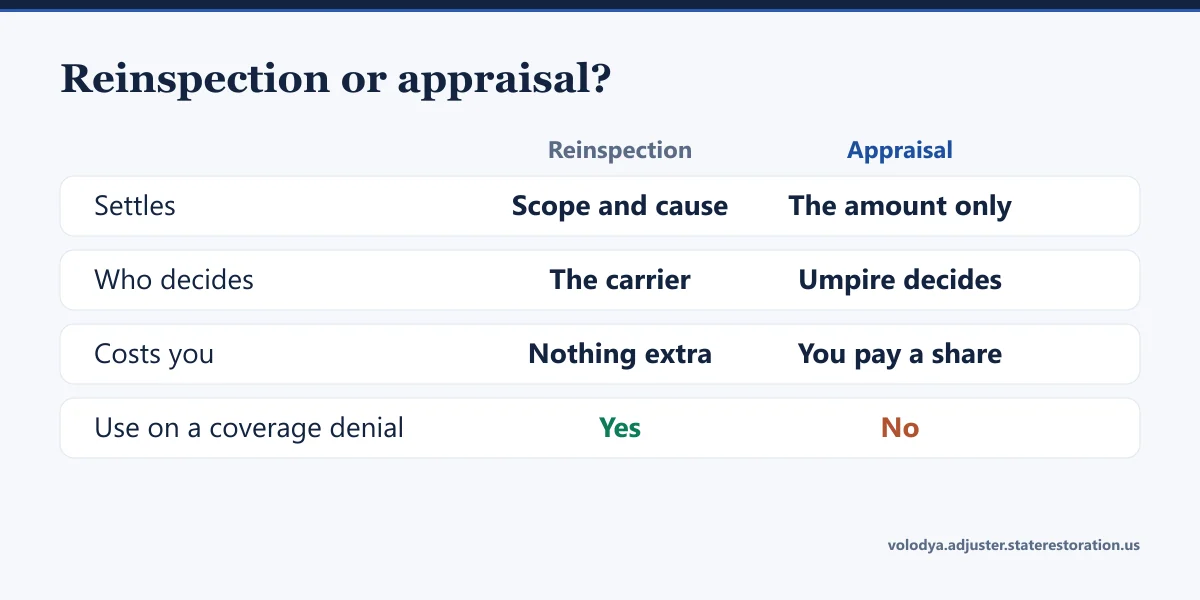
Appraisal is the clause most homeowners never read, and it is genuinely useful when both sides agree the loss is covered and disagree only about the number. It is the wrong tool for a coverage denial. Carriers commonly take the position that appraisal cannot decide coverage at all, and the interaction between an appraisal demand and a coverage dispute is precisely the kind of question a lawyer should answer before you file anything. The Department complaint route sits alongside all of this and costs nothing: you can file directly with the Illinois Department of Insurance, and the fact that a complaint was filed goes on the company record.
What does a rebuttal that gets read look like?
It has four parts and no adjectives. Quote the provision the letter relied on. State in one sentence the fact that contradicts it. Attach evidence that is numbered, dated and captioned. Make one specific request with a date attached. A letter that only says you disagree gives the desk adjuster nothing to act on.
A letter that sets a dated photograph against a named clause gives them something they have to answer, which is the entire difference between the two.
In practice that reads something like this. Your letter of 12 March denies the claim under the wear and deterioration exclusion. The enclosed twelve photographs, taken on 3 March and numbered, show fresh mat fractures on the south and west slopes with matching collateral marks to the gutter apron and the aluminium fascia. The National Weather Service record for 1 March reports hail in this grid square. I am asking for a reinspection with the roof measured, all four slopes test-squared, and the interior ceiling staining viewed from inside the property.
That is four sentences and it does the whole job, because it tells the desk adjuster exactly which finding is disputed and exactly what would settle it. Send it by a method that produces a receipt, keep a copy, and note the date in the same diary as the letter.
Is my denial worth appealing at all?
Sometimes it is not, and you should know that before anyone charges you. If the scope is genuinely complete and the loss genuinely sits under your deductible, there is nothing to recover and no argument to make. The question worth asking is never simply whether the number is below the deductible. It is whether that number represents the whole repair.
| Line | Illustrative amount |
|---|---|
| Replace three courses of shingles, south slope | $610 |
| Ridge cap, 22 linear feet | $190 |
| Reset gutter apron | $145 |
| Debris removal and disposal | $95 |
| Subtotal | $1,040 |
| Less deductible | −$1,500 |
| Payable | $0 |
On that illustrative scope the denial is right and a public adjuster would be an expense with nothing behind it. But notice what the scope does not contain: no other slope, no underlayment, no drip edge, no ice-and-water barrier where code requires it, and no interior. If the same roof is measured properly and three slopes turn out to be affected, the arithmetic changes and so does the answer. That is why the question worth asking is about the scope rather than the price. There is a whole category of claim where the honest advice is to handle it yourself, and I would rather say so — more on where the line falls is on the representation page.
When is this a lawyer question rather than mine?
Whenever the dispute is about what the policy legally requires rather than what the damage physically is. Inspecting a roof, documenting a cause of loss, building a scope and negotiating it is claim handling, and that is my licence. Whether a denial was legally improper, what remedies follow from that, and anything touching the suit-limitation clause are legal questions.
The practical dividing line is easy to apply. If your answer to the denial is a photograph, a measurement or a line item, it belongs with a public adjuster. If your answer to the denial is an argument about what a clause means or what the carrier owed you as a matter of law, talk to an attorney — and talk to one early, because the suit-limitation period in your policy does not pause while you exchange letters. Illinois law does provide remedies where an insurer’s conduct on a claim is found unreasonable, but whether any particular file meets that standard is a judgement for a lawyer and not for me.
Getting help with a denied claim in Chicago
If your claim has been denied and you want somebody to read the letter, the report and the policy together before you respond, that is a conversation worth having early rather than after you have already written back. You can see how I work on the about page, or send the letter through the contact page.
Volodymyr Lukaniuk, licensed public adjuster. 3052 N Long Ave #2, Chicago, IL 60641. Telephone +1 224-481-2095, email volodymyr@staterestoration.us. Hours are Monday to Friday 9–6, Saturday 9–5 and Sunday 10–5, and I speak English, Ukrainian and Russian. I am licensed in Illinois and Indiana only.
Nothing above is legal advice. It is general information about how first-party property claims are handled, written by a public adjuster rather than a lawyer.