If your roof damage claim in Illinois is stuck on how much roof the insurer will pay for, that is an adjusting question, and a public adjuster is the person who measures it, prices it and argues it. It becomes a lawyer's question when the dispute turns on what the policy or the law means, when the insurer accuses you of something, or when the time to sue is running out. Most roof files I see are the first kind. A few are the second, and the letters the insurer sends usually tell you which.
I am a licensed public adjuster in Illinois (#19461872) and Indiana (#3556317), an Illinois licensed roofing contractor and a HAAG certified inspector. I am not a lawyer, and Illinois law sets out exactly where my work stops. That line is the useful part of this post.
What does Illinois law let a public adjuster do on a roof claim?
Represent you on the insurance claim itself: inspect, document, write the scope and price, and negotiate the amount with your insurer. The rules are in 215 ILCS 5/1590, the standards of conduct for a public adjuster, as amended by Public Act 103-216 in 2024. Four of its subsections draw the line on a roof file:
serve with objectivity and complete loyalty for the interests of his client alone
I work for the owner of the roof, never the carrier, and my advice is about the insurance claim: what the policy pays for and what the damage is worth.
may not agree to any loss settlement without the insured's knowledge and consent
You decide when the roof claim settles. On request, I have to give you a document with the scope, amount and value of the damage before I ask for authority to settle.
shall not provide legal advice or representation to the insured
Whether a policy condition was met, whether a denial was lawful, whether to sue: those are legal questions, and the statute sends them to a lawyer.
shall not be construed to prevent an insured from pursuing any civil remedy
Signing with a public adjuster does not take away your right to sue later. A lawyer can still come onto the same claim.
Quoted from the Illinois General Assembly text of Section 1590 (source: P.A. 103-216, eff. 1-1-24).
A roofer is a third party again. In Illinois a roofing contractor may not negotiate your claim for you, which my post on signing a roofer's contract after a hailstorm covers from the state's own brochures.
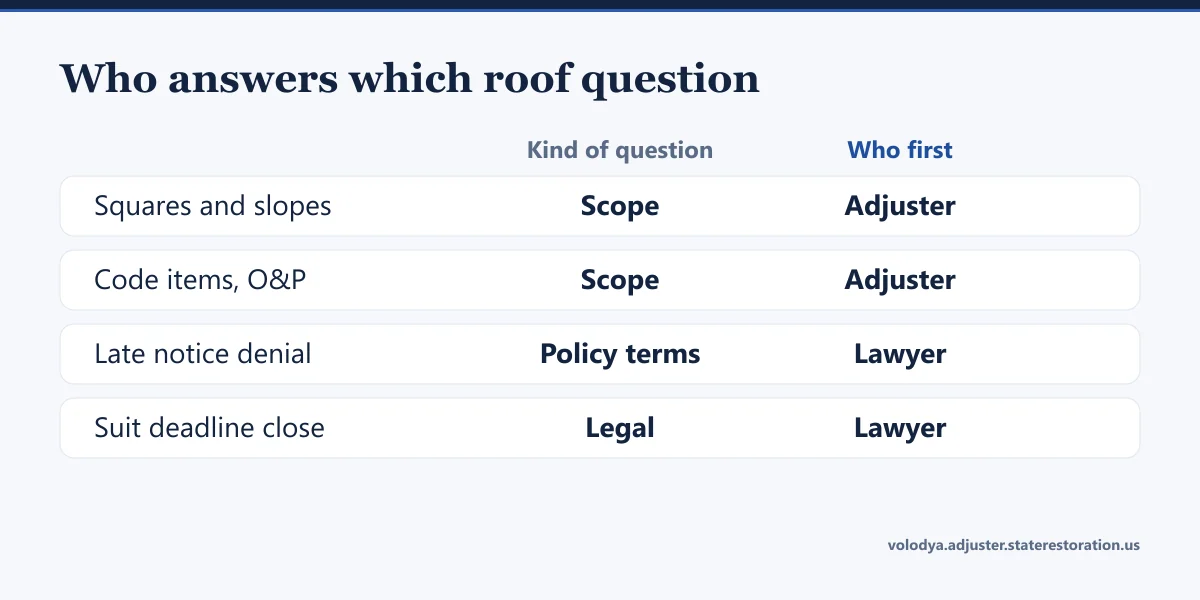
Which roof disputes are about scope, and which are legal?
Ask what would settle the disagreement. If a tape measure, a photo, a code book or a price list would, it is scope. If the answer depends on what a sentence of the policy means, or on what you knew and when, it is legal. These are the eight roof disputes I see most often in Chicago and the suburbs:
| The dispute | What settles it | Who answers it first |
|---|---|---|
| The insurer counts too few hail hits to replace a slope | Test squares on every slope, photographed with chalk marks and a scale. My notes on how a hail inspection on an asphalt roof is done show the method. | Public adjuster |
| A few shingles replaced, but the old ones crack when lifted or the line is discontinued | A brittleness test on site and a written answer from the supplier. | Public adjuster |
| Ice barrier, drip edge or decking left out of the estimate | The code section your town enforces and the ordinance or law coverage on your declarations page. | Public adjuster |
| No overhead and profit on a job with several trades | The trade count in the scope: roofing, gutters, siding, interior ceiling. | Public adjuster |
| Denied as wear and tear, not storm | The storm date, hail size reports and the physical signs of fresh impact. If the letter turns on how an exclusion is worded rather than on the roof, a lawyer reads it too. | Public adjuster |
| Both sides agree it is covered and disagree on the number | Reinspection with your scope in hand, then appraisal if your policy has the clause. Appraisal decides the amount only. | Public adjuster |
| Denied because you reported it too late | Whether the notice condition was met on your facts, and what Illinois courts say about it. | Lawyer |
| The insurer says something you told it was untrue | Your rights under the policy and the law, before you say anything more. | Lawyer |
What does a roof gap look like when the whole fight is scope?
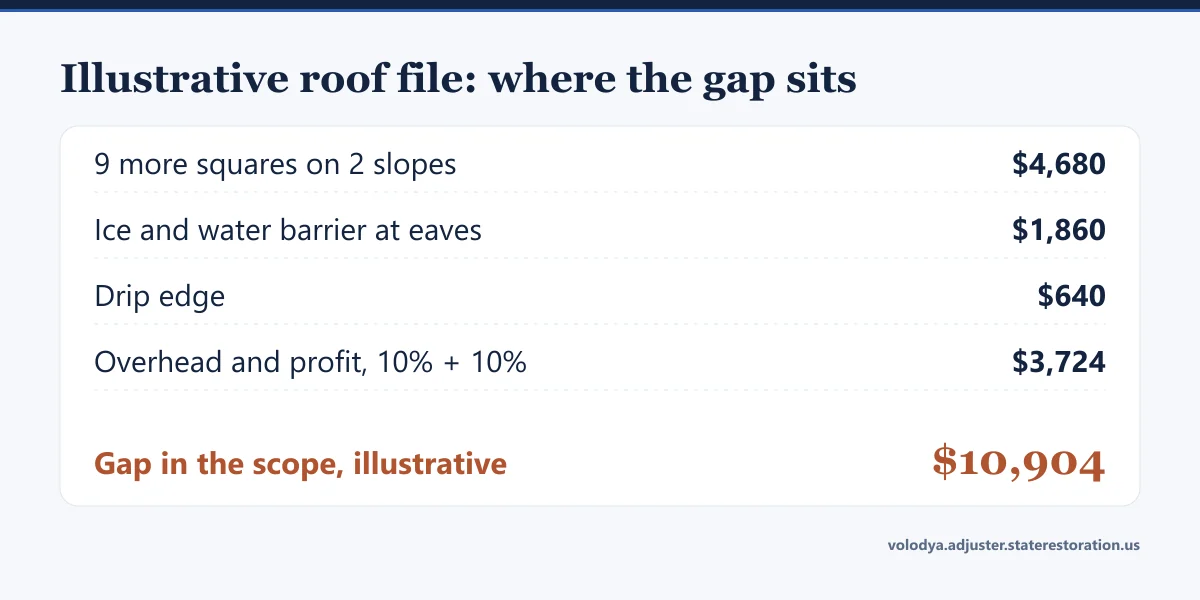
It looks like an estimate that is short line by line, with no question about coverage at all. Take an illustrative Chicago bungalow after a summer hail day. The carrier accepts storm damage and pays for two slopes. I test all four, find hits above the threshold on the other two, and open the policy to see what else the replacement pulls in. Every number in this table is an illustrative worked example, not a quote and not a promise:
| Line | Insurer's estimate | Re-measured scope | Difference |
|---|---|---|---|
| Tear off and replace shingles, $520 a square | 22 squares, $11,440 | 31 squares, $16,120 | $4,680 |
| Ice and water barrier at the eaves | not listed | $1,860 | $1,860 |
| Drip edge | not listed | $640 | $640 |
| Overhead and profit, 10% and 10% on $18,620 | not listed | $3,724 | $3,724 |
| Total, illustrative | $11,440 | $22,344 | $10,904 |
Nothing in that gap needs a court. It needs a photographed test square on every slope, a code citation and a scope written by someone who prices roofs for a living. If you want to see where each of those lines lives in a real estimate, my guide to overhead and profit on a roof estimate walks through the summary page. Whether the carrier accepts the revised number is up to the carrier, and when it does not, appraisal is the next step on an amount dispute, described on my appraisal clause page.
Which words in an insurer's letter mean you should call a lawyer this week?
Words that move the file from the roof to you. When one of these appears in a letter about your roof claim, I tell the owner to put the letter in front of an Illinois lawyer before answering it, and I keep working the scope in the meantime if they want me to:
reservation of rightsThe carrier is still looking at the claim and is keeping the option to deny it under the policy terms it names. Read which terms those are. That reading is legal work.
examination under oathA sworn, recorded questioning that many property policies allow the insurer to ask for. People bring a lawyer to it.
failure to give prompt noticeThe roof might be fine as a claim and still be denied over timing. Whether your notice was soon enough on your facts is a legal question.
misrepresentationorconcealmentThe carrier says something in the claim was untrue. This is about you, not the shingles, and it can affect the whole policy. Stop talking about it until a lawyer has read the letter.
legal action against usThe clause in your policy that limits how long you have to sue. If your roof dispute has used up most of that time, a lawyer needs the file now, not after one more reinspection. My post on the deadlines on an Illinois claim explains how that clock is counted.
Can a public adjuster and a lawyer work the same roof claim?
Yes, and on a contested roof they often do. Section 1590(j)(4) keeps your right to sue open after you sign with a public adjuster, and the work does not have to be done twice. What I hand over is what a lawyer would otherwise have to hire someone to produce: the dated photos, the test square counts, the moisture readings under the deck, the scope in the same estimating format the carrier uses, and the full log of letters. The lawyer handles the legal side and any suit. I keep working the amount. Each of us is paid under our own written contract, so ask both, in writing and before you sign, how their fees work when the other is on the file.
Before you call either of us, put these together. They answer most of the first conversation:
- The declarations page and the full policy, including endorsements added at renewal.
- Every letter and email from the insurer, with the dates you received them.
- The insurer's estimate, all pages, including the summary and the price list date.
- Your photos of the roof and the ceilings, with the date each one was taken.
- The date of the storm and the date you reported the claim.
- Any roofer's estimate or inspection report you already have.
When you need neither
If the carrier paid for the whole roof, the code items are in the estimate and the only open question is the depreciation you collect after the work is done, you do not need me or a lawyer. Finish the job, send the invoice and ask for the held-back amount. The same goes for a repair that comes in under your deductible: there is nothing to argue. I am worth a call when the scope is short and the carrier will not move, which is most of the work on my roof damage claims page. If a letter already carries one of the five phrases above, call a lawyer first; I can still take the roof side once they are on it. You can reach me through the contact page, seven days a week. Nobody honest can promise you a number or a date, and I do not.