A delayed property insurance claim in Illinois runs against clocks you can check. The Department of Insurance rules in Part 919 put the insurer on several of them: an answer to your letters within 15 working days, payment of the undisputed part within 30 days, and on a home policy a written reason for the delay once the claim has been open 75 days, or 25 days after you sent a proof of loss if that comes first. When a clock runs out, your next step is a letter, then a complaint to the Department, and only in a narrow set of files a lawyer.
I am a licensed public adjuster in Illinois (#19461872) and Indiana (#3556317). Most of the stalled files people bring me are not stalled for a dark reason. Some are, and the paper tells you which. This post shows you how to read that paper.
How long can an Illinois insurer take on a property claim?
There is no single deadline for the whole claim. Part 919 sets separate limits for answering you, investigating, explaining and paying, and it counts in calendar days unless it says working days. Five of them matter on a house claim:
To answer a letter or email about the claim. The rules call this reasonable promptness.
A real effort to contact you, when liability is reasonably clear.
Payment of the amount that is agreed, even while other parts are argued.
A written reason for a lower offer or a denial, naming the policy wording it rests on.
A written reason for the delay itself, whichever date comes first.
Sources: definitions in 50 Ill. Adm. Code 919.40, payment and explanation rules in 919.50(a), the delay letter in 919.80(d)(7)(B).
The 75-day rule applies to what the Insurance Code calls a policy of fire and extended coverage. Section 143.13 defines that as a policy covering a home of up to four units, or the household property in it. A Chicago bungalow, a two-flat or a three-flat is inside it. A strip mall is not, and there 919.50 does the work alone. Each of those letters must also carry the Department's notice of availability, which I come back to below. My earlier post on the deadlines on an Illinois claim covers the clocks that run against you, the owner. These are the ones that run against the carrier.
What does a stalled claim look like in a real Illinois file?
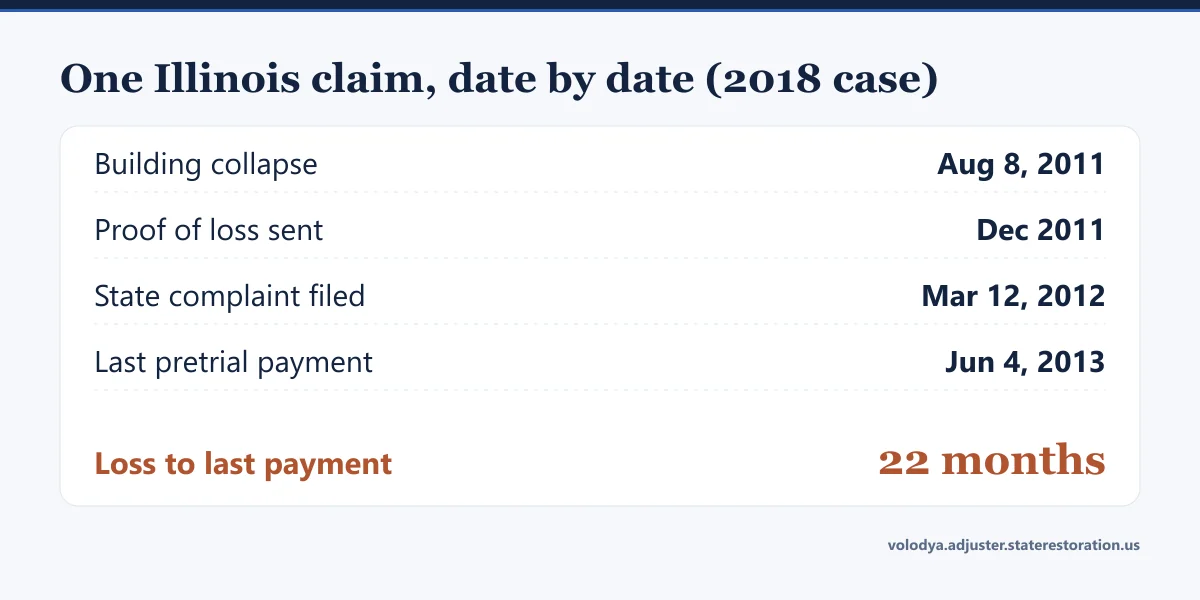
It looks like ordinary letters that never reach a number. The clearest public example I know is an Illinois Appellate Court decision from 2018, 2018 IL App (2d) 170637. A commercial building in Kane County partly collapsed, and the carrier agreed the policy covered it. I read the opinion and put its dates in one table, with the rule each step touches. Commercial building, so the 75-day letter did not apply; 919.50 did.
| Date | What happened, as the court records it | The rule it touches |
|---|---|---|
| Aug 8, 2011 | The building collapses. Coverage is not disputed, the amount is. | The clocks start at notice of loss. |
| Sep 25, 2011 | First payment, $76,000, 48 days after the loss. About $100,000 more follows in November. | Paying the agreed part is what 919.50(a) asks for. |
| Sep and Oct 2011 | The adjuster misses two scheduled site meetings. The owner writes for direction and gets no answer. | 15 working days to answer pertinent communications. |
| Dec 16-17, 2011 | The owner's lawyer writes that payments came with no breakdown by coverage, and sends a sworn proof of loss with contractor quotes. | Payments must say which coverage they are under (154.6(l)). |
| Jan 12, 2012 | The carrier holds the proof of loss "in abeyance" pending its investigation and says it does not agree, without saying why or when. | A lower offer needs a written reason that names the policy wording. |
| Mar 12, 2012 | The owner files a complaint with the Illinois Department of Insurance. A week later the carrier pays $18,000 and $531,263. | The complaint route in the notice of availability. |
| Jun 28, 2012 | The proof of loss comes back as premature, because the rebuild is not finished, and as excessive. | Still no lower offer and no explanation of one. |
| Jul 2012 | The carrier's adjuster stops working on the file without finishing the inspection or the estimate. | Reasonable standards for prompt investigation (154.6(c)). |
| Jun 4, 2013 | Last payments before trial, 1 year and 10 months after the loss and 7 months after the owner sued. | Compelling a policyholder to sue (154.6(e)). |
The trial court found the delay vexatious and unreasonable and awarded the owner $48,784 in attorney fees, $27,692 in other costs and a $30,697 penalty under Section 155. The appellate court affirmed. For a homeowner the useful part is the court's reasoning in paragraph 39: without the carrier's estimate, an owner would have to rebuild without knowing how much of it the policy would pay. A carrier that disagrees with your number still has to put its own number on paper.
The list of practices the court was weighing is short and public. 215 ILCS 5/154.6 names nineteen of them, including failing to acknowledge communications with reasonable promptness, failing to affirm or deny coverage within a reasonable time after a proof of loss, and offering substantially less than an owner later recovers in a suit.
Is my claim delayed for a real reason or being stalled?
Ask what the carrier is waiting for and whether you can hand it over. If there is an answer and an end date, the wait is usually real. If every answer is "under review", the file is stalled. These are the waits I see most on Chicago house claims, and what ends each one:
- An engineer or a cause-of-loss report
- Common on foundation cracks, collapse and wind against hail arguments. Ask for the engineer's name, the inspection date and when the report goes to the adjuster. Once a partial payment is made on the carrier's estimate, 919.80(d)(7)(C) lets you ask for a copy of it.
- A fire cause investigation
- Can hold a fire claim for weeks. My post on when the insurer sends a fire investigator covers what they ask for and the written-reason clock that still runs.
- Missing documents from you
- The fix is a list. Ask for every missing item in one written request, send them together, and keep the email that shows the date.
- A storm with thousands of claims
- After a big Chicago hail day, field adjusters can fall behind for weeks. That explains a slow inspection. It does not explain no reply to a letter.
- The same document asked for twice
- A warning sign. Answer by attaching your first email with its date, not by sending the file again as if new.
- A new adjuster every month
- A warning sign. Each handoff restarts the reading. Send the new adjuster your log and ask them to confirm in writing what is still open.
- Your proof of loss held or returned with no counter-number
- The pattern in the 2018 case. A disagreement is allowed. Silence about the carrier's own figure is the part to put in writing. My notes on the Illinois proof of loss form explain what the form commits you to.
What should I put in writing when the claim goes quiet?
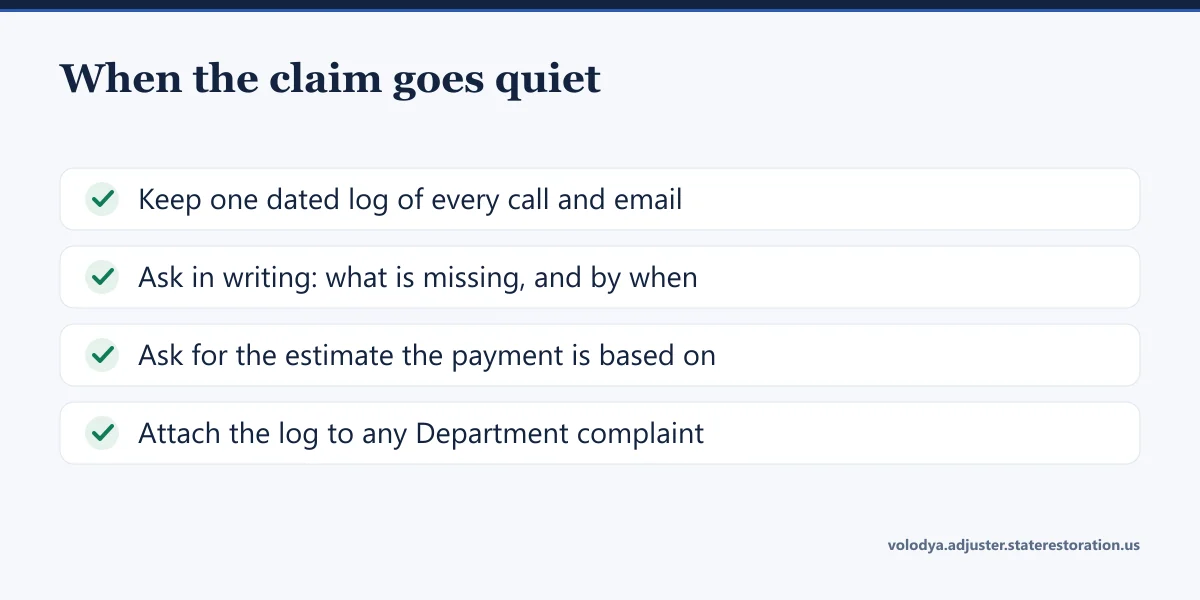
A short email that asks for dates, not sympathy. Phone calls leave nothing a regulator can read, so after any call I send a two-line email confirming what was said. A status request I would send for a homeowner covers five things:
- The claim number, the date of loss and the date you reported it.
- What the carrier still needs from you, as a list, and the date it expects to decide.
- A copy of any estimate or report a payment so far was based on, and which coverage each payment was under.
- If the carrier disagrees with your figure, its own figure and the policy wording behind it.
- If the claim has been open more than 75 days, the written explanation for the delay that 919.80(d)(7)(B) requires.
I reported this loss on [date]. My last two messages, on [date] and [date], have not been answered.
Please send me in writing: anything you still need from me, the date you expect to decide, the estimate behind the payment of [date], and, since the claim has been open more than 75 days, the explanation for the delay that 50 Ill. Adm. Code 919.80(d)(7)(B) calls for.
Thank you. [Name, phone]
Keep it calm and keep a copy. The log of dates you build this way is the same document a Department analyst, an appraiser or a lawyer would ask you for first.
Should I complain to the Illinois Department of Insurance?
Yes, once a written request has gone unanswered past the 15 working days, or the 75-day letter has not come. You do not need a lawyer or a public adjuster to file. Every denial letter and every delay letter under Part 919 must carry a notice that is "no less informative" than this wording from 919.40:
Part 919 of the Rules of the Illinois Department of Insurance requires that our company advise you that, if you wish to take this matter up with the Illinois Department of Insurance, it maintains a Consumer Division in Chicago at 115 S. LaSalle Street, 13th Floor, Chicago, Illinois 60603 and in Springfield at 320 West Washington Street, Springfield, Illinois 62767.
The Department's site lists the Chicago office at that LaSalle Street address, phone (312) 814-2420, and a File a Complaint link. Attach your log, the unanswered emails and any letter the carrier did send. A complaint does not decide what the claim is worth. It puts the file in front of a regulator, and 154.6(f) lists a disproportionate number of meritorious complaints as an improper practice in itself. In the 2018 case the trial court pointed out that the owner had to resort to that complaint to get the carrier to pay or name a number.
When does a delay become a lawyer's question?
When you are thinking about suing, or about Section 155. 215 ILCS 5/155 lets a court add attorney fees, costs and a capped extra amount when a carrier's delay is vexatious and unreasonable. Courts look at the whole conduct of the claim, and a real, genuine dispute about coverage or amount usually defeats it. Whether your file crosses that line is legal advice, and I am not a lawyer. I tell people which files to take to one.
A dispute over the amount alone has another route that is not a lawsuit. Most Illinois property policies have an appraisal clause, explained on my appraisal clause page, and it starts with your written demand. If the delay has already ended in a low offer, the underpaid claim work is where I start.
When you do not need a public adjuster
If the carrier is waiting on one document you can send this week, or the adjuster answered you yesterday with a date, you do not need me. Send the item, write down the date and wait for it. I am worth a call when the claim is large, the carrier has stopped putting numbers on paper, or a payment arrived with no estimate behind it. I can take over the correspondence and write the scope the carrier has not written, under the services I offer. I cannot promise a date or an amount, and nobody honest can. You can reach me through the contact page, seven days a week.