O&P is overhead and profit — the general contractor’s markup for running a job, customarily 10 per cent and 10 per cent on top of the trade work. It belongs on an estimate when the repair is complicated enough that a homeowner would reasonably hire a general contractor to coordinate it, and on a roof claim that is more often than carrier estimates suggest. It goes missing in three ways: never applied at all, applied to some lines and not others, or applied and then held back from the first cheque. All three are visible in about ten minutes, and all three are answered the same way — in writing, by counting the trades.
Overhead and profit is the single most argued-about number on a roof estimate in Chicago, and most homeowners never see it, because it is two lines on a summary page they were never asked to read. The gap it leaves is not small. On a five-trade repair it is a fifth of the job.
I am a licensed public adjuster in Illinois (#19461872) and Indiana (#3556317), a HAAG certified inspector (#992104047) and a licensed Illinois roofing contractor (#105.009193). I write estimates and I read the ones carriers write, several a week, and I have had this conversation with more estimators than I can count. What follows is how O&P works and how to check your own document. It is general information about Illinois and Indiana, the two states I am licensed in, and it is not legal advice.
What does O&P mean on an insurance estimate?
Overhead and profit is the general contractor’s charge for managing a repair rather than performing it: scheduling trades, pulling permits, supervising, carrying insurance and warranty, and taking responsibility when something goes wrong. It is customarily written as 10 per cent overhead and 10 per cent profit, applied on top of the trade cost. Estimators say “ten and ten”.
It is worth being precise about what it is not. It is not a mark-up a contractor invented. It is not sales tax, which is a separate column. It is not the same thing as a contractor’s price simply being higher than the carrier’s — that is usually a scope or quantity question, and I have written about where those hide when reading an Xactimate estimate line by line. And it is not money that goes to you. It pays whoever coordinates the work. If a general contractor runs your repair, it is a cost you will actually be billed.
| Half | Typical rate | What it covers |
|---|---|---|
| Overhead | 10% | Job supervision, scheduling and coordination of the trades, permits, office and administration, general liability and workers’ compensation insurance, warranty exposure |
| Profit | 10% | The contractor’s return for carrying the risk and the responsibility for the finished job |
The arithmetic is plain, and worth seeing once. Take an illustrative Chicago roof loss where the trade work — tear-off and reroof, gutters and downspouts, a strip of siding, interior drywall and paint — subtotals $22,500 before tax. Ten and ten adds $2,250 and $2,250. This is a worked example for illustration only; your own numbers will differ, and no figure here is a promise about any claim.
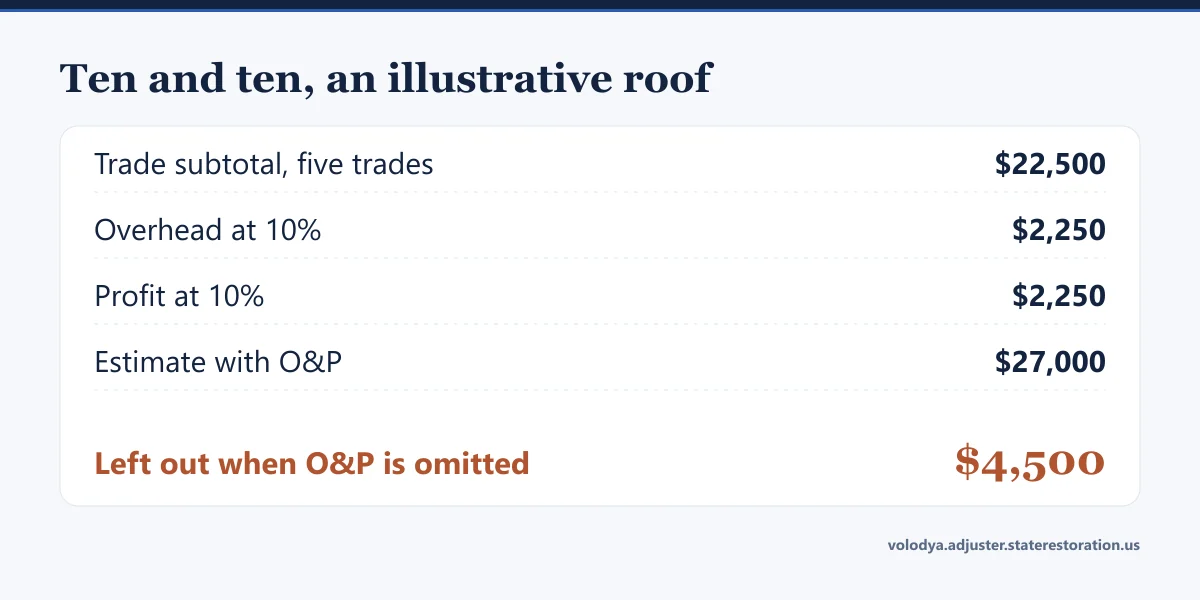
Four and a half thousand dollars is not a rounding error, and it is the amount that disappears silently when the two summary lines are simply absent. Nothing on the page says “O&P omitted”. The estimate just ends sooner.
When is overhead and profit owed on a roof claim?
The usual test is whether the repair is one a homeowner would reasonably hire a general contractor to run. Most carriers apply an internal version of that test, commonly counting trades — three or more separate trades and O&P is added, fewer and it is not. That guideline is a carrier practice, not a law, and the number of trades is a fact you can check yourself.
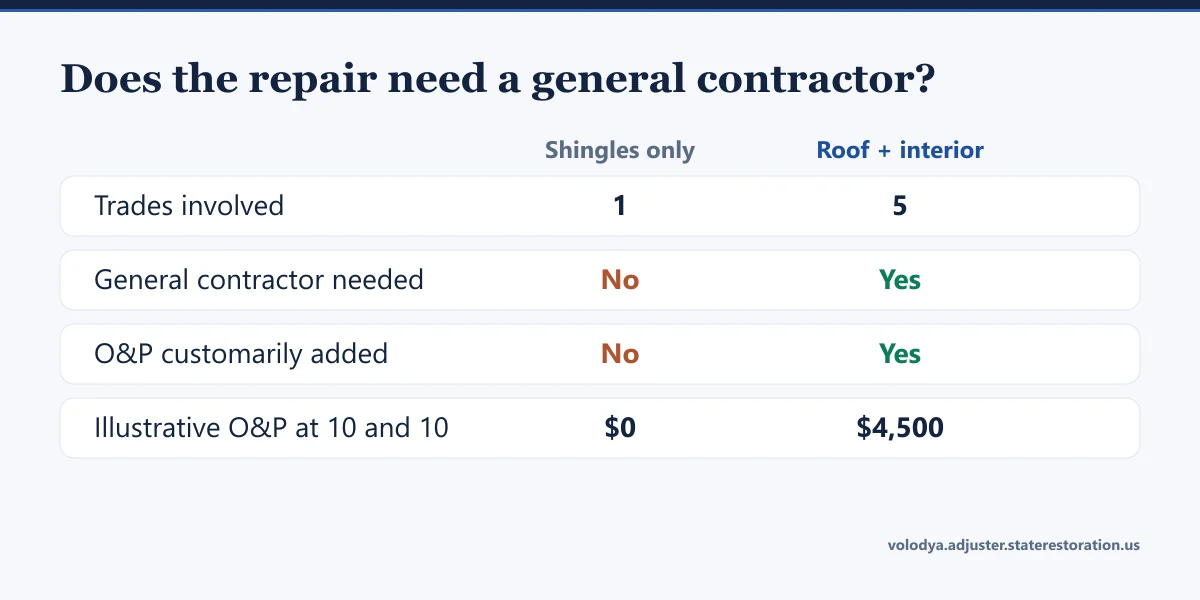
Here is where homeowners lose the argument before it starts: they count rooms, or they count damage, when the estimate counts trades. A roof claim reads on paper as one trade — roofing — until you read the scope properly. Then it is often four or five.
| Trade | Lines that give it away |
|---|---|
| Roofing | Tear-off, felt, shingles, ridge cap, starter, drip edge, pipe jacks, flashing |
| Sheet metal / gutters | Gutter and downspout replacement, gutter apron, valley metal |
| Siding | Siding damaged by the same hail or wind event, soffit and fascia, house wrap |
| Framing and carpentry | Decking replacement, rafter or truss repair, fascia board |
| Insulation and drywall | Wet insulation removal, ceiling drywall, texture |
| Painting | Ceiling and wall paint after the drywall, exterior touch-up |
| Electrical / mechanical | Detach and reset a satellite dish, solar array, service mast or furnace flue |
Count them on your own scope. If the estimate contains a ceiling drywall line, a paint line and a roofing line, that is three trades on the carrier’s own document, written by the carrier’s own estimator, and the trade count is no longer an opinion. That is the strongest position a homeowner can be in on this question, and it costs nothing but reading.
Why is O&P missing from my estimate?
Three patterns account for nearly everything I see. The estimate never applies O&P at all; it applies O&P to part of the scope only; or it applies O&P and then removes it from the first payment. They look very different on the page and they need different questions.
Never applied. The summary runs subtotal, tax, deductible, cheque, with no overhead or profit lines between them. This usually reflects the trade-count guideline being applied to a scope that the estimator read as roofing only.
Applied to part of the scope. Xactimate can carry O&P as a column on individual lines instead of as summary lines. When it does, some sections can have it and others not, and the total still looks complete. If your estimate has an O&P column, read down it and see where the zeros are — it is usually the interior work, or the lines added later in a supplement.
Applied, then held back. The overhead and profit lines are there in the replacement cost column and gone from the amount paid, sometimes with depreciation taken against them. That is a different argument entirely, and it belongs in the next section.
There is a fourth, less common case worth naming: an estimate written for the trade only, on the assumption that you will hire one roofer directly with no general contractor. If that is genuinely how the job will run, the carrier’s position is stronger than it looks, and it is fair to say so.
Was O&P taken out of my first cheque?
Look at the summary page for the replacement cost total and the actual cash value total, then find the overhead and profit lines and check whether they sit above or below the depreciation. If depreciation was applied to O&P, the first cheque is smaller by that amount, and the question becomes whether it is recoverable later.
Your first payment on a replacement cost policy is normally actual cash value — replacement cost minus depreciation — and the rest is released when the work is done. I have set out how that second payment is collected in what ACV means in Illinois and how the second cheque works. O&P sits awkwardly inside that structure, because supervision and profit are not building materials that wear out, and carriers differ in how they treat it.
Whether a carrier may withhold or depreciate overhead and profit in the actual cash value payment has been litigated in a number of states, and the answer turns on the wording of your policy and on state law. I am not a lawyer and I will not tell you what your policy obliges anyone to do. What I can do is show you where the number went and put the question in writing. If the answer that comes back does not satisfy you, that is the point at which talking to an attorney is worth an hour of your time.
How do I ask for O&P to be added?
In writing, naming the trades, with the lines from the carrier’s own estimate that prove each one. Not “you forgot O&P” and not “my contractor says the price is low”. An estimator has to justify a change in their own file, and a list of trades with line references is something they can act on in an afternoon.
A request that works has four parts, and it fits on one page:
- The trade list. Each trade, with at least one line item and its page number from the estimate you were sent. Seven names with seven references is harder to answer than a paragraph of complaint.
- Why the job needs coordinating. One or two sentences: sequencing between the interior and the roof, a permit, more than one crew on site.
- What you are asking for. Overhead and profit applied to the whole scope at the rate the estimate itself uses elsewhere, if it uses one anywhere.
- A question about the first payment. If O&P was depreciated, ask on what basis and whether that depreciation is recoverable on completion.
Keep a copy of everything and note the date each item was sent. Attach the contractor’s own scope if you have one. Then give it a reasonable window before following up — a written record of a request that went unanswered is worth considerably more later than a phone call nobody logged.
When is O&P genuinely not owed?
Sometimes it is not, and pretending otherwise wastes everybody’s time. If the whole repair is one trade — a small shingle patch, one section of gutter, a single detached vent — and no general contractor will be involved, there is no coordination to pay for. Asking for a general contractor’s markup on a job with no general contractor is an argument that goes nowhere and costs credibility on the lines that do matter.
That is worth saying plainly, because the same reasoning runs the other way. Where the trades are genuinely there on the page, this is not a favour anyone is doing you. It is a cost of putting the house back, and the estimate should carry it.
What to do next
If you are holding a roof estimate and cannot tell whether O&P is in it, count the trades first — ten minutes with the scope and the table above will usually settle it. If the answer is three or more and the summary page has no overhead and profit lines, that is worth raising before you cash anything.
If you would rather someone read it with the roof in front of them, the free inspection and policy review is exactly that: I go through the estimate line by line and tell you what is missing, including when the answer is that the scope is fair and you do not need a public adjuster. The offerings page sets out the work I take on, and my licences and certifications are published in full so you can verify them before you call. My hours are Monday to Friday 9–6, Saturday 9–5 and Sunday 10–5, and I speak English, Ukrainian and Russian.
Nothing above is legal advice. Reading an estimate and negotiating a scope is claim handling, and that is my job. What your policy obliges your carrier to pay is a legal question, and if a claim reaches that point, an attorney is the right person to ask.