A commercial property claim denied in Illinois is an insurer's written position, and you can test it. The letter has to name the policy provision it relies on, so start there: that provision tells you which fact decides the claim. Some denials fall apart once the fact is checked, and some turn out to be correct. Find out which you have before you answer, and write down today's date, because the time limit for a lawsuit keeps running in the background.
I'm a licensed public adjuster for policyholders in Illinois (#19461872) and Indiana (#3556317). The wording below comes from standard ISO commercial forms, read in one published policy. Your edition may differ, so hold your own copy next to this page. I'm not a lawyer, and I say below where a question stops being mine.
What must an Illinois denial letter say?
It must explain the denial in writing and name the provision behind it. The Department of Insurance rule, 50 Ill. Adm. Code 919.50, is titled for all insurance companies, so a business owner can use it too. On a first party claim, the explanation "shall clearly set forth the policy definition, limitation, exclusion or condition upon which denial was based", and a notice about the Department has to come with it. Those four words give you a way to sort the letter:
Definition
A word such as "vacant" or "specified cause of loss" has a set meaning. Check your facts against that meaning, not the everyday one.
Limitation
The loss is covered only up to a point or in certain conditions. Look for the words "unless" or "only if" and see whether you meet them.
Exclusion
A cause of loss is taken out. Read to the end of the paragraph, since many add back the damage that results from it.
Condition
You had a duty, such as notice or keeping an alarm working. Find out what the duty was and what your records show.
Who has to show what matters as well. A 2015 First District opinion, 2015 IL App (1st) 140265, puts the first burden on the insured to show a covered loss, and then says "the insurer bears the burden of establishing that a claim falls within a provision of the policy that limits or excludes coverage". How that applies to your file is a question for a lawyer. For you it has a practical use: ask what evidence the insurer has for the provision it named.
Which clause did your letter cite?
Find the words from the letter in the first column. The paragraph numbers are the standard ones in the Special causes of loss form (CP 10 30), the building and personal property form (CP 00 10) and the Protective Safeguards endorsement (CP 04 11).
| Words in the letter | What the form actually asks | What to pull |
|---|---|---|
| Wear and tear, deterioration, latent defect (B.2.d) | Whether age caused the loss. If one of these results in a "specified cause of loss", the form pays for the damage from that cause. | Dated roof and maintenance records, the weather record for the day, photographs of the failed part. |
| Seepage or leakage (B.2.f) | Whether it continued or repeated "over a period of 14 days or more". | Tenant complaints, work orders, water bills and a plumber's written opinion on the failure. |
| Rain to the interior (C.1.c) | Whether the building first took covered damage to its roof or walls where the water entered, or the water came from thawing snow or ice on the building. | Photographs of the opening, taken before the tarp went on if you have them, and a roofer's note. |
| Protective safeguards (CP 04 11) | Fire only. Did you know of an impairment and not tell the insurer, or fail to keep a listed device you controlled in working order? A sprinkler shut off for a leak or freeze gets 48 hours to restore. | The schedule on your policy, plus inspection tags, service tickets and monitoring logs up to the day of the fire. |
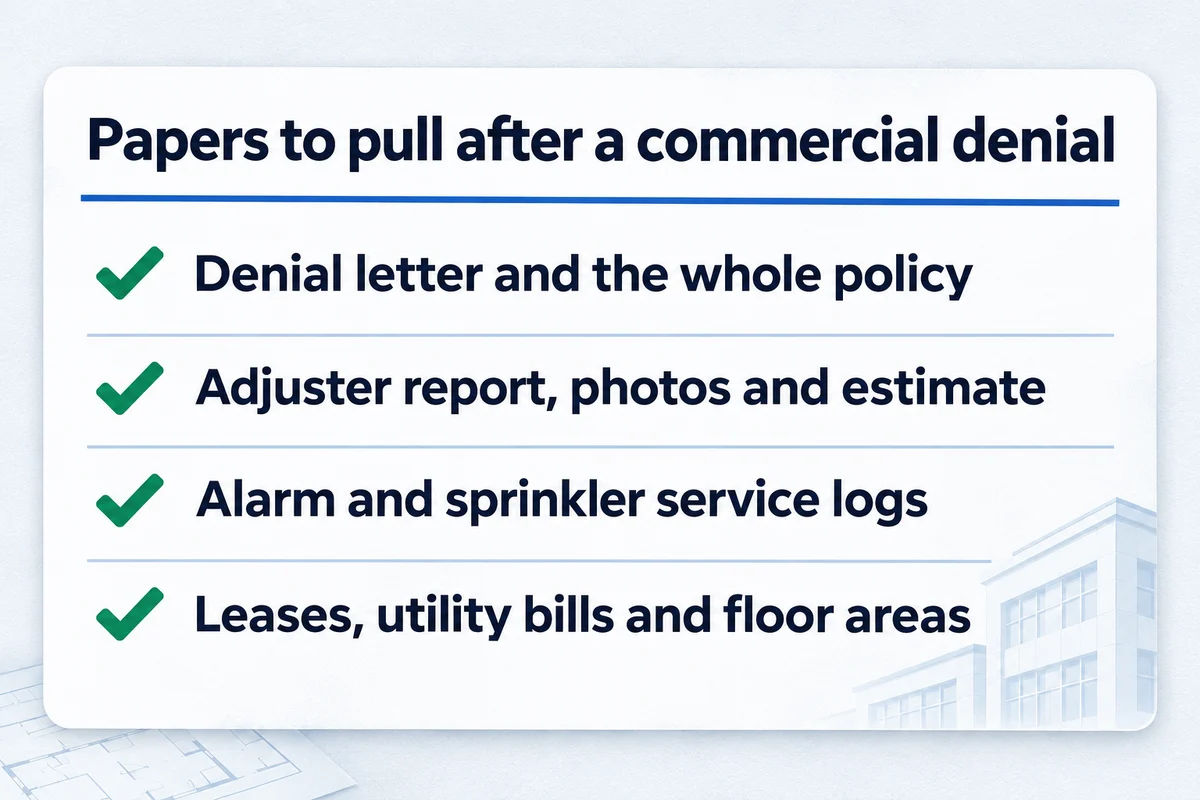
| Vacancy (CP 00 10, Loss Conditions) | Whether the building was vacant for more than 60 days in a row before the loss. Vandalism, water, theft, glass and sprinkler leakage are then not paid. Other covered causes are paid less 15%. | Leases, utility bills, alarm logs and measured floor areas for those days. |
| Late notice (Loss Conditions) | Whether you gave "prompt notice". The form sets no day count. | The storm date, the day you found the damage, your first call, and whatever shows the damage can still be examined. |
Notice the 15% in the vacancy row. A fire in a building that has stood empty is not on that list of unpaid causes, so a flat refusal citing vacancy alone deserves a written question. Roof claims have their own wrinkle on commercial policies, which I went through in the roof surfacing endorsement. The homeowner version of this subject is my article on a denial in the first week.
How has the vacancy clause played out in Illinois courts?
Differently each time, and the facts explain why. All three of these files involve the same 60 day wording and a commercial building. I cite them by number and leave out the parties.
A former meatpacking plant stood empty from 2005 and was vandalized in December 2009. The trial court ruled against the owner on all its claims. The mortgage holder still won a judgment under the mortgage clause, and the appellate court affirmed it.
A warehouse, already empty when bought, was added to a policy and vandalized days later. The days were counted back from the loss, but the insurer could have inspected before adding it, so it could not rely on the clause. This order states it may not be cited as precedent.
A brewery closed in 2020 and the policy renewed in 2021. Flood water came in January 2022. A workers' compensation audit that showed the closure did not count as telling the insurer the owner wanted a change to the property cover.
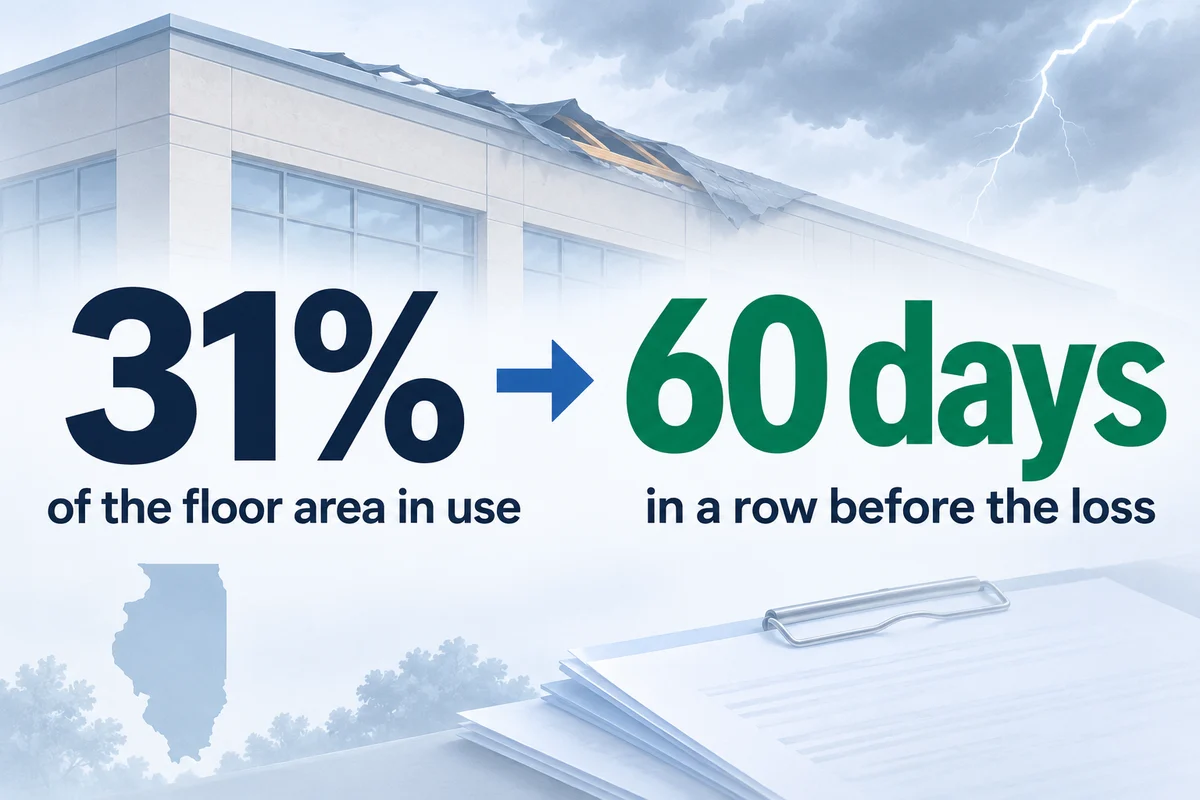
The second file turned on what the insurer could have checked before it took on the building, and the third on what it was actually told. So dates and paperwork from before the loss can decide the claim, which is why I ask to see the application and the renewal early on.
Does a tenant who has closed count toward the 31%?
Possibly not, and that catches owners who are still collecting rent. For an owner or general lessee, the form treats the whole building as vacant unless at least 31% of its total square footage is rented and used by the tenant "to conduct its customary operations", or used by the owner to do the same. Buildings under construction or renovation aren't considered vacant. A policy issued to a tenant uses a different test for that tenant's own unit. This illustrative worked example, with invented figures, measures one building:
Dark bar: 24% in use. Upright line: the 31% needed.
| Space in a 20,000 sq ft building | Sq ft | Counts? |
|---|---|---|
| Restaurant, open and trading | 3,000 | 3,000 |
| Owner's own office, in daily use | 1,800 | 1,800 |
| Shop paying rent, closed for months | 2,500 | 0 |
| Empty upper floors | 12,700 | 0 |
| Needed: 6,200 (31%) | 20,000 | 4,800 |
Illustrative worked example only. Whether a given use is "customary operations" can be argued, and that argument belongs with a lawyer.
If the shop in that example was still taking stock and opening by appointment, the total becomes 7,300 square feet, or 36.5%. Measuring the floor plan and showing how each space was used on those 60 days is fact work, and I can do that part. If water damage is the loss, the same dates matter for a business income claim running alongside it.
Why should the lender and the broker see the letter?
Your lender may hold a right you don't. The standard mortgageholders condition says that if the insurer denies your claim because of your acts or because you failed to comply with the terms, the mortgage holder listed on the declarations "will still have the right to receive loss payment" if it meets certain conditions. The 2015 file above ended that way. Don't treat it as a rescue, because the same condition lets the insurer take over the lender's rights for what it pays. Talk to your lender and a lawyer before anyone pays anything.
Ask your broker for the application as it was submitted, along with every renewal. In the 2015 file the application described the building as 100% owner-occupied and 3,990 square feet, when it was empty and close to 35,500. Check what yours says about occupancy, alarms and sprinklers. If it's wrong, get advice before you write to the insurer about it.
How long do you have to sue after a commercial denial?
Read your own policy, since the clause sets the period and an endorsement can change it. The ISO Commercial Property Conditions in that published policy (CP 00 90) require a legal action within 2 years after the date of the direct physical loss, and not from the date of the letter. 215 ILCS 5/143.1 pauses that period from the day a proof of loss is filed, in the form the policy requires, until the claim is denied in whole or in part. This illustrative worked example shows the arithmetic:
- Hail damages the roof. The 2 years start.
- A sworn proof of loss goes in. The clock pauses with one month used.
- The denial letter arrives. The clock restarts with 23 months left.
- The illustrative last date, against June 1, 2027 with no pause.
Illustrative dates only. Have a lawyer count your real deadline, and don't assume that asking the insurer to reconsider stops it again.
A notarized form may matter here too, which I explained in signing a sworn proof of loss.
What should your written reply look like?
It should answer the cited provision with one fact and make one request. This is an illustrative sample for a roof leak denied as long-term seepage. The dates and details are invented:
Your letter of March 12 relies on paragraph B.2.f, continuous or repeated seepage over 14 days or more.
Our building log and the enclosed tenant emails show no report of water in Suite 200 before the windstorm on February 27. The roofer's note and photographs 1 to 9 show membrane torn at the east parapet.
Please reinspect the east parapet with us present, and send the adjuster's report, photographs and any moisture readings you relied on.
Where can the dispute go after the reply?
That depends on what you're disagreeing about, and a file can use more than one of these.
- A reinspection on new evidence
- This is for cause and scope. It works when something wasn't in front of the adjuster the first time.
- A complaint to the Illinois Department of Insurance
- This is about how the file was handled. The notice that comes with the letter tells you how to reach the Department. A claim that has simply gone quiet is covered in when an insurer sits on your claim.
- Appraisal, where your policy has the clause
- This settles the amount of a loss. Insurers commonly say it can't decide coverage, so read my page on the appraisal clause before you demand it after a denial.
- A lawyer
- This is for what a clause means, waiver and estoppel, and the deadline to sue. 215 ILCS 5/155 lets a court add attorney fees and a limited further amount where an insurer's conduct was vexatious and unreasonable. Whether a file meets that test is a lawyer's call.
When is a public adjuster worth calling on a commercial denial?
Call when the dispute comes down to something that can be measured or dated: the cause of a roof failure, the floor area in use, the scope of the repair, or service records the insurer never looked at. You can handle it without me if the facts behind the clause are plainly true and undisputed, or if the insurer has already agreed to reopen on papers you can send yourself. A dispute that is only about what the words mean should go straight to a lawyer.
You can see how I work with businesses on the commercial property claims page, and what I do with a refusal on the denied claim help page. Send the letter, the forms list and your dates through the contact page. Nobody honest can promise in advance that a denial will be reversed.