Business income insurance pays a business for the money it would have made while it is closed by covered physical damage, plus the bills that keep coming in while the doors are shut. It pays for a window called the period of restoration: the time it should take to repair the damage and reopen, not a fixed year. The 12 months printed on many commercial policies is usually the longest the cover can run, and an Illinois appeals court read it exactly that way in a Chicago case in 2011. So the size of your business income claim comes down to two things you can prove: the dates, and what an ordinary month was worth.
I handle commercial property losses in Chicago from the owner's side, as a licensed public adjuster (Illinois #19461872) and a licensed general contractor (#TGC115063). The building side of these claims is on my commercial property claims page. This post is about the income side, which owners usually think about only after the first few weeks are gone. How a court reads your particular policy is a legal question, and a lawyer is the right person for it.
What does business income cover pay, and what does it not?
It pays lost earnings, not lost sales. The form takes the profit the business would have made and adds the expenses that continue while you are closed. Costs that stop because you are closed, like the food a restaurant no longer buys, are not paid. And nothing is paid unless the shutdown comes from direct physical damage that the policy covers. A drop in customers with no damage behind it is not a business income loss.
Four phrases on the form decide almost every argument, so it is worth knowing what each one means before the adjuster uses them.
- Business income
- The net income, before income tax, that the business would have earned if the damage had not happened, plus continuing normal operating expenses.
- Continuing normal operating expenses
- Bills that keep running while you are closed: rent, loan payments, insurance, and the wages of the people you keep on. If your policy has an endorsement that limits ordinary payroll, it will say so and give a number of days.
- Extra expense
- Money you would not have spent without the damage, spent to stay open somewhere or to reopen sooner. It is a separate line and is read under its own wording.
- Period of restoration
- The window the income is paid for. It closes on the date a reasonably quick repair to the same quality should have been finished, or earlier if you move for good and reopen at a new address.
Which dates decide how much is paid?
Five dates, and every one of them should be written down the week of the loss. The strip below shows how they sit against each other on a typical claim. The exact waiting period and the length of the extended period are printed on your own form and they differ from policy to policy, so read the numbers there rather than from any article.
The widths are only a picture. On a real claim the period of restoration is a number of weeks argued from the repair schedule.
The Chicago case that read 12 months as a promise
On June 6, 2004, a flood damaged a leased facility in downtown Chicago and the telecom equipment that had just been installed in it. The two companies that used it, CIMCO Communications and Vascom, had the equipment repaired and replaced about three months later. They claimed business income losses from the flood all the way to December 2005. The insurer paid for the three months and nothing after. The case reached the Illinois Appellate Court, First District, as CIMCO Communications v. National Fire Insurance Co. of Hartford, No. 1-09-3035, decided February 8, 2011.
The owners leaned on this sentence in the policy, as quoted in the opinion:
"We will only pay for loss of Business Income that occurs within 12 consecutive months after the date of direct physical loss or damage."
Policy wording quoted in the CIMCO opinion
Their reading was that this gave them up to 12 months of losses, however short the repair. The court read the policy as a whole and pointed to a second clause, extended business income, which paid for a lag after the equipment was repaired and operations resumed, ending at the earlier of the date operations could be restored to their pre-loss condition with reasonable speed or 30 consecutive days. If the first clause already paid for 12 months, the second one would have no job to do. So the court held that business income covered the three-month period of restoration, the extended clause covered up to 30 days after it, and the 12 months was the outer limit, not the length of the cover.
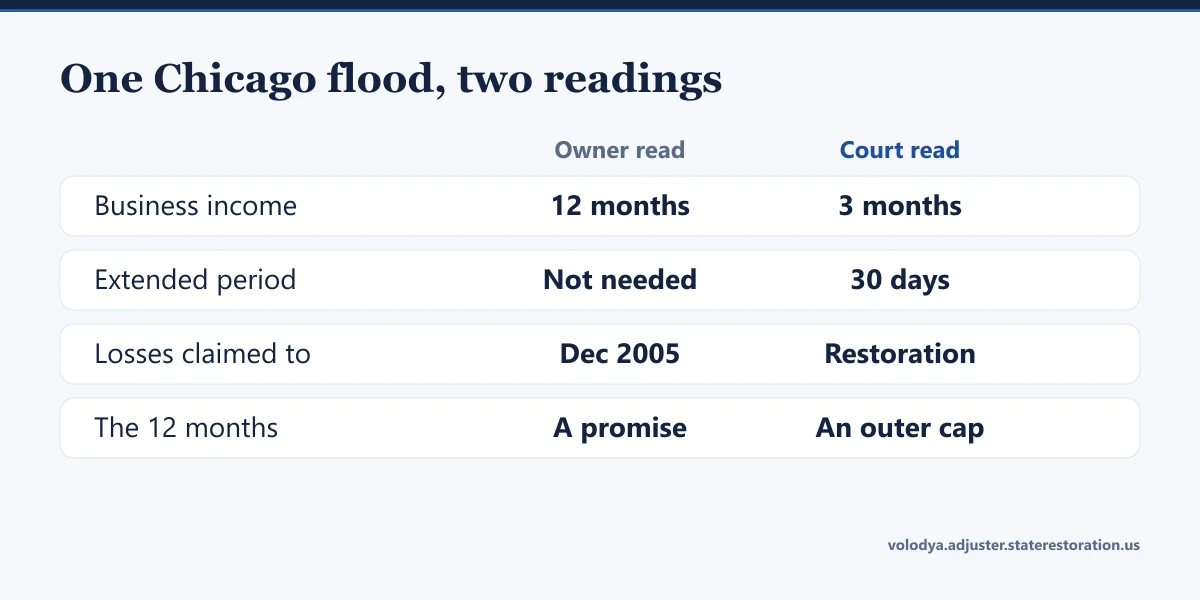
Two lessons come out of it for an owner. The first is that the argument worth having is about the period of restoration, the real time a reasonable repair takes, and not about the 12 months. The second is that the slow climb back after reopening belongs to the extended clause, which has its own short limit. If your sales take longer than that to recover, the time to know it is when the policy is bought, not after the fire. Whether a court would read your own wording the same way is a question to put to an attorney.
How is a month of lost income worked out?
Month by month, from your own books. The adjuster, or an accountant working for the carrier, will look at the same month in past years, the trend in the months just before the loss, and what you would have earned if nothing had happened. Here is one illustrative worked example for a bakery-café closed by a kitchen fire. The figures are made up but realistic.
| Line | Stops or continues? | Illustrative month |
|---|---|---|
| Expected sales, from the same month last year adjusted for this year's trend | $48,000 | |
| Flour, coffee, dairy and packaging, 30% of sales | Stops | $14,400 |
| Gas and power the ovens would have used, and card processing fees | Stops | $2,100 |
| Rent on the space | Continues | $7,500 |
| Wages of the staff kept on | Continues | $15,000 |
| Equipment loan payment | Continues | $2,200 |
| Insurance, software and phone | Continues | $800 |
| Net income the month would have earned | $6,000 | |
| Business income for the month: net income plus continuing expenses | $31,500 |
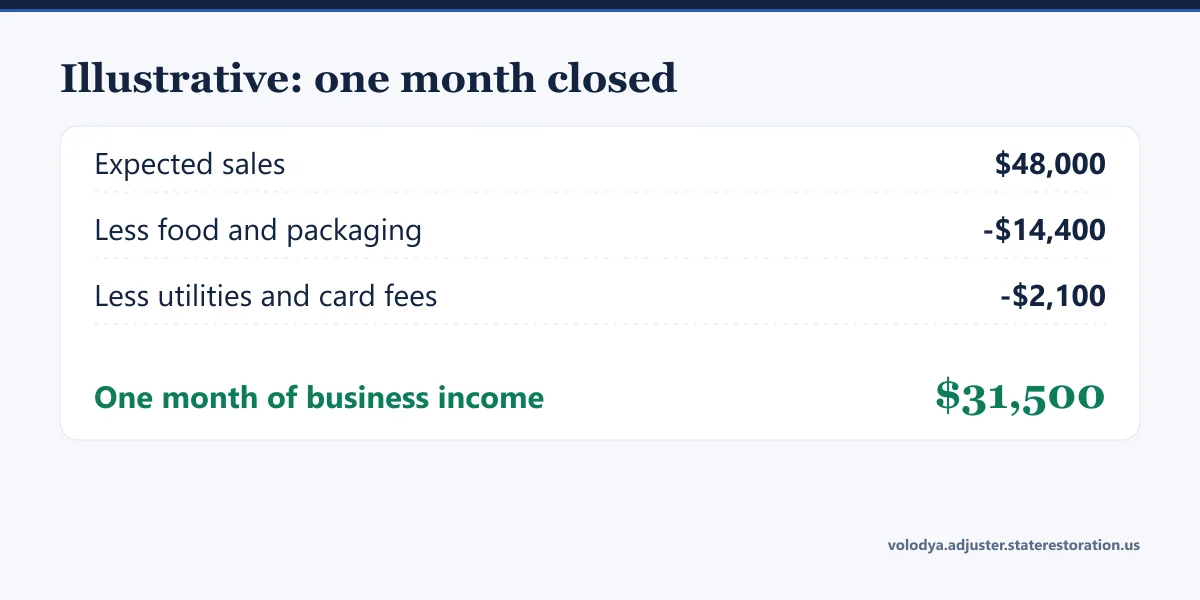
The same answer comes from the other direction: expected sales of $48,000 less the $16,500 of costs that stopped leaves $31,500. Checking it both ways catches errors early. Each month of the closure gets its own row, because a bakery's December is not its February, and the waiting period, if your form has one, comes off the first row.
The two places these numbers move most are the expected sales and the wages. A carrier will often start from the average of the past year. If the business was growing, the months right before the loss are the better evidence, and they have to be shown, not asserted. On wages, a staff member you kept on so that you could reopen with a trained team is a continuing expense; one you laid off is not.
Extra expense: money spent to open sooner
Where the policy carries extra expense, it pays costs you would not have had without the damage, spent to keep trading or to shorten the closure. For the bakery that might be:
- renting time in a commissary kitchen so the wholesale orders keep going out;
- moving the display cases and the mixer to a temporary storefront;
- paying a contractor to work a weekend, or paying for faster shipping on a replacement oven;
- signs and notices telling customers where to find you meanwhile.
The test is whether the spending avoids or shortens the shutdown. A commissary that keeps $20,000 of wholesale sales alive usually reduces the business income loss by more than it costs, and carriers know that. Ask the adjuster in writing before you sign a lease for a temporary space, and keep the answer.
What should I pull from the books in the first week?
- The business tax returns for the last two or three years.
- Monthly profit and loss statements for at least the last 24 months, and then every month of the closure as it ends.
- Daily sales from the register or point-of-sale system, which show the trend better than any monthly total.
- The payroll register, with a note of who was kept on and who was laid off, and on which date.
- The lease, the equipment loan statements and any contract or standing order that was lost because you closed.
- A dated log of the repair: when the adjuster first inspected, when the scope was agreed, when permits were filed and issued, and when each piece of equipment was ordered and arrived.
The last item is the one owners skip, and it is the one that decides the length of the claim. The figures you give the carrier may later go into a sworn statement, so make them ones you can stand behind; I explain what signing one means in sworn proof of loss in Illinois, line by line.
Why the repair schedule is the real argument
Because the period of restoration is defined by how long the repair should take with reasonable speed, the carrier will build its own estimate of that time, and it is often short. It may assume a contractor starts the day after the loss, that permits are issued at once and that a commercial oven or a rooftop unit arrives off the shelf. In Chicago none of that is a given. Plan review, a fire-damaged electrical service waiting on the utility, and equipment with a long lead time can each add weeks that nobody at the business controlled.
The answer to a short estimate is a schedule built trade by trade, with a reason and a document for every week of it. This is the part of a commercial claim where I spend the most time, because the building scope and the income claim are tied together: a roof that has to be torn off and rebuilt keeps the business closed longer than a patch, and my commercial roof damage claims page explains how that scope is measured. Delays the owner causes, like waiting two months to choose a contractor, will not be paid for, so move quickly and write down why each step took as long as it did.
Who should handle which part?
On a large claim, three people may be involved. A public adjuster scopes and prices the physical damage, builds the repair schedule that sets the period of restoration and negotiates with the carrier. An accountant who does insurance loss work builds the income figures from your books, and on a large claim the carrier will have one on its side. A lawyer handles a dispute about what the policy wording means, like the one in CIMCO, or a suit.
Not every closure needs that team. If a burst pipe shuts a shop for four days and the carrier is paying the receipts and the lost days without argument, settle it yourself. If you own the building, the income claim usually travels with a fire damage claim or a water claim on the structure, and both sides should be adjusted together so the dates agree. If you are not sure which situation you are in, send me the declarations page and a short note and I will tell you whether you need help at all.