If your commercial property policy says replacement cost but the insurer is paying the roof at actual cash value, look for a roof surfacing endorsement. It is a separate form attached to the policy, and it changes how the roof covering is valued after a loss, or removes cosmetic wind and hail damage from cover, or both. It reaches only the parts of the roof its own definition names. On a flat commercial roof, that list decides a large share of the cheque.
I am a licensed public adjuster in Illinois (#19461872) and Indiana (#3556317), an Illinois roofing contractor (#105.009193) and a HAAG certified inspector (#992104047), so on a commercial roof file I read the endorsement and the roof estimate side by side. I am not a lawyer. When the meaning of a policy word is the whole dispute, an Illinois attorney is the right person to read it.
What can a roof surfacing endorsement change?
Two things, and the policy can carry one or both. The standard version is the ISO form CP 10 36, Limitations on Coverage for Roof Surfacing. Bill Wilson describes it in his September 2026 Insurance Journal column on commercial property endorsements: it came in with ISO's 2012 countrywide filing, many carriers use their own versions, and the cosmetic part is not approved in every state. The form has a schedule, and the schedule says which of the two changes applies to which building.
Roof surfacing at actual cash value
The building stays on replacement cost, but the roof covering is paid at its depreciated value at the time of loss. In the ISO form this applies to any covered cause of loss, not only storms. An older roof gets a smaller payment, and there is no second cheque for that part once the roof is replaced.
No cover for cosmetic wind or hail damage
Dents, pitting and marks from wind or hail that change how the roof looks but not how it keeps water out are not paid. The argument then moves to one question: did the storm reduce the roof's ability to do its job, now or over its remaining life?
Summary of the two options as described in the Insurance Journal column above. Your carrier's wording may differ; the endorsement in your own policy is the only text that counts.
Where do I find it in my policy?
Not in the main coverage form. Endorsements are separate pages, and most owners never open them until the claim letter quotes one. This is the order I read a commercial policy in when a roof claim comes in:
- Start with the forms schedule, on or right after the declarations page: a list of every form number and edition date in the policy. Look for CP 10 36, or a carrier form whose title has the words roof, roof surfacing or cosmetic in it.
- Open that endorsement and read its own schedule. Each roof form names the premises and the building number it applies to, and which option is chosen. A policy that covers three buildings can have the limit on one of them only.
- Read the title and the first paragraph. Some carrier forms apply only to loss by windstorm or hail. The ISO valuation option applies to every covered cause of loss, so a fire or a fallen tree can be paid the same way.
- Go word by word through what the form calls roof surfacing. The next section is about why.
- Find the renewal notices from the last three years. These endorsements are often added at a renewal, and the notice sent with that renewal shows when yours arrived.
Which parts of a flat roof count as roof surfacing?
Only what the definition names. Here is the definition in one carrier's roof surfacing endorsement, filed with the Wisconsin Office of the Commissioner of Insurance. I quote it because it is a public filing and its wording is typical of what I see; it is not the wording of your policy:
"Roof surfacing" means the:
- Shingles or tiles;
- Cladding;
- Metal or synthetic sheeting or similar materials covering the roof;
- Roof vents;
- Roof flashing and drip edges;
- Underlayment; and
- Any other materials used to cover the roof.
This includes all materials used in securing the roof surface and all materials applied to or under the roof surface for moisture protection.
The same filing extends a similar limit to "exterior surfacing": siding, soffits, fascia, gutters, overhead doors, windows and skylights. Check whether your form reaches past the roof.
A commercial flat roof is a stack, not a single layer, and a hail or wind estimate for one is written line by line. Set those lines against a definition like this one and they fall into three groups:
| Estimate line | Named? | What I look at |
|---|---|---|
| TPO, PVC, EPDM or modified bitumen membrane | Yes | Sheeting covering the roof. This is the line the limit was written for. |
| Fasteners, plates, adhesive, seam tape | Yes | Materials used in securing the roof surface. |
| Perimeter edge metal, counterflashing, curb flashing | Yes | Roof flashing. Coping caps on a parapet can be argued either way. |
| Cover board and rigid insulation | Argued | Insulation is there for heat, not moisture. Whether it is "applied under the roof surface for moisture protection" depends on the exact words and on what the board actually does in your assembly. |
| Vapor retarder above the deck | Usually | It is applied under the surface for moisture control, so expect it to be counted. |
| Steel deck, wood deck, joists | No | Structure is not roof covering. Damaged deck panels stay on the policy's normal valuation. |
| Rooftop units, curbs, drains, interior ceiling and stock | No | Equipment, building interior and contents follow their own coverage and valuation. |
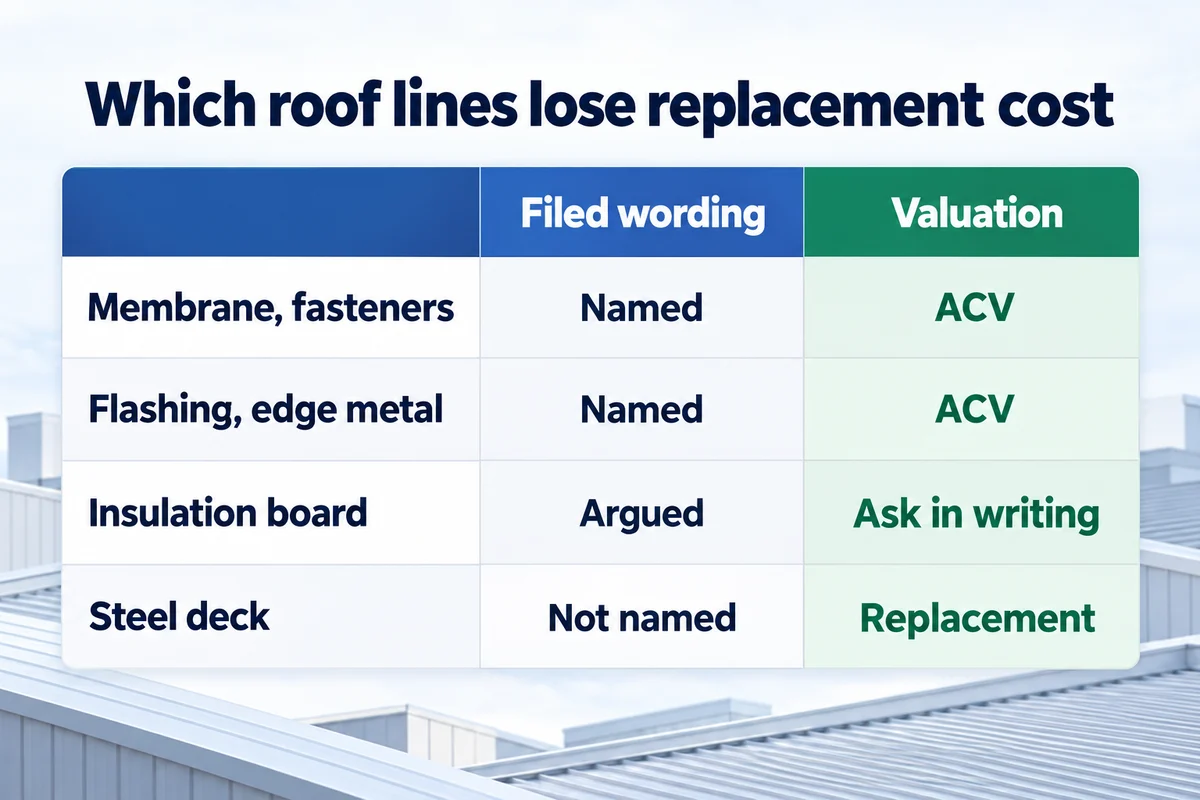
The mistake I see most often is a depreciation percentage applied to the bottom line of the whole roof estimate, deck and insulation included. When that happens, ask the adjuster in writing which estimate lines were treated as roof surfacing, and which words of the endorsement put each one there.
How much does the reading change the payment?
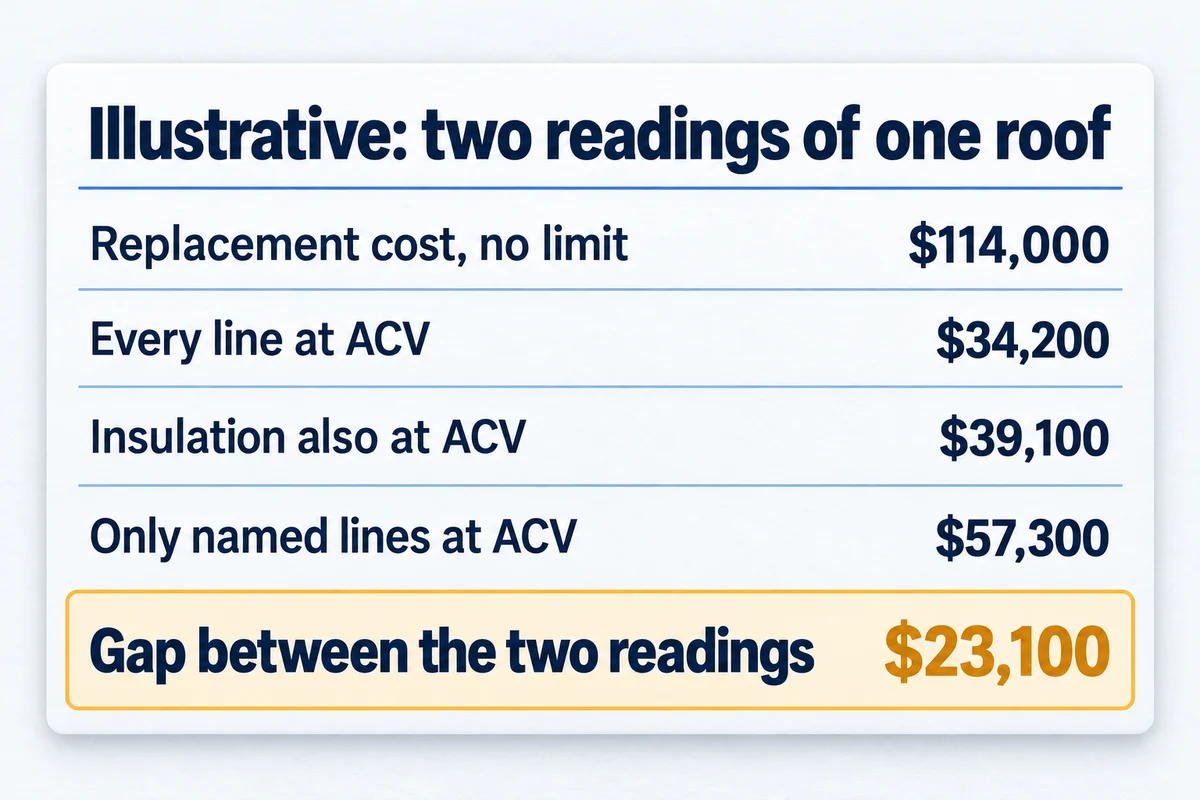
Here is an illustrative worked example, not a real claim. A one-story commercial building in Cook County has a 14-year-old mechanically attached TPO roof over polyiso insulation on a steel deck. A storm tears the membrane, water soaks part of the insulation, and a rooftop unit shifts and crushes two deck panels. The policy has the valuation option, and for the example the adjuster uses a 20-year life, so the roof surfacing is depreciated 70 percent.
| Line (illustrative) | Replacement cost | Every line at ACV | Only named lines at ACV |
|---|---|---|---|
| Tear-off and haul-away | $14,000 | $4,200 | $4,200 |
| TPO membrane, plates, fasteners | $58,000 | $17,400 | $17,400 |
| Edge metal and flashing | $9,000 | $2,700 | $2,700 |
| Wet insulation replaced | $26,000 | $7,800 | $26,000 |
| Two steel deck panels | $7,000 | $2,100 | $7,000 |
| Before deductible | $114,000 | $34,200 | $57,300 |
Illustrative worked example. Every figure is invented to show the arithmetic. Tear-off is counted with the surfacing because the filed form above lists debris removal in its settlement wording. If the insulation is found to be roof surfacing, the right-hand total is $39,100.
The same storm and the same estimate give $34,200 or $57,300, a gap of $23,100, before anyone argues about the damage itself. Then there is the depreciation rate. Twenty years is an assumption about a roof, not a measurement of it. Maintenance records, repair invoices, core samples and the manufacturer's warranty term are how the age and remaining life of your roof get shown, and they are worth gathering before the adjuster's number is final.
The insurer says the hail damage is cosmetic: what then?
Find the definition of cosmetic in your endorsement before you answer. The cosmetic exclusion in the same Wisconsin filing lists marring, pitting, chipping and denting that alter the appearance but do not cause a failure "to perform its intended function of keeping out the elements over an extended period of time". Those last words matter. They ask about the roof's remaining life, not only whether it leaks on the day of the inspection.
On a single-ply roof, hail often fractures the membrane from below, where the hailstone drives it onto the plate or a gap in the insulation, and nothing shows on top. I set out how a test cut shows it in my post on hail on a TPO, PVC or EPDM roof. On standing seam and through-fastened metal roofs, dents are where most cosmetic disputes start. A dented seam that no longer closes, or a split coating over a bare steel panel, is a different finding from a dimple in a flat pan. Photograph each one with a scale in the frame, and ask the insurer's engineer to state in the report which ones were judged functional and why.
What the endorsement does not change
It limits the roof covering, and the rest of the policy still works as written. Three things I check on every one of these files:
- The deductible still comes off. A wind and hail deductible written as a percentage of the building value can take a large bite out of an ACV roof payment, so put the two numbers next to each other early.
- Code work is a separate question. When the City of Chicago or a suburban building department requires more insulation, new edge details or a full tear-off, that cost is answered by the ordinance or law coverage, not by the roof form. My post on code upgrade coverage explains how that coverage is written.
- Holdback depreciation. Under a replacement cost policy the depreciation is held back and paid once the work is done, which I explain in why the first insurance check is smaller. For the roof surfacing lines, the valuation option removes that second payment. For the lines it does not name, the normal recovery rules still apply, so keep those lines separate on the final invoice.
When do you not need a public adjuster?
When the roof is new, the damage is small and the insurer's estimate splits surfacing from deck and insulation the way your policy reads, you can settle it yourself with your roofer's help. I am worth a call when the depreciation was taken off the whole roof, when the cosmetic label is on a roof that leaks or has fractured membrane, or when the building has several roofs of different ages under one claim. My page on commercial roof damage claims lists the records I ask an owner for, and the wider commercial property claims page covers the rest of the building. If the dispute turns into what a word of the endorsement legally means, read when a roof claim needs a lawyer. You can reach me through the contact page seven days a week. The first conversation costs nothing, and nobody honest can promise what an insurer will pay.