When the adjuster's estimate pays to replace a handful of hail-damaged shingles and you expected a new slope or a new roof, the estimate is not automatically wrong. A homeowners policy pays to repair the part of the house that was damaged, so a repair is where every hail roof claim starts. The real question is whether those shingles can be taken out and replaced without breaking the ones around them, and whether a repair would leave a roof that sheds water the way it did before the storm. That is decided on the roof, by the shingles themselves, and it can be recorded so the record survives a second inspection.
I inspect roofs as a HAAG certified inspector and hold an Illinois roofing contractor licence as well as public adjuster licences in Illinois and Indiana, so I lift shingles myself before I argue about them. Below are the two documents that frame this dispute, the test that roofers and adjusters argue about, a record sheet you can use, and one slope priced three ways.
What does the policy actually promise on a damaged roof?
It promises the cost to repair or replace the damaged part with material of like kind and quality, not a whole roof and not a fixed number of shingles. Neither side of the argument can point to the policy and win outright. What settles it is what a proper repair of that part requires, and that is where the shingle maker's own instructions come in.
"The replacement cost of that part of the building damaged with material of like kind and quality and for like use"
The yardstick is the damaged part. If a repair of that part cannot be done without damaging more of the roof, the necessary extra work belongs to the same repair.
"If the damage is confined to one plane of the roof, replacement of just the damaged roof plane may be possible."
The manufacturer says individual shingles can be replaced, but that hidden damage to the shingles around them is difficult to assess, and it treats one plane, one slope, as a normal unit of repair.
The policy line is from the standard ISO form HO 00 03 05 11, Section I Conditions, Loss Settlement, as published by the Maine Bureau of Insurance; many Illinois carriers build their forms on it, but read your own. The bulletin is GAF Technical Advisory Bulletin TAB-R-126, Replacement of Storm Damaged Shingles. It adds three things that matter on an estimate. When individual shingles are replaced, any nails pulled from the surrounding shingles have to be replaced and those shingles resealed by hand. Shingles nailed through to hold a tarp have to be replaced, because caulking the holes is not a permanent repair. And starter strip, ridge cap and other accessories may be needed to finish a repair properly. Those lines are often missing from a three-shingle estimate.
Is there a standard brittleness test for shingles?
No. I know of no published standard method, from a testing body or a manufacturer, that tells you how hard to lift a shingle, at what temperature, and what counts as a fail. What exists is a field practice: a roofer or inspector slowly lifts the bottom edge of a shingle near the damage and watches whether it bends and comes free of its sealant, or cracks, tears along the nail line, or snaps. If the shingles around a hail hit cannot be lifted without breaking, the repair cannot be done as written, and the scope has to grow.
Because there is no standard, the result is only as good as the record of how it was done. A carrier will set aside a test that was rushed, done on a cold morning, or done on one shingle. It will also be suspicious of shingles that appear to have been bent on purpose, and an honest owner is helped, not hurt, by a video that shows a slow, careful lift.
Temperature changes the answer. The Asphalt Roofing Manufacturers Association's cold weather recommendations say asphalt shingles tend to become less flexible as temperature decreases, and that lifting or bending in the cold may cause them to crack or break.
So in a Chicago November a lift test on a frosty roof will fail on almost any roof, new or old, and the carrier's engineer will say exactly that. If the test is what your claim rests on, wait for a mild afternoon with sun on the slope, and write the temperature down.
The same page also says the sealant bond between courses becomes less flexible in cold weather and that roof traffic may break it. An inspection walk in winter can break seals that were sound, which is one more reason to photograph the slope before anyone walks it.
A lift test record you can bring to the reinspection
When I test a slope, I fill in a sheet like the one below for every shingle I lift and keep the video with it. If your roofer does the test, ask for the same. A record like this turns "the roofer said they are brittle" into something an adjuster or an engineer has to answer point by point.
Lift test record, one sheet per slope
Fill in one line set for each shingle lifted. Four spots spread across the damaged slope, never one.
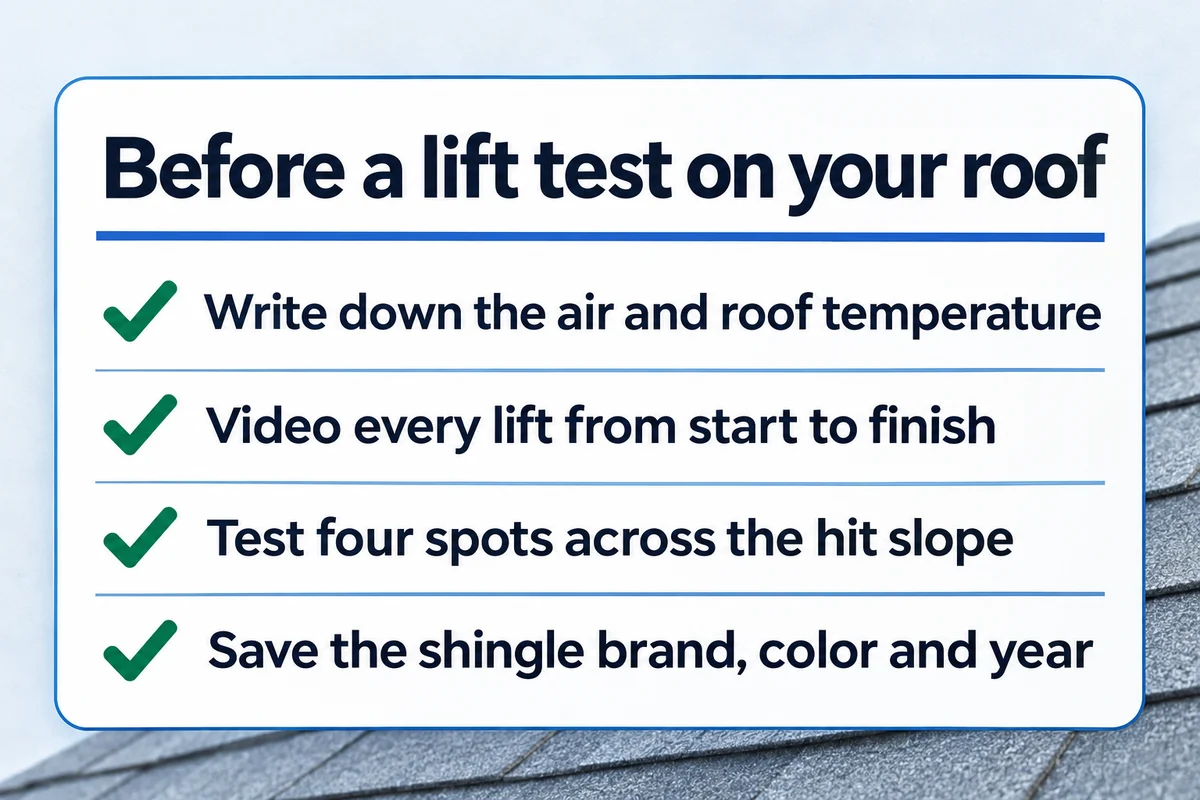
Two things on the sheet carry more weight than the rest. The temperature line answers the cold-weather objection before it is raised. The shingle type and age line matters because a laminated shingle installed a few years ago usually lifts cleanly, while an older three-tab roof is far more likely to crack, and an adjuster reads the result against that background. If you do not know the brand, look for leftover bundles in the garage or attic: the Asphalt Roofing Manufacturers Association notes on its page on repairing shingle roofs that contractors generally leave owners extra shingles for repairs, and a wrapper with a name and color on it answers the question in one photo.
One slope priced three ways: an illustrative worked example
A worked example, every figure illustrative. A gable and hip roof of 28 squares has four slopes. Hail hit hardest on the 8-square west slope, where the inspection marks 11 damaged shingles; the other three slopes show only scattered marks that both sides agree are not damage. The deductible is a flat $1,000.
| Scope | What it includes | Cost | Paid after $1,000 | When it is the right scope |
|---|---|---|---|---|
| Spot repair, 11 shingles | The 11 shingles, resealing and renailing the shingles around each one | $690 | $0 | The shingles around each hit lift and reseal without cracking, and a matching shingle is available |
| West slope, 8 squares | Tear-off and shingles $4,160, underlayment and ice barrier $780, starter, drip edge and ridge cap $660 | $5,600 | $4,600 | The surrounding shingles crack when lifted, or the damage is spread across the plane |
| Whole roof, 28 squares | All four slopes, all accessories | $19,800 | $18,800 | Every slope has damage, or the new slope cannot be made to match the rest and the policy's wording reaches that far |
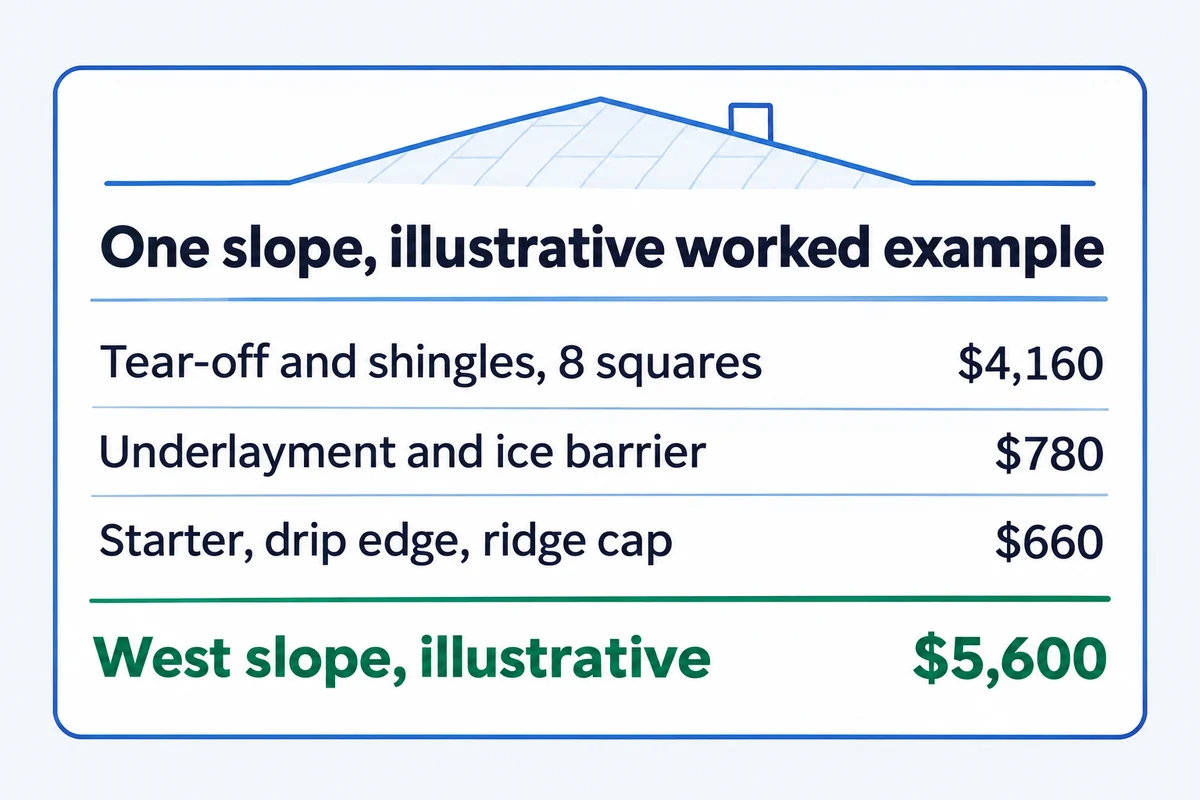
The first row explains why so many owners feel cheated by a spot repair: below the deductible, the claim pays nothing at all. That alone does not make the estimate wrong. It means the evidence for the second row has to be on paper before the claim is closed. On a replacement cost policy, the first cheque on the second or third row may also be paid at actual cash value, with depreciation held back until the work is done; the post on the first, smaller cheque walks through how the rest is collected. The third row is a separate argument about matching, which the matching post covers for roofs and siding.
What moves a file from a few shingles to a slope?
Facts about the roof, written down and photographed. In the files I work on, these are the ones that change an adjuster's scope.
- A lift test record from a mild day, four spots or more, with video, showing that the shingles around the hits crack or tear when lifted.
- The hit count spread across the whole plane rather than clustered in one corner. The more hits, the more of the slope a repair disturbs, and the closer a spot repair comes to a slope replacement in labor alone.
- Tarp nails driven through shingles after the storm. The manufacturer's bulletin says those shingles must be replaced, so every nailed row belongs in the scope.
- The renailing and resealing of the surrounding shingles, priced as their own lines. If the estimate has none, it is not a repair the manufacturer describes.
- Proof that the shingle is no longer made, or that what is available differs in size or exposure. A shingle of a different size cannot be woven into the old courses, which is a function problem, not a color preference.
- Soft metal marks, such as dents in vents, gutters and flashing on the same side, which tie the shingle hits to the storm rather than to wear. How a HAAG inspection reads hail on asphalt explains test squares and what gets mistaken for hail.
Send the record to the adjuster with a written request for a reinspection, and ask that the reinspection happen on a day warm enough for a fair lift. Keep it calm and specific: which slope, which shingles, what happened when they were lifted, and which estimate lines are missing.
When a spot repair is the honest answer
Asphalt shingle roofs are built to be repairable, and plenty of hail claims really are a few shingles. If your roof is a few years old, laminated, and the shingles around the hits lift, reseal and take new nails without cracking, a careful spot repair restores it, and arguing for a new roof is unlikely to change the estimate. In that case you do not need me; my fee would cost more than any difference I could find. If the repair price is below your deductible, the sensible step is often to have your roofer do the repair and keep the photos with your house records.
Where I earn the fee is the roof that cannot be repaired as written: an older roof whose shingles break when lifted, a slope peppered with hits, tarp nails across three courses, a discontinued shingle, or an estimate that prices shingles but no renailing, no sealant and no accessories. I inspect the roof myself, write the scope line by line, and deal with the carrier for you. More on that work is on my hail damage claims page.
Reinspection, appraisal or a lawyer
Most of these disputes end at a reinspection with better evidence. If they do not, many policies have an appraisal clause for disagreements about the amount of loss; whether a panel may also decide repair against replacement depends on the wording and on the facts, and that is a legal question. A denial that says the damage is wear and tear, a dispute about what the policy means, or a deadline in the suit clause is for an attorney. Public adjuster or lawyer on a roof claim sorts which disputes go where. If you want me to look first, send me the estimate and your photos, and I will tell you whether a slope argument is worth making on your roof.