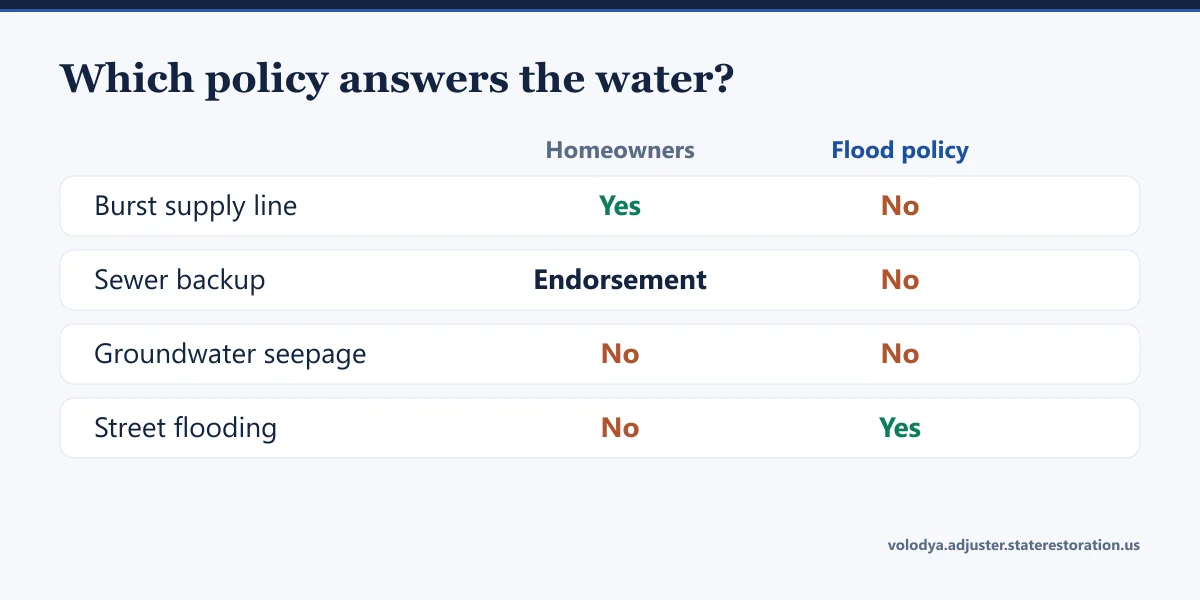
Water damage vs flood is not a question about how much water there was. It is a question about where the water was immediately before it reached your property. Water that escapes suddenly from inside the building — a supply line, a water heater, an appliance, or rain through a hole the wind just made — is a homeowners claim. Water that was sitting on the ground outside and rose or spread onto normally dry land is a flood, and no standard homeowners policy in Illinois covers it. Between those two sits a third category that is neither: sewer backup, sump overflow and groundwater through a foundation, which the homeowners policy excludes by default and sells back only by endorsement.
Three homeowners on the same Chicago block can each have eleven inches of water in a finished basement on the same night, from three different sources, and end up with three completely different answers from their insurers. One is paid in full. One is paid to a sublimit and no further. One is told there is no coverage at all. Nothing about the damage explains that. The cause does, and the cause is decided in the first day, usually before anybody has thought to photograph it.
I am a licensed public adjuster in Illinois (#19461872) and Indiana (#3556317), a HAAG certified inspector (#992104047), a licensed Illinois roofing contractor (#105.009193) and a general contractor (#TGC115063). Water losses are the ones where homeowners most often damage their own claim by cleaning up before recording anything. What follows is general information for Illinois and Indiana, not legal advice.
What is the difference between water damage and flood?
Direction and origin, not volume. Water damage on a homeowners policy comes from inside the building envelope and arrives suddenly. Flood is surface water that was outside on the ground, rising or spreading across land that is normally dry, and it is excluded from every standard homeowners form. A quarter inch of flood water is still flood. A ceiling collapse from a burst pipe is still water damage.
This matters because the two are sold as separate contracts. Your homeowners policy is with a private carrier. Flood cover in Illinois comes either from the National Flood Insurance Program, written through a private company but underwritten federally, or from a private flood market that has grown in the last few years. If you do not hold the second contract, an excluded flood loss is simply uninsured. There is no partial credit for having a good homeowners policy.
What does a homeowners policy cover when water gets in?
Sudden and accidental discharge or overflow from a plumbing, heating, air conditioning or fire sprinkler system, or from a household appliance. The policy pays for the resulting damage and, in most forms, for tearing out and replacing the part of the building needed to reach the failure. What it usually does not pay for is repairing the pipe, valve or appliance that failed.
That last distinction surprises people every time. A supply hose behind a washing machine lets go, and the carrier will pay to dry the room, replace the drywall and put the flooring back, but the eleven-dollar hose is yours. The same logic applies to a failed water heater: the tank is a maintenance item, the ruined finishes around it are the claim.
The other covered route is weather that breaches the building first. Standard forms exclude rain reaching the interior unless a covered peril has already made an opening in the roof or a wall. Wind lifts shingles, the deck is exposed, rain comes in that night — covered, because the wind created the opening. Rain through a window somebody left open, or through a roof that had simply worn out, is not.
Ice dams sit awkwardly across this line and deserve their own treatment; I have written separately about what an Illinois policy usually covers when an ice dam leaks, because the covered-versus-excluded split there turns on sudden entry rather than seepage.
What counts as a flood on an insurance policy?
The federal flood policy defines it narrowly: a general and temporary condition of partial or complete inundation of two or more acres of normally dry land, or of two or more properties one of which is yours, caused by overflow of inland waters, by unusual and rapid accumulation or runoff of surface water from any source, or by mudflow. The two-properties test is the part people miss.
Read that again with your own street in mind. If the storm sewer surcharges, the water comes up the block and into four houses, that is a flood on the definition even though nobody would call the street a river. If a downspout was disconnected and water ponded against one foundation and came through one wall, that is not a flood — but it is not covered by the homeowners policy either, because groundwater intrusion has its own exclusion. That gap is real and it catches people who assume the two policies between them cover everything.
Where is the water in my basement actually coming from?
Four sources account for nearly every basement loss I see in Cook, DuPage and Lake counties, and each one leaves a different signature. Establishing which one you had is the single most valuable hour of work on the claim, and it has to happen while the evidence is still wet.
| Source | What it looks like | Which contract answers | What to record |
|---|---|---|---|
| Supply or appliance failure | Clean water, a single point of origin, wettest nearest the failure, often no rain that day | Homeowners, sudden and accidental discharge | The failed part itself, kept in a bag; the shut-off time; moisture readings radiating from the source |
| Sewer or drain backup | Comes up through floor drains, a laundry tub or a toilet; discoloured; smells; usually during or just after heavy rain | Homeowners only with a water backup endorsement | Photographs of the floor drain, the high-water line, and the municipal notice or rainfall record for that date |
| Groundwater through the foundation | Damp along the wall and cove joint, efflorescence, worst at a known crack, builds slowly | Neither, in most cases — excluded by both | Honest photographs; this is usually a drainage repair rather than a claim |
| Surface water from outside | Enters at grade, window wells, doors or the driveway; the street and neighbours are wet too | Flood policy, if one exists | Street-level photographs, the high-water mark outside, and how many properties were affected |
Two of those can happen in the same hour, which is where most disputes are born. A sewer backup during a rainstorm and surface water through a window well produce one wet basement and two different coverage answers. If you dry it out before anyone documents which line arrived first and how high each got, that argument becomes unwinnable for reasons that have nothing to do with the merits.
Is sewer backup covered in Illinois?
Not on a standard form. Water that backs up through sewers or drains, or overflows from a sump, is written into the water exclusion alongside flood and groundwater. It is available as an endorsement — usually called water backup and sump discharge or overflow — and that endorsement carries its own limit, commonly somewhere between five and twenty-five thousand dollars, entirely separate from your dwelling limit.
In Chicago and the older inner suburbs this is not an exotic risk. Large parts of the system are combined, meaning storm water and sanitary flow share one pipe, so an intense summer cell can surcharge the main and push water back up the lowest fixture in the house. That is a plumbing event caused by weather, and it is precisely the thing the endorsement exists for.
Check your declarations page for it now rather than after a storm. Two details are worth reading: whether the limit covers building and contents together, and whether the sump pump failure itself is included or whether the endorsement responds only to a backup from the municipal side. Those two lines decide most of the payout when it matters.
What does flood insurance actually pay for in a basement?
Less than most people expect. A federal flood policy insures buildings up to $250,000 and contents up to $100,000 for a residence, contents are bought separately, and coverage below the lowest floor is restricted to a defined list rather than to everything down there.
In a basement, the building side generally answers for structural elements, foundation walls, stairways, unfinished drywall, clean-up, and the mechanical equipment servicing the building — furnace, water heater, heat pump, sump pump, electrical panels. The contents side generally answers for a washer, dryer, freezer and the food in it, and a portable air conditioner. Finished walls, ceilings, flooring, carpeting, furniture, electronics and the family's belongings are outside that list. Contents are settled at actual cash value under a flood policy in every case, which is the same depreciation mechanic described in what actual cash value means on an Illinois claim.
Three more features to know before you need them. A new flood policy generally has a thirty-day waiting period, so it cannot be bought when the forecast turns. There is no loss of use or temporary living expense under the federal form. And for a substantially damaged building inside a mapped flood zone there is a separate increased cost of compliance benefit of up to $30,000 for meeting current elevation and code requirements — a cousin of the coverage described in how ordinance or law coverage works in Illinois.
What does the same damage cost under three different causes?
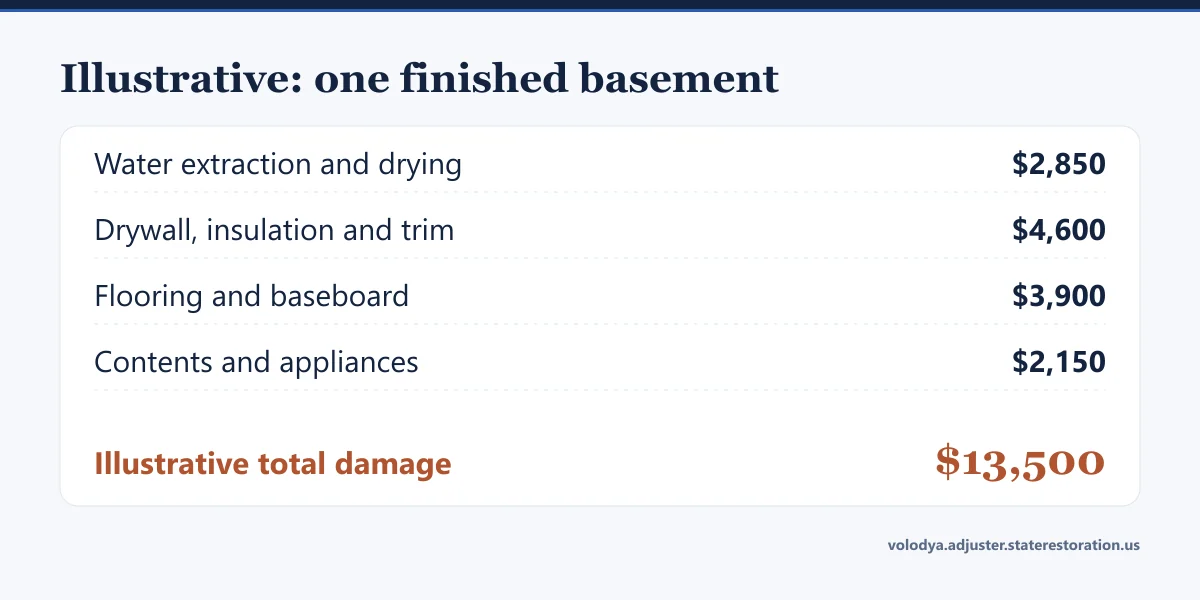
Here is the same finished basement in three versions. The figures below are an illustrative worked example, not a quotation and not a typical settlement; the point is the shape of the outcome, not the numbers.
| Cause of loss | Which contract responds | Illustrative outcome |
|---|---|---|
| Burst supply line at the laundry | Homeowners, sudden and accidental discharge | The full scope is in play; $12,500 after the deductible, with depreciation held back until the work is done |
| Sewer backup through the floor drain | Homeowners, but only through the water backup endorsement | Capped at the endorsement limit — $10,000 in this illustration — and the balance is yours |
| Street flooding through the window wells | Flood policy only; the homeowners policy pays nothing | Clean-up, unfinished elements and mechanical equipment are addressed; the finished walls, flooring and most contents are not |
Same water, same square footage, same contractor, three answers. That is why I am unsentimental about the first day of a water claim: the cause determination is worth more than any amount of arguing later about drying charges.
What should I do in the first 48 hours?
Stop the source if it is safe, then document before you dry. You have a duty under the policy to prevent further damage, so mitigation should not wait — but ten minutes of recording first protects the coverage question permanently, and nothing you photograph can be taken away from you later.
| Step | Why it decides the claim later |
|---|---|
| Shut off the water or the power to the failed equipment, and note the time | Establishes the loss as a discrete event rather than something that had been going on |
| Photograph the high-water line on a wall or a stud, indoors and outdoors, before anything drains | Height and location are the strongest evidence of which source arrived, and a wet mark disappears within hours |
| Keep the failed part — the burst hose, the split fitting, the dead sump pump | It is the physical proof of sudden and accidental failure; once it goes in a skip the argument becomes verbal |
| Record whether the water was clean, grey or contaminated | Category drives the required scope of removal and disinfection, and restoration standards price the three differently |
| Report to the carrier and, if a backup is suspected, to the municipality the same day | Municipal records of a surcharge on that date corroborate the cause independently of your contractor |
| Keep every mitigation invoice, receipt and moisture log | These are reimbursable in most forms and they double as the timeline of the loss |
One thing to avoid: do not let a mitigation crew fill out the cause-of-loss box on their paperwork for you. Restoration technicians are excellent at drying buildings and are not underwriting your claim. A guess written down on day one becomes the file's official version of events, and I have spent weeks unpicking a single careless word on a work authorisation.
When is water damage maintenance rather than a claim?
When it happened slowly. Standard forms exclude loss caused by constant or repeated seepage or leakage over a period of weeks, months or years, and that exclusion does a lot of work. A shower pan that has been quietly wetting a joist since last winter, a foundation crack that weeps every spring, a roof that has been end-of-life for three seasons: none of those is a sudden event.
I tell people this before they file, because a claim that is denied on seepage still sits in the industry loss history and can affect renewal pricing without ever having produced a dollar. If the damage is old, gradual and traceable to something nobody maintained, the honest answer is that it is a repair. If you have already been denied and are not sure the reason holds, what to do in the week after a denial covers how to test it before you argue.
When is this a lawyer question rather than mine?
When the fight moves from the cause to the contract. Determining where the water came from, documenting it, scoping the drying and the rebuild, pricing it and presenting it to the carrier is claim handling, and that is my licence. Arguing how an anti-concurrent causation clause applies when a covered peril and an excluded one both contributed — a common posture in storm-plus-backup losses — is legal work, and I will say so rather than take a position I am not licensed to take.
The rule of thumb I use: if the answer to the carrier is a photograph, a moisture reading, a municipal record or a line item, that is a public adjuster's job. If the answer is an interpretation of exclusionary wording, talk to an attorney, and do it promptly, because the suit-limitation period in your own policy runs from the date of loss regardless of how long the correspondence takes. What I do handle is set out on the representation page.
Getting help with a water claim in Chicago
If you have water in a basement and no idea which of the four sources you are dealing with, that is the call worth making early rather than after the drying equipment leaves. Send me photographs taken before clean-up, your declarations page and endorsement list, and the date and time you first saw water. I will tell you which contract is in play, whether it is worth filing at all, and what is missing from the record. Sometimes the answer is that you have a drainage problem and not a claim, and hearing that in week one saves everybody a month. There is more about how I work on the about page, or send the documents through the contact page.
Volodymyr Lukaniuk, licensed public adjuster. 3052 N Long Ave #2, Chicago, IL 60641. Telephone +1 224-481-2095, email volodymyr@staterestoration.us. Hours are Monday to Friday 9–6, Saturday 9–5 and Sunday 10–5, and I speak English, Ukrainian and Russian. I am licensed in Illinois and Indiana only.
Nothing above is legal advice. It is general information about how first-party property claims are handled, written by a public adjuster rather than a lawyer. Policy wordings differ from one form to the next, and your own declarations page and endorsement list are the authorities on your claim.