A contents inventory after a fire is not proved with receipts, and no carrier expects you to have them for a whole house. It is proved with a list good enough to price a like–kind replacement: what each item was, the brand and model if you know them, roughly how old it was, and what condition it was in. Photographs you already took for other reasons, card statements, online order histories, manuals, warranty registrations and the burned remains themselves all support that list. Build it room by room while the memory is fresh, keep it honest, and expect the first cheque to be the depreciated value rather than the cost of buying everything again.
Contents is the part of a fire claim people dread, and it is the part I see abandoned most often. A household gets a blank inventory spreadsheet with a few hundred rows, tries to fill it in from a hotel room three days after the fire, and gives up somewhere in the second bedroom. The building estimate then gets argued properly, line by line, and the personal property claim gets settled for whatever anyone could face writing down at the time.
It does not have to go that way. I am a licensed public adjuster in Illinois (#19461872) and Indiana (#3556317), a HAAG certified inspector (#992104047), a licensed Illinois roofing contractor (#105.009193) and a general contractor (#TGC115063). What follows is general information about standard homeowners forms in Illinois and Indiana, not legal advice, and your own policy wording is the authority on your claim.
Do I need receipts to claim contents after a fire?
No. The policy asks you to show the quantity, description and amount of the loss, and to cooperate with reasonable requests for records you actually have. It does not ask for a purchase receipt per item. Nobody keeps the receipt for a bedside lamp bought nine years ago, and adjusters know that. What is expected is a reasonable, consistent inventory.
Receipts are one kind of support among many, and they matter in proportion to the number beside the item. A $28 colander is priced from the description and nobody asks twice. A $4,000 camera body, a tool trailer, a ring, a collection of anything — those attract real scrutiny, and that is where you want documentation rather than memory. Sort your effort that way from the beginning: the top twenty items by value deserve an hour each, the kitchen drawer deserves one line that says what was in it.
One more thing worth saying plainly. The inventory usually ends up attached to a sworn statement in proof of loss. Signing it is a sworn act. That cuts in both directions: do not inflate, and do not let anyone talk you into rounding numbers upward to "leave room to negotiate". An honest list that you can explain is worth far more than an ambitious one you cannot.
What does a contents inventory actually have to show?
Enough for someone who never saw the item to price a replacement of like kind and quality. In practice that is seven fields: room, description, brand and model, age, condition, quantity and today's replacement cost. Where you are unsure, write that you are unsure — an estimate labelled as an estimate is normal, a guess presented as fact is a problem.
| Column | Why it matters | If you are not sure |
|---|---|---|
| Room | Groups the loss, and is the memory aid that makes the rest possible | Use the room you last picture it in |
| Description | What the pricing software matches. "Pillow, standard, memory foam" prices very differently from "pillow" | Describe size, material and use rather than naming a price |
| Brand and model | Sets the quality tier, which drives most of the number | Write "unknown"; never upgrade a brand you cannot support |
| Age or year bought | Sets depreciation, which decides the first cheque | Give a range, for example "5–7 years", and mark it an estimate |
| Condition | Adjusts depreciation up or down from the table rate | Good, fair or poor, honestly assessed |
| Quantity | A count is claimable, "several" is not | Count from a photograph if one exists |
| Replacement cost today | The basis for both the first payment and the second | A current online listing for a like item is acceptable support |
Where does the proof come from when the receipts burned?
From records that were never in the house. Almost every household in 2026 has years of evidence sitting in a phone backup, a bank portal and an email archive, and most of it survives a fire untouched. The job is not remembering harder; it is harvesting what already exists, then filling the gaps from memory.
| Source | What it proves | How to get it |
|---|---|---|
| Your own photos and videos | That the item existed, where it sat, and roughly its condition | Search the cloud backup by date; birthdays, holidays and pet photos show whole rooms in the background |
| Card and bank statements | That a purchase happened, when, and for how much | Download three to five years from the bank portal, then read the merchant names |
| Online order history | Item, model, date, price and often a product image | Marketplace and big–box accounts keep orders for years; export to a spreadsheet |
| Email archive | Confirmations for things bought in store as well as online | Search for "order confirmation", "your receipt", "shipped" and "warranty" |
| Warranty and product registrations | Brand, model and serial for appliances, electronics and tools | Manufacturer accounts, extended–warranty portals, the retailer's protection plan |
| Scheduled property and appraisals | Described and valued items already agreed with the carrier | Your own declarations page and any appraisal you filed with it |
| The remains | Existence, model and sometimes serial — a data plate often survives what it was bolted to | Photograph in place before anything is removed |
| Other people | Installations, gifts and custom work you never paid for directly | The flooring contractor, the furniture store, the relative who bought it |
How do I write down a room I can no longer walk into?
Work one room at a time and move in one direction. Start at the door, go clockwise along each wall, then do the floor, then the ceiling, then everything inside something else. Drawers, closets, under the bed, the top of the wardrobe, the back of the door. Memory comes back in waves, so expect to add to yesterday's room tomorrow.
Two practical things make a large difference. First, do it with another person from the household; two people in the same room recall roughly half again as much as one, because each triggers the other. Second, talk rather than type. A voice memo walking through the kitchen produces far more detail than a spreadsheet does, and it can be transcribed afterwards. Thirty focused minutes a day for a fortnight beats one exhausting weekend, and the exhausting weekend is usually where a claim gets under–listed.
Use the categories nobody remembers unprompted: cleaning supplies and the contents of under the sink, linens and towels, the medicine cabinet, spices and the pantry, Christmas decorations and luggage in storage, phone chargers and cables, children's toys and books, tools in the garage, the contents of the freezer. These are low–value lines individually and a meaningful figure together, and they are the ones a hotel–room inventory always misses.
If a restoration contractor performs a pack–out, insist on a copy of their inventory as they go, not at the end. That list tends to become the claim's official record of what existed, and it was written by people working quickly in protective gear. Check it against your own. Items are routinely logged as "box of miscellaneous kitchen" when the box held a stand mixer.
Why is the first contents cheque so much smaller than the list?
Because personal property is normally settled at actual cash value first: replacement cost today, less depreciation for age and condition. If your policy carries replacement cost on contents, the withheld depreciation is recoverable, but usually only after you actually replace items and send proof of what you bought, within the window the policy states.
| Item | Age | Replacement cost today | Illustrative depreciation | Actual cash value |
|---|---|---|---|---|
| Fabric sofa | 6 years | $1,400 | 50% | $700 |
| 55–inch television | 4 years | $600 | 40% | $360 |
| Wool area rug | 8 years | $500 | 70% | $150 |
| Oak bookcase | 3 years | $300 | 25% | $225 |
| Total | $2,800 | $1,435 |
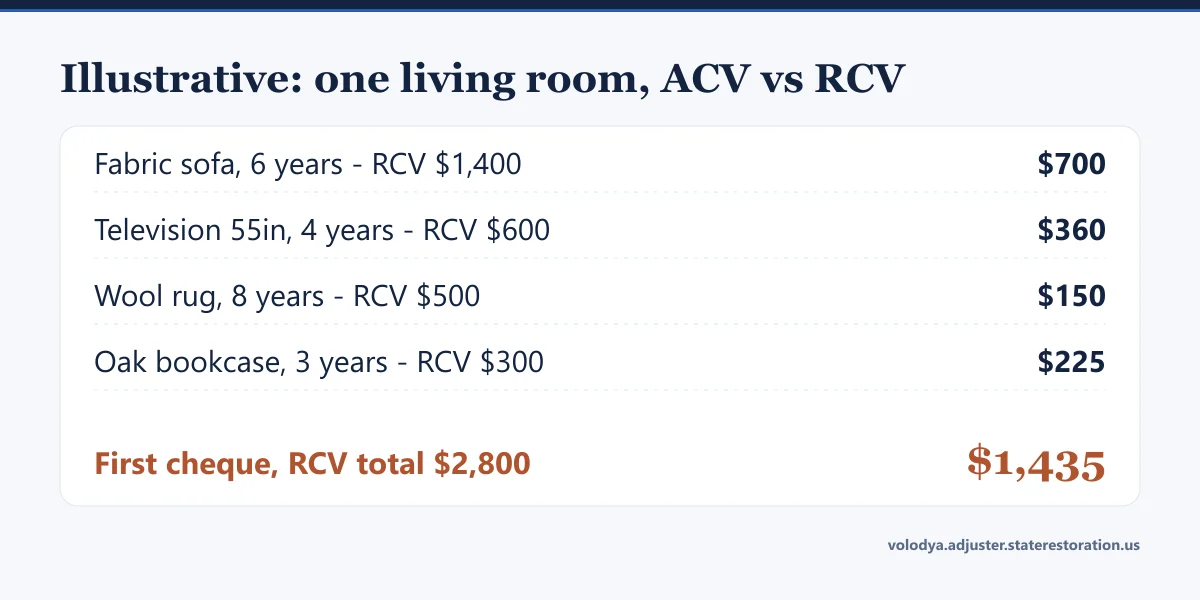
Those percentages are illustrative, not a rate card. The mechanism is what matters: the gap of $1,365 in this worked example is not a denial, it is money held back until the items are replaced. I wrote about that two–cheque structure in more depth in why your first insurance check is smaller than the repair, and the same logic applies to contents as to the roof.
Two details specific to contents are worth knowing. You generally do not have to buy the identical item to recover depreciation — a like–kind, like–quality replacement is the test, so a different brand of sofa at a similar quality level normally counts. And the replacement window is real; it is commonly measured in months from the loss, and it runs while you are displaced and busy. Check your own wording, then put the end date in your calendar next to the other claim dates from the Illinois claim deadline clock.
What should I not throw away after a fire?
Anything, until it is photographed and the carrier has either inspected it or told you in writing to proceed. Damaged property is the physical evidence for your own inventory, and the carrier may also have salvage rights in it. Clearing a house out early feels like progress and regularly costs more than it saves.
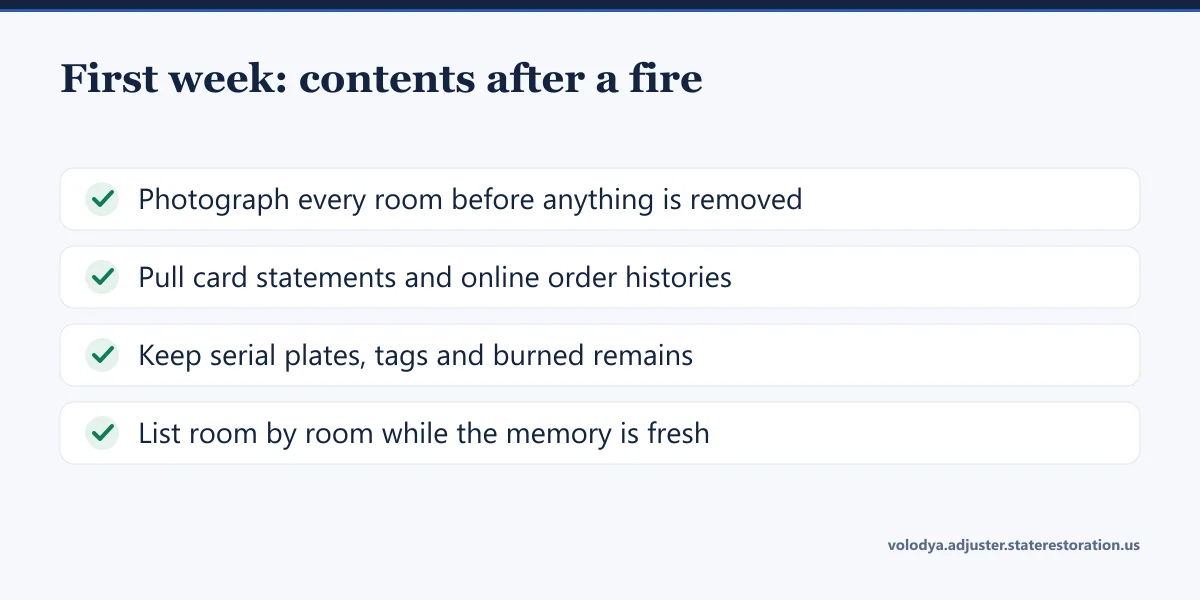
Photograph every room wide before anything moves, then photograph piles and individual high–value items. Cut out and keep data plates from appliances, the tags from furniture, a swatch of carpet, the lid of the paint can. Where something burned past recognition, the serial plate frequently has not.
Smoke is its own argument. Items that never saw flame can still be a total loss: soot is acidic and works into textiles, electronics and porcelain, and odour in upholstery and clothing is often not economically removable. On the other hand, plenty of hard goods clean successfully, and carriers will normally pay for cleaning rather than replacement where cleaning genuinely restores the item. The dispute is about whether it does. Food, opened cosmetics and medicines exposed to smoke or to a loss of refrigeration are replaced rather than cleaned. If cleaning is proposed for something you doubt, ask for it in writing and ask what happens if the odour returns after it comes back.
What gets a contents claim into trouble?
Two opposite mistakes, and the second is far more common. Inflating a list is the one everyone warns about, and rightly: the concealment or fraud condition in the policy is serious, and the inventory is sworn. But most families lose money the other way, by giving up early and signing a list they know is short.
- Round numbers everywhere. A list where every item is $50, $100 or $500 reads as invented even when it is not. Price a sample properly and it lifts the credibility of the whole document.
- Brand upgrades from memory. If you cannot support the premium model, claim the one you can. One unsupportable line makes an adjuster re–read every other line.
- Letting someone else's list stand as yours. A pack–out log or a public list you never checked becomes the record by default.
- Missing the replacement window and losing recoverable depreciation on items you did in fact buy again but never reported.
- Ignoring the limits on your declarations page. Sub–limits on jewellery, firearms, money, business property and collectibles are set per policy; read yours before you spend two evenings itemising a category that is capped.
And keep the living–expense claim moving in parallel rather than after. It is a separate coverage with its own paperwork, and it pays while all of this is going on — see what additional living expenses cover while the house is unlivable.
Do you need a public adjuster for a contents claim?
Often not. If the fire was contained to one room, the carrier is engaging properly, your inventory is complete and the numbers coming back look like the market, finish it yourself and keep the fee. I tell people that regularly. The list above is the whole method, and it works without me.
Where representation earns its keep is a large or total loss, a pack–out you cannot supervise, a household that cannot face the inventory while displaced, or a contents settlement that comes back materially below what the same items cost today with no explanation you can follow. That is the work described on what I do for policyholders: building the inventory, pricing it, and putting it in front of the carrier in the form it has to answer.
One boundary is firm. If the question has become whether the carrier is acting in bad faith, whether a policy condition has been breached, or what a release you are being asked to sign actually gives up, that is a lawyer's question and not mine. I am a public adjuster; I handle the amount of the loss and the evidence for it.
If you are working through a fire claim in Illinois or Indiana and want a second read on the contents side, there is more about my background on the about page, and you can reach me through the contact page.
Volodymyr Lukaniuk, licensed public adjuster. 3052 N Long Ave #2, Chicago, IL 60641. Telephone +1 224-481-2095, email volodymyr@staterestoration.us. Hours are Monday to Friday 9–6, Saturday 9–5 and Sunday 10–5, and I speak English, Ukrainian and Russian. I am licensed in Illinois and Indiana only.
Nothing above is legal advice. It is general information about first–party property claims, written by a public adjuster rather than a lawyer, and your own declarations page and policy are the authorities on your claim.