After a house fire in Illinois there can be up to three separate investigations, and the insurer's own fire investigation is the one that sets the pace of your insurance claim. The fire department looks at every fire. The State Fire Marshal's arson investigators come when a fire department or the police ask for them. The investigator your insurer hires is a private specialist who reports to the claim handler. On a large fire his visit is routine, and on its face it accuses nobody.
I am a licensed public adjuster in Illinois (#19461872) and Indiana (#3556317). I work for the policyholder on fire damage claims, so I see this stage from the owner's side of the table. Below is who each investigator is, what the Illinois text says about them, what to leave alone until they have been through, and what you can ask for when the claim stops moving. It is general information, not legal advice, and your own policy decides what is paid.
Who is investigating my fire, and who does each one answer to?
Three different people may walk through the house in the first weeks, and they work for three different bodies. Only one of them is paid by your insurance company. The two public ones are described in the Illinois Fire Investigation Act (425 ILCS 25).
The fire department
Section 6 of the Act says the chief of the fire department must investigate the cause, origin and circumstances of every fire that damages or destroys property. The investigation has to begin within two days of the fire, not counting Sunday, and a statement of the facts goes to the State Fire Marshal by the 15th of the following month.
Answers to the public. Its basic report is a public record.
The State Fire Marshal
The Division of Arson Investigation describes its investigators as sworn peace officers who may interview witnesses, collect evidence, make arrests and appear in court. It also runs dog teams trained to find traces of accelerant. Fire departments and police call the division in. A homeowner does not. Sections 7 and 8a of the Act let the Office take testimony on oath and enter a building where a fire has occurred.
Answers to the State. Sends evidence of a crime to the prosecutor.
The insurer's investigator
A private origin and cause investigator, sometimes joined by an electrical engineer. The insurance company chooses and pays him. He holds no public powers, and he is on your property because your policy asks you to show the damage as often as the insurer reasonably needs.
Answers to the claim handler. You may never see a written report.
Does an insurer's fire investigator mean they suspect me?
Usually it does not. An insurer sends one when the loss is large, when the fire department left the cause open, or when a product or somebody's work may have started the fire. In the last case the insurer wants the origin recorded so that, after paying you, it can ask the manufacturer or the contractor to pay it back. That is called subrogation, and it follows a paid claim.
Two things do tell you the file has changed. One is a letter saying the insurer is investigating under a reservation of rights. The other is a request that you sit for an examination under oath, or questions that drift from the fire to your finances and where you were that day. Neither means the claim is lost. Both are the moment I tell people to talk to a lawyer before they answer, because what you say there is a legal matter and I am a public adjuster, not a lawyer.
What will the investigator ask for, and what should I leave alone?
He will ask for access, an interview, the items near where the fire started, and records. Give all four, and leave the room where the fire began as the fire left it until he has been through. Most homeowners policies list these under your duties after a loss. Read that page of yours before the visit.
| The request | Why it is asked | What I would do |
|---|---|---|
| To walk the scene, often with you | Burn and smoke patterns show where the fire began, and they are gone once debris is moved | Agree a date quickly. Before it, do not clean, strip or throw out anything in the room of origin. Boarding up and covering the roof against rain are fine, and you keep those receipts. |
| An interview, sometimes recorded | He needs to know what was plugged in, what was running, who was home and what you saw first | Answer what you know. Say "I do not know" for the rest. Ask for a copy of any recording. |
| To take away an appliance, an outlet or a length of wiring | Parts are examined in a laboratory, sometimes with the manufacturer's expert present | Photograph each item where it sits first, then ask for a signed list of everything that leaves the house. |
| A sketch of the room as it was | Furniture and appliances have burned or been moved by the firefighters | Draw it from memory and mark the parts you are unsure of. |
| Records: invoices for recent electrical or heating work, the model of the appliance, phone photos of the room | They put a date on the wiring or the product | Send copies, keep the originals and write down the day you sent them. |
Clearing debris early is the commonest way an owner weakens their own file. It feels like progress, and it removes the one thing every investigator needs. If you are told the building must come down for safety, tell the insurer's adjuster in writing before the work starts and photograph every room first.
How long can the insurer take while the cause is being investigated?
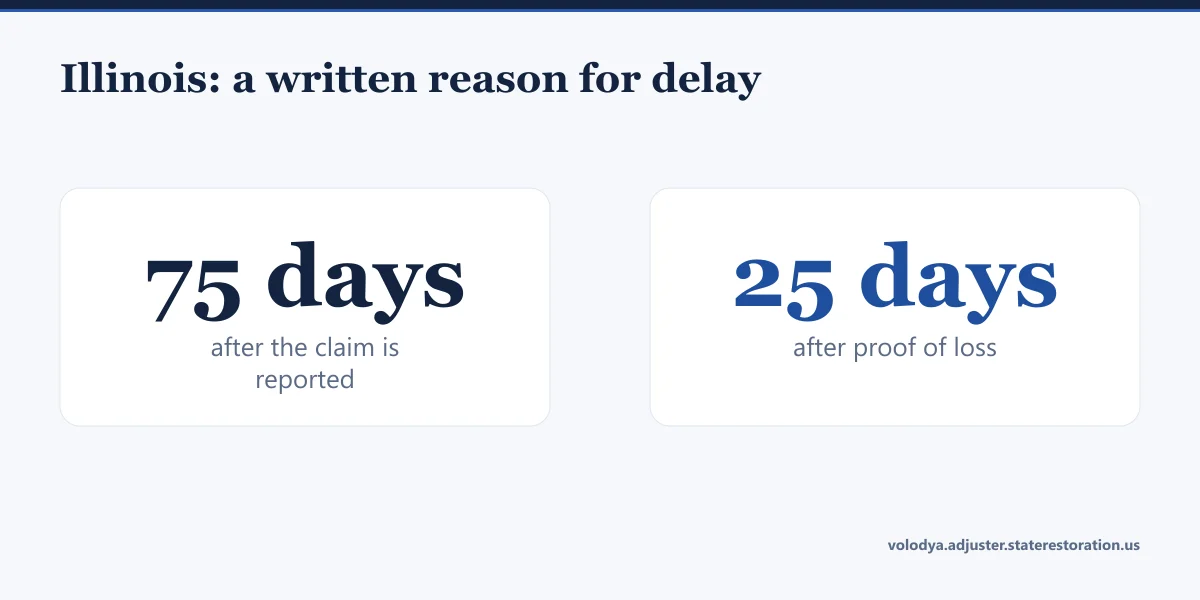
No Illinois rule gives a fire investigation a fixed number of days. What the Department of Insurance regulation gives you is a written reason once the claim has sat for a set time:
If a claim on a policy of fire and extended coverage insurance [...] remains unresolved for more than 75 calendar days from the date it is reported, or 25 calendar days after receipt of proof of loss, whichever is less, the company shall provide a reasonable written explanation for the delay to the insured. Notice of Availability of the Department of Insurance shall accompany the written explanation to the insured.
Two limits run at once and the earlier one counts. The second starts only when the insurer receives your sworn proof of loss, which is one reason to file it early. The illustrative worked example below uses invented dates to show which limit arrives first.
Proof of loss filed early
- 3 March
- Fire reported to the insurer
- 20 March
- Insurer receives proof of loss
- 14 April
- 25 days after proof of loss
- 17 May
- 75 days after the report
Written explanation is owed once 14 April has passed.
Proof of loss filed late
- 3 March
- Fire reported to the insurer
- 5 May
- Insurer receives proof of loss
- 17 May
- 75 days after the report
- 30 May
- 25 days after proof of loss
Written explanation is owed once 17 May has passed.
Be clear about what this is. The rule does not set a date for payment. "We are waiting for the laboratory report on the range" is a reason, and the insurer may give it. The value of the letter is that the cause of the delay is now on paper with a date, next to the Department of Insurance's contact details. The same regulation calls it unreasonable delay when a company's median payment period on these policies is above 40 calendar days, but that measures the company across all its claims and puts no clock on yours. The other dates on a claim are in my guide to Illinois claim deadlines.
How do I get the fire department's report?
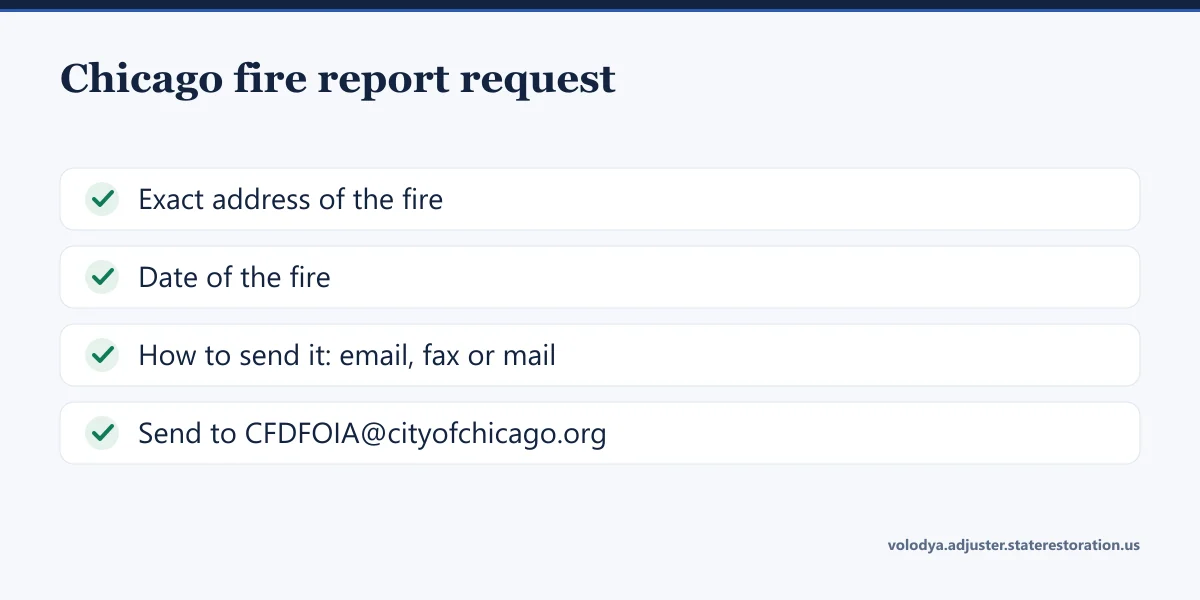
In Chicago you ask the Fire Department under the Freedom of Information Act. Outside Chicago, ask the fire department or fire protection district that came to your fire. The city's Fire FOIA page says what a request must carry:
- Your name, mailing address and contact details.
- The exact location of the fire.
- The date of the fire.
- How you want the records sent: email, fax or mail.
- Send it by email to CFDFOIA@cityofchicago.org, by fax to 312.745.3900, or by mail to the Freedom of Information Officer, Chicago Fire Department, 3510 S. Michigan Avenue, Chicago, Illinois 60653.
Two lines on that page are worth reading before you send. The department lists "fire and investigative reports on closed and/or inactive cases" among its records, so the report on a fire that is still being investigated may not be released yet. And the city posts every FOIA request online with the requester's name. The State keeps a record as well: section 6(c) of the Act says the State Fire Marshal's record of fires "shall at all times be open to the public inspection".
Ask the insurer in writing for its own investigator's findings too. It may decline, and a written report does not always exist. Ask anyway and keep the reply.
What if the cause comes back undetermined, or the two reports disagree?
Undetermined means the investigator could not prove one cause over the others, which is common after a fire that burned for a long time. It says nothing about you. A fire claim can be paid with the cause left open, because the policy covers fire and an open cause is no exclusion.
If the fire department wrote "accidental" and the insurer's investigator says something else, get both positions in writing and compare what each one looked at: who saw the room before debris was moved, and whether any part was tested. If the insurer then denies the claim in whole or in part, section 919.80(d)(8)(C) of the same regulation makes it tell you in writing how many days the period for bringing suit was paused and how many days are left. My page on what to do after a denial covers the first steps. A denial that says the fire was set on purpose, or that you misstated something, belongs with a lawyer from that day. I can still measure and price the loss. The accusation is for a lawyer to answer.
What should keep moving while the cause is open?
Most of the claim does not depend on the cause, and it should not stand still for the laboratory.
- Living costs. Keep every receipt from the first night away from home. The rules are in my guide to additional living expenses.
- The contents list. Memory fades within weeks, so start the contents inventory now, room by room.
- The building estimate. Rooms outside the area of origin can be measured and priced as soon as the investigator releases them. Ask the adjuster in writing which rooms those are.
- Emergency work. Boarding up, covering the roof, pumping out water and temporary power are paid from receipts.
- A dated log. One line for every call, visit and letter, with the name of the person.
You do not need a public adjuster for every fire. If the fire stayed in one room, the fire department wrote down the cause, and the insurer's estimate matches what contractors quote you, finish the claim yourself and keep the fee. If the claim has gone quiet behind an investigation, or the estimate arrived and you cannot tell what it leaves out, send me the letters and the estimate and I will tell you whether there is work in it for me. You can read about my licences and background first. I am licensed in Illinois and Indiana only.