When a fire or a burst pipe damages a rented apartment in Chicago, up to three insurance policies are involved and each one pays a different part. The landlord's policy pays for the building: the walls, floors, cabinets and the pipe itself. Your own renters insurance pays for your belongings and for the extra cost of living somewhere else while the unit is repaired. A neighbour's renters policy comes in only when that neighbour caused the loss through carelessness. If you have no renters policy, there is usually no insurance money for your things at all, and the City of Chicago's rental ordinance decides what happens to your lease and your deposit.
I am a licensed public adjuster in Illinois (#19461872) and Indiana (#3556317). On a fire in a Chicago apartment building the owner's claim and the tenants' claims run side by side, and the tenants are usually the ones left guessing whose job is what. This post is about the insurance. The lease, the ordinance and any claim against a landlord are legal questions, and a tenant attorney is the right person for those. Nothing here is legal advice.
Does the landlord's insurance pay for my things?
No, and that holds even when the landlord's own pipe burst. The Illinois Department of Insurance says in its Property Insurance Consumer Guide that the landlord's insurance "only protects the building structure, not your personal property." The landlord's adjuster will scope your drywall and your kitchen floor, because those belong to the building, and will not write a line for your couch.
If you believe the landlord caused the loss by ignoring a leak you reported, that is a claim against the landlord for negligence, not a claim on the landlord's property insurance. Whether it is worth bringing is a question for a lawyer, and proving it is slow and costly. Your own policy pays you without anyone having to prove fault.
The landlord's building policy
- Belongs to
- The owner of the building
- Pays for
- Walls, ceilings, floors, fixtures, cabinets, plumbing and wiring
- Pays you
- Nothing directly. You see it as the repair of your unit
Your renters policy (HO-4)
- Belongs to
- You, and anyone named on it
- Pays for
- Your belongings, the extra cost of living elsewhere, and your liability to others
- Pays you
- Directly, after your deductible, under the limits on your declarations page
The neighbour's renters policy
- Belongs to
- The tenant whose unit the fire or water came from
- Pays for
- Damage that tenant is legally responsible for
- Pays you
- Only if fault is shown, and often later, through your own insurer
What does a renters policy pay after a fire or a leak?
The Department describes the tenants form, HO-4, as coverage for a renter's personal property, liability and additional living expenses. Those three parts carry three different limits, and each limit is printed on your declarations page.
Personal property is your furniture, clothes, electronics and kitchen things, and the Department notes it can apply even when the item was away from home. It also warns that policies often cap jewellery, art and computers at a lower figure than the main limit, so a ring or a camera kit may need its own scheduled line. Additional living expenses are, in the guide's own definition, the costs above your normal living expenses when a covered loss forces you out. That means the increase, not your whole hotel bill, and I explain the arithmetic in my post on claiming additional living expenses in Illinois.
Two gaps catch renters often. A roommate who is not named on your policy may have no cover for their things under it; the Department lists that as one of the questions to ask your agent. And water is not all the same: a burst pipe or a firefighter's hose is not a flood, while surface water coming in from outside usually is, and standard renters policies exclude flood. I go through that line in water damage vs flood.
Who pays which line after a fire next door?
Here is one illustrative example, with made-up but realistic figures: a fire starts in the unit next to yours. Smoke comes through the shared wall, and water from the firefighting comes through your ceiling. The building is closed for 18 nights while the electrician and the drywall crew work.
| What was damaged | Which policy answers | What proves it |
|---|---|---|
| Drywall, ceiling, floor and cabinets in your unit | Landlord's building policy | Nothing from you; the landlord's adjuster scopes it |
| Clothes, bedding and an upholstered sofa with smoke in them | Your renters policy, personal property | Photos before anything is thrown out and a room-by-room list |
| Laptop and TV soaked from above | Your renters policy, personal property | The items kept until the adjuster has seen them, plus model numbers |
| Hotel for the 18 nights the unit is closed | Your renters policy, additional living expenses | The hotel folio and a note of the rent you were not charged |
| Restaurant meals above your usual grocery bill | Your renters policy, additional living expenses | Receipts and a normal month of grocery spending |
| Your losses, if the neighbour's carelessness started it | The neighbour's liability cover | The fire department report and the cause your insurer finds |
In this illustrative example the smoke-damaged clothes, bedding and sofa come to $6,200 and the wet electronics to $1,900. The hotel is 18 nights at $140, or $2,520. The landlord stops charging rent while the unit is closed, so 18 days of an illustrative $1,800 monthly rent, $1,080, is money you no longer spend, and the net housing increase is $1,440. Add $310 of meals above normal and the living-expense line is $1,750. Less a $500 deductible, the worked example comes to $9,350 on your own policy, and not one dollar of it on the landlord's.
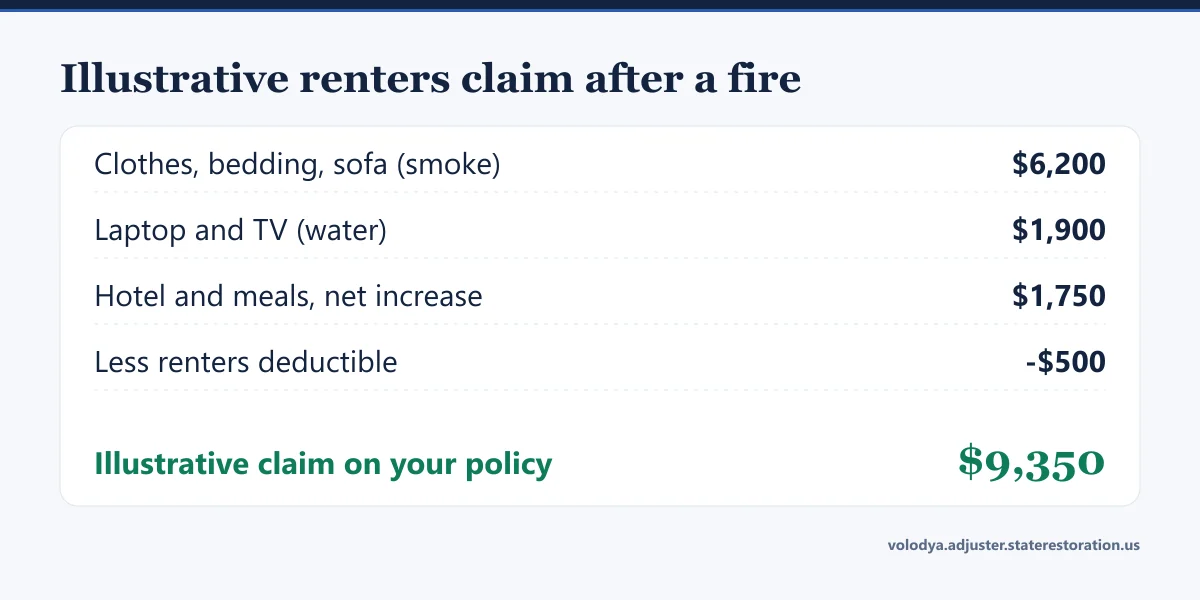
Whether the $8,100 for belongings is paid at replacement cost or at actual cash value first depends on your form. Smoke damage also tends to be argued item by item: cleanable or not. A full list built room by room, the way I describe in documenting contents after a fire without receipts, settles more of those arguments than any letter does.
Why does the advance cheque come off the final payment?
Because it is an advance, not a gift. The Department's guide says an insurer may send a cheque right after the loss for things like living expenses and clothing, and that these amounts are deducted when the claim is settled: clothing from the contents figure, the motel from additional living expenses. Spend it on what you need that week. Then write down what each part of it bought, and keep the receipts, so the deduction lands on the line it belongs to and is taken once.
Can I move out, and do I still owe rent?
For most Chicago rentals the answer comes from the city's Residential Landlord and Tenant Ordinance. The City of Chicago's ordinance page lists what it does not cover: units in owner-occupied buildings with six units or fewer, most hotel, motel and rooming-house units, dormitories, shelters, employee quarters, non-residential rentals and owner-occupied co-ops. A tenant on the second floor of the owner's two-flat is therefore outside it, and the lease and state law decide.
If your unit is covered and the fire was not caused by you, your household or your guests, the city's own summary of the ordinance describes two paths.
Move out
- You may leave the unit straight away.
- Within 14 days after you move out, give the landlord written notice that you are ending the rental agreement.
- The summary gives the landlord 7 days from that notice to return the security deposit and any interest owed, less unpaid rent and damage.
Stay
- You may stay if the unit is still legal to live in.
- If part of it cannot be used, the rent may be reduced to reflect what is left.
- If the landlord does not carry out the repair diligently, the summary describes a written notice within 14 days and ending the agreement.
The city requires a copy of that summary to be attached to every written lease and renewal, so it is probably already in your folder. Read the fire section there, not my paraphrase, and call a tenant attorney before you send a notice you are unsure of. The city's Department of Housing is at 121 N LaSalle St, Room 1000, phone 312-744-3653.
The path you choose also changes your insurance claim. Moving out ends the rent, starts a search for a new home and turns the living-expense question into one about how long the old unit would have stayed unlivable. Staying with reduced rent keeps the claim smaller and simpler. Tell your adjuster which path you took and the date of your notice, in writing.
What if another tenant started it, or I did?
If the neighbour started it, claim on your own policy first. A renters form lists fire among the causes it pays for, and your insurer pays you under your contract regardless of who struck the match. It can then try to recover what it paid from the person responsible. Waiting for the neighbour's insurer to accept fault can take months, and the neighbour may have no policy.
If you started it, the landlord's insurer pays to repair the building and may then ask you to repay it. That letter is what the liability part of your renters policy is for. Send it to your insurer the day it arrives and do not answer it yourself. If a lawsuit follows, that is a matter for a lawyer, usually one your insurer appoints under the policy.
What if I have no renters insurance?
Then no policy pays for your belongings, and I would rather say that plainly than suggest otherwise. A claim against the landlord or the neighbour depends on proving they were careless, which is a question for an attorney. What stays yours is the lease side above: the notice, the reduced rent and the deposit deadline. The Department's guide lists the American Red Cross among the organisations that help people right after a disaster, and the first nights are usually where that help is needed most.
The first week, in order
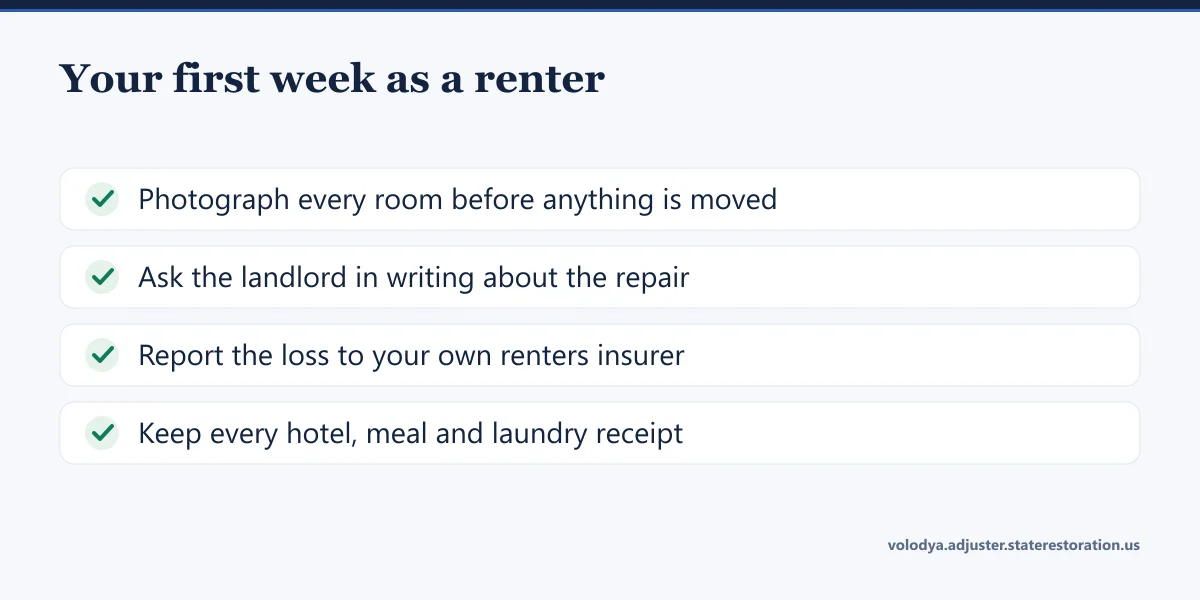
- Photograph and video every room before the restoration crew moves or bags anything, including inside closets and drawers.
- Report the loss to your own renters insurer and write down the claim number and the adjuster's name.
- Ask the landlord, by email or text so there is a date on it, when the unit will be repaired and whether rent is being charged meanwhile.
- Decide with care whether you are moving out or staying, and send any notice in writing within the 14 days.
- Keep every hotel, meal, laundry and mileage receipt in one envelope, and note what your normal monthly costs were.
- Do not throw out damaged items until your adjuster has seen them or agreed in writing that photos are enough.
Does a renter need a public adjuster?
Usually not for a small claim. If a few rooms of things were damaged and your insurer is paying fairly, you can settle it yourself, and the Department of Insurance can look into a complaint if the insurer is slow. A public adjuster earns a fee when the whole apartment's contents are involved, when smoke-damaged items are being called cleanable that you know are not, or when the living-expense dispute runs for months. In Illinois the fee on a residential claim is capped at 10 percent, and I set out how that works in public, company and independent adjusters. For the building side of a fire, my fire damage claims page covers what an owner's claim involves. If you are not sure which side your question is on, send it to me and I will tell you whether you need help at all.