A private fire damage appraiser is the person you name under the appraisal clause of your policy when you and the insurer accept that there was a fire loss and disagree on its price. You send a written demand, the insurer names its own appraiser, the two choose an umpire, and any two of those three can set the amount. Policies usually have you pay your own appraiser and half the umpire. An Illinois statute moves both of those fees to the insurer in one situation, and I'll get to it below.
I'm a licensed public adjuster for policyholders in Illinois (#19461872) and Indiana (#3556317), and this article covers Illinois law. I'm not a lawyer, and I say where a question stops being mine. Your policy's own paragraph decides the steps, so keep it next to this page.
Who is a private fire appraiser, and who isn't?
This person prices damage and repairs, which is a different job from the real estate appraiser who tells a lender what a house would sell for. The two forms I read below ask for no particular licence. They ask for someone "competent" and either "impartial" or "disinterested". In practice you want a person who can read an insurer's estimate line by line, defend quantities and explain a price, the skills I cover in reading an Xactimate estimate.
A public adjuster is a different role again: I represent you through the whole claim, while an appraiser's job is one number. Whether your public adjuster can also sit as your appraiser depends on the impartiality wording in your policy. I check that before anyone is named, so nobody gets disqualified later. My appraisal clause page shows how the panel of three works and what I prepare for it.
Which appraisal wording is in your policy?
Two wordings show how far policies can differ. The short one is the standard ISO homeowners form, HO 00 03 05 11, Section I, Condition F. The long one is a carrier's own form, quoted in an Illinois opinion from May 2025, 2025 IL App (2d) 240723, at paragraph 9.
| Step | Short wording (ISO) | Long wording (2025 opinion) |
|---|---|---|
| Before the demand | You and the insurer fail to agree on the amount. | Your duties after loss are met, and an itemized list of each disputed item went to the insurer at least 10 days earlier. |
| Naming appraisers | Within 20 days after a written request. | Within 20 days of receiving the written demand. |
| Who can serve | "Competent and impartial". | "Competent, disinterested". |
| Time to agree | No period stated before the umpire. | 30 days, unless both sides extend it. |
| No umpire after 15 days | Either side asks a judge in the state. | Written application to a judge in the same state and county, after 10 days' written notice to the other side. |
| The result | A decision agreed by any two sets the amount. | A signed report from any two, item by item, showing actual cash value, replacement cost and market value where it applies. It says "binding upon you and us". |
| After a lawsuit | Nothing on this point. | A party that has sued over the amount can't then demand appraisal. |
Under a form like the long one, a demand sent without the itemized list and the 10 days gives the insurer an easy reason to refuse it. Filing suit first can also close the door. So read your paragraph, and the endorsements that change it, before you write anything.
How did one Illinois fire file lose two years?
By skipping one step in court. In 2018 IL App (5th) 170001, a house burned on February 1, 2015. Both sides accepted a total loss, and they stood $87,519.55 apart: $247,121.03 against $159,601.48. About 13 months after the fire, the owners sent a demand that named their appraiser. I've left out the parties and counted each event from the day the insurer received that letter.
- Day 0Mar 21, 2016
The insurer receives the demand.
- Day 20Apr 10, 2016
Its time to name an appraiser runs out, and it names nobody.
- Day 37Apr 27, 2016
The owners petition the circuit court for an umpire. The judge appoints one from their list that same day. No summons was issued and the insurer was never served.
- Day 44May 4, 2016
The insurer appears in court, says it has chosen an appraiser and asks to propose umpires.
- Day 66May 26, 2016
The umpire and the owners' appraiser file an award: $247,665.93 replacement cost and $212,895.88 actual cash value.
- Day 256Dec 2, 2016
The circuit court confirms the award.
- Day 715Mar 6, 2018
The appellate court vacates the appointment and the award's confirmation, because the insurer had no notice and no chance to be heard. It makes no finding on the award itself and doesn't disqualify the umpire. The case goes back.
The insurer had missed its 20 days, and the owners still lost those two years, since a petition to a judge is a court case with court rules. The lesson for you is practical: if your side needs a judge to pick an umpire, have a lawyer file it and serve the insurer. Give the insurer the chance to object, even when it has gone silent.
What can the panel decide when the insurer says it's a coverage question?
The panel can decide the amount of loss, and a court decides what the policy means. Insurers often describe a large gap as a coverage issue, and that's what happened in the 2025 file. After a hailstorm, the insurer paid $12,677.94 for gutters, downspouts and aluminum wrap. The owner's contractor priced all the windows at $133,817.82. The insurer refused appraisal, the trial court ordered it, and the Second District affirmed. On whether hail damaged the windows, the court wrote: "It is an issue of loss." It added that resolving some questions of causation is necessarily part of appraisal.
Sits with the panel
- The price of a repair the insurer has accepted
- Quantities and the extent of the damage
- Whether the event damaged a covered part, as with the windows in that file
Sits with a court
- Who is insured, what risk is insured, whether a contract exists
- What a policy provision means
- Whether code upgrade costs fall under the policy, as the 2025 opinion describes an earlier case
- Defenses such as late notice, which stayed open in that file
On a fire file, I read that the same way for how far the smoke reached, the subject of my article on smoke in rooms the fire never touched. That's my reading of a hail case, so ask a lawyer before relying on it. Keep the calendar in mind as well: the demand in that file went out on December 22, 2023, and the appellate opinion came on May 12, 2025, with the appraisal itself still ahead. A refusal can cost you that much time.
Who pays the appraiser and the umpire?
Your policy usually says each side pays its own appraiser and splits the umpire and other expenses equally. Illinois adds this rule for one kind of policy:
"When an insured requests an appraisal under a policy of fire and extended coverage insurance, as defined in subsection (b) of Section 143.13, and the insured's full amount of appraised loss is upheld by agreement of the appraisers or the umpire, then the insured's appraisal fee and umpire's appraisal fee shall be paid by the insurer."
215 ILCS 5/397.05
Three conditions sit in that sentence. You have to be the one who asked for the appraisal. The policy has to fit Section 143.13(b), which covers residential property up to a 4 family dwelling and household property, so a commercial building is outside it. And your full amount has to be upheld. I haven't found an Illinois opinion that explains how close "full amount" must be, so that part is for a lawyer. Claiming a padded number won't help you here. The figures in this illustrative worked example are invented, including both fees, and I'm not saying they are typical:
| Insurer's figure $40,000, yours $60,000 | Award $60,000 | Award $48,000 |
|---|---|---|
| Your appraiser, $3,000 | Insurer | You |
| Umpire, $2,400 | Insurer | Split |
| Added to the insurer's figure | $20,000 | $8,000 |
| Fees you carry | $0 | $4,200 |
| Better off by | $20,000 | $3,800 |
Illustrative worked example only. The insurer pays its own appraiser in both columns. Any public adjuster or lawyer fee is separate.
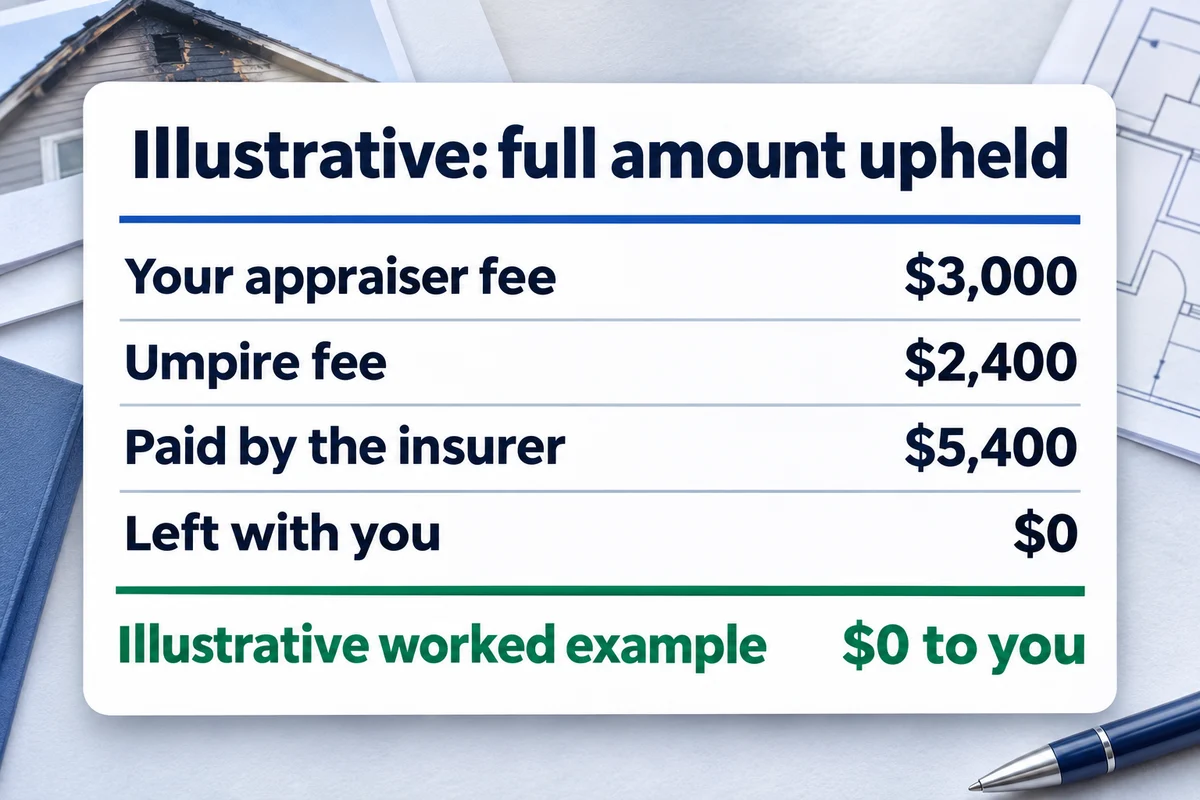
Run the right column on a smaller gap and the fees can take most of the gain, which is why I price the dispute before anyone sends a demand.
Does the award end the dispute?
It depends on your wording. In a 2003 Third District opinion, No. 3-02-0608, the clause said a written agreement of any two "will set the amount of loss". The umpire valued a condominium hail loss at $59,429, the association disagreed and sued, and the court let it. Following its own 1994 decision, it held that giving up the right to sue has to be clear and unambiguous, and that clause did not do so.
The long wording in the table is written differently. It says "binding upon you and us", it keeps both sides' rights on coverage for each item, and it says the award can't be entered as a court judgment. I haven't read an Illinois opinion deciding what that exact language does to a later lawsuit, so have a lawyer read yours before you count on suing afterwards. Whatever the wording, I ask for an award written line by line, so any later argument attaches to named items.
What should you have ready before the demand?
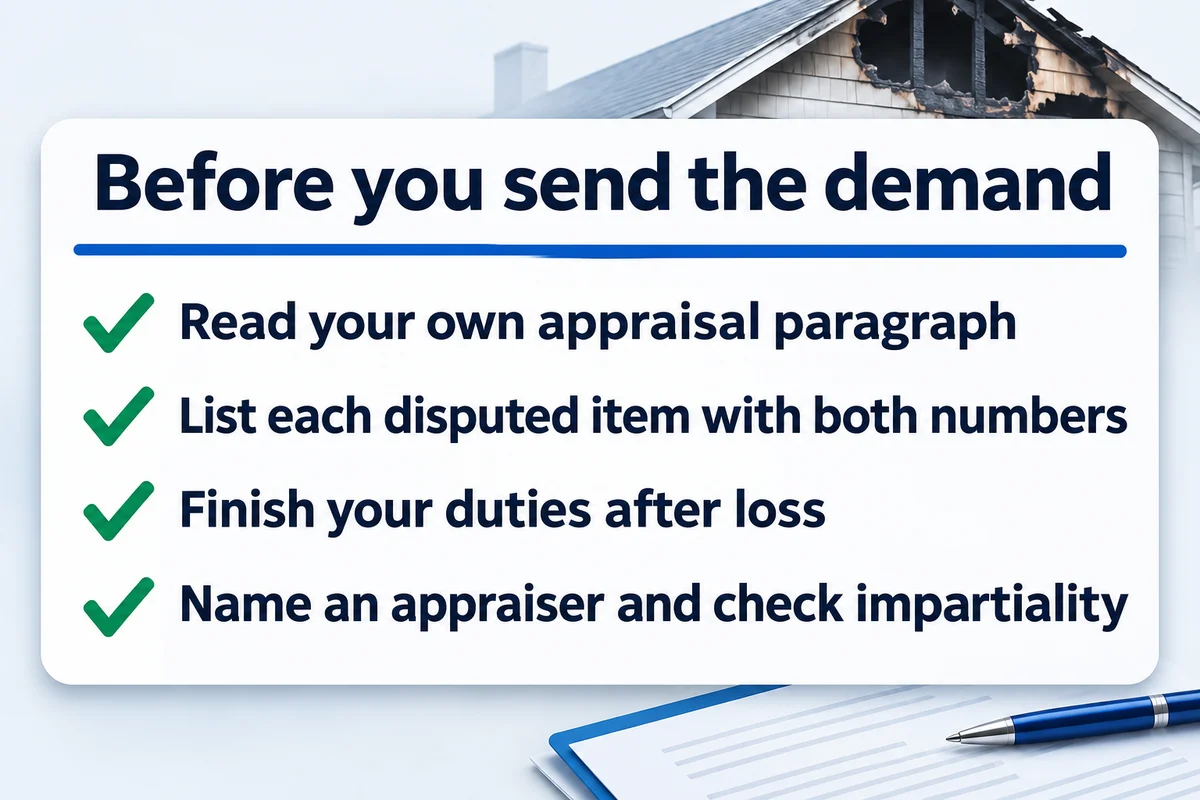
Have a schedule of the items in dispute, with both numbers and the proof behind yours. The long wording requires one 10 days ahead, and under the short wording it still gives your appraiser a starting point. This illustrative worked example uses invented figures for a kitchen fire:
| Disputed item | Insurer | Yours | What backs your number |
|---|---|---|---|
| Kitchen cabinets | $9,800 | $16,400 | Measured run and a supplier's quote |
| Smoke cleaning, second floor | $1,600 | $7,200 | Room by room photographs and the cleaner's scope |
| Roof framing over the fire room | $6,500 | $11,900 | Framer's written scope with measurements |
| Wiring replacement | $2,100 | $5,500 | Electrician's written scope |
| Total, a $21,000 gap | $20,000 | $41,000 |
Illustrative worked example only. Your items and prices come from your own loss.
When is appraisal the wrong next step?
When a cheaper step hasn't been tried, or the dispute isn't about the amount. A supplement costs nothing to file, and many gaps close once the insurer sees measurements it never had, which is how I start on an underpaid claim. A dispute about ordinance costs belongs with the policy wording I covered in code upgrade coverage and, if it stays stuck, with a lawyer.
Watch your deadline too. The ISO form requires a lawsuit within two years after the date of loss, and the paragraphs I read here don't say a demand stops that clock. The four clocks on an Illinois claim explains how they run, and a lawyer should count your actual date.
If the insurer agrees to your contractor's revised estimate, you don't need an appraiser or me. If it won't, send me your estimate and your appraisal paragraph through the contact page, or read how I handle a burned house on the fire damage claims page. Nobody honest can promise what an award will be.