When your contractor opens a wall, a floor or a roof deck during an insurance repair and finds damage the adjuster never saw, stop the work on that spot, photograph it before anything is cut away or covered, and tell the adjuster the same day in writing. The new damage is added to the same claim as a supplement, it is not a new claim, and on most homeowners policies the deductible is not taken a second time. What decides whether it gets paid is simple to say and easy to lose: the insurer has to be able to see it, and someone has to show that it came from the same loss rather than from years of wear.
I am a licensed public adjuster in Illinois and Indiana, and I also hold an Illinois roofing contractor licence and a general contractor licence, so I have been on both sides of an opened wall. The damage found mid-repair is the part of a claim most often lost, and almost always for the same reason: the drywall went back up before anyone from the insurer looked.
What does the policy ask of you once the wall is open?
It asks you to show the damage, protect the house and keep the bills. A standard homeowners form puts these duties in the conditions section, and they do not end when the first payment arrives. The wording below is from the ISO HO 00 03 05 11 homeowners form, which many carriers' forms follow closely; your own policy may number or word them differently, so read yours beside it.
"As often as we reasonably require: a. Show the damaged property"
On the job: the insurer may ask to see the opened wall. If it is closed before they could, you have made that harder for yourself.
"Make reasonable and necessary repairs to protect the property" and "Keep an accurate record of repair expenses"
On the job: drying out a wet cavity or tarping an open deck is expected, not a reason to wait. Keep every invoice.
"We will pay no more than the actual cash value of the damage until actual repair or replacement is complete."
On the job: the added items are paid at depreciated value first, and the rest after the work is done.
"provided you notify us, within 180 days after the date of loss, of your intent to repair or replace the damaged building"
On the job: the clock counts from the date of loss, not from the day the wall was opened.
"When it is apparent to the company that additional benefits would be payable under an insured's policy upon receipt of additional proofs of loss from the insured, the company shall communicate to and cooperate with the insured in determining the extent of the company's additional liability."
On the job: once you show new damage, the insurer is expected to work through it with you. You can quote Section 919.50 in your email.
The first hour: a hold-point log from one job
A hold point is a moment where work stops until someone signs off. Treat the discovery of hidden damage as one. The log below is an illustrative example of a kitchen claim after a burst supply line, a common winter claim in a Chicago bungalow. The insurer paid for the visible damage: cabinets, drywall to four feet, flooring. Then the crew pulled the base cabinets.
- 10:40, the cabinet comes off
The wall behind it is wet to the ceiling, the insulation in the cavity is soaked, and the subfloor under the sink has swollen and lifted at the seams. Work on that wall stops. The crew moves to another room.
- 10:50, photographs before anything else
A wide shot of the whole wall with the room in frame, then close shots, then a tape measure in every shot so the size is not a guess. A moisture meter reading on the screen next to the wet stud is worth more than a sentence describing it.
- 11:15, a phone call, then an email
Call the adjuster or the claim line and give the claim number. Then send the same thing in writing with six to ten photos attached: what was found, where, when, and that work on that area is on hold. The email is the record; the call is only the start.
- Same afternoon, protect it without hiding it
Fans and a dehumidifier go in so the cavity does not grow mould while you wait. Wet insulation can come out, but it goes into a bag in the garage, not the dumpster, and the wall stays open.
- Day 2 to day 7, the reinspection
The adjuster comes back, or asks for more photos and a moisture log instead. Ask which, in writing, and how many days they need. If they say photos will do, get that sentence in an email before the wall is closed.
- After the answer, close it up
Your contractor writes a priced addition for the new items, and the repair carries on.
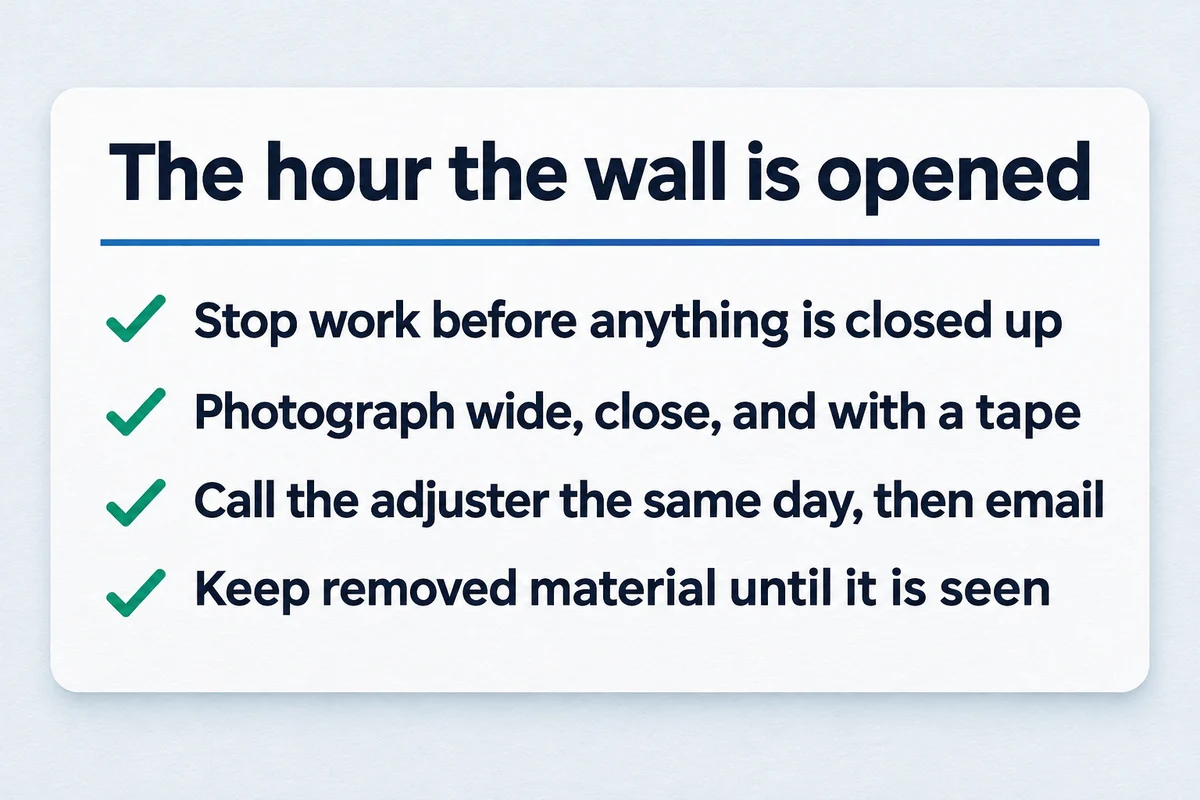
The step people skip is the email. A busy adjuster may say on the phone that you can go ahead. Months later, a different adjuster reads the file, finds no record of the conversation, and asks for proof that cannot be produced any more because the wall is finished and painted.
Same loss or older trouble: what the adjuster will ask first
The first question about any damage found later is whether it came from the loss you claimed. A policy pays for a sudden loss; it does not pay for wear, slow leaks over months or old rot. The adjuster is not being difficult by asking, and the answer is usually on the material itself if someone looks before it is thrown away.
| What is found | What ties it to this loss | What makes it look older |
|---|---|---|
| Wet framing and insulation behind drywall | Wet to the touch, meter readings highest near the failed pipe, clean wood with no staining lines | Dark tide lines in layers, soft wood that crumbles, mould colonies across the whole cavity |
| Swollen or delaminated subfloor | Damage spreads out from the same spot as the leak and matches the water path in the photos | Rot in a ring around the toilet or tub drain, far from the claimed source |
| Cracked or soft roof sheathing under a hail or wind repair | Fresh, bright breaks; wet wood directly under the storm-damaged shingles or a lifted area | Grey, delaminated plies at old nail holes, dark rings around vents, decay along the whole eave |
| Smoke or soot inside wall cavities after a fire | Residue on the back of the drywall in rooms near the fire, smell when the cavity is opened | Rarely an argument; smoke tends to be easy to tie to the fire |
| Wiring or plumbing that no longer meets code | Not damage at all; it is a code item, paid only under Ordinance or Law coverage if you have it | The insurer will say it was already out of code; that is true and not the question |
The last row trips people up. When a wall is opened and the inspector requires an upgrade, that cost comes from a separate coverage with its own limit, which I explain in code upgrade coverage on an Illinois repair. It goes in the same supplement, but on its own line.
What goes into the supplement you send
A supplement the adjuster can approve from a desk has five parts. With them, many are approved without a second visit; without them, the usual reply is a request for more information, and the wall sits open another week.
A one-page cover letter
Claim number, date of loss, what was found, the date it was found, and a list of the items you are asking to add.
Photos in order
Wide, then close, with a tape in the frame, numbered and dated, each with one line saying what it shows.
Readings and samples
Moisture readings with the date and spot, and a note of where the removed material is being kept.
A line-by-line price
Your contractor's estimate for the new items only, written in the same format as the insurer's estimate so it can be added line for line.
The contractor's note
A short signed statement of when and how the damage was found, and why it could not be seen at the first inspection.
The fourth sheet matters more than it looks. If the insurer's estimate is an Xactimate printout, ask your contractor to price the addition the same way. An adjuster can add twelve lines to an estimate in an afternoon; a lump sum on a letterhead goes back with questions. My page on help with an underpaid claim covers the wider case, where the first estimate missed items that were visible all along.
How the money arrives when a supplement is added
The added items are paid the same way as the first ones: depreciated value now, the held-back depreciation after the work is finished, and no second deductible because it is the same loss. Here is an illustrative worked example for the kitchen above. The numbers are made up to show the order of payments, not taken from a real file.
Estimate $9,200, less $1,400 depreciation, less the $1,000 deductible.
Wall cavity, insulation and subfloor: $4,300, less $500 depreciation. No deductible this time.
The $1,400 and $500 held back, released on the final invoice and photos.
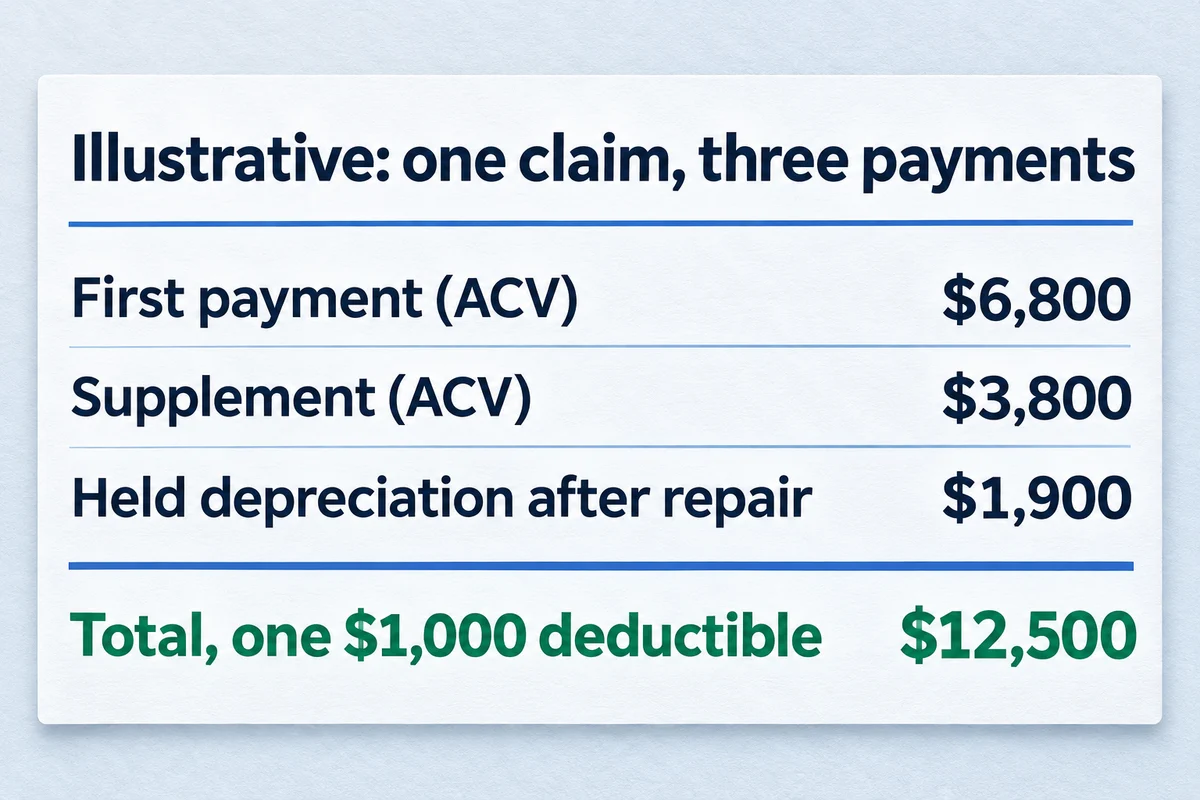
If there is a mortgage on the house, expect the supplement cheque to carry the lender's name too, the same as the first one. How the held-back amount is collected is in why the first insurance check is smaller than the repair. Some policies pay small claims at full replacement cost straight away: the ISO form does this when the repair is under $2,500 and under 5 percent of the building limit.
Which deadlines keep running while the wall is open?
Every deadline on the claim counts from the date of loss, not from the day the new damage was found. On the ISO form and in Illinois practice, these are the ones to write on the calendar:
- 180 days from the date of loss to tell the insurer you intend to repair, if you took an actual cash value payment first (Loss Settlement 2.e).
- Two years from the date of loss to file suit under the policy's Suit Against Us condition, a clock Illinois law can pause while a claim is being considered. The details are in my post on the deadlines on an Illinois claim.
- 30 days after the insurer accepts the added items to pay the part not in dispute, under 50 Ill. Adm. Code 919.50(a), with a written reason if it pays less than you asked.
Damage found months after a storm can still belong to that storm's claim, but the later it is found, the harder the "older trouble" question becomes. Send it as soon as you see it.
When the insurer refuses the added items
The refusal letter will usually give one of three reasons: the damage was not caused by the loss, it could not be verified because it was covered up, or the price is too high. The first two are answered with evidence and a reinspection request; if you kept the material and the photos, ask for a second look in writing and send the contractor's note again. A disagreement about price only, where the insurer accepts the damage but not the amount, can go to the appraisal clause in many policies. A refusal that rests on what the policy means, or on a claim that you broke a policy condition by closing the wall, is a legal question and worth an hour with an Illinois attorney. Public adjuster or lawyer sorts which kind of dispute goes where.
When you do not need me
A lot of supplements go through on the first try, especially water claims where the contractor already works with insurers and sends clean photos. If the added items are small, the adjuster agreed in writing before the wall was closed, and the numbers make sense to you, you do not need a public adjuster, and my fee would take money you should keep. Where I help is the supplement that was refused, the one where the wall was closed too early and the case has to be rebuilt from what is left, or the one where the opened wall shows the first estimate was wrong from the start. On a water damage claim in particular, what is behind the drywall often decides most of the money. If you are not sure, send me the estimate and the photos and I will tell you honestly whether it is worth my time and yours.