Hail dents on a metal roof are paid or refused according to the words of one endorsement, and since July 2026 the most common version of those words has been read more narrowly than insurers read it. A federal appeals court held that a dented roof which has never leaked can still fall outside a cosmetic damage clause if the dents left it measurably weaker against snow and wind. That ruling applied Minnesota law, so an Illinois owner of a warehouse or plant with a steel roof cannot lean on it alone. What carries an Illinois claim is matching the evidence from the roof to the exact wording in the policy.
I am a licensed public adjuster in Illinois (#19461872) and Indiana (#3556317), an Illinois roofing contractor (#105.009193) and a HAAG certified inspector (#992104047), and metal roofs come up on most of the commercial roof damage claims I take in the suburbs west and north of Chicago. I read the appeal for this article in full. I am not a lawyer, and what your clause means in an Illinois court is a question for one.
What did the appeals court decide about hail-dented metal roofs?
It sent the case back for trial instead of letting the insurer win on paper. The opinion is No. 25-3315 of the U.S. Court of Appeals for the Eighth Circuit, a Minnesota school district against its property insurer over two school roofs. The record, in the order it happened:
The win was narrower than headlines suggest. The court agreed with the insurer that a shorter roof life, on its own, does not take damage out of the clause, because the wording is in the present tense. It also said weakening that is "insubstantial, unmeasurable, or inconsequential" stays excluded, as can damage to gutters or decorative trim. And it did not decide whether the district's engineer may testify at all: that challenge went back to the trial judge. The roofs are not yet paid.
Which cosmetic damage wording is in your policy?
Find the endorsement before you argue anything. The appeal itself compared three wordings that courts have read, and they ask the roof to prove very different things:
On a commercial policy the endorsement is usually listed by form number on the declarations page, and it may sit inside a roof surfacing schedule that also changes how the roof is valued. My article on the roof surfacing limitation on a commercial policy covers that second part. If your policy has no cosmetic endorsement at all, a dent is physical damage like any other and the question becomes cost and scope.
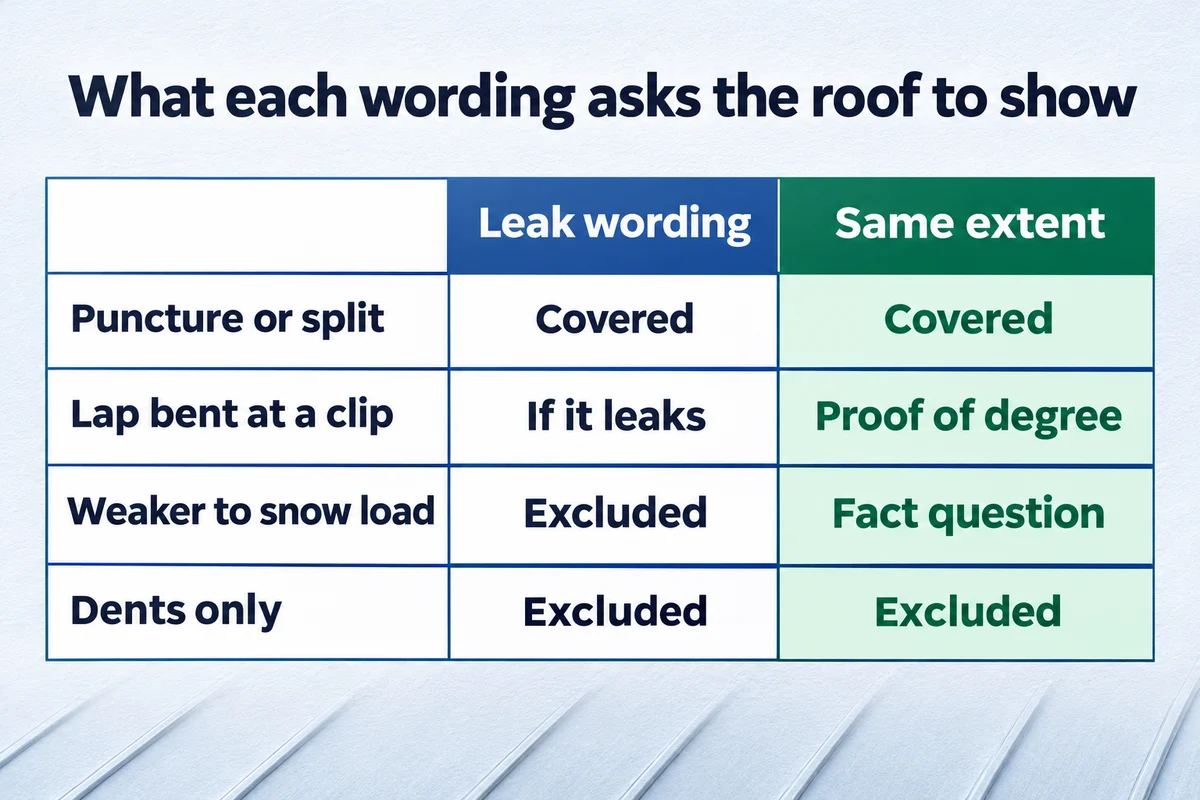
What roof evidence matters under each wording?
Each wording is satisfied by different proof, so the inspection should be planned around the clause, not around counting dents. This is how I sort the evidence on a metal roof file:
| Evidence from the roof | Leak wording | Penetration wording | Barrier wording |
|---|---|---|---|
| A hole or split in the panel | Enough once water gets through | Enough | Enough |
| A side lap, end lap or standing seam bent where it meets a clip | Needs a leak, often in wind-driven rain | Needs water in or a seam that has failed | Strong if a water test or measurement shows the joint sheds less |
| Engineer's calculation that dented panels carry less snow or wind load | Not enough | Argued under "failure of the metal" | The proof the July 2026 appeal accepted as a fact question |
| Cracked coating at the dents, seen under magnification | Not enough | Disputed | Disputed; engineers on each side differ |
| Dent counts and photographs alone | Not enough | Not enough | Shows the hail, not the extent |
The bottom row is the one I see most often. A file built only on dents per square proves that hail hit the roof, which nobody disputes, and leaves the clause unanswered. One more lesson from the appeal: in a Tennessee case it cited, the owner lost because it disclosed no expert in metal roofing systems to answer the insurer's. Under any of these wordings, the owner's side of the engineering has to exist in writing.
How an illustrative warehouse roof survey is recorded
Take an illustrative steel building with a through-fastened roof divided into eight bays, after a storm that left hail stones about 1.75 inches across in the lot. The worked example below is not a real file. Each bay gets a test area of 100 square feet on the slope facing the storm, a dent count and a separate count of dents that fall on a lap or a seam:
Two hundred and four dents tell the adjuster the storm was real. The five lap dents in bays C and F are the part of the survey that can carry the claim, because joints are where a metal roof sheds water and where a dent can change how much it sheds. Those spots get photographed with a scale, measured, and if the clause calls for it, water tested or opened from below before anyone repairs them. The count by bay also shows whether damage stops at a ridge or a parapet, which the insurer will use to limit the scope.
What do engineers report about hail on metal roofing?
Most hail dents steel without breaking it, and the joints are the exception. Jim Koontz and Troy White summarised field and laboratory work in a 2014 paper for IIBEC. In a Dallas field study with hail of 1 to 4 inches, no panel was fractured or punctured, and on exposed fastener roofs no fastener had been loosened by hail. Their warning is about the joints: substantial indentation at side laps, end laps or at concealed clips can affect water shedding, and one roof in Dora, New Mexico, hit by 2.5 inch hail, had laps distorted enough to leak in wind-driven rain. In their laboratory tests only a thin 32 gauge corrugated panel split.
On size, a June 2026 topic brief from Simpson Gumpertz & Heger puts the start of cosmetic damage to metal roofing at hail of 1.5 inches or larger. So the hail size from the storm record decides whether dents are expected, and the joints decide whether they matter. Telling hail apart from wind on the same roof is its own step, covered in wind vs hail and the cause of loss; a membrane roof on the same building is judged differently, as in my article on hail on TPO, PVC or EPDM roofs.
What should you do before the insurer inspects a metal roof?
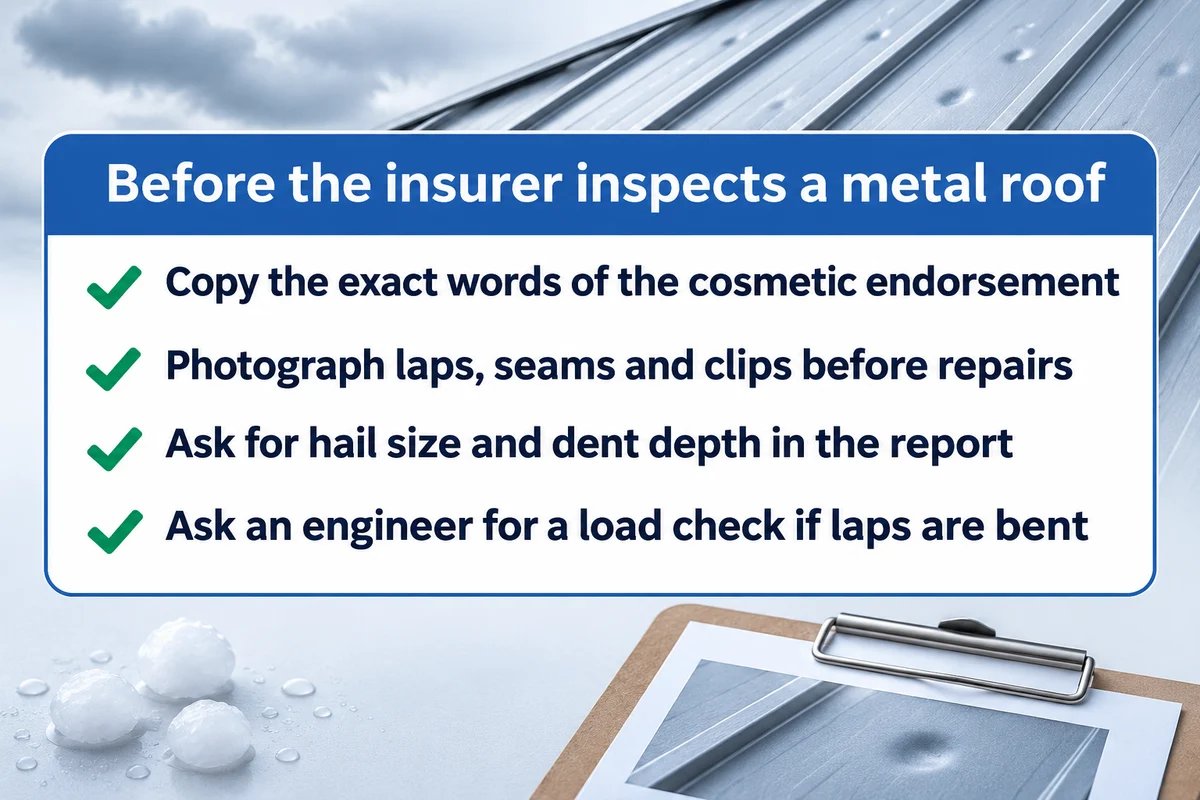
Do these in the first days after the storm, and before any panel is replaced or caulked:
- Ask your broker for the full policy with every endorsement, and copy the exact sentence that defines cosmetic damage.
- Write down the date of the storm and the hail size reported near the building; the National Weather Service storm reports are the usual record.
- Photograph the laps, seams, ridge caps and clips with a ruler or coin in the frame, including any dent that sits on a joint.
- Look inside under the roof after the next heavy rain and photograph any drip marks, stains on the insulation facing or wet spots on the floor.
- Ask that the insurer's report give the hail size it used, dent depths at the joints and whether the coating at the dents was examined.
- Keep any panel or flashing that is removed for an emergency repair, tagged with its bay.
- If the clause is the barrier wording and joints are dented, ask a structural or roofing engineer whether a load or water test is worth doing before the claim is closed.
Does the 2026 appeal apply to a building in Illinois?
Not directly. The court applied Minnesota law and predicted how the Minnesota Supreme Court would read the clause, and an Illinois court deciding an Illinois policy is not bound by it. It is a recent, reasoned reading of the same words that many commercial policies use, and the dissent shows the other reading is alive. Whether your wording is ambiguous, and which reading an Illinois court would take, are legal questions for an Illinois insurance attorney. My article on when a roof claim needs a lawyer sets out where that line sits. What I do on these files is the roof and the estimate: the survey, the joints, the scope and the price of the panels and trim.
When you do not need a public adjuster for this
If your policy has no cosmetic endorsement and the insurer has accepted the dents and priced the panels fairly, there is little left to argue. The same goes for a small outbuilding where the whole claim sits near the deductible. Where I help is a large metal roof with a cosmetic clause, dented joints and a denial that rests on dent counts alone. The services I offer and how I am paid are on one page, and you can call me at +1 224-481-2093, Monday to Friday 7 AM to 7 PM and Saturday and Sunday 9 AM to 5 PM.