A frozen hose bib that splits inside the wall is usually a covered water loss on an Illinois homeowners policy: the insurer pays to open the wall or ceiling to reach the faucet, to put it back, and to repair the water damage around it. It does not pay for the faucet itself. The trouble starts when the leak is found weeks after the first spring watering, because many carrier forms add a clause that excludes continuous or repeated seepage or leakage
of water over 14 days or more, and a faucet that leaks every time you use it fits that sentence on paper.
I see this file every April and May in Chicago bungalows and two-flats. The hose stayed on through a January cold snap, the faucet froze and split out of sight, and nothing happened until the first warm weekend. Below is how the fixture fails, where the 14-day wording lives in a policy, how an adjuster dates a leak, and what to keep before anyone cuts the drywall.
Why does a frost-free outdoor faucet leak inside the wall only in spring?
Because the split happens in winter, but water only escapes when someone opens the handle. A frost-free sillcock keeps its valve seat about a foot or more inside the house, where the heat should protect it, and a long tube carries water out to the spout. A hose left attached keeps that tube full; the outdoor end freezes, the ice pushes back toward the closed seat, and the tube splits inside the wall. The guide on frost-free fixtures published by InspectandTest calls the attached hose the classic cause and notes the leak often goes unnoticed until the hose is turned on in spring.
Illustrative cross-section of one frost-free sillcock through a basement wall. The highlighted cells are where the damage starts.
That pattern matters to the claim. The water is not running for weeks without stopping; it runs for twenty minutes on Saturday, stops, and runs again next week. A carrier will call that repeated leakage. You will want to show when the first water came through and how much damage each episode did.
Where the 14-day wording sits in your policy
It may not be there at all. The ISO homeowners form HO 00 03 05 11, which many Illinois carriers start from (I read it from the Maine Bureau of Insurance copy), has no seepage exclusion in its property section. Carriers add one in their own forms or endorsements, and the wording varies, so the first job is to find the sentence in your policy rather than in a blog post.
In the ISO base form
The freezing exclusion for plumbing does not apply if you used reasonable care to Maintain heat in the building
or to shut off the water and drain the system. A heated house with a hose left on usually meets the first branch.
Accidental discharge from a plumbing system is covered, including the cost to tear out and replace any part of a building
needed to repair it. The same paragraph then leaves out the leaking part itself: the faucet is the plumbing the water escaped from, so its replacement stays with you.
In many carrier forms
An added exclusion for continuous or repeated seepage or leakage. Some say a period of 14 days or more. Others say weeks, months or years, sometimes only where it results in rot or rust.
Look in three places: the exclusions of Section I, any water damage endorsement, and the mold or fungi endorsement, which often carries its own dollar sublimit. Read the declarations page for the list of forms, then pull each one.
If your policy has no such clause, the late discovery is mainly a question of proof and of the wear-and-tear exclusion. If it does, the dates below decide most of the argument. The freezing side of the same file, and the records that prove the heat was on, are covered on my frozen and burst pipe claims page.
One leak laid out day by day
An illustrative calendar for a Chicago bungalow, the kind of file I would build for an adjuster. The dates are invented for the worked example; the method is not.
- January 14Overnight low well below freezing. The hose is still on the back faucet. The tube splits; no water escapes.
- March 1The policy renews. A split from January and water from April may now sit in two policy terms.
- April 18 (day 0)First watering of the season, about 20 minutes. Flow at the spout is weak. Water enters the joist bay above the finished basement ceiling.
- April 25, May 2, May 9Three more waterings. Each one adds water to insulation and drywall that never dried from the last.
- May 11 (day 23)A brown ring appears on the basement ceiling under the faucet. The owner shuts the water to the faucet and calls the insurer.
The carrier sees 23 calendar days and four episodes and cites the 14-day clause. The owner's side sees about 80 minutes of actual flow, and damage from the first two waterings that happened inside the first 14 days. A Florida appeals court accepted that kind of split reading of a 14-day wording in 2018; I found no Illinois appellate decision on it, and how a court here would read your clause is a question for a lawyer. On the date of loss itself, whether January or April, read what the date of loss on your claim decides, because a renewal in between can change the deductible and the form.
How an adjuster dates a leak inside a wall
By the condition of what got wet, and by any record with a date on it. Illinois courts put the burden on the insurer to show that an exclusion applies, so the carrier needs evidence of duration, not a guess. Your job is to make sure the evidence that points to a short leak is collected before the wall is gutted.
| Sign | What it suggests | Who can put it in writing |
|---|---|---|
| Water bill or meter usage history | A jump that starts with the first watering, or a long slow rise that started much earlier. | Your water utility account, printed with dates. |
| One stain ring or several nested rings | Several rings point to wet and dry cycles, which supports episodes rather than one constant leak. | Photos with a ruler, before anything is cut. |
| Visible mold on the back of the drywall | The EPA says growth usually does not start if materials dry within 24 to 48 hours; how far it has spread is read as time. | A mold assessor or the mitigation company, in its first-day notes. |
| Soft or dark wood, rust on nails and hangers | Rot and rust take far longer than a few weeks, and a carrier will read them as an older leak. | A contractor's dated photos and moisture readings. |
| Dates the hose was used | Fixes day 0 and the number of episodes. | Irrigation timer log, phone photos of the garden, a neighbour's text. |
The Illinois Appellate Court, First District, decided a property claim under a policy with the exact phrase Continuous or repeated seepage or leakage of water that occurs over a period of 14 days
(No. 1-02-1540, June 13, 2003). It was a commercial building, not a hose bib, but it shows how duration gets proved here.
- The loss
- An old brick warehouse collapsed on a June afternoon with no storm in the area.
- The evidence of time
- Fungal growth on more than 10 beams and joists, efflorescence on the masonry that the insurer's engineer said usually takes about three months to form, and the owner's own engineer testifying that such growth takes several seasons.
- The paper trail
- City letters and neighbour complaints about roofing blowing off over the previous two years.
- The result
- The court held the water had come in for more than 14 days and affirmed judgment for the insurer. The opinion also restated that in Illinois the insurer carries the burden of showing an exclusion applies.
A spring hose bib leak looks nothing like that file, and that is the point: three or four weeks of intermittent water does not leave seasons of rot. If the joists under your faucet are sound and the stain is fresh, say so with photos and readings before the demolition crew removes them.
What an illustrative estimate looks like, sorted by the 14-day question
A worked example for the bungalow above, with an illustrative $1,000 deductible. Every figure is illustrative; your contractor's prices will differ.
Least disputed
$640
- Opening the basement ceiling to reach the faucet
- Closing and finishing that opening
Where the 14-day question lands
$7,550
- Wet drywall, insulation and paint: $2,380
- Carpet and pad below: $1,520
- Drying equipment and monitoring: $1,450
- Mold removal in the joist bay: $2,200, often under a separate sublimit
Not paid on most forms
$310
- The split sillcock and the plumber's part to replace it
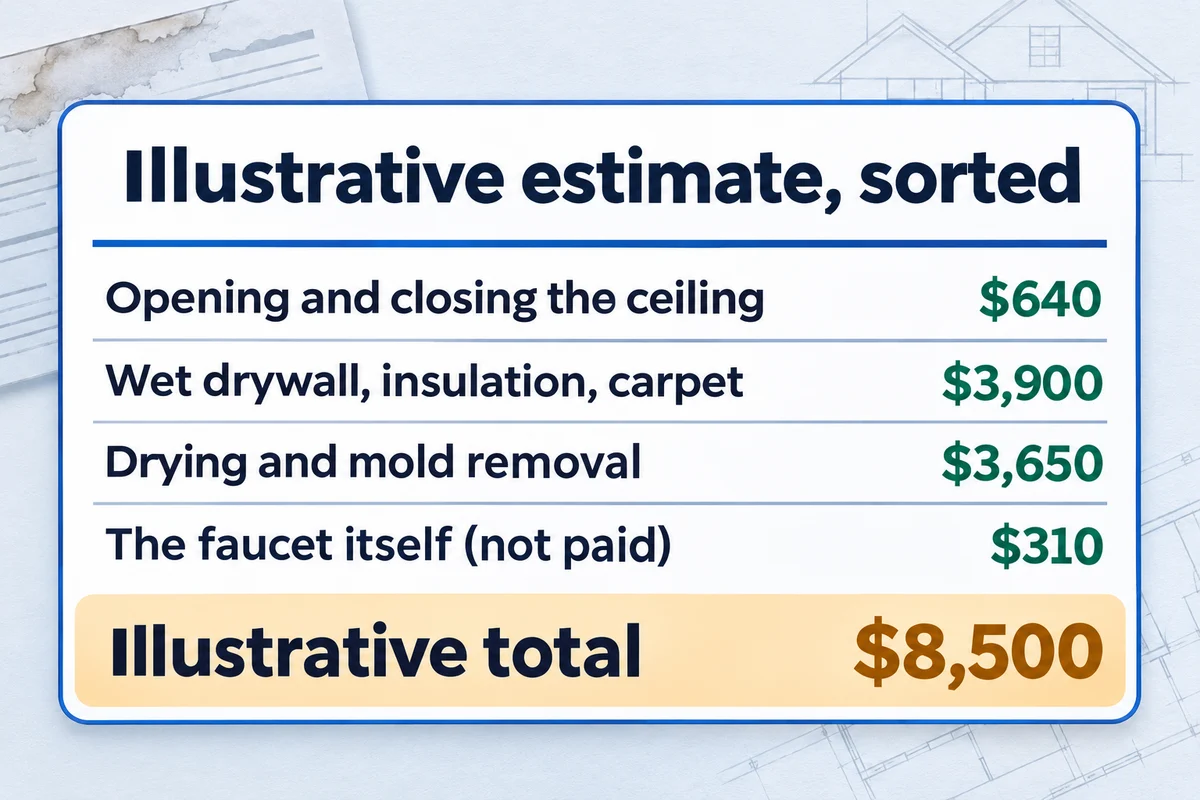
Illustrative total $8,500. If the clause is applied to everything, the claim can fall below the deductible. If the early damage is accepted, most of the middle column comes back. Even the first column can be refused when a carrier's seepage clause is written to exclude the whole loss, which is why the wording comes first.
The drying invoice gets its own scrutiny, and I explain what adjusters ask about each line in the drying bill after a water leak.
The day you find the stain
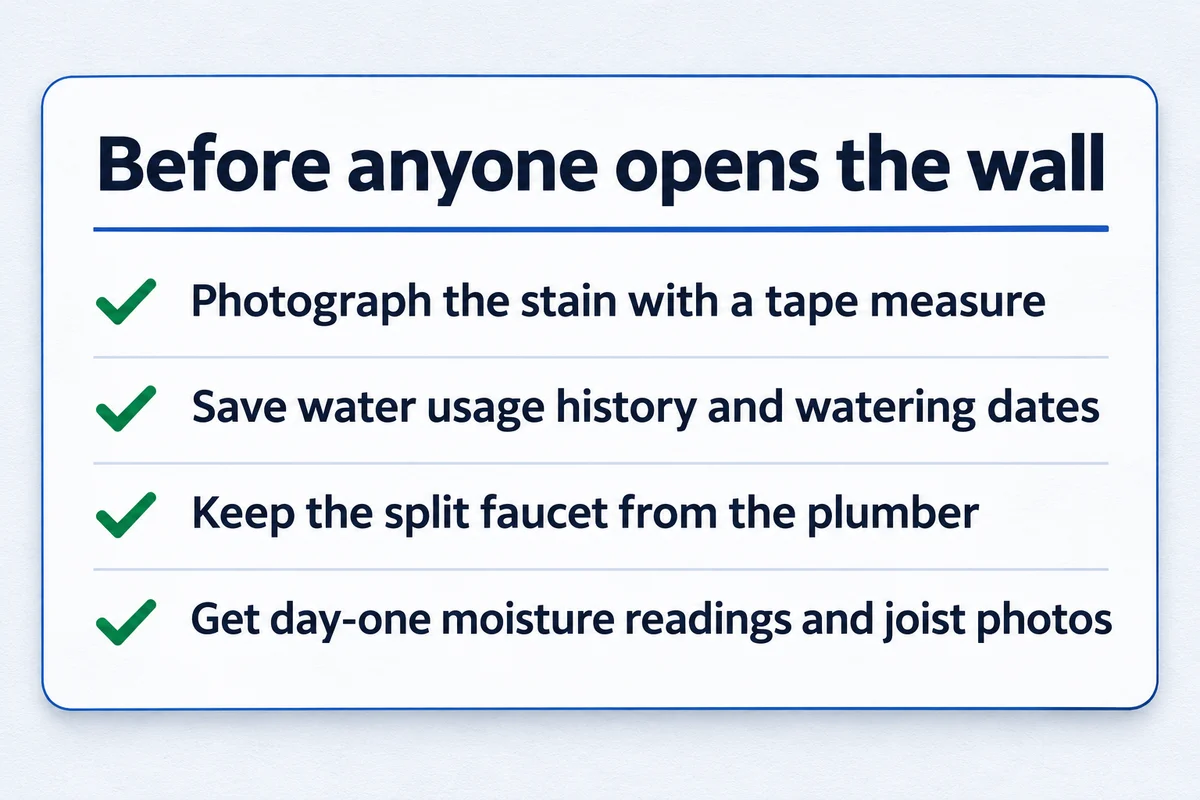
- Close the valve that feeds the outdoor faucet, or the main, and stop using the hose.
- Photograph the ceiling or wall from a distance and close up, with a tape measure across the stain, before anything is opened.
- Download your water usage history and save the photos or timer logs that show when you watered.
- Report the claim in writing and give the date you first used the hose this season and the date you saw the stain, nothing you are unsure of.
- Ask the plumber to write down where the tube split, whether a hose was attached, and to leave you the old faucet.
- Ask the drying company to record moisture readings and the condition of the wood on day one, with photos of the joists once the ceiling is open.
- Request the full policy with every endorsement, not just the declarations page, and find the seepage and mold wording.
If you are leaving for the winter instead, the questions change, and the empty house has its own conditions, which I wrote up in a house left empty in an Illinois winter.
When you can handle this without me, and when a lawyer comes in
If the stain was found the first time the faucet was used, the damage is one ceiling, and the adjuster has not raised the 14-day clause, you can usually settle it yourself with good photos and your contractor's estimate. A public adjuster earns a fee when the scope is large, when a finished basement and contents are involved, or when the seepage clause is cited and the dating evidence has to be built and argued line by line. I do that work on water damage claims across Illinois and Indiana.
I am not a lawyer. If the carrier denies the whole claim under the clause and you want to know how an Illinois court would read that wording, or whether the denial was handled lawfully, talk to an attorney who handles property insurance. If you would like me to read your policy and look at the wall first, send me the date and a photo; that costs you nothing.