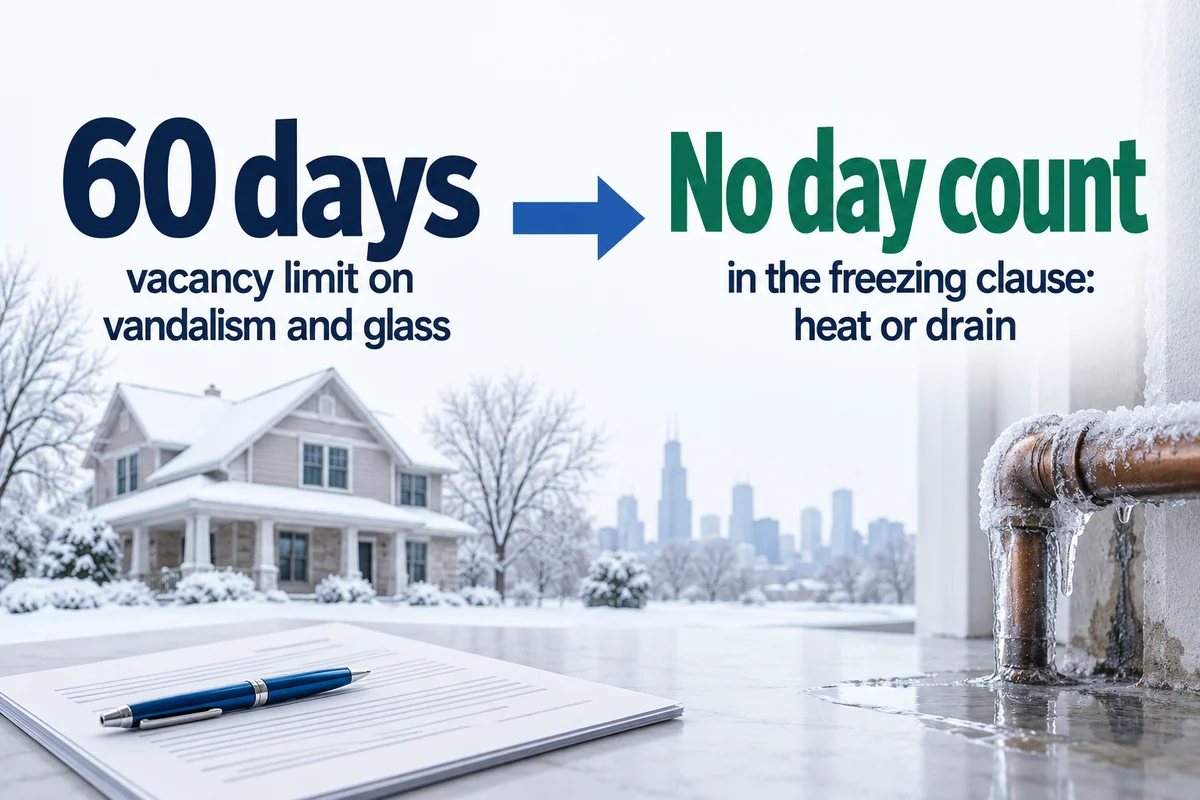
A pipe that freezes and bursts in a vacant house in Illinois can still be a covered claim. On a standard homeowners form the freezing question has no day count at all: it asks whether you used reasonable care to keep the heat on, or shut off the water and drained the lines. The 60-day vacancy limit is a separate sentence that removes other covers, such as vandalism and broken glass. Which sentences your own policy has, and how it words them, decides the claim.
I am a licensed public adjuster in Illinois (#19461872) and Indiana (#3556317), and every winter I get calls about houses that stood empty: a parent's house in probate, a bungalow listed for sale, a two-flat between tenants. I am not a lawyer. Whether a particular house was vacant is a question of fact, and when an insurer disputes it, an Illinois attorney is the person to read the file.
Is a burst pipe in a vacant house covered?
Often yes, if the heat stayed on or the system was drained. The trouble is that owners hear "60 days" and apply it to everything. In the standard ISO homeowners form, HO 00 03 05 11, the day count and the freezing rule live in different places and do different jobs. I read the form from the copy filed with the Maine Bureau of Insurance, because it is the base most carriers start from before they change words:
| Sentence in the form | What sets it off | What it means for an empty house |
|---|---|---|
| Freezing exclusion on the dwelling | Freezing of plumbing, heating, air conditioning, a sprinkler system or an appliance, unless you used reasonable care to "maintain heat in the building" or "shut off the water supply and drain all systems and appliances of water" | No day count. Day 5 and day 95 of an empty house are judged the same way: was the heat kept, or was the house drained? |
| Freezing as a named peril for contents | The same two choices, written as a condition of cover | Furniture left in the house is paid on the same test as the walls. |
| Sprinkler sentence | A building protected by an automatic fire sprinkler system | Draining is not an option. You must keep the water supply on and the heat on. |
| Vandalism and malicious mischief | The dwelling "has been vacant for more than 60 consecutive days immediately before the loss" | A break-in on day 61 is excluded, and so is loss from any intentional act committed in the course of it, such as a vandal opening the taps. |
| Glass or safety glazing | The same 60 consecutive days of vacancy | A window broken on day 61 is not covered, except from earth movement. |
Paraphrased from ISO form HO 00 03 05 11. The form also says "a dwelling being constructed is not considered vacant". Your carrier's form may add vacancy to the freezing sentence, or shorten the count: read your own policy, not this table.
So the first thing I do on one of these files is find every sentence in the policy that uses the words vacant, unoccupied or freezing, and note what each one is attached to. Some carrier forms tie the freezing exclusion to a house that is vacant or unoccupied, and those changes sit in the endorsements listed on the declarations page.
What does vacant mean, and how is it different from unoccupied?
They are two different tests, and Illinois courts have defined both. In Lundquist v. Allstate Insurance Co., 314 Ill. App. 3d 240 (2d Dist. 2000), the policy used both words without defining either, and the Second District gave these meanings:
Vacant
"generally empty or deprived of contents"
It is about things. A parent's house with the furniture, the dishes and the clothes still in it is hard to call empty. A house cleared out and staged with two chairs for a sale is closer to it.
Unoccupied
Nobody living there, and nobody with "actual use or possession" of it, at the time of the loss
It is about people. A house full of furniture where nobody sleeps, cooks or keeps their life can be unoccupied without being vacant.
The facts in Lundquist are the kind I see every winter. The owners had moved to a new house in 1995 and had a contract to sell the Rockford one. Furniture, appliances and clothing stayed, the utilities were kept on, their sons stayed over on weekends and one owner visited weekly. The court said whether a dwelling was vacant or unoccupied at the time of the loss "is a question of fact", reversed the judgment for the insurer, and sent the case back. It also read the policy's 30-day vacancy clause against the Illinois standard fire policy, which allows sixty consecutive days, and would not let the insurer rely on the shorter period.
For an owner the lesson is practical. What stays in the house, who goes there and how often, and whether the utilities run are all evidence. Write them down while they are true.
How are the 60 days counted?
From the last day the house stopped being lived in or emptied of contents, consecutively, up to the day of the loss. The words "immediately before the loss" mean the count is taken backwards from the day the damage happened. Here is an illustrative winter for a house whose owner moved into assisted living on December 1:
Owner moves out. Furniture stays, heat set, water on. Day 1 of a possible count.
Day 30. A policy written with a 30-day clause would already bite here, so read yours.
Day 60. Family removes most of the furniture for an estate sale.
Day 61. On the standard form, vandalism and glass are now outside the policy.
Day 74. The furnace igniter fails in a cold snap and a pipe on an outside wall splits.
Illustrative example only. Dates and events are invented to show the count and are not a real claim.
On February 12 the vandalism limit does not decide anything, because nobody broke in. The freezing sentence does, and it asks what was done to keep the heat on. If a relative checked the house on February 9, saw 60 degrees on the thermostat and wrote it down, that record is the claim. If nobody had been inside since the estate sale, the insurer will ask how anyone knew the furnace was running.
The owner died: who is insured on the house?
The policy does not end with the owner. The Death condition of the same ISO form says the insurer covers "the legal representative of the deceased" for the premises and property covered at the time of death, and, until a representative is appointed, "the person having proper temporary custody of the property". In practice that means the executor or administrator, and before that the family member holding the keys.
Three things go wrong in estates. Nobody pays the renewal because the bills went to the deceased's mail. Nobody tells the carrier that the house now stands empty. And the furniture is cleared out in one weekend, which can turn an unoccupied house into a vacant one overnight. Before the estate sale, call the agent and ask in writing what the policy needs for an empty house, and keep the reply.
What should I do before the first freeze?
Pick one of the two branches the freezing sentence names and keep proof that you followed it. The banner below has the short version; this is the long one.
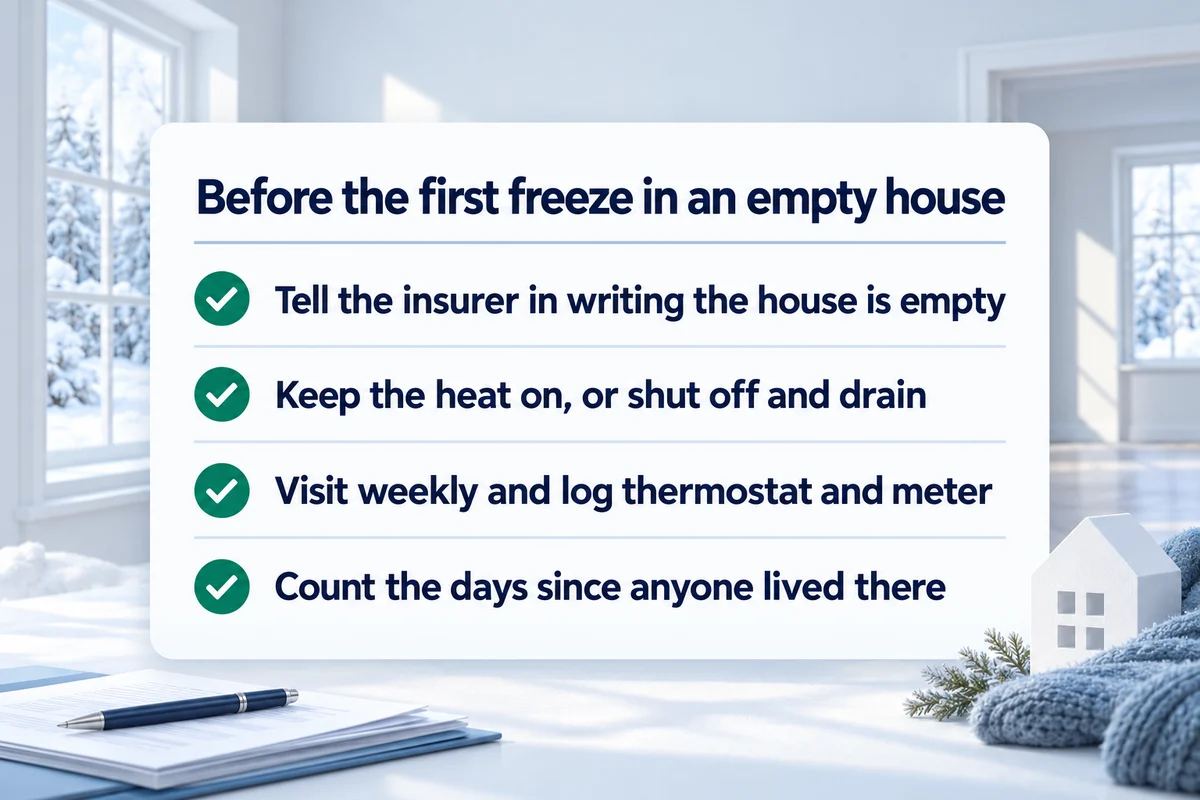
- Write to the agent or carrier that the house is empty, since when, and why. Ask whether the policy stays as it is, needs an endorsement or has to be replaced with a policy for a vacant dwelling. Keep the email.
- Decide: heat, or drain. Heat means the gas and electric accounts stay on, the furnace is serviced, and the thermostat holds a set point. Drain means a plumber closes the main, opens the lines, blows out or drains the water heater, boiler and toilets, and gives you an invoice that lists the work. A house with a sprinkler system cannot take the drain branch.
- If you keep the heat, keep a visit log. The fields below are what an adjuster asks for on a winter water loss.
- Mark the date the house was last lived in and the date the contents went, and set a reminder at day 50.
| Field | What to write | Why the adjuster wants it |
|---|---|---|
| Date and time of the visit | Every visit, even five minutes | Shows the house was watched, and narrows when the pipe failed. |
| Thermostat set point and room reading | Both numbers, plus a dated photo of the display | The direct answer to "did you maintain heat in the building". |
| Gas meter reading | The number, photographed | A meter that moves between visits means the furnace burned fuel. |
| Water and ceilings | "Dry" or what you saw, room by room in the basement and below bathrooms | Separates a sudden burst from a slow leak that ran for weeks. |
| Who went | Name and phone number | A witness the adjuster can call. |
Does the insurer have to be told the house is empty?
Assume it does, and do it in writing. An Illinois appellate decision this summer shows why. The case is summarized by Simpson Thacher; it involved a commercial building, not a house, but the point about notice carries over:
- The building
- A brewery that stopped operating at the property in March 2020. The policy renewed in 2021.
- The loss
- Water damage in January 2022. The insurer denied it under an exclusion for water damage when the building had been vacant for more than 60 consecutive days.
- What the owner argued
- That the insurer knew, because an audit for a different coverage showed the business had closed.
- What the court held
- The exclusion applied. The audit did not show the insurer knew the building was vacant, and the court noted that the insured is responsible for reading the policy.
A homeowners policy is a different contract, but the habit is the same. A letter or email to the agent that names the address and the date the house went empty is a record nobody can argue about later. A remark to a different department is not.
The pipe already burst in the empty house: what now?
Shut off the main, call a plumber and a drying company, and photograph every wet room before anything is removed. Report the claim the same day. Then pull together the visit log, the gas bill for the month, the plumber's note on where the pipe ran, and the cut-out piece of pipe. My page on frozen and burst pipe claims lists the records that prove the heat was on, and my post on the drying bill after a water leak covers the invoice that arrives a week later.
Be careful with the first recorded statement. The adjuster will ask when anyone last lived there and when anyone was last inside. Answer with the dates from your records, not a guess. If you do not know, say you will check. If the claim is denied on the vacancy or freezing wording, ask for the letter that quotes the sentence it relies on, and read my post on what to do after a denial before you answer it.
When you do not need a public adjuster
When the carrier accepts the claim and its estimate is close to your contractor's bid, you can finish it yourself. A small leak caught on a weekly visit, a few feet of drywall and a carpet pad, rarely needs anyone else. I am worth a call when the water ran for days before anyone found it, when the insurer raises vacancy or the heat, or when the house is an estate and nobody in the family has handled a claim before. Landlords with a unit between tenants can start on my page for rental property claims. You can reach me through the contact page seven days a week. The first conversation and the policy review cost nothing, and no honest adjuster can promise what the insurer will pay.