After a fire in an Illinois condo building, the association's master policy pays to rebuild the structure first: the common elements and the bare walls, floors and ceilings of every damaged unit. Your own HO-6 policy pays for what is yours inside those walls, for your belongings, and for the extra cost of living somewhere else. The catch is timing. Your contractor cannot hang a cabinet until the association's contractor has closed the walls, and your loss of use coverage keeps counting months the whole time.
I handle condo fire claims in Chicago and the suburbs, usually for owners who were not in the burned unit at all. Their kitchen is fine, or smoked, but the building is shut, the gas is off, and the board's letter says the rebuild will take most of a year. Below is the order the Illinois Condominium Property Act sets for the money, what an ISO unit-owners form says about the months you are out, and what happens if the master policy is short.
Who repairs what after a condo fire, and in what order?
The association goes first, because the statute routes the building money through it. Under 765 ILCS 605/12(g), a loss under the master property policy must be adjusted by and with the association
, the check is payable to the association or its insurance trustee, and the money goes first to the common elements and the bare walls, ceilings and floors of the units. Only then does it reach any owner upgrades the association chose to insure.
Where exactly the shell ends depends on your building. Section 12(b) lets the association leave out improvements and betterments, and defines them broadly: decorating, fixtures, appliances, heating and cooling equipment, water heaters, cabinets owners installed, and any other upgrade an owner put in. It also says common elements exclude floor, wall and ceiling coverings. Section 12(f) makes the association's policy primary where both policies cover the same thing, and the HO-6 form says the same from its side: its Other Insurance condition makes it excess over insurance in the name of an association of property owners. The layers inside a unit, and who answers for each, are drawn out in my post on water from the condo above; a fire uses the same lines.
How long does your HO-6 pay for a hotel or a rental?
For the shortest time it should take to repair the damage, and that includes the building around your unit. This is the wording I point owners to in the ISO unit-owners form HO 00 06 10 00 (the copy published by the Independent Insurance Agents and Brokers of America). Many Illinois carriers start from it, though your own form may differ.
If a loss by a Peril Insured Against under this policy to covered property or the building containing the property makes the "residence premises" not fit to live in, we cover any necessary increase in living expenses incurred by you so that your household can maintain its normal standard of living.
ISO HO 00 06 10 00, Section I, Coverage D, Additional Living Expense
Two phrases do the work. The building containing the property
means your unit does not have to be burned for the coverage to start; a fire in the building that shuts off your heat, power or exit can be enough. And payment runs for the shortest time required to repair or replace the damage
, which in a condo is mostly the association's schedule, not yours. The same section adds that these periods are not cut off when your policy expires.
| Your unit | Which part of Coverage D is in play | What to keep |
|---|---|---|
| Burned or soaked by the hoses | Additional living expense for as long as the shell and then your finishes reasonably take. | Lease or hotel folio, utility deposits, mileage, the normal monthly costs you no longer pay. |
| Smoke and water only, building still open | Additional living expense while the cleaning or repair makes the unit unfit, often weeks, not months. | The cleaner's dated notes on odor and residue, and your own photos of each room. |
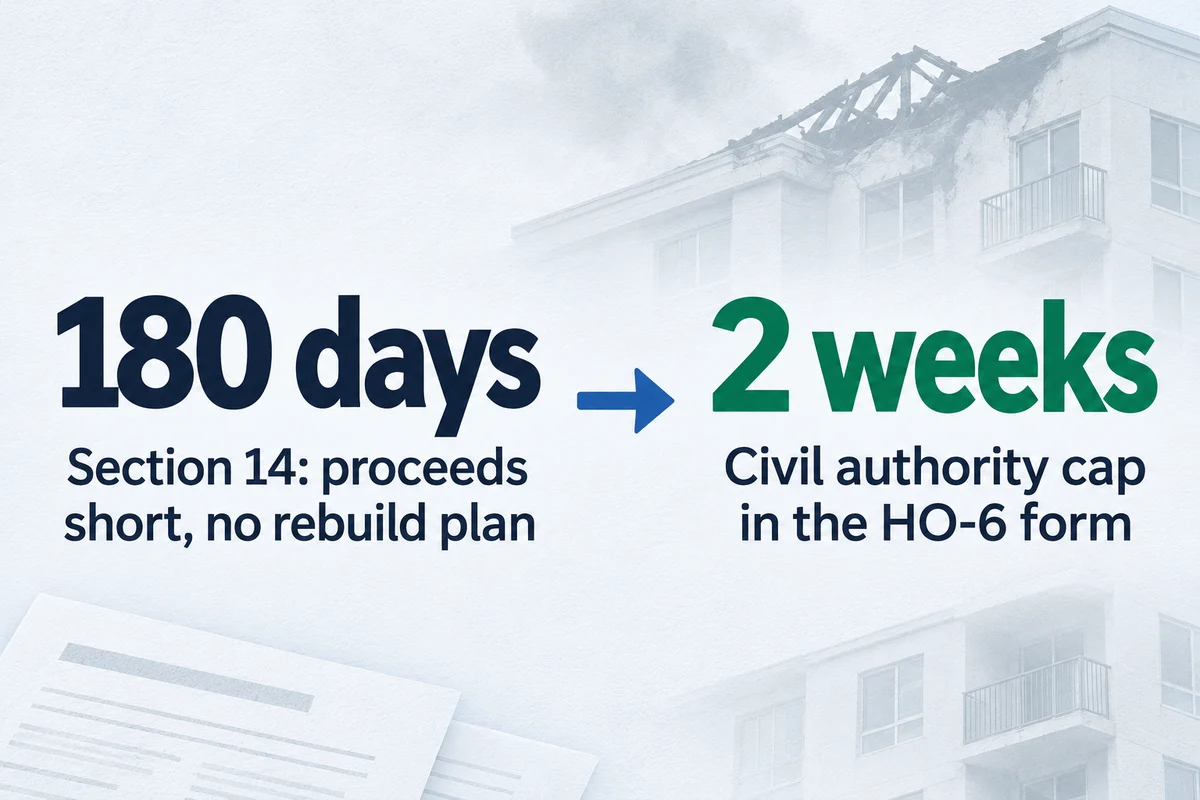
| Untouched, but the building is closed | The "building containing the property" wording, because your building was damaged. The separate civil authority clause, capped at two weeks, is written for damage to neighbouring premises. | The city's or the board's written notice that you cannot occupy, with its date. |
Coverage D pays the increase, not your whole cost of living. Your mortgage and your monthly assessments usually continue, so they are not part of the claim. What counts, and the receipts each line needs, is in my longer post on additional living expenses.
Illustrative: nine months away against one limit
A worked example, every figure illustrative. An owner's HO-6 lists a Coverage D limit of $24,000. Renting a comparable apartment nearby costs $3,000 a month more than the owner spent living at home. The association's contractor takes six months to return the shell, and the owner's contractor needs three more for floors, kitchen and paint.
Waiting on the association's shellYour own finish workLimit used up
8 months x $3,000 = $24,000 paid. Month 9: $3,000 not paid unless the limit is higher.
Two things change the outcome. If the shell slips from six months to eight, the limit runs out with the owner still in a rental. If the owner's contractor is booked and ready on the turnover date, the last leg shrinks. That is why I ask the board for its schedule in writing in the first week, and why the owner should have finish selections and a contractor lined up before the handoff, not after.
When the master policy is not enough: what Section 14 does
It sets a clock and a vote. 765 ILCS 605/14 covers a fire or other disaster where the insurance proceeds are insufficient to reconstruct. Section 12(a)(1) requires the master policy to carry the full insurable replacement cost, less deductibles, including code upgrades, so this should be rare. It happens when the limit was set too low, when values jumped, or when a large deductible sits on the building.
Do the master policy proceeds cover the rebuild?
Yes
The association repairs. Under 12(g), owners receive nothing from the building proceeds unless money is left over once the common elements and units are completely repaired.
No
- If the owners and other parties in interest do not voluntarily provide for reconstruction within 180 days from the date of the damage, the board may record a notice. The property is then owned in common by percentage of interest and can be sold in a partition action, with the sale and insurance money pooled and divided after liens.
- Where fewer than half the units are uninhabitable, the condominium instruments may allow reconstruction on a vote of at least 3/4 of the owners voting at a meeting. The meeting is held within 30 days after the final adjustment of the insurance claims, or otherwise within 90 days of the fire. The board must present the cost estimate and each unit's estimated assessment.
- The instruments may also allow part of the property to be withdrawn, with each withdrawing owner's share reallocated and paid on an equitable basis.
An owner facing that meeting needs the board's repair estimate, the final adjustment figures and the declaration in hand before voting. A rebuild assessment may be partly covered by the loss assessment part of your HO-6; the base ISO form pays up to $1,000 for your share, and many owners buy a higher limit. I worked through an assessment letter line by line in a condo special assessment after storm or fire damage. What your vote means for your title, and whether the instruments allow what the board proposes, are questions for a condominium attorney.
What to ask the board and your carrier in the first two weeks
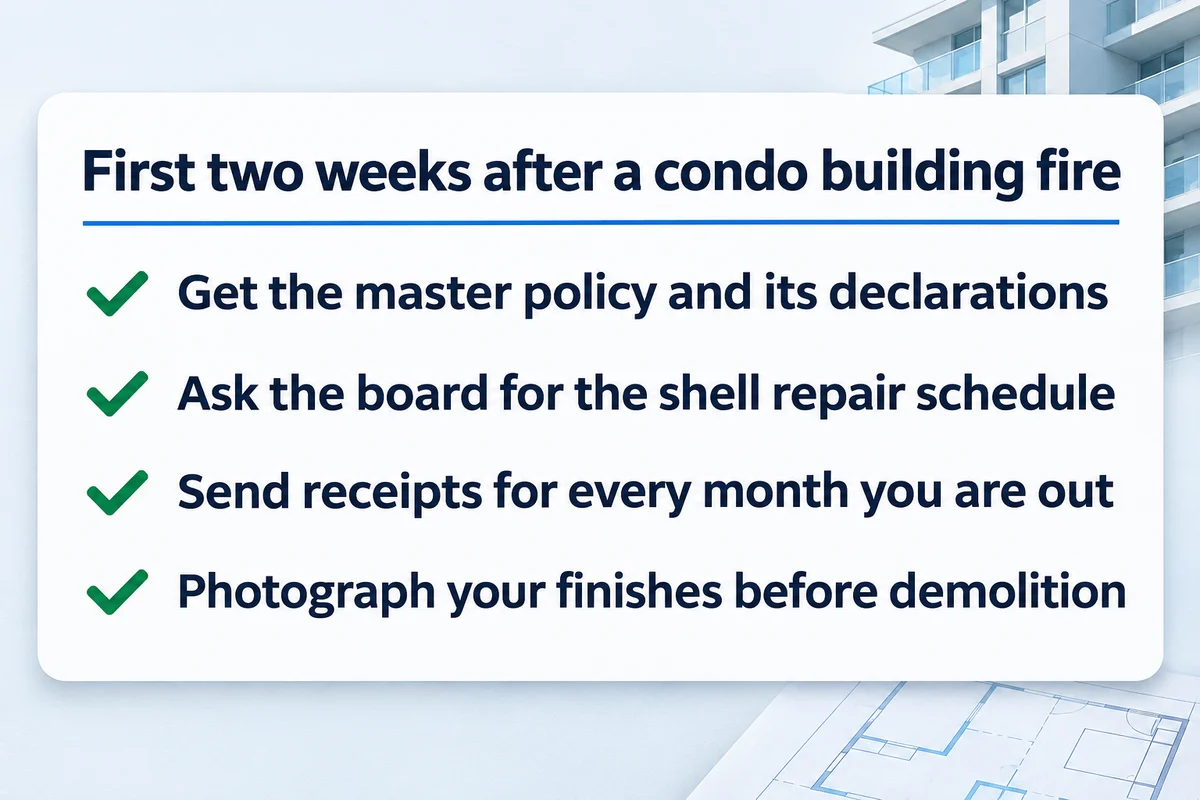
- Report the loss to your own HO-6 carrier in writing, even if your unit looks fine. Give the fire date and the date you left.
- Ask the board or manager for the master policy declarations, the deductible, and the name of the master policy adjuster.
- Ask which version of the shell the association insures: bare walls only, original finishes, or owner upgrades too. The declaration and any board rule under 12(a)(1) and (b) answer it.
- Photograph and list everything you installed after you bought: flooring, cabinets, counters, light fixtures, built-ins. Do it before the association's crew demolishes, because after that the evidence is in a dumpster.
- Ask the board for the expected turnover date of your unit, in writing, and for updates when it moves.
- Keep a monthly loss of use folder: rent or hotel, the costs you no longer pay at home, extra mileage, laundry, meals above normal.
- Find out whether the fire started in a unit. Under 12(c), the board may assess the master deductible against the owner from whose unit the cause originated, after notice and a hearing, or spread it in one of the other ways the statute lists.
Smoke that traveled into units far from the fire has its own estimate problems, from ducts to soft goods; I covered those in smoke damage in rooms the fire never touched.
When an owner needs a public adjuster, and when a lawyer
If your unit had light smoke, the building reopened in a few weeks, and your carrier paid the cleaning and the hotel without a fight, you do not need me. A public adjuster earns the fee when your finishes and upgrades are extensive, when the contents list runs to hundreds of lines, or when the months away start to outrun the limit and every receipt matters. I represent unit owners on their own HO-6 claims, and associations on the master policy, through my condo insurance claims work in Illinois and Indiana; boards start on the association claims page.
I am not a lawyer. A Section 14 vote, a partition action, a deductible charge-back you dispute, or a claim that another owner caused the fire are legal questions, and a condominium or insurance attorney should look at them. If you want me to read your HO-6 and the board's letter first, send them over; that conversation costs nothing.