When a commercial roof leaks into the building, the policy pays for the inside (ceilings, insulation, stock, equipment, drying) in two situations: the storm first made an opening in the roof or walls and the rain came through it, or the water is melt from snow or ice sitting on the building. If the water came in some other way, through worn flashing, a clogged drain or a seam that has been weeping for months, the standard commercial form reads it as rain getting inside and pays nothing for the interior, even when the storm that night was violent.
On Chicago flat roofs the owner calls about the ceiling, the adjuster goes up to the roof, and the claim turns on what was found up there. The wording I quote is from the ISO causes of loss form CP 10 30 10 12, which many commercial policies are built on. Your carrier may use its own version, so find the same paragraph in yours.
Does commercial property insurance cover a roof leak into the building?
It covers the interior only when the leak passes one of two gates in the rain limitation, paragraph C.1.c of the causes of loss form. The limitation applies to rain, snow, sleet, ice, sand and dust whether driven by wind or not
, so a strong wind on the night of the leak does not settle anything by itself.
Gate 1: did a covered cause make the opening first?
The form asks whether the roof or walls were damaged first, by what it calls a Covered Cause of Loss
, and whether the water came in through that damage. Wind lifting a seam, hail fracturing a membrane, a branch puncturing the deck all qualify.
Gate 2: is it melt from snow, sleet or ice on the building?
The second exit in C.1.c covers loss caused by thawing of snow, sleet or ice on the building
. No opening is required. On a Chicago flat roof this is the late winter leak: snow piled against a parapet, a thaw, and water backing under the edge metal.
Passing a gate does not switch off the rest of the policy. Two exclusions in section B still apply to the water: B.2.d, which includes wear and tear, rust, decay and latent defect, and B.2.f, continuous or repeated seepage or leakage over 14 days or more. I come back to the 14 days below, because it is how a real storm claim gets turned into a maintenance claim.
Rain over the flashing: what an Illinois court decided in 1960
The Illinois Appellate Court, Fourth District, ruled on a flat roof leak on March 9, 1960 (25 Ill. App. 2d 35). The policy was an older windstorm endorsement with a stricter phrase, damage by the direct force of wind
, while today's form asks the same two things: was there an opening, and what made it.
- The roof
- Flat and dead level, a brick parapet over 30 inches high with stone coping, one scupper in a corner draining to a downspout.
- The storm
- Nobody disputed a violent wind followed by very heavy rain. Limbs and whole trees came down and debris covered the roof.
- The owner's side
- Water came in and the interior had to be redecorated. The owner's witness said nothing about any opening the wind made.
- The roofer's testimony
- No fractures or holes. The flashing was carried up only a few inches, so in rain that heavy the water rose above it and ran in around the walls. He said it would have happened with no wind at all.
- The claim
- Over $1,000 for the roof and nearly $900 for the interior. A jury returned a verdict and the trial court entered $1,200.
- The result
- The appellate court held the rain wording plain and not ambiguous, reversed, and entered judgment for $386.70, the cost of replacing the old roof as it was, which the insurer had offered. The interior got nothing.
The owner lost because no witness described an opening, while the roofer who looked at the roof after the storm described a cause that had nothing to do with wind. Whoever writes up your roof first is writing the evidence for Gate 1, so ask them to write down what made the hole, not only what it costs to fix.
What the roof shows, and which way the claim goes
Owners describe the roof, not the clause. This is how the usual findings on a low-slope commercial roof line up against the gates. Hail on a membrane needs its own method, which I set out in the post on hail on TPO, PVC and EPDM roofs.
| Found on the roof | Usual reading | What proves it |
|---|---|---|
| Seam or perimeter lifted, membrane torn back from the edge | Gate 1 open if wind did it that day | Clean, fresh tear edges; debris pattern; the wind report for the date |
| Coping or edge metal pulled off the parapet | Gate 1 open if the fasteners failed in the storm | Bent metal, fresh fastener holes, the piece itself kept |
| Puncture under a fallen branch or blown equipment | Gate 1 open | The object, photographed where it landed |
| Drain or scupper blocked, water ponded over low flashing | No opening: the 1960 pattern, interior excluded | Usually the insurer's evidence, not yours |
| Old seam that has been wet for weeks, stained deck below | Seepage over 14 days or wear: B.2.f or B.2.d | Maintenance records showing the seam was sound before |
| Roof opened by a crew mid-reroof, rain under a tarp | Opening made by people, not a covered cause; contested | The contract, the crew's log; the roofer's own insurance is a separate route |
| Snow piled at a parapet, leak during a thaw | Gate 2: thaw exception | Dated photos of the snow, temperatures for the days of the leak |
The 14-day clock on a slow leak
Exclusion B.2.f removes water that leaks continuously or repeatedly over a period of 14 days or more. It does not matter how the leak started. If the adjuster concludes the roof had been dripping into a ceiling cavity for a month before anyone saw a stain, a storm on the reported date stops mattering, because the damage is read as long-running seepage.
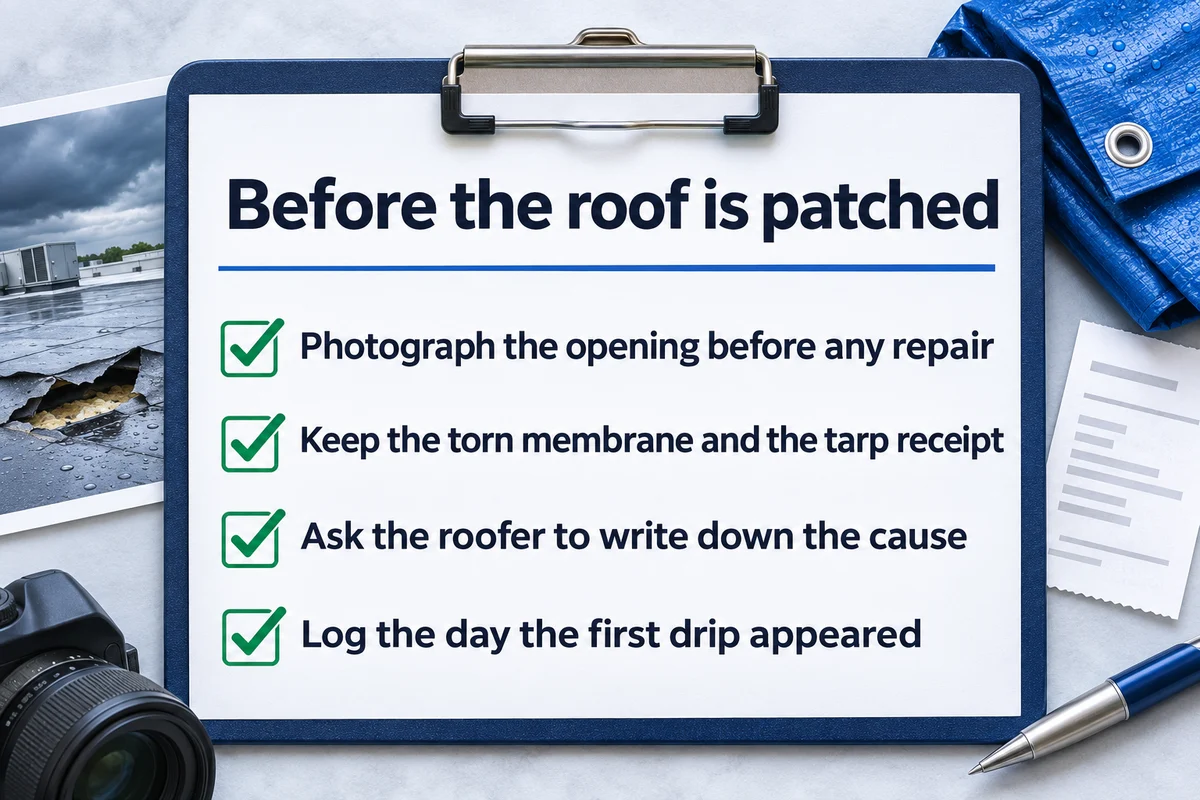
The answer to that is dates, collected before the roof is repaired:
- The day staff first saw water, in an email, a work order or a message to the property manager. A note written on the day beats anyone's memory later.
- The last roof inspection or maintenance visit, with the report. A clean report from two months earlier is strong evidence the opening is new.
- Photos of the ceiling tiles and the deck from below. A fresh stain looks different from a tile that has been wetting and drying for weeks.
- The storm record for your address for the night before the first drip. The post on getting the date of loss right shows how to read the federal storm reports, including the time zone trap.
An illustrative warehouse leak, priced under two causes
This is a worked example, not a real claim: a one-storey warehouse with an office in front, a single-ply roof, a $2,500 deductible, and one leak over the office and two racks of boxed stock. The same damage is priced twice, once where wind tore a seam at the parapet, and once where the roof drain clogged with leaves and water rose over flashing that was set too low.
Illustrative figures only. In the second column the flashing repair is read as a defect or wear item, and every interior line falls under the rain limitation because nothing opened the roof. The insulation sits inside the roof assembly, and adjusters argue which side of the line it belongs on.
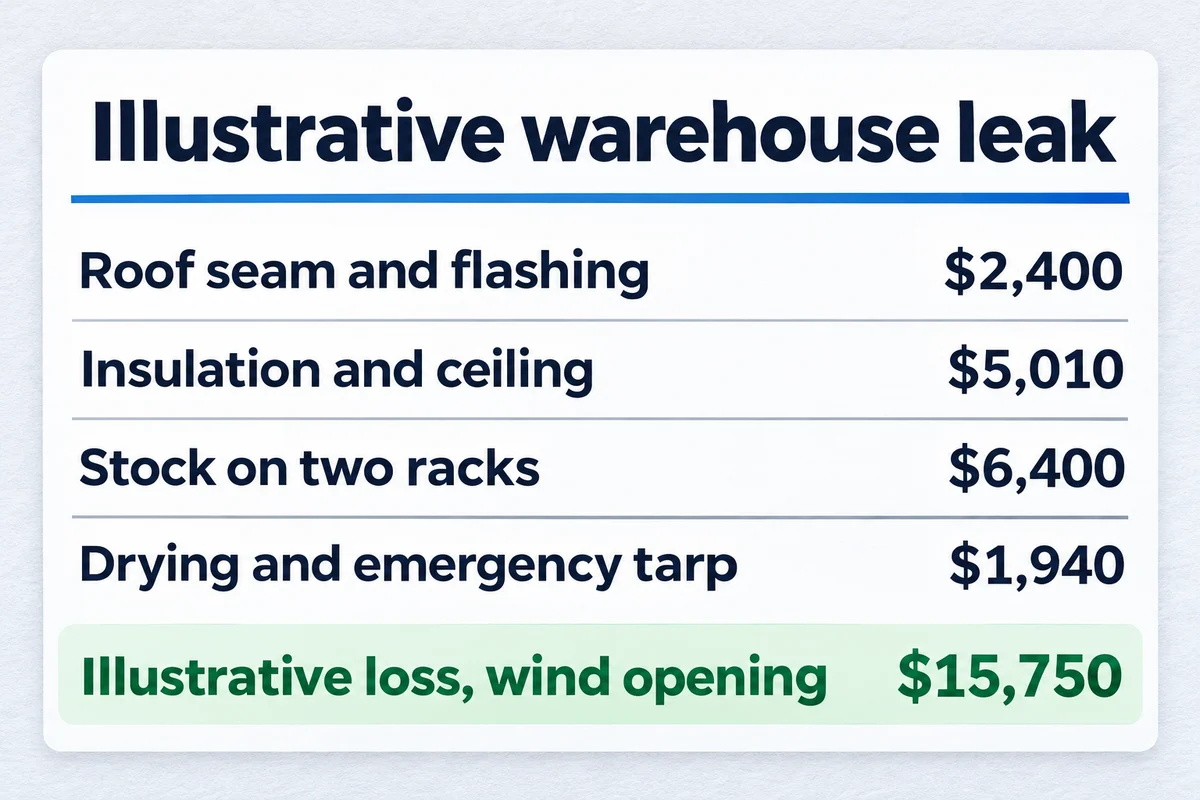
The difference between $13,250 and nothing in this example is not the amount of water or the size of the storm. It is one sentence in the roofer's report about what let the water in. If the leak also closed part of the business, the income side follows the same answer, which the page on business income claims explains.
When the roof itself is paid but the inside is not
Owners are surprised by the opposite split too. An adjuster can agree that wind damaged the edge metal on the north side and still exclude the ceiling in the south bay, because the water in the south bay came through an old seam that the wind never touched. Each leak point needs its own path from opening to stain, and a roof plan with the leak spots marked is the easiest way to show it.
The first 72 hours after water comes through the ceiling
The building and personal property form requires you to take all reasonable steps to protect the property from further damage and to keep a record of what that costs, and, where feasible, to set damaged property aside for examination. Done in this order, those steps also build the Gate 1 file.
- Move stock and equipment away from the drip and photograph what got wet before anything is thrown out.
- Get a roofer up as soon as it is safe, and ask for photos of the opening before the tarp or patch goes on, with the cause written in the report in plain words.
- Keep the torn membrane, the bent coping or the branch. Physical pieces are hard to argue with.
- Write down the date and time the first water was seen, and who saw it.
- Report the claim and send the insurer the photos and the roofer's note in writing, so the cause is on record from the first week.
- Keep every invoice for the tarp, the call-out and the drying in one folder. They are part of the claim, not a cost of doing business.
Tenant or landlord: whose policy answers the leak?
In a leased building there are often two policies on one leak. The owner's policy covers the building, including the roof and usually the ceilings. The tenant's own policy covers the tenant's stock, equipment and often the improvements they paid for. Both are commonly written on the same causes of loss form, so the same two gates apply on each side, and the same roofer's report serves both claims. Who had to maintain the roof, and who pays for a leak the policy does not cover, is a question about the lease. That reading belongs to a lawyer, not to me.
When you do not need a public adjuster for this
If the insurer has accepted in writing that the storm made the opening, and the interior scope is a few ceiling tiles and a day of drying, you can usually handle it yourself with the roofer's report and your invoices. Where I am useful is the larger loss where the cause is in dispute, where the adjuster has written seepage or wear, or where stock, insulation and business income all depend on one finding on the roof. You can read how I handle commercial roof claims, or send me the photos and I will tell you which gate your leak is at. If a denial letter has already arrived, the post on reading a denied commercial claim shows where the cited clause sits in the form. If the dispute turns on what the policy means rather than on what happened on the roof, talk to a lawyer.