After a fire, a burst riser or a hailstorm, a condo board in Illinois can act at once to stop the damage and approve that spending afterwards. The bigger decisions on the master policy claim are board votes taken where owners can watch: hiring a public adjuster, naming who signs for the association, and accepting an amount from the carrier. The Illinois Condominium Property Act sets out how in a few short subsections, and most boards read them for the first time after the loss.
I am a licensed public adjuster in Illinois (#19461872) and Indiana (#3556317), and I work master policy claims for Chicago associations. I am not a lawyer. Your declaration and bylaws may add rules of their own, and reading those is work for the association's counsel. What follows is the part of the Act that every board shares.
What can a condo board do before it meets?
Whatever it takes to stop the damage. Section 18(a)(8)(iv) of the Condominium Property Act defines an emergency as "an immediate danger to the structural integrity of the common elements or to the life, health, safety or property of the unit owners". Section 18.4(j) gives the board access to units for emergency repairs that keep damage from spreading to the common elements or other units. A water shutoff, a plumber on a Sunday night, a drying crew and a tarp over an open roof are that kind of spending.
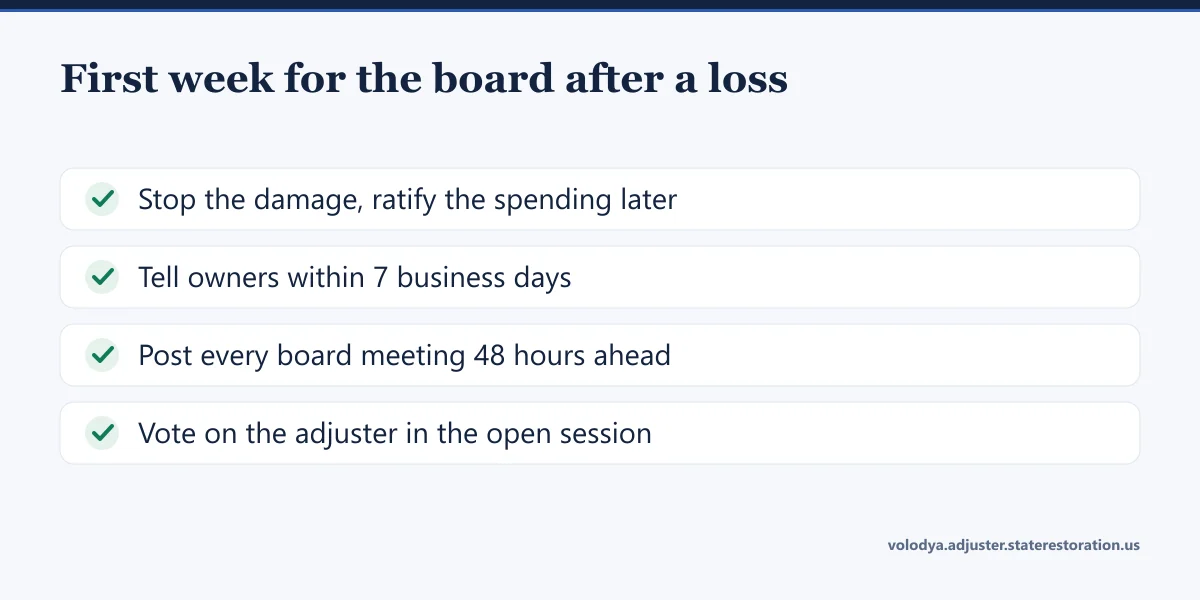
Section 18(a)(21) then lets the board ratify and confirm what its members did in the emergency, and it attaches two notices to owners. Here is an illustrative first week after a riser bursts on a Sunday evening in a 24-unit building:
- Sunday night
The president calls the manager, a plumber and a drying company. The manager reports the loss to the master policy carrier and gets a claim number. Someone photographs every wet ceiling before anything is torn out.
- Monday to Thursday
Drying runs in the units below. The manager keeps every invoice and the daily moisture log, because the carrier asks for both. My post on what an insurer pays for on the drying bill shows what each equipment line has to be backed by.
- Within 7 business days of the event
Owners get notice that the emergency happened. A general description of what the board did goes out within 7 days. Both deadlines are in 18(a)(21), and one letter can cover both.
- The next board meeting, posted 48 hours ahead
The board votes to ratify the emergency spending and puts the claim itself on the agenda: who represents the association, who signs, and who talks to the carrier.
Can the board discuss hiring a public adjuster in a closed session?
It can discuss it and interview candidates behind closed doors, but the vote happens in the open. Section 18(b)(9)(A) says every board meeting is open to any unit owner, then lists six things a board may take into a closed portion. Two of them fit a claim directly. The board may close a portion of the meeting to:
"(ii) discuss the appointment, employment, engagement, or dismissal of an employee, independent contractor, agent, or other provider of goods and services, (iii) interview a potential employee, independent contractor, agent, or other provider of goods and services"
The same sentence ends with the rule that matters: "any vote on these matters shall take place at a meeting of the board of managers or portion thereof open to any unit owner". So the room can be closed for the conversation and must be open for the decision. Whether a particular adjuster, engineer or contractor falls under item (ii) for your building is a question for counsel; the open vote applies either way.
May be held in a closed portion
- Interviewing public adjusters, contractors or engineers for the repair.
- Comparing their proposals and fee terms before a vote.
- Consulting the association's lawyer about a letter from the carrier, item (vi).
- A lawsuit that has been filed, or that the board finds is probable or imminent, item (i).
Must be open to owners
- The vote to engage a public adjuster, contractor or engineer.
- The vote naming the officer who signs for the association.
- The vote ratifying emergency spending.
- Every other item of business on the claim, because only the listed topics may be closed at all.
Board members can take part and vote by phone or video under 18(b)(9)(B). Owners may record the open portions under 18(b)(9)(C), within reasonable rules the board sets. Notice of every board meeting goes to board members and is posted in entranceways, elevators or other conspicuous places at least 48 hours ahead, under 18(b)(9)(D) and (E). On a claim this has a practical side. A contract signed without a proper vote is the first thing an unhappy owner questions, often months later when the repair is half done.
What should the minutes say about the insurance claim?
Enough that someone who missed the meeting can tell what was decided, by whom, and on which papers. The carrier may ask for the resolution that authorizes the person signing for the association. Owners read the minutes. At a resale, a buyer or a lender may read them too. These are three motions I would want to find in the minutes of the first meeting after a loss. They are samples, not forms: have the association's counsel fit the wording to your declaration and bylaws.
Motion to ratify and confirm the emergency actions taken on [date] after the [riser failure, fire or storm] at [address], including the plumbing repair, water extraction and drying billed on the invoices attached to these minutes, under section 18(a)(21) of the Condominium Property Act.
It closes the gap between the Sunday phone call and the board's authority, and it puts the invoices the carrier will ask for into the record on day one.
Motion to engage [name], Illinois public adjuster license no. [number], to represent the association on claim no. [number] under the master policy, at the fee stated in the written contract presented to the board at this meeting, and to authorize [officer] to sign that contract for the association.
It names the license and the claim, puts the fee in front of the whole board before the vote, and names one signer. A public adjuster's contract in Illinois has required contents and a short cancellation window, which I list in my post on public, company and independent adjusters.
Motion to name [manager or officer] as the association's single contact with the carrier and the public adjuster on this claim, and to send owners a written update after each inspection, each estimate and each payment.
The carrier hears one voice. Owners get the same facts at the same time, which keeps guesses about the insurance money out of the elevator.
What fee can a public adjuster charge a condo association in Illinois?
The percentage in the written contract, within the limits of 215 ILCS 5/1570. Two subsections of that section set a 10% ceiling, and each is written for a different kind of property:
- Section 1570(e): damage to a personal residence
- No more than 10% of the amount the insurer pays, on any claim.
- Section 1570(d): damage to property that is anything but a personal residence
- No more than 10% on a claim from a catastrophic event, which the statute ties to a state of disaster declared by the Governor. The declaration can be made county by county, lasts 90 days and can be renewed in 30-day steps. A higher fee needs the written approval of the Director of Insurance.
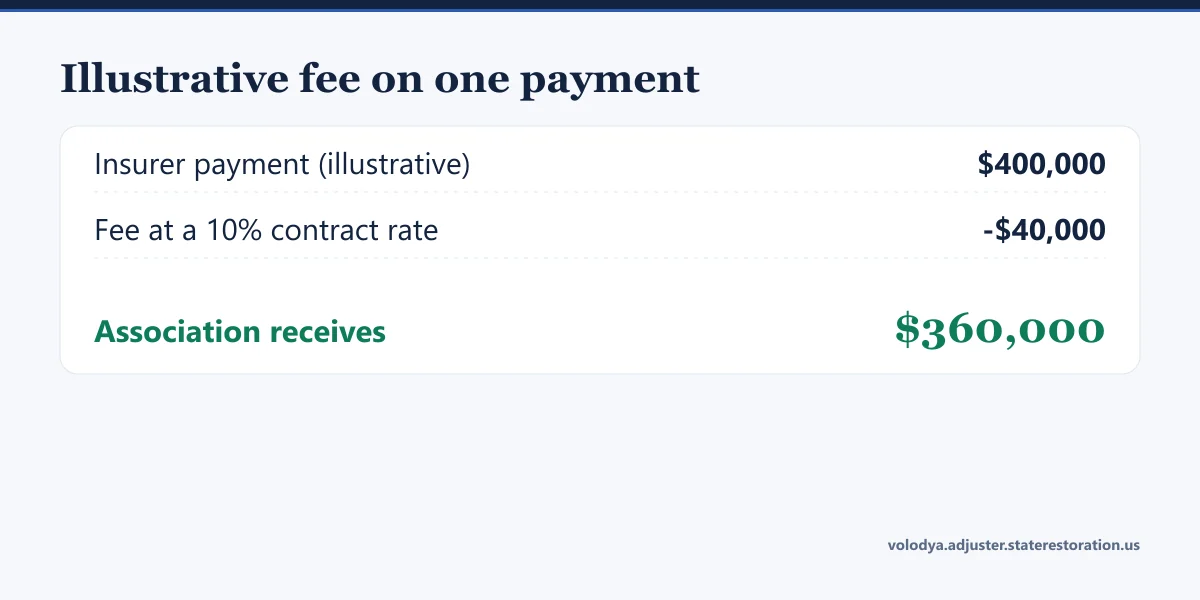
Which of the two describes a building of homes owned through an association is a reading of the statute, so it belongs with the association's counsel, not with me. For the board, the working point is simpler: the rate is written into the contract, the board sees it before it votes, and the fee is taken as a share of each insurer payment as it arrives. Here is an illustrative claim paid in three parts, with a 10% contract rate:
| Insurer payment | Amount | Fee at 10% | To the association |
|---|---|---|---|
| First payment after the joint inspection | $150,000 | $15,000 | $135,000 |
| Supplement for code items and the roof membrane | $210,000 | $21,000 | $189,000 |
| Held-back depreciation, released after the work | $40,000 | $4,000 | $36,000 |
| Total | $400,000 | $40,000 | $360,000 |
Illustrative worked example only. Not a quote, not a typical result and not a promise of any amount.
Two questions belong in writing before the vote. How does the fee work on money the carrier paid before the contract was signed? And how is it paid when the insurance trustee, not the association, receives the check? The board should know both answers on the day it votes.
What can owners see while the claim is open?
More than most boards volunteer, and sharing it early saves meetings. These are the questions owners bring to the second meeting, and where the Act puts the answer:
| What owners ask | Where the answer is |
|---|---|
| Did the board spend money without a vote? | The two 18(a)(21) notices, and the ratification vote in the minutes. |
| Who did the board hire, and on what terms? | The open vote required by 18(b)(9)(A), and the motion as recorded. |
| Can I record the meeting? | Yes, the open portions, under 18(b)(9)(C) and the board's reasonable rules. |
| When does my unit get its share of the money? | Section 12(g): the carrier pays the association or its insurance trustee, the money goes first to the common elements and the bare walls, ceilings and floors of the units, and owners share only a surplus. My page on master policy claims for condo associations draws that order step by step. |
| Will there be a special assessment? | Possibly, for the deductible or a shortfall. The board's options and the owners' petition right are in my post on a special assessment after storm or fire damage. |
Each owner's unit policy is a separate claim with its own adjuster and its own deadlines. When owners ask whether they need help with their floors, cabinets and belongings, that is the work on my page for condo unit owners, kept apart from the association's file line by line.
When a board does not need a public adjuster
When the loss is small and the numbers are close. A leak that ruins one hallway ceiling and a stretch of carpet, where the carrier's estimate sits near the contractor's bid, is a job for the manager and the contractor. So is a loss that lands under the master policy deductible: there is nothing to negotiate with the carrier, only the board's choice under section 12(c) of who pays the deductible.
I am worth a call when several floors or units are hit, when the roof or the facade is involved, or when the carrier's first figure is far below the bids. If the carrier agrees the loss is covered and only the amount is in dispute, read the appraisal clause in the master policy at an open meeting before anyone invokes it. A board member or the manager can reach me through the contact page, seven days a week. The first conversation and the policy review cost the association nothing. What the carrier pays depends on the master policy and the building, and nobody honest can promise a figure or a date.